Species · Birds
Paria Whitestart Myioborus pariae
The scientific name of the Paria Whitestart is Myioborus pariae. It is a species of bird in the family Parulidae (new world warbler), order Passeriformes. The name dates from 1949.
- Scientific name
- Myioborus pariae W. H. Phelps & W. H. Phelps Jr, 1949
- Common name
- Paria Whitestart
- Genus
- Myioborus
- Family
- Parulidae (New World Warbler)
- Order
- Passeriformes
- Class
- Aves
- Red List category
- EN Endangered
- Recorded in
- 1 country
- Name status
- accepted in the Catalogue of Life
Overview
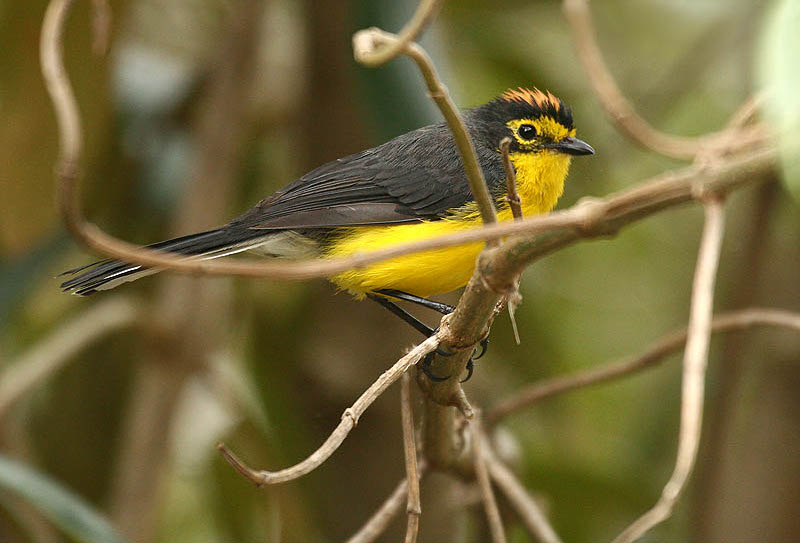
Myioborus pariae is endemic to the Paria Peninsula in northeastern Sucre, Venezuela. It has gray upperparts, bright yellow throat and underparts, a black tail, and white undertail coverts.
Written 27 November 2026 from the sources listed below. Each statement was checked against the passage it cites; statements that could not be supported were removed.
Appearance
The Paria Whitestart measures approximately 13 centimetres in length. Its upperparts are gray, while its throat and underparts are bright yellow.[1][2]
Its tail is black and its undertail coverts are white. Its bill is black, its iris is brown, and its feet and legs are blackish yellow.[3][4][5]
Adult males and females have similar plumage.[6]
Habitat
The Paria Whitestart primarily inhabits the edges and clearings of humid cloud forests. Its documented elevational range is approximately 800–1,150 metres.[7][8]
The species is absent from dense forest interiors and prefers forest edges and clearings. It has also been recorded below the forest canopy beside coffee plantations.[9][10]
Its estimated geographic range covers approximately 270 square kilometres.[11]
Its foraging activity takes place in the lower and middle levels of humid montane forests and cloud forests.[12]
Diet
The Paria Whitestart captures insects by gleaning, flycatching, and picking them from leaves while hovering.[13]
Behaviour
Individuals forage either alone or in pairs. Pairs regularly participate in mixed-species foraging flocks.[14][15]
Its vocal repertoire includes a high, liquid call note lasting less than one second.[16]
Reproduction and life cycle
Female specimens collected in May had ovaries showing signs of laying. Published information about the species' reproduction is unavailable.[17][18]
Conservation
The Paria Whitestart is classified as Endangered by the IUCN and is also nationally classified as Endangered in Venezuela. Its estimated population of mature individuals ranges from 1,500 to 7,000.[19][20][21]
Most of its geographic range falls within the Paria Peninsula National Park system, where protection has existed since 1978.[22]
Uses
The species was captured and sold as a caged songbird to some extent until the 1980s. Very little or no trade in the species is believed to occur currently.[23][24]
Similar species
The Paria Whitestart was initially described as a subspecies of the brown-capped whitestart (Myioborus brunniceps). It was subsequently accepted as a distinct species.[25][26]
Classification of the Paria Whitestart
| Kingdom | Animalia |
|---|---|
| Phylum | Chordata |
| Subphylum | Vertebrata |
| Infraphylum | Gnathostomata |
| Parvphylum | Osteichthyes |
| Megaclass | Tetrapoda |
| Class | Aves (Bird) |
| Order | Passeriformes (Passerine) |
| Family | Parulidae (New World Warbler) |
| Genus | Myioborus (Whitestart) |
| Species | Myioborus pariae W. H. Phelps & W. H. Phelps Jr, 1949 |
Where the Paria Whitestart is found
Checklists and occurrence records place Myioborus pariae in 1 country across South America. GBIF holds 88 georeferenced records of it.
Countries
Regions and cities with the most records
Range as the checklists state it
South America
A number beside a place is its count of GBIF occurrence records. A place without a number comes from a checklist alone. Records show where a species has been observed or collected, which can include escapes and vagrants.
Common names
English
- Paria Whitestart
- Paria Redstart
- Yellow-faced Redstart
- Yellow-faced Whitestart
Names in 24 other languages
- Catalan
- bosquerola de Paria
- Chinese
- 黃臉鴝鶯, 黄脸鸲莺
- Croatian
- parijska sjeničica
- Czech
- lesňáček žlutobrýlí, lesňáček žlutobrýlý
- Danish
- Pariahvidstjert
- Dutch
- Geeloogzanger
- Esperanto
- Flavvizaĝa parulio, paria parulio
- Estonian
- paria mägisäälik
- Finnish
- keltarillikerttuli
- French
- Paruline de Paria
- German
- Goldaugen-Waldsänger, Goldaugenwaldsänger, Goldzügel-Waldsänger
- Italian
- Codirosso di Paria
- Japanese
- キガオアメリカムシクイ
- Lithuanian
- geltonveidis raudonuodeginis parulidas
- Norwegian
- pariahvitstjert
- Polish
- pleszówka żółtolica
- Portuguese
- mariquita-de-cara-amarela, mariquita-de-paria, mariquita-de-pária
- Russian
- Златоглазая канделита, Золотоглазый горихвостковый певун
- Slovak
- horárik kávovníkový
- Spanish
- Candelita de Paria
- Swedish
- pariavitstjärt
- Turkish
- Paria Ötleğeni
- Ukrainian
- чернітка парійська
- Welsh
- tinwen wynebfelen
Synonyms
One other scientific name has been used for this species and is now treated as a synonym of Myioborus pariae.
- Myioborus brunniceps pariae Phelps, WH Sr; Phelps, WH Jr, 1949
Related species
-
 Painted RedstartMyioborus pictus
-
 Slate-throated WhitestartMyioborus miniatus
-
 Collared WhitestartMyioborus torquatus
-
 Golden-fronted WhitestartMyioborus ornatus
-
 Spectacled WhitestartMyioborus melanocephalus
-
 Brown-capped WhitestartMyioborus brunniceps
-
 Tepui WhitestartMyioborus castaneocapilla
- Guaiquinima WhitestartMyioborus cardonai
Compare
Questions and answers
What is the scientific name of the Paria Whitestart?
The scientific name of the Paria Whitestart is Myioborus pariae. Written with its author, the full name is Myioborus pariae W. H. Phelps & W. H. Phelps Jr, 1949.
Which family does the Paria Whitestart belong to?
Myioborus pariae belongs to the family Parulidae, in the order Passeriformes and the class Aves.
Where is the Paria Whitestart found?
Checklists and occurrence records place Myioborus pariae in 1 country: Venezuela.
What is the conservation status of the Paria Whitestart?
The IUCN Red List category recorded for Myioborus pariae is Endangered (EN).
What other names does the Paria Whitestart have?
Myioborus pariae is also known in English as Paria Redstart, Yellow-faced Redstart and Yellow-faced Whitestart.
Sources
Passages the profile rests on
- The Paria whitestart measures approximately 13 centimetres in length. Source passage: “being about 13 centimeters (5.11 inches) in length.” — English Wikipedia
- Its upperparts are gray, while its throat and underparts are bright yellow. Source passage: “The upperparts are gray, with bright yellow throat and underparts” — English Wikipedia
- Its tail is black and its undertail coverts are white. Source passage: “the tail is black with white undertail coverts.” — English Wikipedia
- Its bill is black and its iris is brown. Source passage: “The bill is black, the iris is brown” — English Wikipedia
- Its feet and legs are blackish yellow. Source passage: “the feet and legs are a blackish yellow.” — English Wikipedia
- Adult males and females have similar plumage. Source passage: “Adults of both sex are similar in plumage” — English Wikipedia
- The species primarily inhabits the edges and clearings of humid cloud forests. Source passage: “where it occurs primarily on the edges and in clearings of humid cloud forests.” — English Wikipedia
- Its documented elevational range is approximately 800–1,150 metres. Source passage: “between 800-1,150 meters (2,624-2,772 feet)” — English Wikipedia
- The species is absent from dense forest interiors and prefers forest edges and clearings. Source passage: “It is noted to prefer forest edges and clearings, being absent from denser forest interiors” — English Wikipedia
- The species has been recorded below the forest canopy beside coffee plantations. Source passage: “has been observed below forest canopy at the edges of nearby coffee plantations.” — English Wikipedia
- Its estimated geographic range covers approximately 270 square kilometres. Source passage: “Its range is estimated to be about 270 km2 (167 mi2)” — English Wikipedia
- Its foraging activity takes place in the lower and middle levels of humid montane forests and cloud forests. Source passage: “foraging in the lower and middle levels of montane humid forest and cloud forests” — English Wikipedia
- It captures prey by gleaning, flycatching, and picking insects from leaves while hovering. Source passage: “by gleaning, flycatching, and picking prey from leaves while hovering.” — English Wikipedia
- Individuals forage either alone or in pairs. Source passage: “It forages singly or in pairs” — English Wikipedia
- Pairs regularly participate in mixed-species foraging flocks. Source passage: “pairs regularly join mixed-species foraging flocks.” — English Wikipedia
- Its vocal repertoire includes a high, liquid call note lasting less than one second. Source passage: “The call is a high, liquid tship note lasting less than one second.” — English Wikipedia
- Female specimens collected in May had ovaries showing signs of laying. Source passage: “the female specimens which were collected in May had laying ovaries.” — English Wikipedia
- Published information about the species' reproduction is unavailable. Source passage: “Nothing is published about the Paria whitestart's reproduction.” — English Wikipedia
- The species is classified as Endangered by the IUCN. Source passage: “The Paria whitestart is classified as Endangered by the IUCN” — English Wikipedia
- The species is also nationally classified as Endangered in Venezuela. Source passage: “and is nationally Endangered in Venezuela.” — English Wikipedia
- Its estimated population of mature individuals ranges from 1,500 to 7,000. Source passage: “The potential population of mature individuals is estimated at between 1,500 and 7,000.” — English Wikipedia
- Most of its geographic range falls within the Paria Peninsula National Park system, where protection has existed since 1978. Source passage: “Most of the Paria whitestart's range is protected, being within the Paria Peninsula National Park system since 1978.” — English Wikipedia
- The species was captured and sold as a caged songbird to some extent until the 1980s. Source passage: “There was, to some extent, targeting of the Paria whitestart for capture and sale as a caged songbird up to the 1980s.” — English Wikipedia
- Very little or no trade in the species is believed to occur currently. Source passage: “Very little if any trade is believed to take place today” — English Wikipedia
- The species was initially described as a subspecies of the brown-capped whitestart (Myioborus brunniceps). Source passage: “It was initially described as a subspecies of the brown-capped whitestart (Myioborus brunniceps)” — English Wikipedia
- The Paria whitestart was subsequently accepted as a distinct species. Source passage: “It is at present accepted as its own species.” — English Wikipedia
Data
- Catalogue of Life, 2026-10-16 XR cc by
- Global Biodiversity Information Facility CC BY 4.0
- Wikidata CC0
- GeoNames CC BY 4.0
- Within the Catalogue of Life, this name comes from The Integrated Taxonomic Information System cc0
References
- Phelps, William H., and William H. Phelps, Jr. (1949). Eight New Birds from the Subtropical Zone of the Paria Peninsula, Venezuela. Proceedings of the Biological Society of Washington, Vol. 62. where the name was published
- Gill, Frank, & and Minturn Wright. (2006). Birds of the World: Recommended English Names.
This species in other databases
Page built on 29 November 2026. See how the catalog is made and all sources and licences.
Cite this page
ScientificNames.org. (2026). Myioborus pariae (Paria Whitestart). Retrieved November 29, 2026, from https://scientificnames.org/species/myioborus-pariae
“Myioborus pariae (Paria Whitestart).” ScientificNames.org, 2026, scientificnames.org/species/myioborus-pariae. Accessed 29 Nov. 2026.
ScientificNames.org. “Myioborus pariae (Paria Whitestart).” Accessed November 29, 2026. https://scientificnames.org/species/myioborus-pariae.
@misc{scientificnames_myioborus_pariae_paria_whitestart,
  author = {{ScientificNames.org}},
  title = {Myioborus pariae (Paria Whitestart)},
  year = {2026},
  url = {https://scientificnames.org/species/myioborus-pariae},
  note = {Accessed 2026-11-29}
}