Species · Fishes
Bullnose Eagle Ray Myliobatis freminvillei
The scientific name of the Bullnose Eagle Ray is Myliobatis freminvillei. It is a species of fish in the family Myliobatidae (eagle ray), order Myliobatiformes. The name dates from 1824.
- Scientific name
- Myliobatis freminvillei Lesueur, 1824
- Common name
- Bullnose Eagle Ray
- Genus
- Myliobatis
- Family
- Myliobatidae (Eagle Ray)
- Order
- Myliobatiformes
- Class
- Elasmobranchii
- Red List category
- VU Vulnerable
- Environment
- brackish, marine
- Recorded in
- 4 countries
- Name status
- accepted in the Catalogue of Life

Overview
Myliobatis freminvillei inhabits coastal waters and estuaries along the eastern portions of North and South America. It has a rhomboidal disc wider than it is long, a projecting head, and a slender tail with one or two large spines.
Written 27 November 2026 from the sources listed below. Each statement was checked against the passage it cites; statements that could not be supported were removed.
Appearance
The Bullnose Eagle Ray has a rhomboidal disc that is wider than it is long. Its head is broad and short, projects well beyond the disc, and has a relatively elongated snout.[1][2][3]
Its eyes and spiracles are positioned on the sides of its head. Its mouth has fleshy papillae on the floor, and its teeth form flat, pavement-like plates arranged in seven series, with the central row being the largest.[4][5][6]
Its slender tail is approximately as long as its disc and lacks a tail fin. One or two large spines occur at the base of the tail, behind a small dorsal fin.[7][8]
Its upper surface ranges from grey to red-brown or dark brown and has diffuse white spots usually smaller than the eye.[9]
Its maximum recorded disc width is 106 cm. Its size at birth is approximately 25 cm.[10][11]
Habitat
The Bullnose Eagle Ray inhabits coastal waters and estuaries along the eastern portions of North and South America. It is primarily a bottom-dwelling species in shallow inshore waters, particularly estuaries.[12][13]
It occurs in the water column from the bottom to near the surface.[14]
Diet
Its primary diet includes crustaceans, gastropods, and isopods. Recorded food items include mobile benthic gastropods and bivalves.[15][16]
Recorded food items also include mobile benthic crustaceans such as shrimps and crabs, as well as sessile molluscs and sessile crustaceans.[17][18]
Reproduction and life cycle
Females give birth to six young per litter.[19]
Similar species
The Bullnose Eagle Ray is often confused with the southern eagle ray (Myliobatis goodei) because of similarities in appearance and overlapping geographic ranges.[20]
Behaviour
The Bullnose Eagle Ray is frequently found at depths of 1–10 metres. It can occur at the sea surface and at depths reaching 122 metres.[21][22]
Classification of the Bullnose Eagle Ray
| Kingdom | Animalia |
|---|---|
| Phylum | Chordata |
| Subphylum | Vertebrata |
| Infraphylum | Gnathostomata |
| Parvphylum | Chondrichthyes |
| Class | Elasmobranchii |
| Subclass | Neoselachii |
| Infraclass | Batoidea |
| Order | Myliobatiformes |
| Family | Myliobatidae (Eagle Ray) |
| Genus | Myliobatis (Eagle Rays) |
| Species | Myliobatis freminvillei Lesueur, 1824 |
Where the Bullnose Eagle Ray is found
Checklists and occurrence records place Myliobatis freminvillei in 4 countries. GBIF holds 1,748 georeferenced records of it.
Countries
Regions and cities with the most records
- Virginia Beach, United States 74
- Santa Catarina, Brazil 61
- Balneário Camboriú, Brazil 59
- Balneário Piçarras, Brazil 59
- Camboriú, Brazil 59
- Ilhota, Brazil 59
- Itajaí, Brazil 59
- Navegantes, Brazil 59
- Penha, Brazil 59
- East Hampton, United States 39
- Hampton, United States 33
- Atlantic City, United States 31
- Pleasantville, United States 21
- Long Branch, United States 16
- Asbury Park, United States 15
- Seaford, United States 12
- Tinton Falls, United States 12
- Woodmere, United States 11
- Bellmore, United States 10
- Copiague, United States 10
- East Massapequa, United States 10
- Lindenhurst, United States 10
- Massapequa, United States 10
- Massapequa Park, United States 10
- Merrick, United States 10
- New Jersey, United States 10
- Norfolk, United States 10
- North Amityville, United States 10
- North Massapequa, United States 10
- Armação dos Búzios, Brazil 9
- Freeport, United States 9
- Long Beach, United States 9
- Lynbrook, United States 9
- New York, United States 9
- Oceanside, United States 9
- Rockville Centre, United States 9
A number beside a place is its count of GBIF occurrence records. A place without a number comes from a checklist alone. Records show where a species has been observed or collected, which can include escapes and vagrants.
Common names
English
- Bullnose Eagle Ray
- Bullnose Ray
Names in 8 other languages
- Czech
- siba Freminvilleho
- Danish
- Tyrenæset ørnerokke
- Dutch
- Stierneusadelaarsrog
- French
- Aigle de mer taureau
- German
- Bullennasen-Adlerrochen
- Portuguese
- Raia-focinho-de-vaca
- Russian
- Восточноамериканский орляк
- Spanish
- Chucho Blanco, raya nariz de vaca, águila naríz de vaca
Synonyms
One other scientific name has been used for this species and is now treated as a synonym of Myliobatis freminvillei.
- Myliobatis freminvillii Lesueur, 1824
Related species
-
 Bat RayMyliobatis californica
-
 New Zealand Eagle RayMyliobatis tenuicaudatus
-
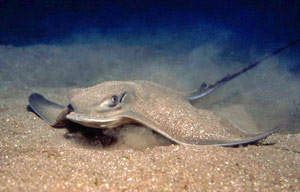 Common Eagle RayMyliobatis aquila
-
 Southern Eagle RayMyliobatis goodei
-
 Purple Eagle RayMyliobatis hamlyni
-
 Japanese Eagle RayMyliobatis tobijei
-
 Chilean Eagle RayMyliobatis chilensis
-
 Longnose Eagle RayMyliobatis longirostris
Compare
Questions and answers
What is the scientific name of the Bullnose Eagle Ray?
The scientific name of the Bullnose Eagle Ray is Myliobatis freminvillei. Written with its author, the full name is Myliobatis freminvillei Lesueur, 1824.
Which family does the Bullnose Eagle Ray belong to?
Myliobatis freminvillei belongs to the family Myliobatidae, in the order Myliobatiformes and the class Elasmobranchii.
Where is the Bullnose Eagle Ray found?
Checklists and occurrence records place Myliobatis freminvillei in 4 countries: United States, Brazil, Argentina and French Guiana.
What is the conservation status of the Bullnose Eagle Ray?
The IUCN Red List category recorded for Myliobatis freminvillei is Vulnerable (VU).
What other names does the Bullnose Eagle Ray have?
Myliobatis freminvillei is also known in English as Bullnose Ray.
Sources
Passages the profile rests on
- The species has a rhomboidal disc that is wider than it is long. Source passage: “Disc rhomboidal, wider than long” — biogeodb.stri.si.edu
- Its head is broad, short, and projects well beyond the disc. Source passage: “head broad, short, projecting well before disc” — biogeodb.stri.si.edu
- Its snout is relatively elongated. Source passage: “snout relatively elongate” — biogeodb.stri.si.edu
- Its eyes and spiracles are positioned on the sides of its head. Source passage: “eyes and spiracles on side of head” — biogeodb.stri.si.edu
- Its mouth has fleshy papillae on the floor. Source passage: “mouth with fleshy papillae on its floor” — biogeodb.stri.si.edu
- Its teeth form flat, pavement-like plates arranged in seven series, with the central row being the largest. Source passage: “teeth in flat, pavement-like plates, with 7 series of plates, central row is largest” — biogeodb.stri.si.edu
- Its tail is slender, approximately as long as its disc, and lacks a tail fin. Source passage: “tail slender, about as long as disc, no tail fin” — biogeodb.stri.si.edu
- It has one or two large spines at the base of its tail, behind a small dorsal fin. Source passage: “1-2 large spines at base, after small dorsal fin” — biogeodb.stri.si.edu
- Its upper surface ranges from grey to red-brown or dark brown and has diffuse white spots usually smaller than the eye. Source passage: “Upper surface grey, redbrown or dark brown, with diffuse white spots that are usually smaller than the eye” — biogeodb.stri.si.edu
- Its maximum recorded disc width is 106 cm. Source passage: “It reaches a maximum disc width 106 cm (42 in) in disc width” — English Wikipedia
- Its size at birth is approximately 25 cm. Source passage: “size at birth is 25 cm.” — biogeodb.stri.si.edu
- It inhabits coastal waters and estuaries along the eastern portions of North and South America. Source passage: “The species resides in the coastal waters and estuaries of the Eastern portions of North and South America.” — English Wikipedia
- It is primarily a bottom-dwelling species in shallow inshore waters, particularly estuaries. Source passage: “Bottom living on shallow inshore waters, mainly in estuaries.” — biogeodb.stri.si.edu
- It occurs in the water column from the bottom to near the surface. Source passage: “Mid Water Near Bottom Near Surface Bottom” — biogeodb.stri.si.edu
- Its primary diet includes crustaceans, gastropods, and isopods. Source passage: “The bullnose ray feeds primarily on crustaceans, gastropods, and isopods.” — English Wikipedia
- Its recorded food items include mobile benthic gastropods and bivalves. Source passage: “Mobile benthic gastropods/bivalves” — biogeodb.stri.si.edu
- Its recorded food items include mobile benthic crustaceans such as shrimps and crabs. Source passage: “Mobile benthic crustacea (shrimps/crabs)” — biogeodb.stri.si.edu
- Its recorded food categories include sessile molluscs and sessile crustaceans. Source passage: “Sessile molluscs Sessile crustacea” — biogeodb.stri.si.edu
- Females give birth to six young per litter. Source passage: “gives birth to six young per litter.” — English Wikipedia
- It is often confused with the southern eagle ray (Myliobatis goodei) because of similarities in appearance and overlapping geographic ranges. Source passage: “It is often confused with the southern eagle ray (M. goodei), due to a similarity in appearance and overlap in range.” — English Wikipedia
- It is frequently found at depths of 1–10 metres. Source passage: “It is most frequently found at a depth of 1–10 metres (3–33 ft)” — English Wikipedia
- It can occur at the sea surface and at depths reaching 122 metres. Source passage: “but can be found at the surface and up to a depth of 122 metres (400 ft).” — English Wikipedia
Data
- Catalogue of Life, 2026-10-16 XR cc by
- Global Biodiversity Information Facility CC BY 4.0
- Wikidata CC0
- GeoNames CC BY 4.0
- Wikimedia Commons per image; credit shown with each image
- Within the Catalogue of Life, this name comes from World Register of Marine Species cc by
References
- Lesueur, C. A. (1824). Description of several species of the Linnaean genus Raia, of North America. Journal of the Academy of Natural Sciences, Philadelphia, v. 4 (pt 1): 100–121, Pls. 4–6. where the name was published
This species in other databases
- Catalogue of Life 453CK
- Wikidata Q3015242
- iNaturalist 106322
- WoRMS urn:lsid:marinespecies.org:taxname:399783
- ITIS 564391-160980
Page built on 29 November 2026. See how the catalog is made and all sources and licences.
Cite this page
ScientificNames.org. (2026). Myliobatis freminvillei (Bullnose Eagle Ray). Retrieved November 29, 2026, from https://scientificnames.org/species/myliobatis-freminvillei
“Myliobatis freminvillei (Bullnose Eagle Ray).” ScientificNames.org, 2026, scientificnames.org/species/myliobatis-freminvillei. Accessed 29 Nov. 2026.
ScientificNames.org. “Myliobatis freminvillei (Bullnose Eagle Ray).” Accessed November 29, 2026. https://scientificnames.org/species/myliobatis-freminvillei.
@misc{scientificnames_myliobatis_freminvillei_bullnose_eagle_ray,
  author = {{ScientificNames.org}},
  title = {Myliobatis freminvillei (Bullnose Eagle Ray)},
  year = {2026},
  url = {https://scientificnames.org/species/myliobatis-freminvillei},
  note = {Accessed 2026-11-29}
}