Species · Fishes
Peamouth Mylocheilus caurinus
The scientific name of the Peamouth is Mylocheilus caurinus. It is a species of fish in the family Cyprinidae (carps), order Cypriniformes. The name dates from 1836.
- Scientific name
- Mylocheilus caurinus (Richardson, 1836)
- Common name
- Peamouth
- Genus
- Mylocheilus
- Family
- Cyprinidae (Carps)
- Order
- Cypriniformes
- Class
- Teleostei
- Red List category
- LC Least Concern
- Environment
- brackish, freshwater
- Recorded in
- 2 countries
- Name status
- accepted in the Catalogue of Life

Overview
Mylocheilus caurinus inhabits western North America, including the Mackenzie, Nass, Peace and Columbia River systems. It has a slender, somewhat compressed body, a dark back, silvery underparts with two dusky longitudinal stripes and a forked tail.
Written 26 November 2026 from the sources listed below. Each statement was checked against the passage it cites; statements that could not be supported were removed.
Appearance
The peamouth has a slender, somewhat compressed body, a subterminal mouth, large eyes, a rounded snout and a forked tail. Its dark back contrasts with silvery underparts marked by two dusky longitudinal stripes.[1][2]
The corners of its reddish mouth bear small barbels. Breeding males develop red coloration along their sides, belly, mouth, gill cover and pectoral fin base.[3][4]
The dorsal and anal fins each have eight soft rays, and the lateral line contains between 66 and 84 scales.[5][6]
The peamouth can reach 36 centimetres in total length. Peamouth minnows in Lake Washington average 12 inches in size.[7][8]
Habitat
The species inhabits shallow, weedy areas of lakes and rivers, particularly where vegetation is abundant. It generally stays near the bottom at depths shallower than 18 metres.[9][10]
During winter, the species moves into deeper parts of lakes. Peamouth minnows inhabit Lake Washington throughout the year.[11][12]
Diet
Young peamouth primarily consume micro-crustaceans. Adults eat micro-crustaceans, snails, adult aquatic and terrestrial insects, and occasionally small fish.[13][14]
Behaviour
Peamouth may spend daylight hours in deeper water and move into shallow areas to feed at night. Spawning migrations involve large numbers of brightly coloured fish entering warm, shallow, flowing water.[15][16]
Newly hatched peamouth fry form schools near shore before moving into deeper water later in summer. Peamouth schools attract predators that feed on fish.[17][18]
Large numbers of peamouth return to Bellevue's Kelsey Creek each spring to spawn. After spawning, they return to the lake.[19][20]
Reproduction and life cycle
Peamouth reach sexual maturity between three and four years of age, with males generally maturing earlier than females. They may live for up to eight years.[21][22]
Spawning generally occurs in May and June when water temperatures reach 12–18 °C. In Bellevue, spawning occurs in streams from April through June.[23][24]
Peamouth spawn in streams or along lake shores over gravel or stony substrates in shallow water. Spawning sites are located within 0.91 metres of the bank.[25][26]
Peamouth eggs adhere to rocks or other substrates. A female can lay between 5,000 and 30,000 eggs, depending on her age and size.[27][28]
Females are normally accompanied by at least two males during spawning. Individual peamouth may spawn several times during one season.[29][30]
Peamouth eggs in Bellevue streams hatch approximately one week after being laid.[31]
Uses
Peamouth have historically been consumed as food fish and continue to be caught by anglers. Early settlers knew peamouth as redhorses, and the fish was served in restaurants along the Columbia River.[32][33]
Similar species
Hybridisation between peamouth and northern pikeminnow has been recorded in North America. Hybridisation between peamouth and redside shiner has also been recorded in North America.[34][35]
The peamouth and redside shiner hybrid was formerly described as Cheonda cooperi.[36]
Classification of the Peamouth
| Kingdom | Animalia |
|---|---|
| Phylum | Chordata |
| Subphylum | Vertebrata |
| Infraphylum | Gnathostomata |
| Parvphylum | Osteichthyes |
| Gigaclass | Actinopterygii |
| Superclass | Actinopteri |
| Class | Teleostei (Teleost) |
| Order | Cypriniformes |
| Family | Cyprinidae (Carps) |
| Subfamily | Leuciscinae |
| Genus | Mylocheilus (Peamouths) |
| Species | Mylocheilus caurinus (Richardson, 1836) |
Where the Peamouth is found
Checklists and occurrence records place Mylocheilus caurinus in 2 countries. GBIF holds 1,059 georeferenced records of it.
Countries
Regions and cities with the most records
- British Columbia, Canada 490
- Oregon, United States 145
- Washington, United States 91
- Victoria-Fraserview, Canada 82
- Richmond, Canada 79
- Riley Park, Canada 79
- Vancouver, Canada 79
- Delta, Canada 76
- Burnaby, Canada 67
- New Westminster, Canada 67
- North Vancouver, Canada 65
- Port Coquitlam, Canada 62
- Strawberry Hill, Canada 62
- Coquitlam, Canada 61
- Fleetwood, Canada 61
- Port Moody, Canada 60
- Surrey, Canada 60
- Pitt Meadows, Canada 43
- Abbotsford, Canada 33
- Bellevue, United States 33
- Kirkland, United States 33
- Chilliwack, Canada 32
- Idaho, United States 32
- Redmond, United States 32
- Mission, Canada 31
- Sammamish, United States 31
- Seattle, United States 29
- Albany, United States 28
- City of Sammamish, United States 28
- West Lake Sammamish, United States 27
- Columbia City, United States 26
- Inglewood-Finn Hill, United States 26
- Mercer Island, United States 26
- Bryn Mawr-Skyway, United States 24
- Corvallis, United States 23
- Tukwila, United States 23
A number beside a place is its count of GBIF occurrence records. A place without a number comes from a checklist alone. Records show where a species has been observed or collected, which can include escapes and vagrants.
Common names
English
- Peamouth
- Peamouth Chub
Names in 3 other languages
- Czech
- jelčík arktický
- French
- méné deux-barres
- Russian
- Северо-западный милохейлус
Synonyms
5 other scientific names have been used for this species and are now treated as synonyms of Mylocheilus caurinus.
- Clarkina caurina (Richardson, 1836)
- Cyprinus caurinus Richardson, 1836
- Mylocheilus fraterculus Girard, 1856
- Mylocheilus lateralis Agassiz & Pickering, 1855
- Cheonda cooperi Girard, 1856 ambiguous synonym
Related species
-
 GoldfishCarassius auratus
-
 Common CarpCyprinus carpio
- ZebrafishDanio rerio
-
 Grass CarpCtenopharyngodon idella
-
 Common RoachRutilus rutilus
-
 Silver CarpHypophthalmichthys molitrix
-
 Crucian CarpCarassius carassius
-
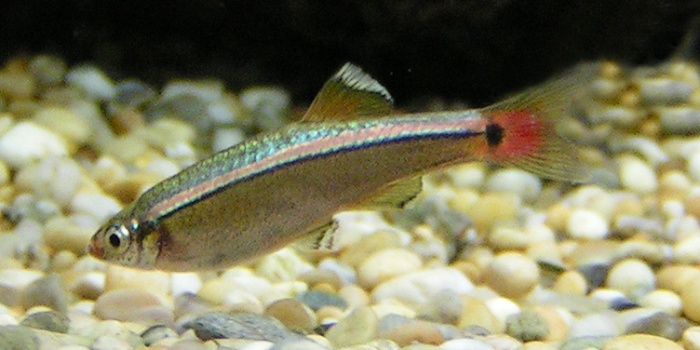 White Cloud Mountain MinnowTanichthys albonubes
Compare
Questions and answers
What is the scientific name of the Peamouth?
The scientific name of the Peamouth is Mylocheilus caurinus. Written with its author, the full name is Mylocheilus caurinus (Richardson, 1836).
Which family does the Peamouth belong to?
Mylocheilus caurinus belongs to the family Cyprinidae, in the order Cypriniformes and the class Teleostei.
Where is the Peamouth found?
Checklists and occurrence records place Mylocheilus caurinus in 2 countries: Canada and United States.
What is the conservation status of the Peamouth?
The IUCN Red List category recorded for Mylocheilus caurinus is Least Concern (LC).
What other names does the Peamouth have?
Mylocheilus caurinus is also known in English as Peamouth Chub.
Sources
Passages the profile rests on
- The peamouth has a slender, somewhat compressed body, a subterminal mouth, large eyes, a rounded snout and a forked tail. Source passage: “The peamouth is a slender fish, with a somewhat compressed body and a subterminal mouth, large eyes, a rounded snout and a forked tail.” — English Wikipedia
- Its dark back contrasts with silvery underparts marked by two dusky longitudinal stripes. Source passage: “It has a dark back, contrasting with silvery underparts separated by two dusky, longitudinal stripes.” — English Wikipedia
- The corners of its reddish mouth bear small barbels. Source passage: “The mouth is reddish at the corners where there are small barbels.” — English Wikipedia
- Breeding males develop red coloration along their sides, belly, mouth, gill cover and pectoral fin base. Source passage: “When breeding the mature males develop a red stripe along the sides on the belly, mouth, gill cover and pectoral fin base.” — English Wikipedia
- Its dorsal and anal fins each have eight soft rays. Source passage: “The dorsal fin and the anal fin each have 8 soft rays” — English Wikipedia
- Its lateral line contains between 66 and 84 scales. Source passage: “the lateral line has 66–84 scales.” — English Wikipedia
- The peamouth can reach 36 centimetres in total length. Source passage: “They can grow to 36 centimetres (14 in) in total length.” — English Wikipedia
- Peamouth minnows in Lake Washington average 12 inches in size. Source passage: “our Lake Washington peamouth minnows are practically giants, with an average size of 12 inches.” — bellevuewa.gov
- The species inhabits shallow, weedy areas of lakes and rivers, particularly where vegetation is abundant. Source passage: “The peamouth can be found in the shallow, weedy zones of lakes and rivers, where it is most common among vegetation.” — English Wikipedia
- It generally stays near the bottom at depths shallower than 18 metres. Source passage: “It is usually found near the bed in depths of less than 60 feet (18 m)” — English Wikipedia
- During winter, the species moves into deeper parts of lakes. Source passage: “although in winter they will move to the deeper parts of lakes.” — English Wikipedia
- Peamouth minnows inhabit Lake Washington throughout the year. Source passage: “Peamouth minnows, Mylocheilus caurinus, quietly school in Lake Washington year-round.” — bellevuewa.gov
- Young peamouth primarily consume micro-crustaceans. Source passage: “Young peamouths feed predominantly on micro-crustaceans” — English Wikipedia
- Adult peamouth eat micro-crustaceans, snails, adult aquatic and terrestrial insects, and occasionally small fish. Source passage: “their diet is expanded to include snails, adult aquatic and terrestrial insects and even the occasional small fish.” — English Wikipedia
- Peamouth may spend daylight hours in deeper water and move into shallow areas to feed at night. Source passage: “The fish may spend the day in deeper water and move to the shallows to feed at night.” — English Wikipedia
- Spawning migrations involve large numbers of brightly coloured fish entering warm, shallow, flowing water. Source passage: “The spawning runs of the peamouth make an impressive natural spectacle as the brightly colored fish move into areas of warm, shallow, flowing water in large numbers.” — English Wikipedia
- Newly hatched peamouth fry form schools near shore before moving into deeper water later in summer. Source passage: “The newly hatched fry form schools near the shore, moving into deeper water later in the summer.” — English Wikipedia
- Peamouth schools attract predators that feed on fish. Source passage: “These schools attract many fish-eating predators.” — English Wikipedia
- Large numbers of peamouth return to Bellevue's Kelsey Creek each spring to spawn. Source passage: “Each spring thousands of peamouth minnows leave Lake Washington to spawn in Kelsey Creek.” — bellevuewa.gov
- After spawning, peamouth return to the lake. Source passage: “After spawning, the peamouth minnows return to the lake.” — bellevuewa.gov
- Peamouth reach sexual maturity between three and four years of age, with males generally maturing earlier than females. Source passage: “The peamouth reaches sexual maturity at 3–4 years old, the males normally reaching it faster than the females.” — English Wikipedia
- The peamouth may live for up to eight years. Source passage: “They may attain a life span of 8 years” — English Wikipedia
- Spawning generally occurs in May and June when water temperatures reach 12–18 °C. Source passage: “Spawning takes place in May and June when the water reaches temperatures of 54–64 °F (12–18 °C)” — English Wikipedia
- In Bellevue, peamouth spawning occurs in streams from April through June. Source passage: “These large minnows spawn in Bellevue’s streams during April through June.” — bellevuewa.gov
- Peamouth spawn in streams or along lake shores over gravel or stony substrates in shallow water. Source passage: “and happens in streams or along the shores of lakes where there are gravel or stony substrates in shallow water” — English Wikipedia
- Spawning sites are located within 0.91 metres of the bank. Source passage: “which is within 3 feet (0.91 m) of the bank.” — English Wikipedia
- Peamouth eggs adhere to rocks or other substrates. Source passage: “The eggs adhere to rocks or other substrates.” — English Wikipedia
- A female peamouth can lay between 5,000 and 30,000 eggs, depending on her age and size. Source passage: “can lay between 5,000 and 30,000 eggs, the amount being dependent on the age and size of the individual fish.” — English Wikipedia
- Females are normally accompanied by at least two males during spawning. Source passage: “Each female is normally attended by at least two males” — English Wikipedia
- Individual peamouth may spawn several times during one season. Source passage: “The fish may spawn several times in a season” — English Wikipedia
- Peamouth eggs in Bellevue streams hatch approximately one week after being laid. Source passage: “that only take about a week to hatch.” — bellevuewa.gov
- Peamouth have historically been consumed as food fish and continue to be caught by anglers. Source passage: “They have been used as a food fish by people the past and are still fished for by anglers.” — English Wikipedia
- Early settlers knew peamouth as redhorses and the fish was served in restaurants along the Columbia River. Source passage: “Historically, Peamouth was known as redhorses by early settlers and was served in restaurants along Columbia River.” — seagrant.oregonstate.edu
- Hybridisation between peamouth and northern pikeminnow has been recorded in North America. Source passage: “Hybrids between the peamouth and the Northern pikeminnow (Ptychocheilus oregonensis)” — English Wikipedia
- Hybridisation between peamouth and redside shiner has also been recorded in North America. Source passage: “and the redside shiner (Richardsonius balteatus) have been recorded throughout North America.” — English Wikipedia
- The peamouth and redside shiner hybrid was formerly described as Cheonda cooperi. Source passage: “The latter hybrid was once described as Cheonda cooperi before its true nature was discovered.” — English Wikipedia
Data
- Catalogue of Life, 2026-10-16 XR cc by
- Global Biodiversity Information Facility CC BY 4.0
- Wikidata CC0
- GeoNames CC BY 4.0
- Wikimedia Commons per image; credit shown with each image
- Within the Catalogue of Life, this name comes from World Register of Marine Species cc by
This species in other databases
- Catalogue of Life 4545K
- Wikidata Q2706124
- iNaturalist 106328
- WoRMS urn:lsid:marinespecies.org:taxname:281605
- ITIS 163521
Page built on 27 November 2026. See how the catalog is made and all sources and licences.
Cite this page
ScientificNames.org. (2026). Mylocheilus caurinus (Peamouth). Retrieved November 27, 2026, from https://scientificnames.org/species/mylocheilus-caurinus
“Mylocheilus caurinus (Peamouth).” ScientificNames.org, 2026, scientificnames.org/species/mylocheilus-caurinus. Accessed 27 Nov. 2026.
ScientificNames.org. “Mylocheilus caurinus (Peamouth).” Accessed November 27, 2026. https://scientificnames.org/species/mylocheilus-caurinus.
@misc{scientificnames_mylocheilus_caurinus_peamouth,
  author = {{ScientificNames.org}},
  title = {Mylocheilus caurinus (Peamouth)},
  year = {2026},
  url = {https://scientificnames.org/species/mylocheilus-caurinus},
  note = {Accessed 2026-11-27}
}