Species · Mammals
Transbaikal Zokor Myospalax psilurus
The scientific name of the Transbaikal Zokor is Myospalax psilurus. It is a species of mammal in the family Spalacidae (spalacids), order Rodentia. The name dates from 1874.
- Scientific name
- Myospalax psilurus (Milne-Edwards, 1874)
- Common name
- Transbaikal Zokor
- Genus
- Myospalax
- Family
- Spalacidae (Spalacids)
- Order
- Rodentia
- Class
- Mammalia
- Red List category
- LC Least Concern
- Recorded in
- 1 country
- Name status
- accepted in the Catalogue of Life

Overview
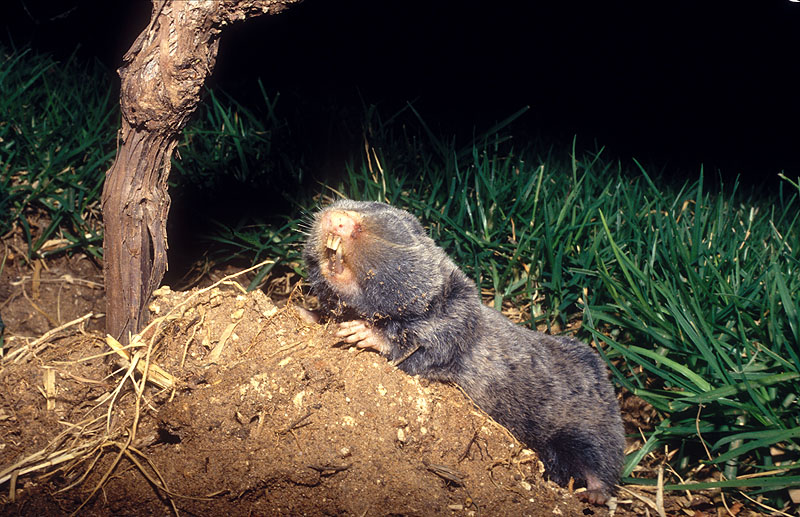
Myospalax psilurus inhabits the meadow steppe of Inner Mongolia in northern China. It reshapes surface soil into continuous mounds while feeding on underground plant roots.
Written 26 November 2026 from the sources listed below. Each statement was checked against the passage it cites; statements that could not be supported were removed.
Habitat
The species occurs in China, Mongolia, and Russia.[1]
It inhabits the meadow steppe of Inner Mongolia in northern China. The Hulunbuir meadow steppe in Inner Mongolia is a natural habitat of the species.[2][3]
Diet
The species feeds on underground plant organs.[4]
Behaviour
The species has two observed daytime activity peaks, from 03:00 to 07:00 and from 17:00 to 23:00. It occasionally has a short additional daytime activity period around 13:00 and sometimes engages in activity or brings food to the ground at night.[5][6][7]
During its subterranean life, the species reshapes surface soil into continuous mounds while feeding on plant roots. During periods of peak activity, it digs underground to feed and produces numerous soil mounds that bury surface vegetation.[8][9]
The species seals exposed burrow entrances relatively quickly after its burrow is damaged. Wind and light were not significantly correlated with the frequency of burrow entrance sealing in the studied population.[10][11]
Classification of the Transbaikal Zokor
| Kingdom | Animalia |
|---|---|
| Phylum | Chordata |
| Subphylum | Vertebrata |
| Infraphylum | Gnathostomata |
| Parvphylum | Osteichthyes |
| Megaclass | Tetrapoda |
| Class | Mammalia (Mammal) |
| Subclass | Theria |
| Infraclass | Eutheria |
| Order | Rodentia (Rodent) |
| Suborder | Myomorpha (Mice) |
| Superfamily | Muroidea |
| Family | Spalacidae (Spalacids) |
| Subfamily | Myospalacinae |
| Genus | Myospalax (Zokors) |
| Species | Myospalax psilurus (Milne-Edwards, 1874) |
Where the Transbaikal Zokor is found
Checklists and occurrence records place Myospalax psilurus in 1 country across Asia. GBIF holds 43 georeferenced records of it.
Countries
Regions and cities with the most records
Range as the checklists state it
Europe & Northern Asia (excluding China)
Southern Asia
A number beside a place is its count of GBIF occurrence records. A place without a number comes from a checklist alone. Records show where a species has been observed or collected, which can include escapes and vagrants.
Common names
English
- Transbaikal Zokor
- Manchurian Zokor
- North China Zokor
Names in 9 other languages
- Chinese
- 東北鼢鼠
- Czech
- cokor mandžuský
- Dutch
- Chinese Molhamster
- Finnish
- mantšuriantsokori, ussurintsokori
- Japanese
- ヒガシモグラネズミ
- Korean
- 자바이칼조코
- Mongolian
- Manj Nomin
- Polish
- cokor mandżurski
- Russian
- Manchzhurskii Tsokor, Маньчжурский цокор, Северокитайский цокор
Synonyms
4 other scientific names have been used for this species and are now treated as synonyms of Myospalax psilurus.
- Myospalax epsilanus Thomas, 1912
- Myospalax spilurus (Trouessart, 1897)
- Siphneus psilurus Milne-Edwards, 1874
- Siphneus spilurus Trouessart, 1897
Related species
-
 False ZokorMyospalax aspalax
-
 Siberian ZokorMyospalax myospalax
-
 Large Bamboo RatRhizomys sumatrensis
-
 Giant Root-ratTachyoryctes macrocephalus
-
 Chinese Bamboo RatRhizomys sinensis
-
 Lesser Blind Mole-ratSpalax leucodon
-
 Middle East Blind Mole-ratSpalax ehrenbergi
-
 Giant Blind Mole-ratSpalax giganteus
Compare
Questions and answers
What is the scientific name of the Transbaikal Zokor?
The scientific name of the Transbaikal Zokor is Myospalax psilurus. Written with its author, the full name is Myospalax psilurus (Milne-Edwards, 1874).
Which family does the Transbaikal Zokor belong to?
Myospalax psilurus belongs to the family Spalacidae, in the order Rodentia and the class Mammalia.
Where is the Transbaikal Zokor found?
Checklists and occurrence records place Myospalax psilurus in 1 country: China.
What is the conservation status of the Transbaikal Zokor?
The IUCN Red List category recorded for Myospalax psilurus is Least Concern (LC).
What other names does the Transbaikal Zokor have?
Myospalax psilurus is also known in English as Manchurian Zokor and North China Zokor.
Sources
Passages the profile rests on
- The species occurs in China, Mongolia, and Russia. Source passage: “It is found in China, Mongolia, and Russia.” — inaturalist.org
- The species inhabits the meadow steppe of Inner Mongolia in northern China. Source passage: “The Transbaikal zokor (Myospalax psilurus) is a dominant rodent distributed in the meadow steppe of Inner Mongolia in northern China.” — pmc.ncbi.nlm.nih.gov
- The Hulunbuir meadow steppe in Inner Mongolia is a natural habitat of this species. Source passage: “The Hulunbuir meadow steppe is the natural habitat of the Transbaikal zokor in Inner Mongolia” — pmc.ncbi.nlm.nih.gov
- The species feeds on underground plant organs. Source passage: “The zokor is a subterranean rodent that feeds on plant underground organs.” — pmc.ncbi.nlm.nih.gov
- The species has two observed daytime activity peaks, from 03:00 to 07:00 and from 17:00 to 23:00. Source passage: “the Transbaikal zokor's daytime activity peaks is 3:00 a.m. ~7:00 a.m. and 17:00 p.m. ~23:00 p.m.” — pmc.ncbi.nlm.nih.gov
- The species occasionally has a short additional daytime activity period around 13:00. Source passage: “with a short activity period occasionally around 13:00 p.m.” — pmc.ncbi.nlm.nih.gov
- The species sometimes engages in activity or brings food to the ground at night. Source passage: “the zokor often engaged in activity or ingested foods to the ground at night” — pmc.ncbi.nlm.nih.gov
- The species reshapes surface soil into continuous mounds while feeding on plant roots during its subterranean life. Source passage: “The zokor often reshapes surface soil to form continuous mounds in the process of feeding plant roots during its year-round subterranean life” — pmc.ncbi.nlm.nih.gov
- During periods of peak activity, the species digs underground to feed and produces numerous soil mounds that bury surface vegetation. Source passage: “Especially during its peak activity, zokors dig and burrow to ingest foods underground, and dig out the surface soil to form a large number of mounds, which bury the surface vegetation” — pmc.ncbi.nlm.nih.gov
- The species seals exposed burrow entrances relatively quickly after its burrow is damaged. Source passage: “When a burrow is damaged, exposed entrances appear, and within a relatively short time, the zokor would be active in sealing the entrances” — pmc.ncbi.nlm.nih.gov
- Wind and light were not significantly correlated with the frequency of burrow entrance sealing in the studied population. Source passage: “there were no significant correlations between wind or light factors and the frequency of zokor burrow entrance sealing.” — pmc.ncbi.nlm.nih.gov
Data
- Catalogue of Life, 2026-10-16 XR cc by
- Global Biodiversity Information Facility CC BY 4.0
- Wikidata CC0
- GeoNames CC BY 4.0
- Wikimedia Commons per image; credit shown with each image
- Within the Catalogue of Life, this name comes from The Integrated Taxonomic Information System cc0
References
- Rech. Hist. Nat. Mammifères p.126 where the name was published
- Ellerman, J. R., and T. C. S. Morrison-Scott. (1966). Checklist of Palaearctic and Indian Mammals 1758 to 1946, 2nd Edition.
- Wilson, Don E., and DeeAnn M. Reeder, eds. (1993). Mammal Species of the World: A Taxonomic and Geographic Reference, 2nd Ed., 3rd Printing.
- Wilson, Don E., and F. Russell Cole. (2000). Common Names of Mammals of the World.
- Musser, Guy G., and Michael D. Carleton / Wilson, Don E., and DeeAnn M. Reeder, eds. (2005). Superfamily Muroidea. Mammal Species of the World: A Taxonomic and Geographic Reference, 3rd Ed., Vol. 2.
This species in other databases
Page built on 27 November 2026. See how the catalog is made and all sources and licences.
Cite this page
ScientificNames.org. (2026). Myospalax psilurus (Transbaikal Zokor). Retrieved November 27, 2026, from https://scientificnames.org/species/myospalax-psilurus
“Myospalax psilurus (Transbaikal Zokor).” ScientificNames.org, 2026, scientificnames.org/species/myospalax-psilurus. Accessed 27 Nov. 2026.
ScientificNames.org. “Myospalax psilurus (Transbaikal Zokor).” Accessed November 27, 2026. https://scientificnames.org/species/myospalax-psilurus.
@misc{scientificnames_myospalax_psilurus_transbaikal_zokor,
  author = {{ScientificNames.org}},
  title = {Myospalax psilurus (Transbaikal Zokor)},
  year = {2026},
  url = {https://scientificnames.org/species/myospalax-psilurus},
  note = {Accessed 2026-11-27}
}