Species · Mammals
Middle East Blind Mole-rat Spalax ehrenbergi
The scientific name of the Middle East Blind Mole-rat is Spalax ehrenbergi. It is a species of mammal in the family Spalacidae (spalacids), order Rodentia. The name dates from 1898.
- Scientific name
- Spalax ehrenbergi Nehring, 1898
- Common name
- Middle East Blind Mole-rat
- Genus
- Spalax
- Family
- Spalacidae (Spalacids)
- Order
- Rodentia
- Class
- Mammalia
- Red List category
- LC Least Concern
- Recorded in
- 4 countries
- Name status
- accepted in the Catalogue of Life
Overview
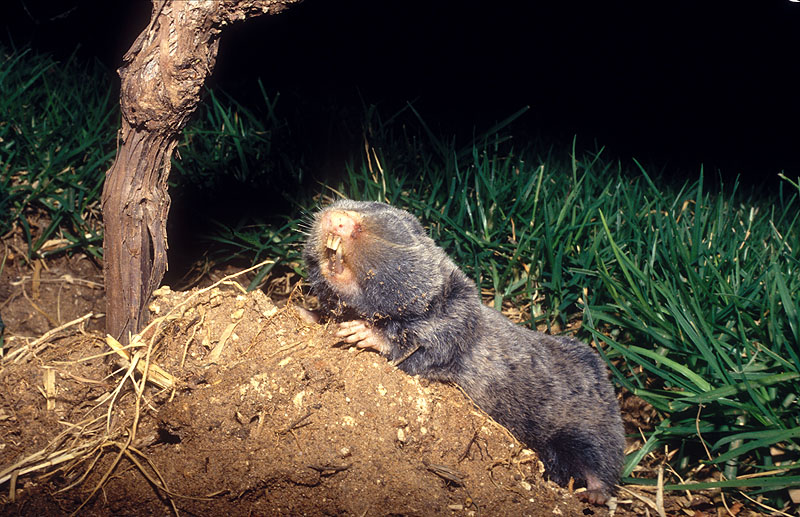
Spalax ehrenbergi inhabits Mediterranean-type shrubby vegetation, dry steppes, semi-deserts, and agricultural areas from northeastern Libya through Egypt, Jordan, Syria, and southern Turkey, with records in Israel, Palestine, and Lebanon. It is strictly fossorial, spends most of its life underground, and has incisors that project in front of its lips, allowing it to dig with its mouth closed.
Written 26 November 2026 from the sources listed below. Each statement was checked against the passage it cites; statements that could not be supported were removed.
Appearance
Adults weigh between 100 and 200 grams, and body length ranges from 150 to 270 mm. Its fur is described as light gray, and its pelage is bluish and dark gray.[1][2][3][4]
Its body is robust and streamlined, with a large head, powerful limbs, and small claws. It lacks an external tail, and its external ears are reduced to small ridges.[5][6][7]
It has two large upper incisors and two smaller lower incisors. Its dental formula is 1/1, 0/0, 0/0, 3/3, giving a total of 16 teeth.[8][9]
Its incisors project in front of its lips, allowing it to dig while keeping its mouth closed. Its cheek teeth have enamel patterns resembling the letters Z and S.[10][11]
Habitat
The Middle East Blind Mole-rat inhabits Mediterranean-type shrubby vegetation. It occupies dry steppes, semi-deserts, and agricultural areas, particularly cultivated fields, and prefers sandy and loamy soils suitable for burrowing.[12][13][14]
It does not occur in desert areas. Its populations occur in fragmented areas where soil conditions are suitable for burrowing.[15][16]
Its underground burrow systems contain nesting chambers, food-storage areas, and foraging tunnels, as well as aboveground mounds with sleeping chambers. It digs its burrows deeper during the hotter months.[17][18]
Diet
The Middle East Blind Mole-rat is a strict herbivore. Its diet primarily consists of underground plant roots, stems, tubers, and seeds.[19][20]
It stores excess harvested plant material in underground chambers.[21]
Behaviour
The Middle East Blind Mole-rat spends most of its life underground in burrows and tunnel systems and is strictly fossorial. It is generally solitary, with individual animals occupying separate burrow systems.[22][23][24]
It produces six distinct types of vocalization: attack, crying, invitation, courting, release, and threat calls. It also communicates through vibrations produced by drumming its head against tunnel ceilings.[25][26]
Reproduction and life cycle
The Middle East Blind Mole-rat breeds during winter, between November and March. Females mate with one male per breeding season but may mate with different males in successive seasons.[27][28]
Gestation lasts approximately 34 days. The average litter contains three to four pups, with a recorded range of one to five.[29][30]
Young are born between January and April and become independent at four to six weeks of age. Females provide the primary parental care.[31][32][33]
Conservation
Habitat loss is identified as a threat to the Middle East Blind Mole-rat.[34]
Uses
The species is used as a laboratory animal in cancer research because of its apparent resistance to cancer.[35]
Classification of the Middle East Blind Mole-rat
| Kingdom | Animalia |
|---|---|
| Phylum | Chordata |
| Subphylum | Vertebrata |
| Infraphylum | Gnathostomata |
| Parvphylum | Osteichthyes |
| Megaclass | Tetrapoda |
| Class | Mammalia (Mammal) |
| Subclass | Theria |
| Infraclass | Eutheria |
| Order | Rodentia (Rodent) |
| Suborder | Myomorpha (Mice) |
| Superfamily | Muroidea |
| Family | Spalacidae (Spalacids) |
| Subfamily | Spalacinae |
| Genus | Spalax (Greater Blind Mole Rats) |
| Species | Spalax ehrenbergi Nehring, 1898 |
Where the Middle East Blind Mole-rat is found
Checklists and occurrence records place Spalax ehrenbergi in 4 countries. GBIF holds 1,416 georeferenced records of it.
Countries
Regions and cities with the most records
- Northern District, Israel 357
- Maghār, Israel 233
- Karmi’el, Israel 197
- Sakhnīn, Israel 189
- Southern District, Israel 189
- Majd el Kurūm, Israel 186
- Safed, Israel 184
- Gedera, Israel 175
- Gan Yavne, Israel 168
- Kafr Mandā, Israel 166
- Modi‘in Makkabbim Re‘ut, Israel 156
- Yavné, Israel 156
- Central District, Israel 154
- Tamra, Israel 154
- Shefar‘am, Israel 147
- Kafr Kannā, Israel 145
- Mazkeret Batya, Israel 144
- maalot Tarshīhā, Israel 140
- Reẖovot, Israel 139
- Ramla, Israel 138
- Battir, Palestinian Territory 137
- Yirkā, Israel 137
- Kiryat Gat, Israel 133
- Lod, Israel 131
- Be’er Ya‘aqov, Israel 129
- Ness Ziona, Israel 129
- Qiryat Mal’akhi, Israel 129
- Mevasseret Tsiyyon, Israel 128
- Qiryat HaYovel, Israel 127
- Modiin Ilit, Israel 124
- Bayt Jālā, Palestinian Territory 123
- Judeida Makr, Israel 123
- Or Yehuda, Israel 123
- Ashdod, Israel 121
- Jerusalem, Israel 121
- Kiryat Ono, Israel 121
3 more countries have a few records outside this range
These countries hold a few records of Spalax ehrenbergi but lie outside the range the checklists give for it. Such records are often zoo or garden specimens, museum material or vagrants, so the species is not counted as occurring there.
Range as the checklists state it
Europe & Northern Asia (excluding China)
A number beside a place is its count of GBIF occurrence records. A place without a number comes from a checklist alone. Records show where a species has been observed or collected, which can include escapes and vagrants.
Common names
English
- Middle East Blind Mole-rat
- Middle East Blind Mole Rat
- Palestine Mole Rat
Synonyms
5 other scientific names have been used for this species and are now treated as synonyms of Spalax ehrenbergi.
- Nannospalax ehrenbergi (Nehring, 1898)
- Spalax aegyptiacus Nehring, 1898
- Spalax berytensis Miller, 1903
- Spalax intermedius Nehring, 1898
- Spalax kirgisorum Nehring, 1898
Related species
-
 Lesser Blind Mole-ratSpalax leucodon
-
 Giant Blind Mole-ratSpalax giganteus
-
 Greater Blind Mole-ratSpalax microphthalmus
-
 Sandy Blind Mole-ratSpalax arenarius
- Mehely's Blind Mole-ratSpalax antiquus
- Bukovina Blind Mole-ratSpalax graecus
-
 Podolsk Blind Mole-ratSpalax zemni
- Kazakhstan Blind Mole-ratSpalax uralensis
Compare
Questions and answers
What is the scientific name of the Middle East Blind Mole-rat?
The scientific name of the Middle East Blind Mole-rat is Spalax ehrenbergi. Written with its author, the full name is Spalax ehrenbergi Nehring, 1898.
Which family does the Middle East Blind Mole-rat belong to?
Spalax ehrenbergi belongs to the family Spalacidae, in the order Rodentia and the class Mammalia.
Where is the Middle East Blind Mole-rat found?
Checklists and occurrence records place Spalax ehrenbergi in 4 countries: Israel, Turkey, Lebanon and Syria.
What is the conservation status of the Middle East Blind Mole-rat?
The IUCN Red List category recorded for Spalax ehrenbergi is Least Concern (LC).
What other names does the Middle East Blind Mole-rat have?
Spalax ehrenbergi is also known in English as Middle East Blind Mole Rat and Palestine Mole Rat.
What do Spalax eat?
Spalax ehrenbergi is a strict herbivore that primarily eats underground plant roots, stems, tubers, and seeds.[19][20]
Sources
Passages the profile rests on
- Adults weigh between 100 and 200 grams. Source passage: “weighs 100–200 grams (3.5–7.1 oz)” — English Wikipedia
- Body length ranges from 150 to 270 mm. Source passage: “body length ranges from 150 to 270 mm” — animaldiversity.org
- Its fur is described as light gray. Source passage: “It has light gray fur” — English Wikipedia
- Its pelage is bluish and dark gray. Source passage: “the pelage is bluish, dark gray.” — animaldiversity.org
- It lacks an external tail. Source passage: “lack of an external tail” — animaldiversity.org
- Its external ears are reduced to small ridges. Source passage: “pinnae reduced to small ridges” — animaldiversity.org
- Its body is robust and streamlined, with a large head, powerful limbs, and small claws. Source passage: “robustly built and streamlined bodies with large heads, powerful limbs, and small claws.” — animaldiversity.org
- It has two large upper incisors and two smaller lower incisors. Source passage: “two large teeth in the upper jaw and two smaller teeth in the lower jaw.” — English Wikipedia
- Its dental formula is 1/1, 0/0, 0/0, 3/3, giving a total of 16 teeth. Source passage: “The dental formula for Spalax ehrenbergi is 1/1, 0/0, 0/0, 3/3 = 16.” — animaldiversity.org
- Its incisors project in front of its lips, allowing it to dig while keeping its mouth closed. Source passage: “the incisors can be used to dig even when the mouth is closed.” — animaldiversity.org
- Its cheek teeth have enamel patterns resembling the letters Z and S. Source passage: “The cheek teeth are rooted and display enamel patterns that resemble the letters "z" and "s."” — animaldiversity.org
- It inhabits Mediterranean-type shrubby vegetation. Source passage: “The natural habitat of the mole is Mediterranean-type shrubbish vegetation” — English Wikipedia
- It occupies dry steppes, semi-deserts, and agricultural areas, particularly cultivated fields. Source passage: “inhabit dry steppes, semi-desert, and agricultural areas, especially cultivated fields.” — animaldiversity.org
- It prefers sandy and loamy soils suitable for burrowing. Source passage: “they seem to prefer habitats with sandy and loamy soils.” — animaldiversity.org
- It does not occur in desert areas. Source passage: “Though Middle East blind mole rats are not found in desert areas” — animaldiversity.org
- Its populations occur in fragmented areas where soil conditions are suitable for burrowing. Source passage: “found in fragmented areas with appropriate soils for burrowing.” — animaldiversity.org
- Its underground burrow systems contain nesting chambers, food-storage areas, foraging tunnels, and aboveground mounds with sleeping chambers. Source passage: “These are complex, with nesting chambers, storage areas, tunnels used for foraging, and aboveground mounds with sleeping chambers.” — animaldiversity.org
- It digs its burrows deeper during the hotter months. Source passage: “Burrows are dug deeper in the hot months of the year.” — animaldiversity.org
- It is a strict herbivore. Source passage: “Middle East blind mole rats are strict herbivores” — animaldiversity.org
- Its diet primarily consists of underground plant roots, stems, tubers, and seeds. Source passage: “primarily feed on the underground roots, stems, tubers, and seeds of plants.” — animaldiversity.org
- It stores excess harvested plant material in underground chambers. Source passage: “use underground chambers to store excess, harvested food.” — animaldiversity.org
- It spends most of its life underground in burrows and tunnel systems. Source passage: “They spend the vast majority of their lives in their underground burrows and tunnel systems.” — animaldiversity.org
- It is strictly fossorial. Source passage: “They are strictly fossorial” — animaldiversity.org
- It is generally solitary, with individual animals occupying separate burrow systems. Source passage: “Generally single individuals occupy burrow systems” — animaldiversity.org
- It produces six distinct types of vocalization: attack, crying, invitation, courting, release, and threat calls. Source passage: “Six distinct vocalizations are used: attack, crying, invitation, courting, release, and threat calls.” — animaldiversity.org
- It communicates through vibrations produced by drumming its head against tunnel ceilings. Source passage: “Head thumping against tunnel ceilings is also used in vibrational communication” — animaldiversity.org
- It breeds during winter, between November and March. Source passage: “breed in the winter, from November to March.” — animaldiversity.org
- Females mate with one male per breeding season but may mate with different males in successive seasons. Source passage: “Females only mate with one male for each breeding season, but may mate with different males throughout their lifetime” — animaldiversity.org
- Gestation lasts approximately 34 days. Source passage: “Gestation lasts 34 days” — animaldiversity.org
- The average litter contains three to four pups, with a recorded range of one to five. Source passage: “the average litter size is 3 to 4 (range 1 to 5) pups.” — animaldiversity.org
- Young are born between January and April. Source passage: “Young are born from January to April.” — animaldiversity.org
- Offspring become independent at four to six weeks of age. Source passage: “Young are independent at 4 to 6 weeks old.” — animaldiversity.org
- Females provide the primary parental care. Source passage: “Females provide sole parental care.” — animaldiversity.org
- Habitat loss is identified as a threat to the species. Source passage: “it is threatened by habitat loss.” — English Wikipedia
- The species is used as a laboratory animal in cancer research because of its apparent resistance to cancer. Source passage: “is an important lab animal for researching cancer due to its apparent resistance to the disease.” — English Wikipedia
- Its distribution extends from northeastern Libya through Egypt, Jordan, Syria, and southern Turkey. Source passage: “from northeastern Libya through Egypt, Jordan, Syria, and southern Turkey.” — animaldiversity.org
- It is also recorded in Israel, Palestine, and Lebanon. Source passage: “Israel, Syria, Palestine, Jordan and Lebanon” — English Wikipedia
Data
- Catalogue of Life, 2026-10-16 XR cc by
- Global Biodiversity Information Facility CC BY 4.0
- Wikidata CC0
- GeoNames CC BY 4.0
- Wikimedia Commons per image; credit shown with each image
- Within the Catalogue of Life, this name comes from The Integrated Taxonomic Information System cc0
References
- Sitzb. Ges. Naturf. Fr. Berlin vol.(for December, 1897)178 p.pl. 2 where the name was published
- Ellerman, J. R., and T. C. S. Morrison-Scott. (1966). Checklist of Palaearctic and Indian Mammals 1758 to 1946, 2nd Edition.
- Osborn, Dale J., and Ibrahim Helmy. (1980). The Contemporary Land Mammals of Egypt (Including Sinai). Fieldiana Zoology, N.S., No. 5.
- Musser, Guy G., and Michael D. Carleton / Wilson, Don E., and DeeAnn M. Reeder, eds. (2005). Superfamily Muroidea. Mammal Species of the World: A Taxonomic and Geographic Reference, 3rd Ed., Vol. 2.
This species in other databases
Page built on 29 November 2026. See how the catalog is made and all sources and licences.
Cite this page
ScientificNames.org. (2026). Spalax ehrenbergi (Middle East Blind Mole-rat). Retrieved November 29, 2026, from https://scientificnames.org/species/spalax-ehrenbergi
“Spalax ehrenbergi (Middle East Blind Mole-rat).” ScientificNames.org, 2026, scientificnames.org/species/spalax-ehrenbergi. Accessed 29 Nov. 2026.
ScientificNames.org. “Spalax ehrenbergi (Middle East Blind Mole-rat).” Accessed November 29, 2026. https://scientificnames.org/species/spalax-ehrenbergi.
@misc{scientificnames_spalax_ehrenbergi_middle_east_blind_mole_rat,
  author = {{ScientificNames.org}},
  title = {Spalax ehrenbergi (Middle East Blind Mole-rat)},
  year = {2026},
  url = {https://scientificnames.org/species/spalax-ehrenbergi},
  note = {Accessed 2026-11-29}
}