Species · Fishes
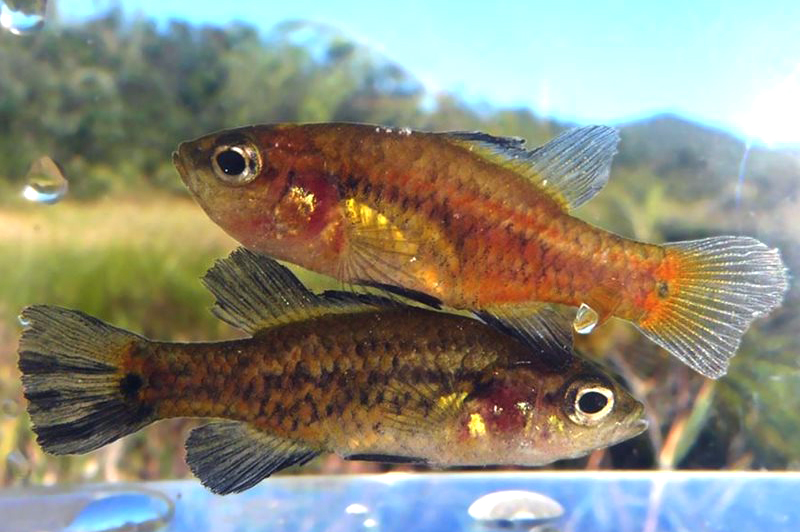
Little Pygmy Perch Nannoperca pygmaea
The scientific name of the Little Pygmy Perch is Nannoperca pygmaea. It is a species of fish in the family Percichthyidae (temperate perch), order Centrarchiformes. The name dates from 2013.
- Scientific name
- Nannoperca pygmaea Morgan, Beatty & Adams, 2013
- Common name
- Little Pygmy Perch
- Genus
- Nannoperca
- Family
- Percichthyidae (Temperate Perch)
- Order
- Centrarchiformes
- Class
- Teleostei
- Red List category
- EN Endangered
- Environment
- brackish, freshwater
- Recorded in
- 1 country
- Name status
- accepted in the Catalogue of Life
Overview
The little pygmy perch (Nannoperca pygmaea) is a freshwater species of ray finned fish, a temperate perch from the family Percichthyidae that is endemic to south-western Western Australia. It is known from just four sites in the Denmark catchment. It is found in tannin stained, acidic and shallow streams in woodland dominated by Melaleuca rhaphiophylla.
Classification of the Little Pygmy Perch
| Kingdom | Animalia |
|---|---|
| Phylum | Chordata |
| Subphylum | Vertebrata |
| Infraphylum | Gnathostomata |
| Parvphylum | Osteichthyes |
| Gigaclass | Actinopterygii |
| Superclass | Actinopteri |
| Class | Teleostei (Teleost) |
| Order | Centrarchiformes |
| Family | Percichthyidae (Temperate Perch) |
| Genus | Nannoperca (Pygmy Perches) |
| Species | Nannoperca pygmaea Morgan, Beatty & Adams, 2013 |
Origin of the name. Etymology. The specific epithet pygmaea is the feminised form of the Latin noun pygmaeus meaning " dwarf " applied as a noun in apposition, and in reference to this being the smallest of the pygmy perches. Common name Little Pygmy Perch applied in recognition of the relative small size. Genetic assessment. The final allozyme dataset comprised genotypes at 56 putative loci for 41 fish from nine sites, and included sympatric series of both N. pygmaea (n = 8) and N. vittata (n = 8) from the Hay River catchment. An initial PCA (Fig. 3) clearly demonstrated the presence of two major genetic lineages, diagnosable by a complete absence of shared alleles at 15 different allozyme loci (Table 4). The absence of heterozygous individuals at any of the 15 diagnostic loci demonstrates that these two lineages do not interbreed in sympatry and display no evidence of introgression in allopatry, i. e. the unequivocal genetic signature of different biological species. The NJ tree among populations (Fig. 4) further demonstrates their genetic distinctiveness. The two species display a mean Nei D of 0.34, considerably larger than the maximum between-population value of 0.06 within N. vittata. TABLE 1. Mean and range (in parentheses) of proportional external measurements of Nannoperca vittata and type specimens of Nannoperca pygmaea sp. nov. from the Mitchell / Hay River catchment, expressed as a percentage of standard length (SL). Species Nannoperca vittata Nannoperca pygmaea number of fish n = 22 Holotype Paratypes n = 14 mean (range) SL (mm) 40.02 (28.1 - 50.7) 31.6 32.38 (28.6 - 38.7) Total length (TL) 121.58 (115.58 - 127.01) 124.7 123.69 (116.4 - 128.3) Greatest body depth 33.97 (30.29 - 39.59) 29.7 33.2 (29.1 - 36.5) Head length 31.19 (27.45 - 33.78) 28.3 30.8 (28.2 - 34.3) Snout length 6.64 (5.80 - 8.09) 5.8 6.8 (5.0 - 9.3) Maxilla length 7.11 (5.36 - 8.42) 5.9 6.3 (4.8 - 7.3) Eye diameter 8.02 (6.98 - 9.16) 7.5 8.7 (7.8 - 10.1) Caudal peduncle length 22.85 (20.73 - 27.56) 25.9 24.8 (21.6 - 26.6) Caudal peduncle depth 16.89 (14.28 - 21.78) 18.4 17.9 (15.6 - 19.8) Pectoral fin length 18.30 (15.57 - 22.22) 17.5 18.5 (15.0 - 22.0) Pelvic fin length 18.48 (16.84 - 20.44) 17.5 18.3 (16.3 - 20.2) Length of dorsal fin base 34.70 (32.30 - 36.19) 33.0 33.6 (29.2 - 39.0) Length of anal fin base 15.43 (13.30 - 17.51) 12.7 14. 9 (11.9 - 17.9) Caudal fin length 22.23 (20.06 - 27.65) 23.1 23.3 (20.2 - 25.2) 1 st dorsal spine length 9.29 (7.26 - 12.15) 7.6 9. 5 (7.5 - 11.8) 2 nd dorsal spine length 19.25 (16.80 - 21.85) 17.9 18.9 (16.3 - 21.1) Longest dorsal spine length 2 nd 2 nd 2 nd Longest soft dorsal ray 3 rd 3 rd 3 rd or 4 th 1 st anal spine length 5.93 (4.88 - 7.11) 5.2 5.7 (3.7 - 6.2) 2 nd anal spine length 11.42 (9.27 - 13.36) 10.4 11.6 (10.1 - 13.5) 3 rd anal spine length 9.76 (7.99 - 11.24) 9.4 10.2 (7.9 - 11.5) Longest soft anal ray length 3 rd or 4 th 3 rd 2 nd or 3 rd TABLE 2. Dorsal and anal fin-ray counts for Nannoperca spp. and Nannatherina balstoni (N. vittata and N. pygmaea from this study, others and N. vittata from Kuiter and Allen (1986 )). Dorsal spines Soft dorsal rays Soft anal rays VI VII VIII IX 7 8 9 10 11 6 7 8 9 10 N. pygmaea 1 6 8 10 5 5 10
Where the Little Pygmy Perch is found
Checklists and occurrence records place Nannoperca pygmaea in 1 country. GBIF holds 35 georeferenced records of it.
Countries
Regions and cities with the most records
A number beside a place is its count of GBIF occurrence records. A place without a number comes from a checklist alone. Records show where a species has been observed or collected, which can include escapes and vagrants.
Common names
English
- Little Pygmy Perch
Related species
-
 Southern Pygmy PerchNannoperca australis
- Western Pygmy PerchNannoperca vittata
-
 Oxleyan Pygmy PerchNannoperca oxleyana
- Yarra Pygmy PerchNannoperca obscura
- Golden Pygmy PerchNannoperca variegata
- Murray CodMaccullochella peelii
-
 Aucha PerchSiniperca chuatsi
-
 Golden PerchMacquaria ambigua
Compare
Questions and answers
What is the scientific name of the Little Pygmy Perch?
The scientific name of the Little Pygmy Perch is Nannoperca pygmaea. Written with its author, the full name is Nannoperca pygmaea Morgan, Beatty & Adams, 2013.
Which family does the Little Pygmy Perch belong to?
Nannoperca pygmaea belongs to the family Percichthyidae, in the order Centrarchiformes and the class Teleostei.
Where is the Little Pygmy Perch found?
Checklists and occurrence records place Nannoperca pygmaea in 1 country: Australia.
What is the conservation status of the Little Pygmy Perch?
The IUCN Red List category recorded for Nannoperca pygmaea is Endangered (EN).
Sources
Data
- Catalogue of Life, 2026-10-16 XR cc by
- Global Biodiversity Information Facility CC BY 4.0
- Wikidata CC0
- English Wikipedia CC BY-SA 4.0
- GeoNames CC BY 4.0
- Within the Catalogue of Life, this name comes from World Register of Marine Species cc by
References
- Morgan, D. L., Beatty, S. J., & Adams, M. (2013). Nannoperca pygmaea, a new species of pygmy perch (Teleostei: Percichthyidae) from Western Australia. Zootaxa, 3637. https://doi.org/10.11646/zootaxa.3637.4.1 Link where the name was published
This species in other databases
- Catalogue of Life 45MLC
- Wikidata Q20708180
- iNaturalist 619068
- WoRMS urn:lsid:marinespecies.org:taxname:1007453
Page built on 25 November 2026. See how the catalog is made and all sources and licences.
Cite this page
ScientificNames.org. (2026). Nannoperca pygmaea (Little Pygmy Perch). Retrieved November 25, 2026, from https://scientificnames.org/species/nannoperca-pygmaea
“Nannoperca pygmaea (Little Pygmy Perch).” ScientificNames.org, 2026, scientificnames.org/species/nannoperca-pygmaea. Accessed 25 Nov. 2026.
ScientificNames.org. “Nannoperca pygmaea (Little Pygmy Perch).” Accessed November 25, 2026. https://scientificnames.org/species/nannoperca-pygmaea.
@misc{scientificnames_nannoperca_pygmaea_little_pygmy_perch,
  author = {{ScientificNames.org}},
  title = {Nannoperca pygmaea (Little Pygmy Perch)},
  year = {2026},
  url = {https://scientificnames.org/species/nannoperca-pygmaea},
  note = {Accessed 2026-11-25}
}