Species · Fishes
Western Pygmy Perch Nannoperca vittata
The scientific name of the Western Pygmy Perch is Nannoperca vittata. It is a species of fish in the family Percichthyidae (temperate perch), order Centrarchiformes. The name dates from 1873.
- Scientific name
- Nannoperca vittata (Castelnau, 1873)
- Common name
- Western Pygmy Perch
- Genus
- Nannoperca
- Family
- Percichthyidae (Temperate Perch)
- Order
- Centrarchiformes
- Class
- Teleostei
- Red List category
- VU Vulnerable
- Environment
- freshwater
- Recorded in
- 1 country
- Name status
- accepted in the Catalogue of Life
Overview
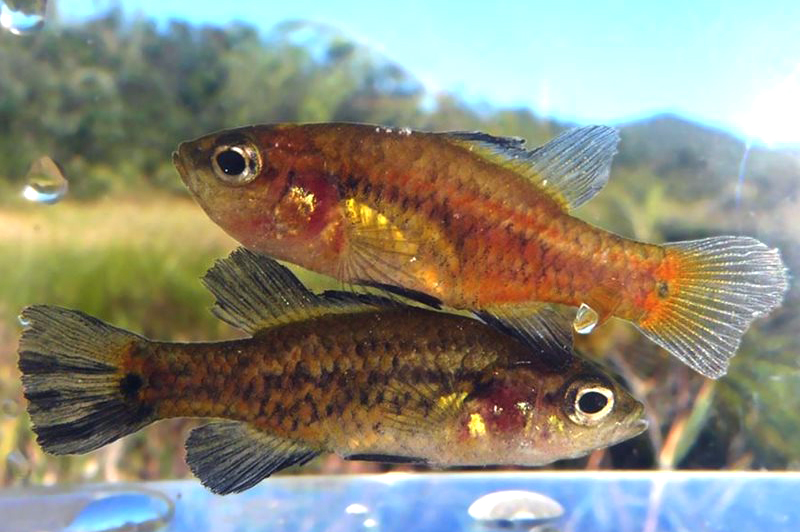
Nannoperca vittata is endemic to southwestern Australia, where it occurs in river drainages and lakes near the south coast. It has an olive, brown and green mottled body with two orange stripes along its flanks.
Written 27 November 2026 from the sources listed below. Each statement was checked against the passage it cites; statements that could not be supported were removed.
Appearance
The fish has an olive, brown and green mottled body with two orange stripes along its flanks. It can reach a total length of 8 cm.[1][2]
Breeding males develop golden flank mottling, a reddish-orange abdomen and darker fins, while breeding females develop a bluish body colour.[3][4]
During the mating season, males display vibrant green, yellow and red colours, while females have more muted pastel colours.[5]
Habitat
The species predominantly inhabits lakes, streams and swamps. It prefers shallow water near the shoreline, particularly among vegetation.[6][7]
It occupies both flowing and static waters, including clear and tannin-stained environments. It prefers habitats containing substantial detritus and woody debris.[8][9]
The species tolerates slightly brackish water and can acclimatise to water temperatures ranging from almost 0 to 25 °C.[10][11]
Diet
The species is carnivorous and feeds mainly on dipteran larvae, ostracods and copepods, supplemented by small quantities of algae. Its diet also includes benthic microcrustaceans and terrestrial insects.[12][13]
Behaviour
The species can tolerate mildly acidic water. It is not obligatorily migratory.[14][15]
During its July-to-November breeding period, it moves upstream into small streams.[16]
Reproduction and life cycle
The breeding season extends from July through November. Spawning usually takes place during the latter part of the morning.[17][18]
The female lays between 12 and 15 individual eggs over a period of up to three hours rather than depositing them in a single mass. The eggs measure approximately 1.2 mm and are slightly adhesive.[19][20][21]
The eggs attach to submerged plants, rocks or debris and hatch approximately three days after being laid.[22][23]
Newly hatched larvae measure approximately 3 mm and initially lack a mouth. They become recognisably perch-like after approximately 27 to 30 days.[24][25]
The species reaches sexual maturity at approximately one year of age. It can reproduce in backyard ponds when adequate aquatic plants are available.[26][27]
Conservation
The species is not currently listed as threatened. Its geographic range has contracted mainly because of secondary salinisation in larger river systems.[28][29]
Its spawning migrations have been associated with winter-spring rainfall, which is declining because of climate change.[30]
Uses
The species can be safely kept in aquariums with tropical fish. It is also used in frog ponds to control mosquito larvae.[31][32]
Classification of the Western Pygmy Perch
| Kingdom | Animalia |
|---|---|
| Phylum | Chordata |
| Subphylum | Vertebrata |
| Infraphylum | Gnathostomata |
| Parvphylum | Osteichthyes |
| Gigaclass | Actinopterygii |
| Superclass | Actinopteri |
| Class | Teleostei (Teleost) |
| Order | Centrarchiformes |
| Family | Percichthyidae (Temperate Perch) |
| Genus | Nannoperca (Pygmy Perches) |
| Species | Nannoperca vittata (Castelnau, 1873) |
Where the Western Pygmy Perch is found
Checklists and occurrence records place Nannoperca vittata in 1 country. GBIF holds 1,140 georeferenced records of it.
Countries
Regions and cities with the most records
- Western Australia, Australia 1,097
- Albany, Australia 72
- Busselton, Australia 38
- Kwinana, Australia 18
- Rockingham, Australia 17
- Perth, Australia 15
- Bunbury, Australia 13
- Mandurah, Australia 8
A number beside a place is its count of GBIF occurrence records. A place without a number comes from a checklist alone. Records show where a species has been observed or collected, which can include escapes and vagrants.
Common names
English
- Western Pygmy Perch
- Western Pigmy Perch
- Westralian Pygmy Perch
- Westralian Pigmy Perch
Names in 1 other language
- Czech
- paokoun pobřežní
Synonyms
One other scientific name has been used for this species and is now treated as a synonym of Nannoperca vittata.
- Edelia vittata Castelnau, 1873
Related species
-
 Southern Pygmy PerchNannoperca australis
-
 Oxleyan Pygmy PerchNannoperca oxleyana
- Yarra Pygmy PerchNannoperca obscura
- Golden Pygmy PerchNannoperca variegata
- Little Pygmy PerchNannoperca pygmaea
- Murray CodMaccullochella peelii
-
 Chinese PerchSiniperca chuatsi
-
 Golden PerchMacquaria ambigua
Compare
Questions and answers
What is the scientific name of the Western Pygmy Perch?
The scientific name of the Western Pygmy Perch is Nannoperca vittata. Written with its author, the full name is Nannoperca vittata (Castelnau, 1873).
Which family does the Western Pygmy Perch belong to?
Nannoperca vittata belongs to the family Percichthyidae, in the order Centrarchiformes and the class Teleostei.
Where is the Western Pygmy Perch found?
Checklists and occurrence records place Nannoperca vittata in 1 country: Australia.
What is the conservation status of the Western Pygmy Perch?
The IUCN Red List category recorded for Nannoperca vittata is Vulnerable (VU).
What other names does the Western Pygmy Perch have?
Nannoperca vittata is also known in English as Western Pigmy Perch, Westralian Pygmy Perch and Westralian Pigmy Perch.
How big are pygmy perch?
Western Pygmy Perch can reach a total length of 8 cm, although individuals are more commonly shorter than 60 mm.[2][33]
Do pygmy perch eat algae?
Yes. Western Pygmy Perch eat small quantities of algae.[12]
What do pygmy perch eat?
Western Pygmy Perch feed mainly on dipteran larvae, ostracods and copepods. Their diet also includes benthic microcrustaceans, terrestrial insects, mosquito larvae and small quantities of algae.[12][13][34]
How long do pygmy perch live?
Western Pygmy Perch can live for up to five years.[35]
Sources
Passages the profile rests on
- The fish has an olive, brown and green mottled body with two orange stripes along its flanks. Source passage: “small fish with an olive, brown and green mottled body with two orange stripes along the flanks.” — English Wikipedia
- The species can reach a total length of 8 cm. Source passage: “It can reach 8 cm (3.1 in) TL.” — English Wikipedia
- Breeding males develop golden flank mottling, a reddish-orange abdomen and darker fins. Source passage: “the males develop brighter colouration with golden mottling along the flanks, a reddish-orange abdomen and the fins darken.” — English Wikipedia
- Breeding females develop a bluish body colour. Source passage: “The females develop a bluish colour when breeding.” — English Wikipedia
- Males display vibrant green, yellow and red colours during the mating season, while females have more muted pastel colours. Source passage: “during mating season males will often display vibrant green, yellow and red colours on their bodies and a dark orange-red coloured belly (more muted and pastel colour palette in the females).” — rivers.dwer.wa.gov.au
- The species predominantly inhabits lakes, streams and swamps. Source passage: “found predominantly in lakes, streams, and swamps” — English Wikipedia
- The species prefers living among vegetation in shallow water near the shoreline. Source passage: “They have a preference for living among vegetation in the shallows around the water perimeter” — English Wikipedia
- The species occupies both flowing and static waters, including clear and tannin-stained environments. Source passage: “from flowing to static, clear or tannin-stained.” — rivers.dwer.wa.gov.au
- The species prefers habitats containing substantial detritus and woody debris. Source passage: “They prefer areas with good detritus and woody debris.” — rivers.dwer.wa.gov.au
- The species tolerates slightly brackish water. Source passage: “Tolerant of salinity up to slightly brackish” — rivers.dwer.wa.gov.au
- The species can acclimatise to water temperatures ranging from almost 0 to 25 °C. Source passage: “acclimatise readily to a range of water temperatures from almost 0 to 25 °C.” — English Wikipedia
- The species feeds mainly on dipteran larvae, ostracods and copepods, supplemented by small quantities of algae. Source passage: “they eat various dipteran larvae, including mosquitos, ostracods, and copepods, and small quantities of algae” — English Wikipedia
- The species is carnivorous and feeds particularly on benthic microcrustaceans and terrestrial insects. Source passage: “feeding on a variety of macroinvertebrates (particularly benthic microcrustacean and terrestrial insects).” — rivers.dwer.wa.gov.au
- The species can tolerate mildly acidic water. Source passage: “mild acidity (associated with many tannin-rich environments).” — rivers.dwer.wa.gov.au
- The species is not obligatorily migratory. Source passage: “However, is not obligately migratory” — rivers.dwer.wa.gov.au
- The species moves upstream into small streams during its July-to-November breeding period. Source passage: “Moves upstream into small streams to breed from July-November.” — rivers.dwer.wa.gov.au
- The breeding season extends from July through November. Source passage: “During the breeding season (July to November)” — English Wikipedia
- Spawning usually takes place during the latter part of the morning. Source passage: “Spawning usually occurs in the latter part of the morning.” — English Wikipedia
- The species lays individual eggs rather than depositing them in a single mass. Source passage: “They produce eggs singly” — English Wikipedia
- A female lays between 12 and 15 eggs over a period of up to three hours. Source passage: “laying 12 to 15 over a period of up to three hours.” — English Wikipedia
- The eggs measure approximately 1.2 mm and are slightly adhesive. Source passage: “The eggs measure around 1.2 mm and are slightly adhesive” — English Wikipedia
- The eggs attach to submerged plants, rocks or debris. Source passage: “which allows them to cling to submerged plants, rocks, or debris.” — English Wikipedia
- The eggs hatch approximately three days after being laid. Source passage: “Hatching occurs after around three days from laying.” — English Wikipedia
- Newly hatched larvae measure approximately 3 mm and initially lack a mouth. Source passage: “The 3-mm larvae look quite different from juveniles of the species and have no mouth for several days” — English Wikipedia
- Larvae become recognisably perch-like after approximately 27 to 30 days. Source passage: “are recognizably perch-like after around 27 to 30 days.” — English Wikipedia
- The species can reproduce in backyard ponds when adequate aquatic plants are available. Source passage: “can reproduced readily in backyard ponds provided adequate aquatic plants are provided.” — rivers.dwer.wa.gov.au
- The species reaches sexual maturity at approximately one year of age. Source passage: “They attain sexual maturity at one year old” — English Wikipedia
- The species' geographic range has contracted mainly because of secondary salinisation in larger river systems. Source passage: “Range has contracted mostly due to secondary salinisation of larger river systems.” — rivers.dwer.wa.gov.au
- The species is not currently listed as threatened. Source passage: “Not listed as threatened” — rivers.dwer.wa.gov.au
- The species' spawning migrations have been associated with winter-spring rainfall, which is declining because of climate change. Source passage: “Its spawning migrations have been linked to the amount of winter-spring rainfall which is declining due to climate change.” — rivers.dwer.wa.gov.au
- The species can be safely kept in aquariums with tropical fish. Source passage: “Pygmy perch may be safely kept in an aquarium along with tropical fish.” — English Wikipedia
- The species is used in frog ponds to control mosquito larvae. Source passage: “so are used in frog ponds to control mosquito larvae.” — English Wikipedia
- The species reaches up to 80 mm in length, although individuals are more commonly shorter than 60 mm. Source passage: “small (up to 80 mm, but much more commonly less than 60 mm)” — rivers.dwer.wa.gov.au
- The species can capture mosquito larvae from the water surface. Source passage: “are adept at taking mosquitoes from the surface of the water.” — English Wikipedia
- The species can live for up to five years. Source passage: “can live as long as 5 years.” — English Wikipedia
Data
- Catalogue of Life, 2026-10-16 XR cc by
- Global Biodiversity Information Facility CC BY 4.0
- Wikidata CC0
- GeoNames CC BY 4.0
- Within the Catalogue of Life, this name comes from World Register of Marine Species cc by
This species in other databases
- Catalogue of Life 45MLG
- Wikidata Q6431678
- iNaturalist 530608
- WoRMS urn:lsid:marinespecies.org:taxname:1020471
- ITIS 641886
Page built on 27 November 2026. See how the catalog is made and all sources and licences.
Cite this page
ScientificNames.org. (2026). Nannoperca vittata (Western Pygmy Perch). Retrieved November 27, 2026, from https://scientificnames.org/species/nannoperca-vittata
“Nannoperca vittata (Western Pygmy Perch).” ScientificNames.org, 2026, scientificnames.org/species/nannoperca-vittata. Accessed 27 Nov. 2026.
ScientificNames.org. “Nannoperca vittata (Western Pygmy Perch).” Accessed November 27, 2026. https://scientificnames.org/species/nannoperca-vittata.
@misc{scientificnames_nannoperca_vittata_western_pygmy_perch,
  author = {{ScientificNames.org}},
  title = {Nannoperca vittata (Western Pygmy Perch)},
  year = {2026},
  url = {https://scientificnames.org/species/nannoperca-vittata},
  note = {Accessed 2026-11-27}
}