Species · Amphibians
Sri Lanka Rock Frog Nannophrys ceylonensis
The scientific name of the Sri Lanka Rock Frog is Nannophrys ceylonensis. It is a species of amphibian in the family Dicroglossidae (forked tongued frogs), order Anura. The name dates from 1869.
- Scientific name
- Nannophrys ceylonensis Günther, 1869
- Common name
- Sri Lanka Rock Frog
- Genus
- Nannophrys
- Family
- Dicroglossidae (Forked Tongued Frogs)
- Order
- Anura
- Class
- Amphibia
- Red List category
- VU Vulnerable
- Recorded in
- 1 country
- Name status
- accepted in the Catalogue of Life

Overview
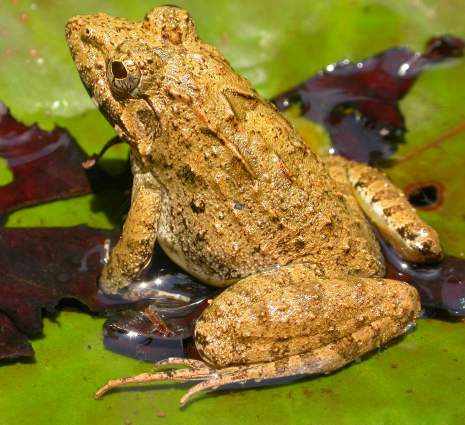
The Sri Lanka rock frog is an amphibian endemic to Sri Lanka. It inhabits subtropical and tropical moist lowland and montane forests, particularly fast-flowing mountain streams and wet rocks beside waterfalls. Its olive-green or yellowish-brown body has brown patches, and its legs have transverse brown bars.
Written 27 November 2026 from the sources listed below. Each statement was checked against the passage it cites; statements that could not be supported were removed.
Appearance
The Sri Lanka rock frog has an olive-green or yellowish-brown body mottled with brown patches. Its legs have transverse brown bars, and it is well camouflaged when sitting on algae-covered rocks.[1][2][3]
Females grow to approximately 5 centimetres in length, while males grow to approximately 4 centimetres.[4][5]
Habitat
The Sri Lanka rock frog inhabits subtropical and tropical moist lowland forests and subtropical and tropical moist montane forests. It is adapted to rapidly flowing creeks and occurs beneath boulders and on wet rocks beside waterfalls.[6][7][8][9]
The species can also occupy disturbed terrestrial areas where suitable breeding sites, such as wet seeps, occur. It has been reported in lowland forest in Kanneliya Forest in southwestern Sri Lanka.[10][11]
The species is endemic to Sri Lanka and occurs in southern, central and western Sri Lanka. Its distribution includes the Sabaragamuwa, Western, Central and Southern provinces, with records in wet tropical forests at elevations up to 1,200 metres above sea level.[12][13][14][15]
Behaviour
The Sri Lanka rock frog is largely aquatic. Its tadpoles are semi-terrestrial and sometimes occur on wet rocks beside torrents.[16][17][18]
Diet
The tadpoles forage for small invertebrates on rock surfaces near their nests. The alga Selenastrum also provides food for the larvae.[19][20]
Reproduction and life cycle
Females typically lay clusters of eggs in crevices within the splash zone of mountain streams. After spawning, females do not participate further in parental care.[21][22]
Males guard eggs in several nests and keep the guarded eggs moist.[23][24]
Conservation
The Sri Lanka rock frog is classified as Vulnerable on the IUCN Red List, and its population numbers appear to be declining. It has several geographically disjunct populations, and its total range covers less than 2,000 square kilometres.[25][26][27][28]
Streams used by the species for living and breeding are exposed to agrochemical pollution. Water volumes in these streams decrease during drought periods.[29][30]
Classification of the Sri Lanka Rock Frog
| Kingdom | Animalia |
|---|---|
| Phylum | Chordata |
| Subphylum | Vertebrata |
| Infraphylum | Gnathostomata |
| Parvphylum | Osteichthyes |
| Megaclass | Tetrapoda |
| Class | Amphibia (Amphibians) |
| Order | Anura (Frogs) |
| Family | Dicroglossidae (Forked Tongued Frogs) |
| Subfamily | Dicroglossinae |
| Genus | Nannophrys (Streamlined Frogs) |
| Species | Nannophrys ceylonensis Günther, 1869 |
Where the Sri Lanka Rock Frog is found
Checklists and occurrence records place Nannophrys ceylonensis in 1 country. GBIF holds 116 georeferenced records of it.
Countries
Regions and cities with the most records
- Hatton, Sri Lanka 21
- Homagama, Sri Lanka 9
- Ratnapura, Sri Lanka 9
- Kalutara, Sri Lanka 6
- Panadura, Sri Lanka 6
- Hanwella Ihala, Sri Lanka 5
- Gampola, Sri Lanka 3
A number beside a place is its count of GBIF occurrence records. A place without a number comes from a checklist alone. Records show where a species has been observed or collected, which can include escapes and vagrants.
Common names
English
- Sri Lanka Rock Frog
- Ceylon Streamlined Frog
Names in 3 other languages
- Czech
- indoskokan cejlonský
- Russian
- каскоголовая лягушка
- Sinhala
- Lanka Galpara Madiya
Synonyms
2 other scientific names have been used for this species and are now treated as synonyms of Nannophrys ceylonensis.
- Trachucephalus ceylanicus Ferguson, 1874
- Trachycephalus ceylanicus Ferguson, 1874
Related species
-
 Gunther's Streamlined FrogNannophrys guentheri
-
 Kirthisinghe's Rock FrogNannophrys marmorata
-
 Sri Lanka Tribal Rock-frogNannophrys naeyakai
-
 Crab-eating FrogFejervarya cancrivora
-
 Indian BullfrogHoplobatrachus tigerinus
-
 Asian Grass FrogFejervarya limnocharis
-
 Sulawesi Wart FrogLimnonectes larvaepartus
-
 Blyth's River FrogLimnonectes blythii
Compare
Questions and answers
What is the scientific name of the Sri Lanka Rock Frog?
The scientific name of the Sri Lanka Rock Frog is Nannophrys ceylonensis. Written with its author, the full name is Nannophrys ceylonensis Günther, 1869.
Which family does the Sri Lanka Rock Frog belong to?
Nannophrys ceylonensis belongs to the family Dicroglossidae, in the order Anura and the class Amphibia.
Where is the Sri Lanka Rock Frog found?
Checklists and occurrence records place Nannophrys ceylonensis in 1 country: Sri Lanka.
What is the conservation status of the Sri Lanka Rock Frog?
The IUCN Red List category recorded for Nannophrys ceylonensis is Vulnerable (VU).
What other names does the Sri Lanka Rock Frog have?
Nannophrys ceylonensis is also known in English as Ceylon Streamlined Frog.
What is a frog's scientific name?
The scientific name of the Sri Lanka rock frog is Nannophrys ceylonensis.[31]
Sources
Passages the profile rests on
- The species has an olive-green or yellowish-brown body mottled with brown patches. Source passage: “The colour is olive green or yellowish-brown, mottled with brown patches.” — English Wikipedia
- Its legs have transverse brown bars. Source passage: “The legs have transverse bars of brown.” — English Wikipedia
- The species is well camouflaged when sitting on algae-covered rocks. Source passage: “When sitting on alga covered rocks it is well camouflaged.” — English Wikipedia
- Females grow to approximately 5 centimetres in length. Source passage: “Female Sri Lanka rock frogs grow to a length of about 5 centimetres (2.0 in)” — English Wikipedia
- Males grow to approximately 4 centimetres in length. Source passage: “males grow to 4 centimetres (1.6 in).” — English Wikipedia
- The species inhabits subtropical and tropical moist lowland forests. Source passage: “its natural habitats are subtropical or tropical moist lowland forests” — English Wikipedia
- The species also inhabits subtropical and tropical moist montane forests. Source passage: “subtropical or tropical moist montane forests” — English Wikipedia
- The species occurs in fast-flowing mountain streams, beneath boulders and on wet rocks beside waterfalls. Source passage: “occurs in fast flowing mountain streams, under boulders and on wet rocks beside waterfalls.” — English Wikipedia
- The species is adapted to rapidly flowing creeks. Source passage: “They are well-adapted to rapid flowing creeks.” — amphibiaweb.org
- The species can also occupy disturbed terrestrial areas where suitable breeding sites such as wet seeps occur. Source passage: “It is also found on land in disturbed areas where there are suitable breeding locations such as wet seeps.” — English Wikipedia
- The species has been reported in lowland forest in Kanneliya Forest in southwestern Sri Lanka. Source passage: “reported the species in lowland forest in the Kanneliya Forest of southwestern Sri Lanka.” — amphibiansoftheworld.amnh.org
- The species is endemic to Sri Lanka. Source passage: “It is endemic to Sri Lanka” — English Wikipedia
- The species occurs in southern, central and western Sri Lanka. Source passage: “The Sri Lanka rock frog is endemic to south, central and western Sri Lanka” — English Wikipedia
- Its distribution includes the Sabaragamuwa, Western, Central and Southern provinces of Sri Lanka. Source passage: “Sabaragamuwa, Western, Central, and Southern provinces, in western and southern Sri Lanka” — amphibiansoftheworld.amnh.org
- The species has been recorded in wet tropical forests at elevations up to 1,200 metres above sea level. Source passage: “where it is found in wet tropical forests at altitudes of up to 1,200 metres (3,900 ft) above sea level.” — English Wikipedia
- The species is largely aquatic. Source passage: “It is a largely aquatic species” — English Wikipedia
- Its tadpoles are semi-terrestrial. Source passage: “The tadpoles are semi-terrestrial” — English Wikipedia
- Its tadpoles sometimes occur on wet rocks beside torrents. Source passage: “are sometimes found on wet rocks beside torrents.” — English Wikipedia
- The tadpoles forage for small invertebrates on rock surfaces near their nests. Source passage: “The eggs hatch into tadpoles that forage for small invertebrates on the surface of the rocks near their nest.” — English Wikipedia
- The alga Selenastrum provides food for the larvae. Source passage: “Selenastrum, an alga that provides food for larval. Nannophrys ceylonensis.” — digitalcommons.mtu.edu
- Females typically lay clusters of eggs in crevices within the splash zone of mountain streams. Source passage: “The female Sri Lanka rock frog typically spawns a cluster of eggs in a crevice in the splash zone of a mountain stream.” — English Wikipedia
- Females do not participate further in parental care after spawning. Source passage: “while the female plays no further part in parental care.” — English Wikipedia
- Males guard eggs in several nests. Source passage: “The male frog guards the eggs in several nests” — English Wikipedia
- Males keep the guarded eggs moist. Source passage: “and ensures that they are kept moist” — English Wikipedia
- The species is classified as Vulnerable on the IUCN Red List. Source passage: “Nannophrys ceylonensis is listed as Vulnerable.” — English Wikipedia
- The species' population numbers appear to be declining. Source passage: “This is because numbers seem to be declining” — English Wikipedia
- The species has several geographically disjunct populations. Source passage: “it has several disjunct populations” — English Wikipedia
- The total area of the species' range is less than 2,000 square kilometres. Source passage: “the total area of its range being less than 2,000 square kilometres (770 square miles).” — English Wikipedia
- Streams used by the species for living and breeding are exposed to agrochemical pollution. Source passage: “The streams in which it lives and breeds are subject to pollution by agrochemicals” — English Wikipedia
- Water volumes in its streams decrease during drought periods. Source passage: “the volume of water is reduced during periods of drought.” — English Wikipedia
- The species was originally described by Günther in 1869. Source passage: “Nannophrys ceylonensis Günther, 1869” — amphibiansoftheworld.amnh.org
Data
- Catalogue of Life, 2026-10-16 XR cc by
- Global Biodiversity Information Facility CC BY 4.0
- Wikidata CC0
- GeoNames CC BY 4.0
- Wikimedia Commons per image; credit shown with each image
- Within the Catalogue of Life, this name comes from The Integrated Taxonomic Information System cc0
This species in other databases
Page built on 28 November 2026. See how the catalog is made and all sources and licences.
Cite this page
ScientificNames.org. (2026). Nannophrys ceylonensis (Sri Lanka Rock Frog). Retrieved November 28, 2026, from https://scientificnames.org/species/nannophrys-ceylonensis
“Nannophrys ceylonensis (Sri Lanka Rock Frog).” ScientificNames.org, 2026, scientificnames.org/species/nannophrys-ceylonensis. Accessed 28 Nov. 2026.
ScientificNames.org. “Nannophrys ceylonensis (Sri Lanka Rock Frog).” Accessed November 28, 2026. https://scientificnames.org/species/nannophrys-ceylonensis.
@misc{scientificnames_nannophrys_ceylonensis_sri_lanka_rock_frog,
  author = {{ScientificNames.org}},
  title = {Nannophrys ceylonensis (Sri Lanka Rock Frog)},
  year = {2026},
  url = {https://scientificnames.org/species/nannophrys-ceylonensis},
  note = {Accessed 2026-11-28}
}