Species · Flowering plants
Flask-shaped Pitcher Plant Nepenthes ampullaria
The scientific name of the Flask-shaped Pitcher Plant is Nepenthes ampullaria. It is a species of flowering plant in the family Nepenthaceae (monkey cups), order Caryophyllales.
- Scientific name
- Nepenthes ampullaria Jack
- Common name
- Flask-shaped Pitcher Plant
- Genus
- Nepenthes
- Family
- Nepenthaceae (Monkey Cups)
- Order
- Caryophyllales
- Class
- Magnoliopsida
- Red List category
- LC Least Concern
- Recorded in
- 10 countries
- Name status
- accepted in the Catalogue of Life

Overview
The species is native to Borneo, the Maluku Islands, New Guinea, Peninsular Malaysia, Singapore, Sumatra, and Thailand, and occurs on several additional islands. It produces numerous urn-shaped pitchers that can form a carpet-like covering over the soil and obtains a substantial portion of its nutrients by digesting fallen leaf matter.
Written 26 November 2026 from the sources listed below. Each statement was checked against the passage it cites; statements that could not be supported were removed.
Appearance
The flask-shaped pitcher plant produces numerous pitchers that can form a carpet-like covering over the soil. Pink or white foliage leaves emerging directly from the rhizome contribute to this growth habit.[1][2]
The stem is light brown and can climb to a height of 15 metres. The leaves are light green and can reach 25 centimetres in length and 6 centimetres in width, while the tendrils bearing pitchers are no longer than 15 centimetres.[3][4][5][6][7]
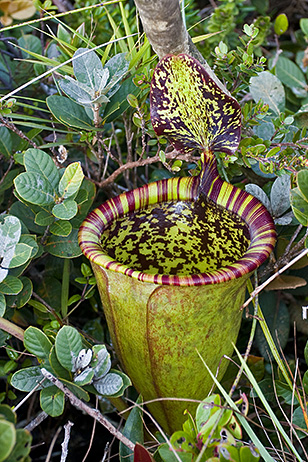
The pitchers are generally urn-shaped and rarely exceed 10 centimetres in height or 7 centimetres in width. Their rim is strongly curved inward, and their coloration ranges from entirely light green to completely dark red, including intermediate forms.[8][9][10][11]
Pitchers from Sumatra and Peninsular Malaysia are almost exclusively green or green with red speckles, while red pitcher forms are mostly restricted to Borneo. A large-pitched form has been recorded in New Guinea.[12][13][14]
Upper pitchers are very rarely produced and are smaller than those formed on rosettes or offshoots. The inflorescence is a dense panicle.[15][16]
Young plants have short brown hairs densely covering all their parts. Mature plants have sparser hair covering, except on their inflorescences.[17][18]
Habitat
The flask-shaped pitcher plant generally inhabits damp, shady forests at elevations ranging from sea level to 2,100 metres.[19]
In Borneo, it commonly grows in kerangas forest, peat swamp forest, and degraded swamp forest. Its recorded elevation range there is between 0 and 1,000 metres.[20][21]
In Sumatra and Peninsular Malaysia, it inhabits heath forest, padang, belukar, peat swamp forest, degraded swamp forest, and paddy fields.[22]
In New Guinea, the species predominantly occurs in Araucaria forests. It has also been recorded in secondary forests, open microphyllous vegetation, and swamp grassland.[23][24]
Diet
The flask-shaped pitcher plant obtains a substantial portion of its nutrients by digesting leaf matter falling onto the forest floor. It is partially detritivorous rather than relying entirely on carnivory.[25][26]
Behaviour
Subsurface runners and offshoots contribute to its growth architecture. Its pitchers are relatively long-lived because nutrients accumulate slowly.[27][28]
Organisms living inside the pitchers, including mosquito larvae, are thought to assist leaf-litter decomposition and nitrogen transfer. Bacterial decomposition of leaf matter produces ammonium ions.[29][30]
Reproduction and life cycle
The species flowers once or twice each year, with each flowering period lasting several weeks. Flowering periods often coincide with those of other Nepenthes species, allowing natural hybridization.[31][32]
A variety named Nepenthes ampullaria var. racemosa occurs in Sarawak and has a racemose inflorescence.[33]
Similar species
The flask-shaped pitcher plant is difficult to confuse with other members of its genus because of its distinctive pitcher morphology and growth habit.[34]
Classification of the Flask-shaped Pitcher Plant
| Kingdom | Plantae |
|---|---|
| Subkingdom | Pteridobiotina |
| Phylum | Tracheophyta |
| Class | Magnoliopsida |
| Order | Caryophyllales |
| Family | Nepenthaceae (Monkey Cups) |
| Genus | Nepenthes (Pitcherplant) |
| Species | Nepenthes ampullaria Jack |
Where the Flask-shaped Pitcher Plant is found
Checklists and occurrence records place Nepenthes ampullaria in 10 countries across Asia and Oceania. GBIF holds 2,144 georeferenced records of it.
Countries
- Brunei 36
- China 3
- India 4
- Indonesia 1,021
- Malaysia 833
- Papua New Guinea 96
- Philippines
- Singapore 138
- Sri Lanka 6
- Thailand 7
Regions and cities with the most records
- Sarawak, Malaysia 422
- Kuching, Malaysia 193
- Riau, Indonesia 137
- Sabah, Malaysia 124
- Bau, Malaysia 100
- Siburan, Malaysia 83
- Novena, Singapore 74
- Singapore, Singapore 74
- Eunos, Singapore 72
- MacPherson, Singapore 72
- Marine Parade, Singapore 72
- Queenstown Estate, Singapore 72
- Ulu Bedok, Singapore 71
- Ang Mo Kio New Town, Singapore 70
- Bedok New Town, Singapore 70
- Kampong Pasir Ris, Singapore 70
- Yio Chu Kang, Singapore 69
- Anak Bukit, Singapore 68
- Bukit Timah, Singapore 68
- Matilda Estate, Singapore 68
- Punggol, Singapore 68
- Sengkang New Town, Singapore 68
- Bukit Panjang New Town, Singapore 65
- Jurong East, Singapore 65
- Jurong Town, Singapore 65
- Teck Whye, Singapore 65
- Choa Chu Kang New Town, Singapore 64
- Keat Hong Village, Singapore 64
- Sungai Simpang, Singapore 64
- Yishun New Town, Singapore 64
- Boon Lay, Singapore 63
- Jurong West, Singapore 63
- Yew Tee, Singapore 63
- Sembawang Estate, Singapore 62
- Marsiling, Singapore 61
- Woodlands, Singapore 61
1 more country has a few records outside this range
These countries hold a few records of Nepenthes ampullaria but lie outside the range the checklists give for it. Such records are often zoo or garden specimens, museum material or vagrants, so the species is not counted as occurring there.
Range as the checklists state it
peninsular Thailand; peninsular Malaysia (widespread); Singapore; Sumatera (incl. minor islands); Borneo; Philippines (only once); Moluccas; New Guinea (Irian Jaya, Papua New Guinea)
A number beside a place is its count of GBIF occurrence records. A place without a number comes from a checklist alone. Records show where a species has been observed or collected, which can include escapes and vagrants.
Common names
English
- Flask-shaped Pitcher Plant
Names in 6 other languages
- Chinese
- 蘋果豬籠草
- Italian
- Pianta cobra
- Japanese
- ツボウツボカズラ
- Lithuanian
- Pūslėtasis ąsotenis
- Russian
- Непентес кувшинчиковый
- Swedish
- klotkannranka
Synonyms
12 other scientific names have been used for this species and are now treated as synonyms of Nepenthes ampullaria.
- Nepenthes ampullacea Jack
- Nepenthes ampullacea H.Low
- Nepenthes ampullaria f. vittata Hort. ex Beck
- Nepenthes ampullaria var. geelvinkiana Becc.
- Nepenthes ampullaria var. guttata S.Moore
- Nepenthes ampullaria var. longicarpa Becc.
- Nepenthes ampullaria var. microsepala Macfarl.
- Nepenthes ampullaria var. picta B.S.Williams
- Nepenthes ampullaria var. racemosa J.H.Adam & Wilcock
- Nepenthes ampullaria var. vittata André
- Nepenthes ampullaria var. vittata-major Mast.
- Nepenthes vittata Beck
Related species
-
 Low's Pitcher PlantNepenthes lowii
-
 Attenborough's Pitcher PlantNepenthes attenboroughii
-
 Indian Pitcher PlantNepenthes khasiana
-
 Common Swamp Pitcher-PlantNepenthes mirabilis
-
 Raffles' Pitcher-plantNepenthes rafflesiana
-
 Fanged Pitcher PlantNepenthes bicalcarata
-
 Veitch's Pitcher-plantNepenthes veitchii
-
 Slender Pitcher-PlantNepenthes gracilis
Compare
Questions and answers
What is the scientific name of the Flask-shaped Pitcher Plant?
The scientific name of the Flask-shaped Pitcher Plant is Nepenthes ampullaria. Written with its author, the full name is Nepenthes ampullaria Jack.
Which family does the Flask-shaped Pitcher Plant belong to?
Nepenthes ampullaria belongs to the family Nepenthaceae, in the order Caryophyllales and the class Magnoliopsida.
Where is the Flask-shaped Pitcher Plant found?
Checklists and occurrence records place Nepenthes ampullaria in 10 countries, including Indonesia, Malaysia, Singapore, Papua New Guinea, Brunei and Thailand.
What is the conservation status of the Flask-shaped Pitcher Plant?
The IUCN Red List category recorded for Nepenthes ampullaria is Least Concern (LC).
What do Nepenthes pitcher plants eat?
The flask-shaped pitcher plant obtains a substantial portion of its nutrients by digesting leaf matter falling onto the forest floor. It is partially detritivorous rather than relying entirely on carnivory.[25][26]
What habitat do pitcher plants live in?
The flask-shaped pitcher plant generally inhabits damp, shady forests at elevations ranging from sea level to 2,100 metres. Its habitats also include peat swamp forests, heath forests, Araucaria forests, secondary forests, open microphyllous vegetation, and swamp grassland.[19][20][22][23][24]
Sources
Passages the profile rests on
- The species produces numerous pitchers that can form a carpet-like covering over the soil. Source passage: “The species often forms a "carpet" of pitchers covering the soil.” — English Wikipedia
- Its carpet-like growth habit results partly from pink or white foliage leaves emerging directly from the rhizome. Source passage: “many pink or white foliage leaves which emerge directly from the rhizome.” — English Wikipedia
- The stem is light brown. Source passage: “The stem of N. ampullaria is light brown in colour” — English Wikipedia
- The stem can climb to a height of 15 metres. Source passage: “may climb to 15 metres (49 ft) in height.” — English Wikipedia
- The leaves are light green. Source passage: “Leaves are light green” — English Wikipedia
- The leaves can reach 25 centimetres in length and 6 centimetres in width. Source passage: “up to 25 centimetres (9.8 in) long, and 6 centimetres (2.4 in) wide.” — English Wikipedia
- The tendrils bearing pitchers are no longer than 15 centimetres. Source passage: “no more than 15 centimetres (5.9 in) long.” — English Wikipedia
- The pitchers are generally urn-shaped. Source passage: “The urceolate pitchers are generally quite small” — English Wikipedia
- The pitchers rarely exceed 10 centimetres in height or 7 centimetres in width. Source passage: “rarely exceeding 10 centimetres (3.9 in) in height and 7 centimetres (2.8 in) in width.” — English Wikipedia
- The pitcher rim is strongly curved inward. Source passage: “The peristome is greatly incurved” — English Wikipedia
- Pitcher coloration ranges from entirely light green to completely dark red, including intermediate forms. Source passage: “Pitchers range in colouration from light green throughout to completely dark red, with many intermediate forms recorded.” — English Wikipedia
- Pitchers from Sumatra and Peninsular Malaysia are almost exclusively green or green with red speckles. Source passage: “almost exclusively green throughout or green with red speckles” — English Wikipedia
- Red pitcher forms are mostly restricted to Borneo. Source passage: “the red forms are mostly confined to Borneo.” — English Wikipedia
- A large-pitched form has been recorded in New Guinea. Source passage: “A large-pitchered form has been recorded from New Guinea.” — English Wikipedia
- The upper pitchers are very rarely produced and are smaller than the pitchers formed on rosettes or offshoots. Source passage: “Upper pitchers are very rarely produced and are considerably smaller than those formed on rosettes or offshoots.” — English Wikipedia
- The inflorescence is a dense panicle. Source passage: “The inflorescence of N. ampullaria is a dense panicle.” — English Wikipedia
- Young plants have short brown hairs densely covering all their parts. Source passage: “All parts of the plant are densely covered with short, brown hairs when young.” — English Wikipedia
- Mature plants have sparser hair covering, except on their inflorescences. Source passage: “The indumentum of mature plants is more sparse, except on the inflorescenes.” — English Wikipedia
- The species generally inhabits damp, shady forests at elevations ranging from sea level to 2,100 metres. Source passage: “generally grows in damp, shady forest from sea level to 2,100 metres (6,900 ft) altitude.” — English Wikipedia
- In Borneo, the species commonly grows in kerangas forest, peat swamp forest, and degraded swamp forest. Source passage: “it occurs usually on relatively flat terrain in kerangas forest, peat swamp forest, and degraded swamp forest” — English Wikipedia
- In Borneo, the species occurs at elevations between 0 and 1,000 metres. Source passage: “at elevations of 0 to 1,000 metres (3,300 ft).” — English Wikipedia
- In Sumatra and Peninsular Malaysia, the species inhabits heath forest, padang, belukar, peat swamp forest, degraded swamp forest, and paddy fields. Source passage: “heath forest, padang, belukar, peat swamp forest, degraded swamp forest, and in paddy fields.” — English Wikipedia
- In New Guinea, the species predominantly occurs in Araucaria forests. Source passage: “In New Guinea, it is predominantly present in Araucaria forests.” — English Wikipedia
- The species has also been recorded in secondary forests, open microphyllous vegetation, and swamp grassland. Source passage: “The species has also been recorded from secondary forests, open microphyllous vegetation, and swamp grassland.” — English Wikipedia
- The species obtains a substantial portion of its nutrients by digesting leaf matter falling onto the forest floor. Source passage: “acquires a substantial portion of its nutrients from digesting leaf matter that falls to the forest floor.” — English Wikipedia
- The species is partially detritivorous rather than relying entirely on carnivory. Source passage: “It is thus partially detritivorous.” — English Wikipedia
- The species has subsurface runners and offshoots that contribute to its unusual growth architecture. Source passage: “The plant's architecture, consisting of subsurface runners and offshoots, is unusual for the genus.” — English Wikipedia
- The species' pitchers are relatively long-lived because nutrients accumulate slowly. Source passage: “The pitchers of N. ampullaria are relatively long-lived, as the species relies on a slow accumulation of nutrients over time.” — English Wikipedia
- Organisms living inside the pitchers, including mosquito larvae, are thought to assist leaf-litter decomposition and nitrogen transfer. Source passage: “infaunal organisms, such as mosquito larvae, facilitate breakdown of leaf litter and aid in the transfer of nitrogen” — English Wikipedia
- Bacterial decomposition of leaf matter produces ammonium ions. Source passage: “Bacterial breakdown of leaf matter is also known to produce ammonium ions.” — English Wikipedia
- The species flowers once or twice each year, with each flowering period lasting several weeks. Source passage: “N. ampullaria flowers once or twice annually for several weeks at a time.” — English Wikipedia
- Flowering periods often coincide with those of other Nepenthes species, allowing natural hybridization. Source passage: “Its flowering period often coincides with those of other Nepenthes species; consequently, it readily forms natural hybrids.” — English Wikipedia
- A variety named Nepenthes ampullaria var. racemosa occurs in Sarawak and has a racemose inflorescence. Source passage: “N. ampullaria var. racemosa, occurs in Sarawak and has a racemose inflorescence.” — English Wikipedia
- The species is difficult to confuse with other members of its genus because of its distinctive pitcher morphology and growth habit. Source passage: “Due to its unique pitcher morphology and unusual growth habit, it is difficult to confuse N. ampullaria with any other species in the genus.” — English Wikipedia
Data
- Catalogue of Life, 2026-10-16 XR cc by
- Global Biodiversity Information Facility CC BY 4.0
- Wikidata CC0
- GeoNames CC BY 4.0
- Wikimedia Commons per image; credit shown with each image
- Within the Catalogue of Life, this name comes from Synonymic Checklists of the Vascular Plants of the World cc by
References
- Jack. (1835). Compan. Bot. Mag. 1: 271 (1835). where the name was published
This species in other databases
- Catalogue of Life 46X6Z
- Wikidata Q134453
- iNaturalist 346348
- World Flora Online wfo-0000382394
- GRIN 25149
Page built on 28 November 2026. See how the catalog is made and all sources and licences.
Cite this page
ScientificNames.org. (2026). Nepenthes ampullaria (Flask-shaped Pitcher Plant). Retrieved November 28, 2026, from https://scientificnames.org/species/nepenthes-ampullaria
“Nepenthes ampullaria (Flask-shaped Pitcher Plant).” ScientificNames.org, 2026, scientificnames.org/species/nepenthes-ampullaria. Accessed 28 Nov. 2026.
ScientificNames.org. “Nepenthes ampullaria (Flask-shaped Pitcher Plant).” Accessed November 28, 2026. https://scientificnames.org/species/nepenthes-ampullaria.
@misc{scientificnames_nepenthes_ampullaria_flask_shaped_pitcher_plant,
  author = {{ScientificNames.org}},
  title = {Nepenthes ampullaria (Flask-shaped Pitcher Plant)},
  year = {2026},
  url = {https://scientificnames.org/species/nepenthes-ampullaria},
  note = {Accessed 2026-11-28}
}