Species · Flowering plants
Common Swamp Pitcher-Plant Nepenthes mirabilis
The scientific name of the Common Swamp Pitcher-Plant is Nepenthes mirabilis. It is a species of flowering plant in the family Nepenthaceae (monkey cups), order Caryophyllales.
- Scientific name
- Nepenthes mirabilis (Lour.) Druce
- Common name
- Common Swamp Pitcher-Plant
- Genus
- Nepenthes
- Family
- Nepenthaceae (Monkey Cups)
- Order
- Caryophyllales
- Class
- Magnoliopsida
- Red List category
- LC Least Concern
- Recorded in
- 19 countries
- Name status
- accepted in the Catalogue of Life

Overview
The Common Swamp Pitcher-Plant is a Nepenthes species with the widest geographical distribution of any species in its genus. It occurs across continental Southeast Asia and the major islands of the Malay Archipelago, with a range extending from China to Australia. It has the greatest number of known natural hybrids among species in its genus.
Written 26 November 2026 from the sources listed below. Each statement was checked against the passage it cites; statements that could not be supported were removed.
Appearance
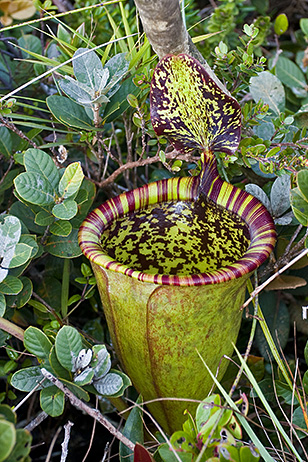
The species exhibits substantial variation in pitcher morphology and colour across its geographical range.[1]
The Bornean variety Nepenthes mirabilis var. echinostoma has an exceptionally wide peristome. Its pitcher mouths resemble the deflexed teeth of a giant moss.[2][3]
Habitat
The species grows along the Jardine River in Australia. It occurs in Australia, China, the Philippines and the Caroline Islands, among other locations.[4][5][6][7][8]
Behaviour
The pitchers contain acidic digestive fluid that can reach a pH as low as 2. The pitcher bacterial communities differ significantly according to pitcher type.[9][10]
The pitchers of Australian populations have been found to contain the fly Sarcophaga papuensis and the mite Nepenthacarus warreni. The mosquito Aedes dybasi inhabits the pitchers on Palau, while Aedes maehleri inhabits those on Yap.[11][12][13][14]
The pitcher bacterial communities are more diverse than those found in Nepenthes ampullaria and Nepenthes gracilis in Peninsular Malaysia.[15]
The species undergoes a developmental shift from predominantly root-derived nitrogen uptake to predominantly pitcher-derived nitrogen uptake.[16]
Reproduction and life cycle
The species has the greatest number of known natural hybrids among species in its genus.[17]
Conservation
The species is classified as Least Concern on the IUCN Red List. It is protected under Forestry Regulations Cap. 96A in Hong Kong.[18][19]
Uses
The pitchers are used as toy phallocrypts in New Guinea.[20]
Classification of the Common Swamp Pitcher-Plant
| Kingdom | Plantae |
|---|---|
| Subkingdom | Pteridobiotina |
| Phylum | Tracheophyta |
| Class | Magnoliopsida |
| Order | Caryophyllales |
| Family | Nepenthaceae (Monkey Cups) |
| Genus | Nepenthes (Pitcherplant) |
| Species | Nepenthes mirabilis (Lour.) Druce |
Where the Common Swamp Pitcher-Plant is found
Checklists and occurrence records place Nepenthes mirabilis in 19 countries across Asia and Oceania. GBIF holds 3,568 georeferenced records of it.
Countries
- Australia 613
- Brunei 27
- Cambodia 50
- China 224
- Hong Kong 160
- Indonesia 1,033
- Japan 4
- Laos 3
- Macao 23
- Malaysia 436
- Micronesia 59
- Myanmar 1
- Palau 192
- Papua New Guinea 380
- Philippines 13
- Singapore 8
- Sri Lanka 5
- Thailand 284
- Vietnam 53
Regions and cities with the most records
- Queensland, Australia 510
- Sabah, Malaysia 158
- Sarawak, Malaysia 135
- Discovery Bay, Hong Kong 130
- Sam Shing, Hong Kong 123
- Butterfly, Hong Kong 121
- Tuen Mun, Hong Kong 118
- Sham Tseng, Hong Kong 117
- Tuen Mun San Hui, Hong Kong 117
- Ting Kau, Hong Kong 115
- Tsing Yi Town, Hong Kong 113
- Tai Wo Hau, Hong Kong 112
- Discovery Park, Hong Kong 111
- Tsuen Wan, Hong Kong 111
- Shap Pat Heung, Hong Kong 110
- Tung Chung, Hong Kong 109
- San Tung Chung Hang, Hong Kong 107
- Ha Tsuen, Hong Kong 104
- Ping Shan, Hong Kong 104
- Yuen Long San Hui, Hong Kong 104
- Kam Tin, Hong Kong 103
- Yeung Uk Tsuen, Hong Kong 102
- Bengkulu, Indonesia 101
- Tin Shui Wai, Hong Kong 101
- Kwai Chung, Hong Kong 100
- Pat Heung, Hong Kong 99
- Shek Lei, Hong Kong 99
- Yuen Long, Hong Kong 99
- Yuen Long Kau Hui, Hong Kong 99
- Riau, Indonesia 96
- Fairview Park, Hong Kong 94
- Mei Foo, Hong Kong 91
- Shenzhenwan, China 91
- Mei Foo Sun Chuen, Hong Kong 90
- San Tin, Hong Kong 89
- Shawei, China 89
3 more countries have a few records outside this range
These countries hold a few records of Nepenthes mirabilis but lie outside the range the checklists give for it. Such records are often zoo or garden specimens, museum material or vagrants, so the species is not counted as occurring there.
Range as the checklists state it
China (Hainan, Guangdong, Hongkong, Macau); Myanmar; Thailand; Laos; Cambodia; Vietnam; peninsular Malaysia (widespread); Sumatera; Borneo; Sulawesi; S-Philippines (Mindanao, Dinagat); Jawa; Lesser Sunda Isl. (Bali); Moluccas; New Guinea (Irian Jaya, Papua New Guinea, Louisiade Arch., d'Entrecasteaux Isl.); Australia (NE-Queensland); Palau (Babeldaob, Koror, Ngarakabesang, Malakal, Ulebsechel, Urukthapel, Orokuiza); Fed. States of Micronesia (Yap)
A number beside a place is its count of GBIF occurrence records. A place without a number comes from a checklist alone. Records show where a species has been observed or collected, which can include escapes and vagrants.
Common names
English
- Common Swamp Pitcher-Plant
- Pitcher-Plant
- Tropical Pitcherplant
Names in 8 other languages
- Chinese
- 奇異豬籠草, 豬籠草
- Danish
- kandebærer
- Japanese
- ナンヨウウツボカズラ, 南洋靫草
- Lithuanian
- Puošnusis ąsotenis
- Polish
- dzbanecznik przedziwny
- Russian
- Непентес удивительный
- Thai
- เขนงนายพราน
- pau
- Meliik
Synonyms
30 other scientific names have been used for this species and are now treated as synonyms of Nepenthes mirabilis.
- Nepenthea hainaniana Metcalfe & Chalk
- Nepenthes albolineata F.M.Bailey
- Nepenthes alicae F.M.Bailey
- Nepenthes armbrustae F.M.Bailey
- Nepenthes bernaysii F.M.Bailey
- Nepenthes cantharifera Juss. ex Raf.
- Nepenthes cholmondeleyi F.M.Bailey
- Nepenthes echinostoma Hook.fil.
- Nepenthes fimbriata Blume
- Nepenthes fimbriata var. leptostachya Blume
- Nepenthes garrawayae F.M.Bailey
- Nepenthes jardinei F.M.Bailey
- Nepenthes kennedyana F.Muell.
- Nepenthes kennedyi Benth.
- Nepenthes macrostachya Blume
- Nepenthes mirabilis var. biflora J.H.Adam & Wilcock
- Nepenthes mirabilis var. echinostoma (Hook.fil.) J.H.Adam & Wilcock
- Nepenthes mirabilis var. globosa M.Catal.
- Nepenthes moluccensis Oken
- Nepenthes moorei F.M.Bailey
- Nepenthes pascoensis F.M.Bailey
- Nepenthes phyllamphora var. macrantha Hook.fil.
- Nepenthes phyllamphora var. pediculata Lecomte
- Nepenthes phyllamphora var. platyphylla Blume
- Nepenthes phyllamphora var. speciosa Rafarin
- Nepenthes rowanae F.M.Bailey
- Nepenthes scyphus Juss. ex Raf.
- Nepenthes tubulosa Macfarl.
- Phyllamphora mirabilis Lour.
- Nepenthes phyllamphora Willd. ambiguous synonym
Subspecies and varieties
Related species
-
 Low's Pitcher PlantNepenthes lowii
-
 Attenborough's Pitcher PlantNepenthes attenboroughii
-
 Flask-shaped Pitcher PlantNepenthes ampullaria
-
 Indian Pitcher PlantNepenthes khasiana
-
 Raffles' Pitcher-plantNepenthes rafflesiana
-
 Fanged Pitcher PlantNepenthes bicalcarata
-
 Veitch's Pitcher-plantNepenthes veitchii
-
 Slender Pitcher-PlantNepenthes gracilis
Compare
Questions and answers
What is the scientific name of the Common Swamp Pitcher-Plant?
The scientific name of the Common Swamp Pitcher-Plant is Nepenthes mirabilis. Written with its author, the full name is Nepenthes mirabilis (Lour.) Druce.
Which family does the Common Swamp Pitcher-Plant belong to?
Nepenthes mirabilis belongs to the family Nepenthaceae, in the order Caryophyllales and the class Magnoliopsida.
Where is the Common Swamp Pitcher-Plant found?
Checklists and occurrence records place Nepenthes mirabilis in 19 countries, including Indonesia, Australia, Malaysia, Papua New Guinea, Thailand and China.
What is the conservation status of the Common Swamp Pitcher-Plant?
The IUCN Red List category recorded for Nepenthes mirabilis is Least Concern (LC).
What other names does the Common Swamp Pitcher-Plant have?
Nepenthes mirabilis is also known in English as Pitcher-Plant and Tropical Pitcherplant.
What is the scientific name of pitcher plant?
The scientific name of the Common Swamp Pitcher-Plant is Nepenthes mirabilis (Lour.) Druce.[21]
Sources
Passages the profile rests on
- The species exhibits substantial variation in pitcher morphology and colour across its geographical range. Source passage: “Across its range, N. mirabilis exhibits great variability in terms of pitcher morphology and colour” — English Wikipedia
- The Bornean variety Nepenthes mirabilis var. echinostoma has an exceptionally wide peristome. Source passage: “N. mirabilis var. echinostoma, is endemic to Borneo and possesses an extremely wide peristome.” — English Wikipedia
- The pitchers of the echinostoma variety have mouths resembling the deflexed teeth of a giant moss. Source passage: “The mouths of the urns remind one of the deflexed teeth of some gigantic moss” — English Wikipedia
- The species grows along the Jardine River in Australia. Source passage: “a specimen of N. mirabilis growing along the Jardine River in Australia.” — English Wikipedia
- The species is recorded in Australia's Cape York Peninsula. Source passage: “Australia (Cape York Peninsula)” — English Wikipedia
- The species occurs in China, including Guangdong Province, Hainan, Hong Kong and Macau. Source passage: “China (Guangdong Province, Hainan, Hong Kong, and Macau)” — English Wikipedia
- The species occurs on the Philippine islands of Dinagat and Mindanao. Source passage: “Philippines (Dinagat and Mindanao)” — English Wikipedia
- The species occurs on the Caroline Islands of Palau and Yap. Source passage: “Caroline Islands (Palau and Yap)” — English Wikipedia
- The pitchers contain acidic digestive fluid that can reach a pH as low as 2. Source passage: “the acidic digestive juices (which may have a pH as low as 2)” — English Wikipedia
- The species' pitcher bacterial communities differ significantly according to pitcher type. Source passage: “their composition can also differ significantly according to pitcher type” — English Wikipedia
- The species' pitchers in Australian populations have been found to contain the fly Sarcophaga papuensis. Source passage: “the sarcophagid fly Sarcophaga papuensis” — English Wikipedia
- The mite Nepenthacarus warreni has been found in the pitchers of Australian populations. Source passage: “the mite Nepenthacarus warreni, which have both been found in Australian populations of the plant.” — English Wikipedia
- The mosquito Aedes dybasi inhabits the species' pitchers on Palau. Source passage: “the mosquitoes Aedes dybasi and Aedes maehleri reside in the pitchers of N. mirabilis on the islands of Palau and Yap, respectively.” — English Wikipedia
- The mosquito Aedes maehleri inhabits the species' pitchers on Yap. Source passage: “Aedes maehleri reside in the pitchers of N. mirabilis on the islands of Palau and Yap, respectively.” — English Wikipedia
- The pitcher bacterial communities of this species are more diverse than those found in Nepenthes ampullaria and Nepenthes gracilis in Peninsular Malaysia. Source passage: “These bacterial communities appear to be more diverse than those found in the pitcher fluid of N. ampullaria and sympatric N. gracilis in Peninsular Malaysia.” — English Wikipedia
- The species undergoes a developmental shift from predominantly root-derived nitrogen uptake to predominantly pitcher-derived nitrogen uptake. Source passage: “there is an ontogenic switch from primarily root-derived N uptake to chiefly pitcher-derived N uptake from” — pmc.ncbi.nlm.nih.gov
- The species has the greatest number of known natural hybrids among species in its genus. Source passage: “Nepenthes mirabilis has the greatest number of known natural hybrids of any species in the genus.” — English Wikipedia
- The species is classified as Least Concern on the IUCN Red List. Source passage: “The conservation status of N. mirabilis is listed as Least Concern on the IUCN Red List.” — English Wikipedia
- The species is protected under Forestry Regulations Cap. 96A in Hong Kong. Source passage: “In Hong Kong, it is a protected species under Forestry Regulations Cap. 96A.” — English Wikipedia
- The pitchers of the species are used as toy phallocrypts in New Guinea. Source passage: “the pitchers of N. mirabilis are used as toy phallocrypts in New Guinea.” — English Wikipedia
- The species has the widest geographical distribution of any Nepenthes species. Source passage: “By far the most widespread of all Nepenthes” — English Wikipedia
- The species occurs across continental Southeast Asia and the major islands of the Malay Archipelago, excluding the Lesser Sunda Islands and northern Philippines. Source passage: “its range covers continental Southeast Asia and all major islands of the Malay Archipelago (minus the Lesser Sunda Islands and northern Philippines)” — English Wikipedia
- The species' geographical range extends from China in the north to Australia in the south. Source passage: “stretching from China in the north to Australia in the south.” — English Wikipedia
Data
- Catalogue of Life, 2026-10-16 XR cc by
- Global Biodiversity Information Facility CC BY 4.0
- Wikidata CC0
- GeoNames CC BY 4.0
- Wikimedia Commons per image; credit shown with each image
- Within the Catalogue of Life, this name comes from Synonymic Checklists of the Vascular Plants of the World cc by
References
- Druce. Rep. Bot. Soc. Exch. Club Brit. Isles 637 (1916 publ. 1917). where the name was published
This species in other databases
- Catalogue of Life 46XBC
- Wikidata Q150525
- iNaturalist 348343
- World Flora Online wfo-0001086539
- GRIN 25157
Page built on 29 November 2026. See how the catalog is made and all sources and licences.
Cite this page
ScientificNames.org. (2026). Nepenthes mirabilis (Common Swamp Pitcher-Plant). Retrieved November 29, 2026, from https://scientificnames.org/species/nepenthes-mirabilis
“Nepenthes mirabilis (Common Swamp Pitcher-Plant).” ScientificNames.org, 2026, scientificnames.org/species/nepenthes-mirabilis. Accessed 29 Nov. 2026.
ScientificNames.org. “Nepenthes mirabilis (Common Swamp Pitcher-Plant).” Accessed November 29, 2026. https://scientificnames.org/species/nepenthes-mirabilis.
@misc{scientificnames_nepenthes_mirabilis_common_swamp_pitcher_plant,
  author = {{ScientificNames.org}},
  title = {Nepenthes mirabilis (Common Swamp Pitcher-Plant)},
  year = {2026},
  url = {https://scientificnames.org/species/nepenthes-mirabilis},
  note = {Accessed 2026-11-29}
}