Species · Birds
Changeable Hawk-eagle Nisaetus cirrhatus
The scientific name of the Changeable Hawk-eagle is Nisaetus cirrhatus. It is a species of bird in the family Accipitridae (hawks), order Accipitriformes. The name dates from 1788.
- Scientific name
- Nisaetus cirrhatus (J. F. Gmelin, 1788)
- Common name
- Changeable Hawk-eagle
- Genus
- Nisaetus
- Family
- Accipitridae (Hawks)
- Order
- Accipitriformes
- Class
- Aves
- Red List category
- LC Least Concern
- Recorded in
- 15 countries
- Name status
- accepted in the Catalogue of Life
Overview
Nisaetus cirrhatus occurs throughout peninsular India, Sri Lanka, the Himalayan foothills, Nepal, northeastern India, Burma, Southeast Asia, the Malay Peninsula, the Philippines, the Greater Sunda Islands, the Andaman Islands and Simeulue Island. It is distinguished by substantial plumage variation and occurs in both crested and crestless groups.
Written 26 November 2026 from the sources listed below. Each statement was checked against the passage it cites; statements that could not be supported were removed.
Appearance
Adult individuals are generally dark brown on their upperparts and prominently streaked on their underparts. They have a strong bill, relatively short wings, a long thinly barred tail and feathered legs.[1][2]
Adults may have a floppy crest of varying size or lack a crest entirely. Adult birds have yellow to orange-yellow eyes, while individuals of all ages have yellow feet.[3][4][5]
Juvenile birds generally have dark brown upperparts with conspicuous white edges on their mantle and wings. Dark-morph adults range in coloration from dark chocolate brown to almost entirely black.[6][7]
Reported total body length ranges from 51 to 82 cm, although these figures may include a different species formerly grouped with it. Reported wingspans range from 100 to 160 cm, although these measurements may include the Flores hawk-eagle.[8][9]
Females are approximately 7% larger than males on average. Reported body masses range from 1.2 to 1.9 kg.[10][11]
Habitat
The Changeable Hawk-eagle is a forest-dwelling predator.[12]
Diet
The Changeable Hawk-eagle consumes birds, mammals, reptiles and other vertebrates.[13]
Behaviour
Individuals commonly perch in an upright posture. They use both relatively secluded and open locations as perching sites.[14][15]
Reproduction and life cycle
Individuals may attempt to breed at three years of age. Full adult plumage is generally acquired during the fourth year.[16][17]
Conservation
The island subspecies are considered to have a higher risk of extinction than other lineages. They are recommended for conservation treatment as evolutionarily significant units regardless of their taxonomic status.[18][19]
Similar species
The Flores hawk-eagle was traditionally classified as a subspecies of the Changeable Hawk-eagle but is now often recognized as a separate species.[20]
Classification of the Changeable Hawk-eagle
| Kingdom | Animalia |
|---|---|
| Phylum | Chordata |
| Subphylum | Vertebrata |
| Infraphylum | Gnathostomata |
| Parvphylum | Osteichthyes |
| Megaclass | Tetrapoda |
| Class | Aves (Bird) |
| Order | Accipitriformes (Hawks) |
| Family | Accipitridae (Hawks) |
| Genus | Nisaetus (Asian Hawk-Eagles) |
| Species | Nisaetus cirrhatus (J. F. Gmelin, 1788) |
Where the Changeable Hawk-eagle is found
Checklists and occurrence records place Nisaetus cirrhatus in 15 countries across Asia. GBIF holds 76,522 georeferenced records of it.
Countries
- Bangladesh 316
- Bhutan 39
- Brunei 59
- Cambodia 668
- India 40,128
- Indonesia 1,754
- Laos 45
- Malaysia 8,072
- Myanmar 129
- Nepal 1,403
- Philippines 295
- Singapore 12,622
- Sri Lanka 10,170
- Thailand 612
- Vietnam 210
Regions and cities with the most records
- Yio Chu Kang, Singapore 12,488
- Ang Mo Kio New Town, Singapore 12,451
- Novena, Singapore 12,430
- Yishun New Town, Singapore 12,335
- Sungai Simpang, Singapore 12,308
- Sengkang New Town, Singapore 12,241
- Sembawang Estate, Singapore 12,088
- Bukit Timah, Singapore 11,828
- Queenstown Estate, Singapore 11,781
- Matilda Estate, Singapore 11,651
- Woodlands, Singapore 11,511
- Anak Bukit, Singapore 11,390
- Singapore, Singapore 11,320
- Bukit Panjang New Town, Singapore 11,173
- Punggol, Singapore 11,131
- Teck Whye, Singapore 11,121
- Choa Chu Kang New Town, Singapore 11,098
- Yew Tee, Singapore 11,072
- Keat Hong Village, Singapore 10,766
- Jurong East, Singapore 10,716
- MacPherson, Singapore 10,656
- Jurong West, Singapore 10,653
- Jurong Town, Singapore 10,621
- Eunos, Singapore 10,592
- Marsiling, Singapore 10,562
- Marine Parade, Singapore 10,273
- Kampong Pasir Ris, Singapore 10,262
- Ulu Bedok, Singapore 10,232
- Bedok New Town, Singapore 10,118
- Boon Lay, Singapore 9,852
- Kampung Pasir Gudang Baru, Malaysia 9,051
- Kerala, India 8,135
- Johor Bahru, Malaysia 8,041
- Masai, Malaysia 7,868
- Pasir Gudang, Malaysia 7,826
- Kampong Loyang, Singapore 7,571
Range as the checklists state it
Southern Asia
A number beside a place is its count of GBIF occurrence records. A place without a number comes from a checklist alone. Records show where a species has been observed or collected, which can include escapes and vagrants.
Common names
English
- Changeable Hawk-Eagle
- Changeable Hawk Eagle
- Crested Hawk-Eagle
Names in 33 other languages
- Arabic
- أفياء متغير, عقاب بازي متغير
- Bengali
- শাবাজ
- Catalan
- àguila variable
- Chinese
- 冠鷹鵰, 凤头鹰雕, 鳳頭鷹鵰
- Croatian
- pjegavoglavi orao
- Czech
- orel proměnlivý
- Danish
- Lysbuget Høgeørn
- Dutch
- Indische Kuifarend
- Esperanto
- varia aglo
- Estonian
- välu-tuttkotkas
- Finnish
- jalokotka
- French
- Aigle huppé, Aigle huppé ja=カワリクマタカ
- German
- Haubenadler, Indienhaubenadler
- Hungarian
- főkötős vitézsas
- Indonesian
- Elang brontok
- Italian
- Aquila dal ciuffo variabile, Aquilastore variabile
- Japanese
- インドクマタカ, カワリクマタカ
- Lithuanian
- kuoduotasis peslinis erelis
- Malayalam
- കിന്നരിപ്പരുന്ത്
- Marathi
- मोरघार
- Norwegian
- vekselskogørn
- Norwegian Bokmål
- indiaskogørn
- Persian
- شاهباز
- Polish
- wojownik indyjski
- Portuguese
- gavião-variável, águia-gavião-variável, águia-variável
- Russian
- Изменчивый хохлатый орёл
- Serbian
- Raznobojni/ćubasti jastrebasti orao
- Slovak
- orlovec viactvarý
- Spanish
- Águila azor variable, Águila variable, Águila-azor variable
- Swedish
- Indisk tofsörn, orientörn, variabel hökörn
- Thai
- เหยี่ยวต่างสี
- Turkish
- Değişken Atmaca Kartalı
- Ukrainian
- орел-чубань індійський
Synonyms
4 other scientific names have been used for this species and are now treated as synonyms of Nisaetus cirrhatus.
- Falco cirrhatus J. F. Gmelin, 1788
- Nisaetus limnaeetus limnaeetus Horsfield, T, 1821
- Spizaetus cirrhatus (J. F. Gmelin, 1788)
- Spizaetus cirrhatus cirrhatus Gmelin, JF, 1788
Subspecies and varieties
- Nisaetus cirrhatus andamanensis (Andaman Changeable Hawk-Eagle) subspecies
- Nisaetus cirrhatus ceylanensis (Ceylon Hawk-Eagle) subspecies
- Nisaetus cirrhatus cirrhatus (Crested Hawk-Eagle) subspecies
- Nisaetus cirrhatus limnaeetus (Changeable Hawk-Eagle) subspecies
- Nisaetus cirrhatus vanheurni (Simeulue Changeable Hawk-Eagle) subspecies
Related species
-
 Javan Hawk-eagleNisaetus bartelsi
-
 Mountain Hawk-eagleNisaetus nipalensis
-
 Philippine Hawk-eagleNisaetus philippensis
-
 Flores Hawk-eagleNisaetus floris
-
 Pinsker's Hawk-eagleNisaetus pinskeri
-
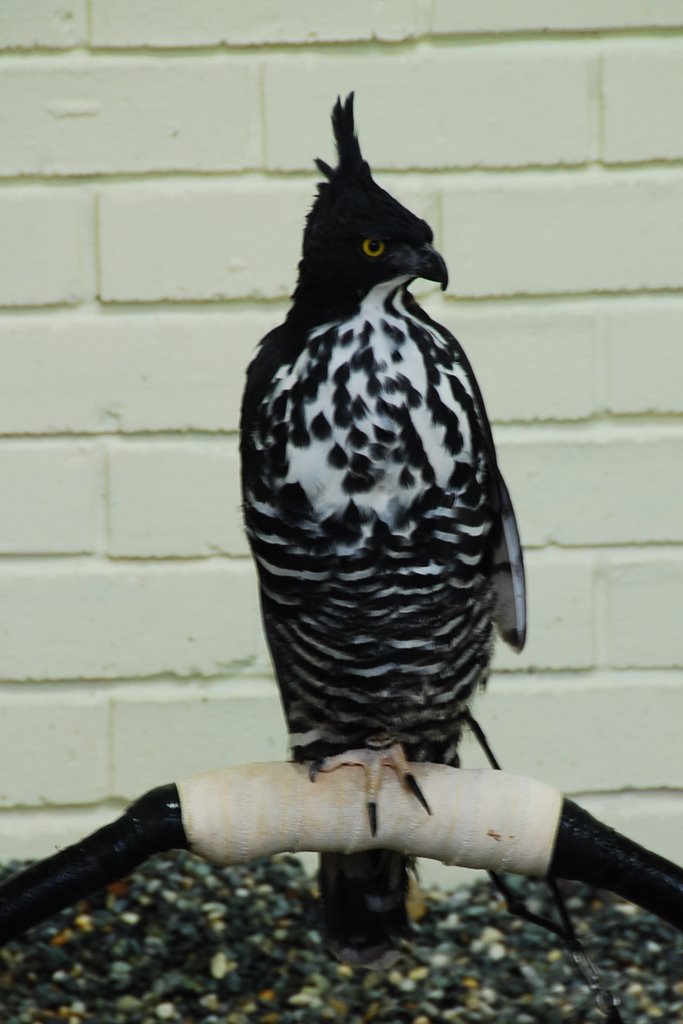 Blyth's Hawk-eagleNisaetus alboniger
-
 Wallace's Hawk-eagleNisaetus nanus
-
 Legge's Hawk-eagleNisaetus kelaarti
Compare
Questions and answers
What is the scientific name of the Changeable Hawk-eagle?
The scientific name of the Changeable Hawk-eagle is Nisaetus cirrhatus. Written with its author, the full name is Nisaetus cirrhatus (J. F. Gmelin, 1788).
Which family does the Changeable Hawk-eagle belong to?
Nisaetus cirrhatus belongs to the family Accipitridae, in the order Accipitriformes and the class Aves.
Where is the Changeable Hawk-eagle found?
Checklists and occurrence records place Nisaetus cirrhatus in 15 countries, including India, Singapore, Sri Lanka, Malaysia, Indonesia and Nepal.
What is the conservation status of the Changeable Hawk-eagle?
The IUCN Red List category recorded for Nisaetus cirrhatus is Least Concern (LC).
What other names does the Changeable Hawk-eagle have?
Nisaetus cirrhatus is also known in English as Changeable Hawk Eagle and Crested Hawk-Eagle.
Why is it called a changeable hawk-eagle?
The species exhibits substantial plumage variation associated with age and moulting. It comprises crested and crestless groups.[21][22]
What do hawk eagles eat?
The Changeable Hawk-eagle consumes birds, mammals, reptiles and other vertebrates.[13]
Sources
Passages the profile rests on
- Adult individuals are generally dark brown on their upperparts and prominently streaked on their underparts. Source passage: “Adult changeable hawk-eagles are typically dark brown above and boldly streaked below” — English Wikipedia
- The species has a strong bill, relatively short wings, a long thinly barred tail and feathered legs. Source passage: “with a strong bill, a variably sized, often floppy crest or no crest, rather short wings, a quite long, thinly-barred tail and long feathered legs.” — English Wikipedia
- Adult individuals may have a floppy crest of varying size or lack a crest entirely. Source passage: “a variably sized, often floppy crest or no crest” — English Wikipedia
- Adult birds have yellow to orange-yellow eyes. Source passage: “Adults have yellow to orange yellow eyes” — English Wikipedia
- Individuals of all ages have yellow feet. Source passage: “while all ages have yellow feet.” — English Wikipedia
- Juvenile birds generally have dark brown upperparts with conspicuous white edges on their mantle and wings. Source passage: “Most juvenile changeable hawk-eagles are dark brown above but with far more conspicuous white edges on mantle and wings than the adults” — English Wikipedia
- Dark-morph adults range in coloration from dark chocolate brown to almost entirely black. Source passage: “the dark morph adult can range from all dark chocolate brown to almost pure black” — English Wikipedia
- The species has a reported total body length ranging from 51 to 82 cm, although these figures may include a different species formerly grouped with it. Source passage: “total length has been reported in the past to vary from 51 to 82 cm (20 to 32 in)” — English Wikipedia
- Reported wingspans range from 100 to 160 cm, although these measurements may include the Flores hawk-eagle. Source passage: “wingspan from 100 to 160 cm (39 to 63 in)” — English Wikipedia
- Females are approximately 7% larger than males on average. Source passage: “females are larger than males with an average overall size difference of 7%” — English Wikipedia
- Reported body masses for the species range from 1.2 to 1.9 kg. Source passage: “Weights in this species have been reported from 1.2 to 1.9 kg (2.6 to 4.2 lb)” — English Wikipedia
- The species is described as a forest-dwelling predator. Source passage: “it is an agile forest-dwelling predator” — English Wikipedia
- The species consumes birds, mammals, reptiles and other vertebrates. Source passage: “readily varies its prey selection between birds, mammals or reptiles as well as other vertebrates.” — English Wikipedia
- Individuals commonly perch in an upright posture. Source passage: “This species tends to perch bolt upright” — English Wikipedia
- Individuals use both relatively secluded and open locations as perching sites. Source passage: “may perch in various places from somewhat secluded spots to also quite open area as well.” — English Wikipedia
- Individuals may attempt to breed at three years of age. Source passage: “Changeable hawk-eagles may attempt to breed at 3 years of age” — English Wikipedia
- Full adult plumage is generally acquired during the fourth year. Source passage: “but full adult plumage is not obtained until the 4th year.” — English Wikipedia
- The island subspecies are considered to have a higher risk of extinction than other lineages. Source passage: “the island taxa which are obviously at higher risk of extinction” — English Wikipedia
- The island subspecies are recommended for conservation treatment as evolutionarily significant units regardless of their taxonomic status. Source passage: “for conservation considered evolutionary significant units regardless of their systematic status.” — English Wikipedia
- The Flores hawk-eagle was traditionally classified as a subspecies of the changeable hawk-eagle but is now often recognized as a separate species. Source passage: “the Flores hawk-eagle has traditionally been treated as a subspecies of the changeable hawk-eagle, but it is now often treated as a separate species, N. floris.” — English Wikipedia
- The species exhibits substantial plumage variation associated with age and moulting. Source passage: “Individuals show a wide range of variation in plumage from pale to dark, varying with moult and age” — English Wikipedia
- The species comprises crested and crestless groups. Source passage: “Two distinct groups exist in the changeable hawk-eagle; one with crests and one without or with hardly visible crests.” — English Wikipedia
Data
- Catalogue of Life, 2026-10-16 XR cc by
- Global Biodiversity Information Facility CC BY 4.0
- Wikidata CC0
- GeoNames CC BY 4.0
- Within the Catalogue of Life, this name comes from The Integrated Taxonomic Information System cc0
This species in other databases
Page built on 29 November 2026. See how the catalog is made and all sources and licences.
Cite this page
ScientificNames.org. (2026). Nisaetus cirrhatus (Changeable Hawk-eagle). Retrieved November 29, 2026, from https://scientificnames.org/species/nisaetus-cirrhatus
“Nisaetus cirrhatus (Changeable Hawk-eagle).” ScientificNames.org, 2026, scientificnames.org/species/nisaetus-cirrhatus. Accessed 29 Nov. 2026.
ScientificNames.org. “Nisaetus cirrhatus (Changeable Hawk-eagle).” Accessed November 29, 2026. https://scientificnames.org/species/nisaetus-cirrhatus.
@misc{scientificnames_nisaetus_cirrhatus_changeable_hawk_eagle,
  author = {{ScientificNames.org}},
  title = {Nisaetus cirrhatus (Changeable Hawk-eagle)},
  year = {2026},
  url = {https://scientificnames.org/species/nisaetus-cirrhatus},
  note = {Accessed 2026-11-29}
}