Species · Birds
Philippine Hawk-eagle Nisaetus philippensis
The scientific name of the Philippine Hawk-eagle is Nisaetus philippensis. It is a species of bird in the family Accipitridae (hawks), order Accipitriformes. The name dates from 1863.
- Scientific name
- Nisaetus philippensis (Gould, 1863)
- Common name
- Philippine Hawk-eagle
- Genus
- Nisaetus
- Family
- Accipitridae (Hawks)
- Order
- Accipitriformes
- Class
- Aves
- Red List category
- EN Endangered
- Recorded in
- 1 country
- Name status
- accepted in the Catalogue of Life

Overview
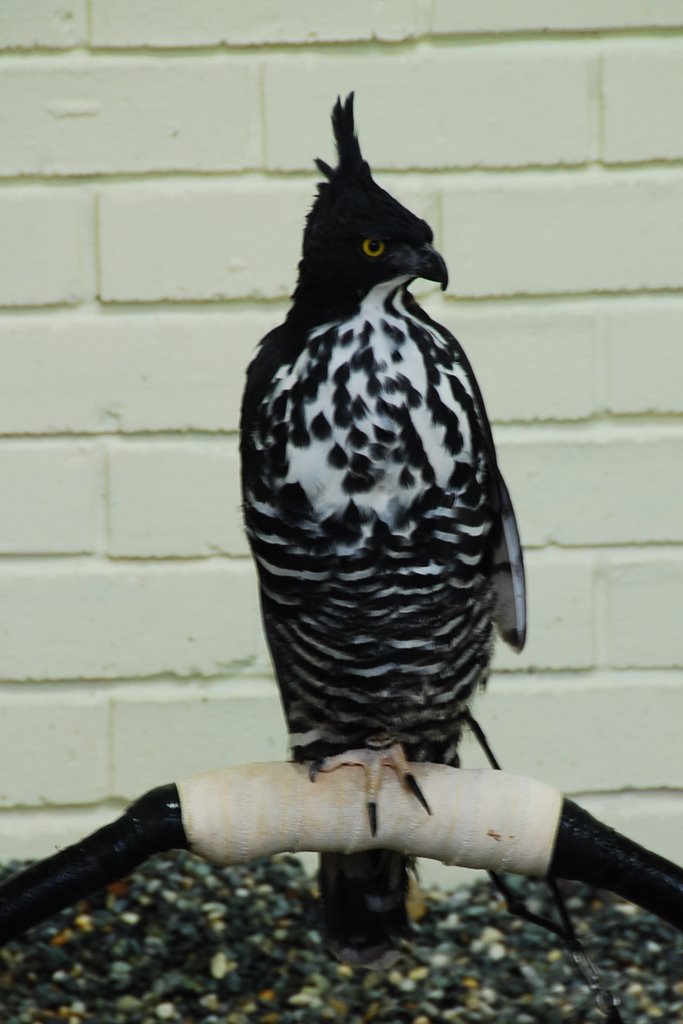
Nisaetus philippensis has dark brown upper plumage, streaked head and chest markings, fine belly barring and a prominent backward-curving crest.
Written 26 November 2026 from the sources listed below. Each statement was checked against the passage it cites; statements that could not be supported were removed.
Appearance
The Philippine Hawk-eagle has dark brown upper plumage and a pale brown belly. Its head and chest have streaked markings, while its lower belly has fine barring.[1][2]
The species has a prominent crest that curves backwards. Its call consists of a high-pitched screeching phrase or a single note.[3][4]
The Philippine Hawk-eagle measures between 56 and 67 centimetres in length, with a wingspan ranging from 105 to 125 centimetres. One recorded female weighed 1.16 kilograms.[5][6][7]
Habitat
The Philippine Hawk-eagle inhabits tropical moist lowland forests, including both primary and secondary forests. It is associated with lowland and foothill forests, with habitat extending to lower mountain slopes.[8][9][10][11]
The species occasionally visits forest clearings and cultivated areas. A documented breeding pair nested in a Bombax ceiba tree in secondary forest.[12][13]
The Philippine Hawk-eagle is endemic to the Philippines and occurs in the northern Philippines. Most recorded occurrences are below 1,000 metres above sea level.[14][15][16]
Diet
The Philippine Hawk-eagle is believed to feed primarily on birds and small mammals. Birds accounted for 35 percent of the recorded diet of a studied nesting pair in 2020.[17][18]
Behaviour
The species perches high in the forest canopy. It is commonly observed at forest edges or soaring above forests.[19][20]
A documented breeding pair occupied a territory covering 3.3 square kilometres.[21]
Reproduction and life cycle
Incubation in a studied nesting pair lasted approximately three weeks. Nestling body size doubled each week during the first three weeks.[22][23]
Feather development and juvenile plumage were observed between the fourth and seventh weeks. Fledging takes approximately two months.[24][25]
Conservation
The Philippine Hawk-eagle is classified as endangered on the IUCN Red List. Its mature population was estimated at 1,000 to 2,000 individuals as of 2024, and its population is continuing to decline.[26][27][28]
Habitat loss is the species' main threat. Forest clearance caused by logging, agricultural conversion and mining threatens its habitat.[29][30]
The species is also threatened by trapping and hunting for food and the pet trade.[31]
The Philippine Hawk-eagle occurs in Mount Makiling National Park, Mount Isarog National Park, Kalbario–Patapat Natural Park, Northern Sierra Madre Natural Park and Bataan National Park.[32]
Similar species
The Philippine Hawk-eagle was formerly treated as conspecific with Pinsker's Hawk-Eagle. Compared with Pinsker's Hawk-Eagle, it has a shorter crest, larger body size, browner plumage and plainer belly markings.[33][34]
Classification of the Philippine Hawk-eagle
| Kingdom | Animalia |
|---|---|
| Phylum | Chordata |
| Subphylum | Vertebrata |
| Infraphylum | Gnathostomata |
| Parvphylum | Osteichthyes |
| Megaclass | Tetrapoda |
| Class | Aves (Bird) |
| Order | Accipitriformes (Hawks) |
| Family | Accipitridae (Hawks) |
| Genus | Nisaetus (Asian Hawk-Eagles) |
| Species | Nisaetus philippensis (Gould, 1863) |
Where the Philippine Hawk-eagle is found
Checklists and occurrence records place Nisaetus philippensis in 1 country across Asia. GBIF holds 902 georeferenced records of it.
Countries
Regions and cities with the most records
- Olongapo, Philippines 242
- Morong, Philippines 241
- Subic, Philippines 239
- Teresa, Philippines 221
- Tanay, Philippines 220
- Baras, Philippines 218
- Morong, Philippines 218
- Cardona, Philippines 216
- Binangonan, Philippines 214
- Rodriguez, Philippines 214
- Angono, Philippines 210
- Taytay, Philippines 210
- Antipolo, Philippines 209
- Cainta, Philippines 209
- San Mateo, Philippines 177
- Bagong Silangan, Philippines 176
- Malanday, Philippines 176
- Calumpang, Philippines 175
- Baclaran, Philippines 174
- Bel Air, Philippines 174
- Makati City, Philippines 174
- Mandaluyong, Philippines 174
- Mandaluyong City, Philippines 174
- Manila, Philippines 174
- Marikina City, Philippines 174
- Pasay, Philippines 174
- Pasig City, Philippines 174
- Pateros, Philippines 174
- Quezon City, Philippines 174
- San Juan, Philippines 174
- Taguig, Philippines 174
- Upper Bicutan, Philippines 174
- Bagong Pagasa, Philippines 173
- Commonwealth, Philippines 173
- Paranaque City, Philippines 173
- Bagong Barrio, Philippines 172
Range as the checklists state it
Southern Asia
A number beside a place is its count of GBIF occurrence records. A place without a number comes from a checklist alone. Records show where a species has been observed or collected, which can include escapes and vagrants.
Common names
English
- Philippine Hawk-Eagle
- North Philippine Hawk-eagle
Names in 28 other languages
- Arabic
- أفياء فلبيني, نسر الصقري الفلبيني
- Catalan
- Àguila astor filipina, àguila de les Filipines
- Chinese
- 菲律宾鹰雕, 菲律宾鹰鵰, 菲律賓鷹鵰
- Croatian
- riđoprsi orao
- Czech
- orel filipínský
- Danish
- Filippinsk Høgeørn
- Dutch
- Filipijnse kuifarend, Noord-Filipijnse Kuifarend, Noord-Filippijnse Kuifarend
- Esperanto
- nordfilipina aglo
- Estonian
- filipiini tuttkotkas
- Finnish
- filippiinienjalokotka
- French
- Aigle des Philippines
- German
- Luzonhaubenadler, Philippinen-Adler, Philippinenhaubenadler
- Hungarian
- fülöp-szigeteki vitézsas
- Italian
- Aquilastore delle Filippine
- Japanese
- フィリピンクマタカ
- Lithuanian
- filipininis peslinis erelis
- Mongolian
- Филиппин бүргэд
- Norwegian
- filippinerskogørn
- Polish
- wojownik filipiński
- Portuguese
- gavião-filipino, águia-filipina-setentrional, águia-gavião-filipina
- Russian
- Филиппинский хохлатый орёл
- Serbian
- Filipinski jastrebasti orao
- Slovak
- orlovec filipínsky
- Spanish
- Águila azor filipina, Águila de Filipinas, Águila filipina
- Swedish
- Luzonhökörn, luzonörn
- Turkish
- Filipin Atmaca Kartalı
- Ukrainian
- орел-чубань філіпінський
- Vietnamese
- Diều Philippin
Synonyms
2 other scientific names have been used for this species and are now treated as synonyms of Nisaetus philippensis.
- Spizaetus philippensis Gould, 1863
- Spizaetus philippensis philippensis Gould, J, 1863
Related species
- Changeable Hawk-eagleNisaetus cirrhatus
-
 Javan Hawk-eagleNisaetus bartelsi
-
 Mountain Hawk-eagleNisaetus nipalensis
-
 Flores Hawk-eagleNisaetus floris
-
 Pinsker's Hawk-eagleNisaetus pinskeri
-
 Blyth's Hawk-eagleNisaetus alboniger
-
 Wallace's Hawk-eagleNisaetus nanus
-
 Legge's Hawk-eagleNisaetus kelaarti
Compare
Questions and answers
What is the scientific name of the Philippine Hawk-eagle?
The scientific name of the Philippine Hawk-eagle is Nisaetus philippensis. Written with its author, the full name is Nisaetus philippensis (Gould, 1863).
Which family does the Philippine Hawk-eagle belong to?
Nisaetus philippensis belongs to the family Accipitridae, in the order Accipitriformes and the class Aves.
Where is the Philippine Hawk-eagle found?
Checklists and occurrence records place Nisaetus philippensis in 1 country: Philippines.
What is the conservation status of the Philippine Hawk-eagle?
The IUCN Red List category recorded for Nisaetus philippensis is Endangered (EN).
What other names does the Philippine Hawk-eagle have?
Nisaetus philippensis is also known in English as North Philippine Hawk-eagle.
Sources
Passages the profile rests on
- The Philippine Hawk-Eagle has dark brown upper plumage and a pale brown belly. Source passage: “The Philippine hawk-eagle is a large raptor with a dark brown upper plumage and a pale brown belly.” — English Wikipedia
- Its head and chest have streaked markings, while its lower belly has fine barring. Source passage: “Head and chest are streaked and the lower belly is finely barred.” — English Wikipedia
- The species has a prominent crest that curves backwards. Source passage: “The species has a conspicuous backwards crest.” — English Wikipedia
- Its call consists of a high-pitched screeching phrase or a single note. Source passage: “The call a high, screeching "week wik!" or single "week!".” — English Wikipedia
- The Philippine Hawk-Eagle measures between 56 and 67 centimetres in length. Source passage: “it is a smaller eagle with a length of 56 to 67 cm” — English Wikipedia
- Its wingspan ranges from 105 to 125 centimetres. Source passage: “and a wingspan of 105 to 125 cm.” — English Wikipedia
- One recorded female weighed 1.16 kilograms. Source passage: “One female weighed 1.16 kg.” — English Wikipedia
- The species inhabits tropical moist lowland forests. Source passage: “Its natural habitat is tropical moist lowland forests.” — English Wikipedia
- The species occurs in both primary and secondary forests. Source passage: “It inhabits primary and secondary forest” — English Wikipedia
- Its habitat extends from lowland areas to lower mountain slopes. Source passage: “from the lowlands to lower mountain slopes.” — English Wikipedia
- The species is associated with lowland and foothill forests. Source passage: “raptor of lowland and foothill forest in the northern Philippines.” — ebird.org
- It occasionally visits forest clearings and cultivated areas. Source passage: “occasionally frequenting clearings and cultivations” — English Wikipedia
- A documented breeding pair nested in a Bombax ceiba tree in secondary forest. Source passage: “This breeding pair nested in a Bombax ceiba tree in secondary forest” — English Wikipedia
- The Philippine Hawk-Eagle is endemic to the Philippines. Source passage: “It is endemic to the Philippines.” — English Wikipedia
- Most recorded occurrences are below 1,000 metres above sea level. Source passage: “The majority of records are below 1,000 meters above sea level.” — English Wikipedia
- The species occurs in the northern Philippines. Source passage: “in the northern Philippines.” — ebird.org
- The species is believed to feed primarily on birds and small mammals. Source passage: “believed to feed mostly on birds and small mammals.” — English Wikipedia
- Birds accounted for 35 percent of the recorded diet of a studied nesting pair in 2020. Source passage: “the nest in 2020 revealed the diet to consist of 35% birds” — English Wikipedia
- The species perches high in the forest canopy. Source passage: “It perches high up in the cannopy” — English Wikipedia
- It is commonly observed at forest edges or soaring above forests. Source passage: “but is mostly seen at forest edge or soaring over the forest.” — English Wikipedia
- A documented breeding pair occupied a territory covering 3.3 square kilometres. Source passage: “with a territory spanning 3.3 square kilometers.” — English Wikipedia
- Incubation in the studied nesting pair lasted approximately three weeks. Source passage: “Incubation took approximately 3 weeks” — English Wikipedia
- Nestling body size doubled each week during the first three weeks. Source passage: “in the first to third week the body size doubled every week.” — English Wikipedia
- Feather development and juvenile plumage were observed between the fourth and seventh weeks. Source passage: “In the 4th to 7th week, the development of the feathers and juvenile plummage was observed.” — English Wikipedia
- Fledging takes approximately two months. Source passage: “Fledging took approximately two months.” — English Wikipedia
- The Philippine Hawk-Eagle is classified as endangered on the IUCN Red List. Source passage: “The IUCN Red List has assessed this bird as endangered” — English Wikipedia
- Its mature population was estimated at 1,000 to 2,000 individuals as of 2024. Source passage: “the population being estimated at 1,000 to 2,000 mature individuals as of 2024” — English Wikipedia
- The species' population is continuing to decline. Source passage: “continuing to decrease.” — English Wikipedia
- Habitat loss is identified as the species' main threat. Source passage: “This species' main threat is habitat loss” — English Wikipedia
- Forest clearance caused by logging, agricultural conversion and mining threatens the species. Source passage: “wholesale clearance of forest habitats as a result of logging, agricultural conversion and mining activities occurring within the range.” — English Wikipedia
- The species is also threatened by trapping and hunting for food and the pet trade. Source passage: “It is also trapped and hunted for food and the pet trade.” — English Wikipedia
- The species occurs in Mount Makiling National Park, Mount Isarog National Park, Kalbario–Patapat Natural Park, Northern Sierra Madre Natural Park and Bataan National Park. Source passage: “It occurs in a few protected areas including Mt. Makiling National Park, Mount Isarog National Park, Kalbario–Patapat Natural Park, Northern Sierra Madre Natural Park and Bataan National Park.” — English Wikipedia
- The Philippine Hawk-Eagle was formerly treated as conspecific with Pinsker's Hawk-Eagle. Source passage: “It was formerly conspecific with the Pinsker's hawk-eagle” — English Wikipedia
- Compared with Pinsker's Hawk-Eagle, the Philippine Hawk-Eagle has a shorter crest, larger body size, browner plumage and plainer belly markings. Source passage: “but has a shorter crest, larger size, browner plummage and plain markings on the belly.” — English Wikipedia
Data
- Catalogue of Life, 2026-10-16 XR cc by
- Global Biodiversity Information Facility CC BY 4.0
- Wikidata CC0
- GeoNames CC BY 4.0
- Wikimedia Commons per image; credit shown with each image
- Within the Catalogue of Life, this name comes from The Integrated Taxonomic Information System cc0
This species in other databases
Page built on 27 November 2026. See how the catalog is made and all sources and licences.
Cite this page
ScientificNames.org. (2026). Nisaetus philippensis (Philippine Hawk-eagle). Retrieved November 27, 2026, from https://scientificnames.org/species/nisaetus-philippensis
“Nisaetus philippensis (Philippine Hawk-eagle).” ScientificNames.org, 2026, scientificnames.org/species/nisaetus-philippensis. Accessed 27 Nov. 2026.
ScientificNames.org. “Nisaetus philippensis (Philippine Hawk-eagle).” Accessed November 27, 2026. https://scientificnames.org/species/nisaetus-philippensis.
@misc{scientificnames_nisaetus_philippensis_philippine_hawk_eagle,
  author = {{ScientificNames.org}},
  title = {Nisaetus philippensis (Philippine Hawk-eagle)},
  year = {2026},
  url = {https://scientificnames.org/species/nisaetus-philippensis},
  note = {Accessed 2026-11-27}
}