Species · Flowering plants
Nitre Bush Nitraria billardierei
The scientific name of the Nitre Bush is Nitraria billardierei. It is a species of flowering plant in the family Nitrariaceae (nitre bush family), order Sapindales.
- Scientific name
- Nitraria billardierei DC.
- Common name
- Nitre Bush
- Genus
- Nitraria
- Family
- Nitrariaceae (Nitre Bush Family)
- Order
- Sapindales
- Class
- Magnoliopsida
- Recorded in
- 1 country
- Name status
- accepted in the Catalogue of Life

Overview
Nitraria billardierei is native to Australia and occurs across all mainland Australian states. It is a drought-resistant, spreading shrub with spiny branchlets and edible fruits that mature to purple, red or golden.
Written 26 November 2026 from the sources listed below. Each statement was checked against the passage it cites; statements that could not be supported were removed.
Appearance
The nitre bush is a stiff, spreading shrub that forms hummocks. It grows 0.6–2 metres high and reaches up to 4 metres in diameter.[1][2]
Its branchlets are often tangled and spiny. Its leaves are clustered, narrow-obovate and often glaucous and minutely pubescent.[3][4]
Its flowers have white petals measuring 2–4 mm long. Its fruit is an ovoid-oblong drupe that becomes purple, red or golden when mature and measures 10–20 mm long.[5][6][7]
Habitat
The nitre bush commonly grows in saline or over-grazed areas and other disturbed locations. It occurs on loamy or clayey soils in inland districts.[8][9][10]
Behaviour
The nitre bush is drought-resistant and is not particularly palatable to livestock.[11][12]
Reproduction and life cycle
The nitre bush flowers chiefly in spring.[13][14]
Emus and other birds disperse its ripe fruits. Fruit consumption by emus assists the species' spread and germination in heavy clay soils.[15][16]
Uses
The ripe fruits are edible and are described as tasting like salty grapes. Indigenous Australians, including the Wemba-Wemba, ate the fruit whole, sometimes including the stone.[17][18][19]
The fruit can be processed into jam or dried for storage.[20]
Classification of the Nitre Bush
| Kingdom | Plantae |
|---|---|
| Subkingdom | Pteridobiotina |
| Phylum | Tracheophyta |
| Class | Magnoliopsida |
| Order | Sapindales |
| Family | Nitrariaceae (Nitre Bush Family) |
| Subfamily | Nitrarioideae |
| Genus | Nitraria (Nitre Bushes) |
| Species | Nitraria billardierei DC. |
Where the Nitre Bush is found
Checklists and occurrence records place Nitraria billardierei in 1 country across Oceania. GBIF holds 7,754 georeferenced records of it.
Countries
Regions and cities with the most records
- South Australia, Australia 5,078
- New South Wales, Australia 1,407
- Victoria, Australia 569
- Western Australia, Australia 250
- Adelaide, Australia 207
- Adelaide Hills, Australia 77
- Gawler, Australia 59
- Mildura, Australia 58
- Whyalla, Australia 45
- Geraldton, Australia 16
- Kwinana, Australia 12
- Broken Hill, Australia 11
- Rockingham, Australia 11
- Queensland, Australia 8
- Northern Territory, Australia 6
- Kalgoorlie, Australia 4
1 more country has a few records outside this range
These countries hold a few records of Nitraria billardierei but lie outside the range the checklists give for it. Such records are often zoo or garden specimens, museum material or vagrants, so the species is not counted as occurring there.
Range as the checklists state it
Australia (Western Australia: Carnavon to Perth, Northern Territory, South Australia, New South Wales, Victoria)
A number beside a place is its count of GBIF occurrence records. A place without a number comes from a checklist alone. Records show where a species has been observed or collected, which can include escapes and vagrants.
Common names
English
- Nitre Bush
- Dillonbush
Names in 1 other language
- Chinese
- 澳洲白刺
Synonyms
2 other scientific names have been used for this species and are now treated as synonyms of Nitraria billardierei.
- Nitraria schoberi var. billardierei (DC.) Kom.
- Zygophyllum australasicum Miq.
Related species
-
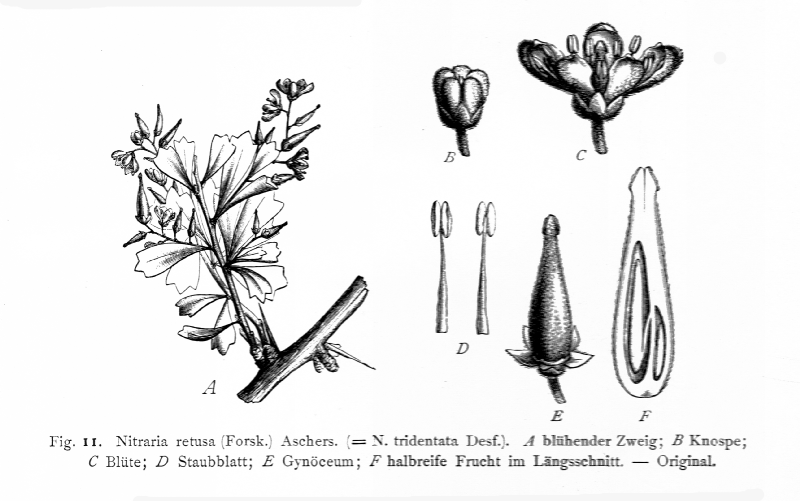 Salt TreeNitraria retusa
- Nitraria sibirica
- Nitraria schoberi
- Nitraria sphaerocarpa
- Nitraria roborowskii
- Nitraria iliensis
- Nitraria komarovii
- Nitraria pamirica
Compare
Questions and answers
What is the scientific name of the Nitre Bush?
The scientific name of the Nitre Bush is Nitraria billardierei. Written with its author, the full name is Nitraria billardierei DC..
Which family does the Nitre Bush belong to?
Nitraria billardierei belongs to the family Nitrariaceae, in the order Sapindales and the class Magnoliopsida.
Where is the Nitre Bush found?
Checklists and occurrence records place Nitraria billardierei in 1 country: Australia.
What other names does the Nitre Bush have?
Nitraria billardierei is also known in English as Dillonbush.
Where does the nitre bush occur?
It is native to Australia and occurs across all mainland Australian states. It is recorded from Queensland, Victoria, Western Australia, South Australia and the Northern Territory.[21][22][23]
Sources
Passages the profile rests on
- Nitraria billardierei is a stiff, spreading shrub that forms hummocks. Source passage: “Stiff spreading shrub, forming hummocks 0.6–2 m high and up to 4 m diam.” — plantnet.rbgsyd.nsw.gov.au
- The shrub grows 0.6–2 metres high and reaches up to 4 metres in diameter. Source passage: “0.6–2 m high and up to 4 m diam.” — plantnet.rbgsyd.nsw.gov.au
- Its branchlets are often tangled and spiny. Source passage: “branchlets often tangled and spiny.” — plantnet.rbgsyd.nsw.gov.au
- Its leaves are clustered, narrow-obovate and often glaucous and minutely pubescent. Source passage: “Leaves clustered, narrow-obovate, 5–30 mm long, often glaucous, often minutely pubescent.” — plantnet.rbgsyd.nsw.gov.au
- Its petals are white and measure 2–4 mm long. Source passage: “petals 2–4 mm long, white.” — plantnet.rbgsyd.nsw.gov.au
- Its fruit is an ovoid-oblong drupe that becomes purple, red or golden when mature. Source passage: “Drupe ovoid-oblong, 10–20 mm long, minutely pubescent, purple, red or golden when mature.” — plantnet.rbgsyd.nsw.gov.au
- Its mature fruit measures 10–20 mm long. Source passage: “Drupe ovoid-oblong, 10–20 mm long” — plantnet.rbgsyd.nsw.gov.au
- The species commonly grows in saline or over-grazed areas. Source passage: “Often grows on saline or over-grazed areas” — plantnet.rbgsyd.nsw.gov.au
- It occurs on loamy or clayey soils in inland districts. Source passage: “on loamy or clayey soils, inland districts.” — plantnet.rbgsyd.nsw.gov.au
- The species is often found in saline areas or other disturbed locations. Source passage: “It is often found in saline areas or other areas which have been disturbed.” — English Wikipedia
- The species is drought-resistant. Source passage: “Drought-resistant species” — plantnet.rbgsyd.nsw.gov.au
- The species is not particularly palatable to livestock. Source passage: “not particularly palatable to stock.” — plantnet.rbgsyd.nsw.gov.au
- The species flowers chiefly in spring. Source passage: “Flowering: chiefly spring.” — plantnet.rbgsyd.nsw.gov.au
- Its flowers are produced predominantly during spring. Source passage: “This species produces flowers predominantly in spring” — English Wikipedia
- Its ripe fruits are dispersed by emus and other birds. Source passage: “The ripe fruits are edible and are distributed by emus and other birds.” — plantnet.rbgsyd.nsw.gov.au
- Fruit consumption by emus assists the species' spread and germination in heavy clay soils. Source passage: “The plant's spread and germination in areas of heavy clay soil is assisted by the fruit's consumption by emus.” — English Wikipedia
- The ripe fruits of the species are edible. Source passage: “The ripe fruits are edible” — plantnet.rbgsyd.nsw.gov.au
- The fruit is described as tasting like salty grapes. Source passage: “The fruit are edible, said to taste like salty grapes.” — English Wikipedia
- Indigenous Australians, including the Wemba-Wemba, ate the fruit whole, sometimes including the stone. Source passage: “They were eaten, sometimes whole, including the stone, by indigenous Australians such as the Wemba-Wemba.” — English Wikipedia
- The fruit can be processed into jam or dried for storage. Source passage: “Fruit can also be made into jam or dried and stored.” — English Wikipedia
- The species is native to Australia. Source passage: “is a perennial shrub native to Australia.” — English Wikipedia
- The species occurs across all mainland Australian states. Source passage: “Nitre bush is found across all mainland states of Australia.” — English Wikipedia
- The species is recorded from Queensland, Victoria, Western Australia, South Australia and the Northern Territory. Source passage: “Other Australian states: ?Qld Vic. W.A. S.A. N.T.” — plantnet.rbgsyd.nsw.gov.au
Data
- Catalogue of Life, 2026-10-16 XR cc by
- Global Biodiversity Information Facility CC BY 4.0
- Wikidata CC0
- GeoNames CC BY 4.0
- Wikimedia Commons per image; credit shown with each image
- Within the Catalogue of Life, this name comes from Synonymic Checklists of the Vascular Plants of the World cc by
References
- DC. (1828). Prodr. [A.P. de Candolle] 3: 456 (1828). where the name was published
This species in other databases
- Catalogue of Life 47JVC
- Wikidata Q7041367
- iNaturalist 481614
- World Flora Online wfo-0000381028
- GRIN 450990
Page built on 29 November 2026. See how the catalog is made and all sources and licences.
Cite this page
ScientificNames.org. (2026). Nitraria billardierei (Nitre Bush). Retrieved November 29, 2026, from https://scientificnames.org/species/nitraria-billardierei
“Nitraria billardierei (Nitre Bush).” ScientificNames.org, 2026, scientificnames.org/species/nitraria-billardierei. Accessed 29 Nov. 2026.
ScientificNames.org. “Nitraria billardierei (Nitre Bush).” Accessed November 29, 2026. https://scientificnames.org/species/nitraria-billardierei.
@misc{scientificnames_nitraria_billardierei_nitre_bush,
  author = {{ScientificNames.org}},
  title = {Nitraria billardierei (Nitre Bush)},
  year = {2026},
  url = {https://scientificnames.org/species/nitraria-billardierei},
  note = {Accessed 2026-11-29}
}