Species · Flowering plants
Salt Tree Nitraria retusa
The scientific name of the Salt Tree is Nitraria retusa. It is a species of flowering plant in the family Nitrariaceae (nitre bush family), order Sapindales.
- Scientific name
- Nitraria retusa (Forssk.) Asch.
- Common name
- Salt Tree
- Genus
- Nitraria
- Family
- Nitrariaceae (Nitre Bush Family)
- Order
- Sapindales
- Class
- Magnoliopsida
- Recorded in
- 18 countries
- Name status
- accepted in the Catalogue of Life
Overview
Nitraria retusa grows in salt marshes, semi-arid saline areas of deserts and on barren sand dunes. It is described as both halophytic and drought-resistant.
Written 26 November 2026 from the sources listed below. Each statement was checked against the passage it cites; statements that could not be supported were removed.
Appearance
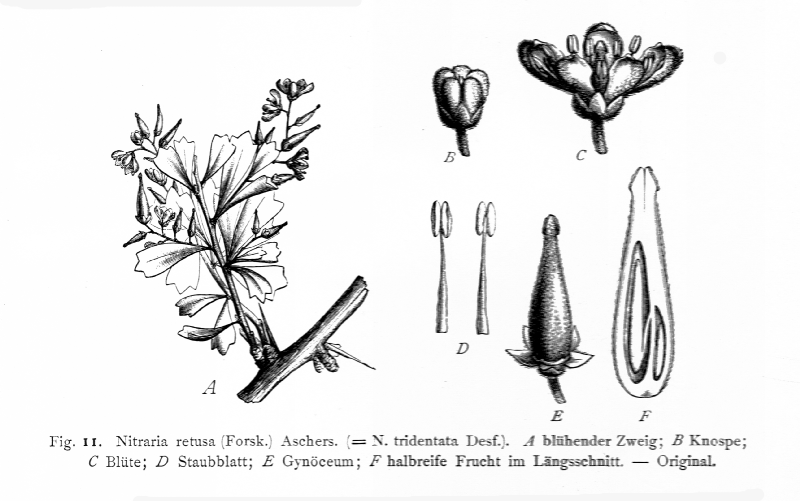
The salt tree has bluish-grey, fleshy, alternate leaves that are wedge-shaped or sickle-shaped, with entire margins. Its flowers are whitish or greenish, sweet-scented, and have short pedicels and floral parts arranged in fives.[1][2][3]
Its fruit is a triangular drupe that turns red when ripe. The fruits measure 5–10 mm in diameter, while the leaves measure 10–15 mm long and 8–10 mm wide.[4][5][6][7]
The shrub can reach approximately 2.5 metres in height but rarely exceeds one metre.[8][9]
Habitat
The salt tree grows in salt marshes and semi-arid saline areas of deserts. It also grows on barren sand dunes during primary succession and tolerates a range of soil salinity levels and water availability.[10][11][12][13]
In the Moghra Oasis, it grows near the lake alongside sea rush, common reed, salt grass and Zygophyllum album. At the outer fringe of the vegetated zone, it grows alongside Zygophyllum album and Nile tamarisk.[14][15]
The salt tree is native to North Africa, East Africa, the Arabian Peninsula and the Middle East.[16]
Diet
Camels and goats feed on its succulent leaves. Wildlife consume its fruits.[17][18]
Behaviour
The salt tree contributes to sand dune stabilisation in the Moghra Oasis. In some zones of the oasis, it is the dominant plant and forms hummocks called nabkhas.[19][20]
Reproduction and life cycle
Wildlife help disperse the salt tree's seeds by eating its fruits.[21]
Uses
Humans consume the ripe red fruits. Desert-dwellers have used the plant as a source of salt, and its wood is used as fuel.[22][23][24]
Its fruits are sometimes used to prepare an intoxicating drink. The species is being investigated as a potential livestock fodder crop.[25][26]
Fresh leaves are used in North African traditional medicine to prepare decoctions for gastrointestinal disorders.[27]
Classification of the Salt Tree
| Kingdom | Plantae |
|---|---|
| Subkingdom | Pteridobiotina |
| Phylum | Tracheophyta |
| Class | Magnoliopsida |
| Order | Sapindales |
| Family | Nitrariaceae (Nitre Bush Family) |
| Subfamily | Nitrarioideae |
| Genus | Nitraria (Nitre Bushes) |
| Species | Nitraria retusa (Forssk.) Asch. |
Where the Salt Tree is found
Checklists and occurrence records place Nitraria retusa in 18 countries across Africa and Asia. GBIF holds 1,530 georeferenced records of it.
Countries
- Algeria 48
- Egypt 167
- Iraq 12
- Israel 884
- Jordan 62
- Kuwait 47
- Libya 17
- Mali 5
- Mauritania 113
- Morocco 58
- Palestinian Territory 31
- Saudi Arabia 18
- Senegal 13
- Somalia 3
- Sudan 1
- Syria 2
- Tunisia 42
- Western Sahara 7
Regions and cities with the most records
- Southern District, Israel 699
- Eilat, Israel 131
- Aqaba, Jordan 129
- West Bank, Palestinian Territory 122
- Jericho, Palestinian Territory 113
- Safi, Jordan 86
- Trarza, Mauritania 54
- Ma‘ale Adummim, Palestinian Territory 46
- Al Jahrā’, Kuwait 34
- Al ‘Ayzarīyah, Palestinian Territory 26
- Ksar, Mauritania 21
- Tevragh Zeina, Mauritania 21
- Dar Naim, Mauritania 20
- Nouakchott, Mauritania 20
- Arad, Israel 19
- Aqaba, Jordan 18
- Dimona, Israel 18
- Dakhlet Nouadhibou, Mauritania 12
- Inchiri, Mauritania 10
- Tabuk Region, Saudi Arabia 9
- Madaba, Jordan 8
- Medenine Governorate, Tunisia 7
- Balqa, Jordan 5
- Gabès Governorate, Tunisia 5
- Hurghada, Egypt 5
- Saint-Louis, Senegal 5
- Teboulbou, Tunisia 5
- Ajim, Tunisia 4
- El Mgarsa, Tunisia 4
- Kebili Governorate, Tunisia 4
- Midoun, Tunisia 4
- Bethlehem, Palestinian Territory 3
- Chenini Nahal, Tunisia 3
- Gabès, Tunisia 3
- Guelmim, Morocco 3
- Houmt Souk, Tunisia 3
1 more country has a few records outside this range
These countries hold a few records of Nitraria retusa but lie outside the range the checklists give for it. Such records are often zoo or garden specimens, museum material or vagrants, so the species is not counted as occurring there.
Range as the checklists state it
Morocco; S-Algeria; Tunisia; Libya; Egypt (Desert Oases, Eastern Desert, Great Southwestern Desert, Nile Delta, Nile Valley, NW-coastal Egypt, SE-Egypt); Mauritania; Sudan; Iraq (NW-Iraq, SE-Iraq: Mesopotamia, S-Iraq, W-Iraq: Desert); Syria (Jazira); Israel (Rift Valley, Negev Desert); Sinai peninsula (C-Sinai, N-Sinai, S-Sinai); Jordania (S-Jordania, W-Jordania, E-Jordania); Saudi Arabia (C-Saudi Arabia, NE-Saudi Arabia, N-Saudi Arabia, Hejaz, Midyan, Asir, Nejd Desert); Kuwait
A number beside a place is its count of GBIF occurrence records. A place without a number comes from a checklist alone. Records show where a species has been observed or collected, which can include escapes and vagrants.
Common names
English
- Salt Tree
Names in 4 other languages
- Arabic
- دقرغ, غرقد الكليل, غرقد كليل, قدرغ
- Chinese
- 地中海白刺
- Hebrew
- ימלוח פגום
- Russian
- Селитрянка притуплённая
Synonyms
7 other scientific names have been used for this species and are now treated as synonyms of Nitraria retusa.
- Berberis africana Hebenstr. & Ludw. ex Schult. & Schult.f.
- Nitraria retusa subsp. tridentata (Desf.) A.Chev.
- Nitraria schoberi var. faurei Maire
- Nitraria senegalensis Poir.
- Nitraria sericea Jaub. & Spach
- Nitraria tridentata Desf.
- Peganum retusum Forssk.
Related species
-
 Nitre BushNitraria billardierei
- Nitraria sibirica
- Nitraria schoberi
- Nitraria sphaerocarpa
- Nitraria roborowskii
- Nitraria iliensis
- Nitraria komarovii
- Nitraria pamirica
Compare
Questions and answers
What is the scientific name of the Salt Tree?
The scientific name of the Salt Tree is Nitraria retusa. Written with its author, the full name is Nitraria retusa (Forssk.) Asch..
Which family does the Salt Tree belong to?
Nitraria retusa belongs to the family Nitrariaceae, in the order Sapindales and the class Magnoliopsida.
Where is the Salt Tree found?
Checklists and occurrence records place Nitraria retusa in 18 countries, including Israel, Egypt, Mauritania, Jordan, Morocco and Algeria.
Sources
Passages the profile rests on
- Its leaves are bluish-grey, fleshy, alternate, wedge-shaped or sickle-shaped, and have entire margins. Source passage: “with the bluish-grey fleshy leaves being alternate, wedge or sickle-shaped, with entire margins” — English Wikipedia
- Its flowers are whitish or greenish and have a sweet scent. Source passage: “The small, sweetly-scented, whitish or greenish flowers” — English Wikipedia
- Its flowers have short pedicels and floral parts arranged in fives. Source passage: “have short pedicels and parts in fives.” — English Wikipedia
- Its fruit is a triangular drupe. Source passage: “The fruit is a triangular drupe” — English Wikipedia
- Its fruits turn red when ripe. Source passage: “The fruit turns red as it ripens” — English Wikipedia
- Its leaves measure 10–15 mm long and 8–10 mm wide. Source passage: “measuring 10 to 15 mm (0.4 to 0.6 in) by 8 to 10 mm (0.3 to 0.4 in).” — English Wikipedia
- Its fruits measure 5–10 mm in diameter. Source passage: “5 to 10 mm (0.2 to 0.4 in) in diameter.” — English Wikipedia
- The shrub can reach approximately 2.5 metres in height. Source passage: “Nitraria retusa is a bush growing to a maximum height of about 2.5 m (8 ft).” — English Wikipedia
- The shrub rarely exceeds one metre in height. Source passage: “although it rarely exceeds more than 1 m in height.” — English Wikipedia
- The species grows in salt marshes. Source passage: “It typically grows in salt marshes” — English Wikipedia
- It inhabits semi-arid saline areas of deserts. Source passage: “semi-arid saline areas of deserts” — English Wikipedia
- It grows on barren sand dunes during primary succession. Source passage: “It grows in primary succession on barren sand dunes.” — English Wikipedia
- The species tolerates a range of soil salinity levels and water availability. Source passage: “It shows a range of tolerances toward soil salinity and the availability of water.” — English Wikipedia
- In the Moghra Oasis, it grows near the lake alongside sea rush, common reed, salt grass and Zygophyllum album. Source passage: “Near the lake, where salinity is low and the water table high, it associates with the sea rush, the common reed, salt grass and Zygophyllum album.” — English Wikipedia
- At the outer fringe of the vegetated zone in the Moghra Oasis, it grows alongside Zygophyllum album and Nile tamarisk. Source passage: “it grows with Z. album and the Nile tamarisk.” — English Wikipedia
- The species is native to North Africa, East Africa, the Arabian Peninsula and the Middle East. Source passage: “This plant is native to North and East Africa, the Arabian Peninsula and the Middle East.” — English Wikipedia
- Camels and goats feed on its succulent leaves. Source passage: “Camels and goats feed on the succulent leaves of this plant” — English Wikipedia
- Wildlife consume its fruits. Source passage: “Wildlife eat the fruit” — English Wikipedia
- The species contributes to sand dune stabilisation in the Moghra Oasis. Source passage: “In the Moghra Oasis, N. retusa plays an important role in the stabilisation of sand dunes.” — English Wikipedia
- In some zones of the Moghra Oasis, it is the dominant plant and forms hummocks called nabkhas. Source passage: “Here it is the dominant plant in some zones, forming hummocks known as nabkhas” — English Wikipedia
- Wildlife help disperse the species' seeds by eating its fruits. Source passage: “Wildlife eat the fruit and help spread the seeds.” — English Wikipedia
- Humans consume the ripe red fruits. Source passage: “The fruit turns red as it ripens and is enjoyed by humans.” — English Wikipedia
- Desert-dwellers have used the plant as a source of salt. Source passage: “desert-dwellers have used it as a source of salt.” — English Wikipedia
- The plant's wood is used as fuel. Source passage: “The wood is used for fuel” — English Wikipedia
- Its fruits are sometimes used to prepare an intoxicating drink. Source passage: “the fruits are sometimes used to make an intoxicating drink.” — English Wikipedia
- The species is being investigated as a potential livestock fodder crop. Source passage: “N. retusa is one of a number of salt-tolerant plants that are being investigated as potential fodder crops for livestock.” — English Wikipedia
- Fresh leaves are used in North African traditional medicine to prepare decoctions for gastrointestinal disorders. Source passage: “gastrointestinal disorders ranging from poisoning to discomfort in the abdomen are treated with a decoction made from fresh N. retusa leaves in North African medicine.” — pmc.ncbi.nlm.nih.gov
Data
- Catalogue of Life, 2026-10-16 XR cc by
- Global Biodiversity Information Facility CC BY 4.0
- Wikidata CC0
- GeoNames CC BY 4.0
- Wikimedia Commons per image; credit shown with each image
- Within the Catalogue of Life, this name comes from Synonymic Checklists of the Vascular Plants of the World cc by
References
- Asch. (1876). Verh. Bot. Vereins Prov. Brandenburg 18: 94 (1876). where the name was published
This species in other databases
- Catalogue of Life 47JVJ
- Wikidata Q2576228
- iNaturalist 199193
- World Flora Online wfo-0000381039
- GRIN 25344
Page built on 27 November 2026. See how the catalog is made and all sources and licences.
Cite this page
ScientificNames.org. (2026). Nitraria retusa (Salt Tree). Retrieved November 27, 2026, from https://scientificnames.org/species/nitraria-retusa
“Nitraria retusa (Salt Tree).” ScientificNames.org, 2026, scientificnames.org/species/nitraria-retusa. Accessed 27 Nov. 2026.
ScientificNames.org. “Nitraria retusa (Salt Tree).” Accessed November 27, 2026. https://scientificnames.org/species/nitraria-retusa.
@misc{scientificnames_nitraria_retusa_salt_tree,
  author = {{ScientificNames.org}},
  title = {Nitraria retusa (Salt Tree)},
  year = {2026},
  url = {https://scientificnames.org/species/nitraria-retusa},
  note = {Accessed 2026-11-27}
}