Species · Fishes
Golden Shiner Notemigonus crysoleucas
The scientific name of the Golden Shiner is Notemigonus crysoleucas. It is a species of fish in the family Cyprinidae (carps), order Cypriniformes. The name dates from 1814.
- Scientific name
- Notemigonus crysoleucas (Mitchill, 1814)
- Common name
- Golden Shiner
- Genus
- Notemigonus
- Family
- Cyprinidae (Carps)
- Order
- Cypriniformes
- Class
- Teleostei
- Red List category
- LC Least Concern
- Environment
- brackish, freshwater
- Recorded in
- 4 countries
- Name status
- accepted in the Catalogue of Life

Overview
Notemigonus crysoleucas is native to the Atlantic drainage basin from Nova Scotia to southern Texas, the Great Lakes basin, and the Mississippi River drainage basin from Alberta to Wyoming, Montana, and Oklahoma.
Written 26 November 2026 from the sources listed below. Each statement was checked against the passage it cites; statements that could not be supported were removed.
Appearance
The Golden Shiner has a thin, deep-bodied, laterally compressed body, a dark green or olive back, and a silvery or brassy white belly. Smaller individuals have silver sides, while larger individuals living in stained water can have golden sides.[1][2][3]
It has a small, upturned mouth and yellow-green eyes and median and pelvic fins. Spawning males can develop orange coloration in these fins and a deep golden coloration during the breeding season.[4][5][6]
The anal fin has 8–19 rays, and the dorsal fin has seven to nine rays. The lateral line has a pronounced downward curve, and the belly has a scaleless fleshy keel between the pelvic fins and the anal fin.[7][8][9]
Habitat
Golden Shiners inhabit vegetated lakes, ponds, swamps, and pools of creeks and small to medium-sized rivers. They are typically associated with slow-moving or stagnant water and also inhabit sloughs and ditches.[10][11][12]
Diet
Golden Shiners are omnivorous and feed primarily on plankton, including zooplankton, phytoplankton, and microcrustaceans. Odonata nymphs make up a minor component of their diet.[13][14][15]
Their diet also includes insects, plants, and algae. They can obtain plankton by sucking in individual food particles or small crustaceans.[16][17]
Behaviour
Golden Shiners are social fish that live in schools throughout their lives. Their schools reduce the likelihood of individual fish being captured by predators.[18][19]
They feed in the nearshore zone within one hour of sunset and move into open water as the sun sets. They can detect water movement through their lateral line and use visual cues to locate food and avoid predators.[20][21][22]
Reproduction and life cycle
Golden Shiners typically spawn between May and August. They form spawning aggregations and release their eggs over algae or aquatic plants, to which the eggs attach.[23][24][25]
Female Golden Shiners can produce up to 200,000 eggs and may spawn four to five times during one breeding season. They generally reach sexual maturity at one year of age, although some mature during their second year in cooler waters.[26][27][28]
The eggs hatch after an incubation period of four to seven days when the water temperature reaches 20 °C. Golden Shiners provide no parental care after laying eggs.[29][30][31]
Conservation
Golden Shiners are considered fairly common and are not currently protected by law. The species is classified as Least Concern on the IUCN Red List.[32][33]
Uses
They help maintain plankton levels below those associated with eutrophication.[34]
Classification of the Golden Shiner
| Kingdom | Animalia |
|---|---|
| Phylum | Chordata |
| Subphylum | Vertebrata |
| Infraphylum | Gnathostomata |
| Parvphylum | Osteichthyes |
| Gigaclass | Actinopterygii |
| Superclass | Actinopteri |
| Class | Teleostei (Teleost) |
| Order | Cypriniformes |
| Family | Cyprinidae (Carps) |
| Subfamily | Leuciscinae |
| Genus | Notemigonus (Golden Shiner) |
| Species | Notemigonus crysoleucas (Mitchill, 1814) |
Where the Golden Shiner is found
Checklists and occurrence records place Notemigonus crysoleucas in 4 countries. GBIF holds 40,853 georeferenced records of it.
Countries
Regions and cities with the most records
- Minnesota, United States 4,942
- Pennsylvania, United States 4,206
- Florida, United States 4,145
- Texas, United States 2,390
- New York, United States 2,229
- Oklahoma, United States 1,873
- New Jersey, United States 1,662
- Michigan, United States 1,638
- Illinois, United States 1,517
- Ontario, Canada 1,436
- North Carolina, United States 1,255
- Wisconsin, United States 1,198
- Georgia, United States 990
- Alabama, United States 953
- Ohio, United States 794
- Mississippi, United States 756
- Maryland, United States 617
- Louisiana, United States 525
- Scranton, United States 420
- South Carolina, United States 419
- Quebec, Canada 401
- Missouri, United States 378
- Arkansas, United States 370
- Saint Paul, United States 366
- Roseville, United States 351
- Massachusetts, United States 349
- Vermont, United States 343
- West Saint Paul, United States 342
- Longfellow Community, United States 335
- Back Mountain, United States 332
- Minneapolis, United States 320
- Shoreview, United States 311
- New Brighton, United States 308
- Columbia Heights, United States 303
- White Bear Lake, United States 298
- Savage, United States 296
1 more country has a few records outside this range
These countries hold a few records of Notemigonus crysoleucas but lie outside the range the checklists give for it. Such records are often zoo or garden specimens, museum material or vagrants, so the species is not counted as occurring there.
A number beside a place is its count of GBIF occurrence records. A place without a number comes from a checklist alone. Records show where a species has been observed or collected, which can include escapes and vagrants.
Common names
English
- Golden Shiner
Names in 7 other languages
- Czech
- jeleček zlatý
- Danish
- Guldløje
- Finnish
- Kultahohtaja
- French
- méné jaune
- German
- Goldbrassen
- Russian
- Золотистый Шайнер, Золотой нотемигонус
- Spanish
- Carpita dorada
Synonyms
17 other scientific names have been used for this species and are now treated as synonyms of Notemigonus crysoleucas.
- Abramis crysoleucas Mitchill, 1814
- Abramis versicolor DeKay, 1842
- Cyprinus crysoleucas Mitchill, 1814
- Cyprinus hemiplus Rafinesque, 1817
- Hemiplus lacustris Rafinesque, 1820
- Leuciscus boscii Valenciennes, 1844
- Leuciscus chrysopterus DeKay, 1842
- Leuciscus gardoneus Valenciennes, 1844
- Luxilus leptosomus Girard, 1856
- Luxilus seco Girard, 1856
- Notemigonus auratus Rafinesque, 1819
- Notemigonus crysoleucas boscii (Valenciennes, 1844)
- Notemigonus crysoleucas crysoleucas (Mitchill, 1814)
- Notemigonus ischanus Jordan, 1877
- Notropis chrysoleucas (Mitchill, 1814)
- Plagyrus americanus Cope, 1865
- Plargyrus americanus Cope, 1865
Related species
-
 GoldfishCarassius auratus
-
 Common CarpCyprinus carpio
- ZebrafishDanio rerio
-
 Grass CarpCtenopharyngodon idella
-
 Common RoachRutilus rutilus
-
 Silver CarpHypophthalmichthys molitrix
-
 Crucian CarpCarassius carassius
-
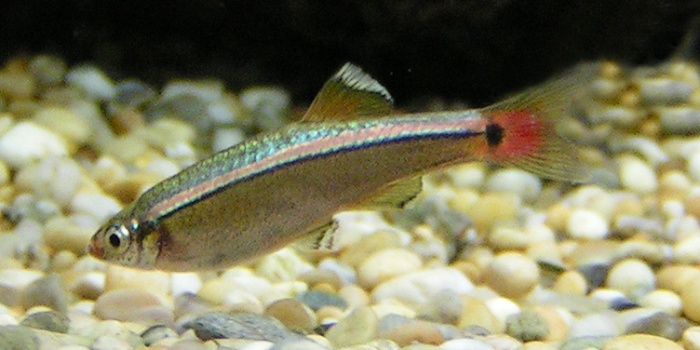 White Cloud Mountain MinnowTanichthys albonubes
Compare
Questions and answers
What is the scientific name of the Golden Shiner?
The scientific name of the Golden Shiner is Notemigonus crysoleucas. Written with its author, the full name is Notemigonus crysoleucas (Mitchill, 1814).
Which family does the Golden Shiner belong to?
Notemigonus crysoleucas belongs to the family Cyprinidae, in the order Cypriniformes and the class Teleostei.
Where is the Golden Shiner found?
Checklists and occurrence records place Notemigonus crysoleucas in 4 countries: United States, Canada, Belize and Mexico.
What is the conservation status of the Golden Shiner?
The IUCN Red List category recorded for Notemigonus crysoleucas is Least Concern (LC).
Are golden shiners rare?
Golden Shiners are considered fairly common and are classified as Least Concern on the IUCN Red List.[32][33]
How big do golden shiners get?
Wild mature Golden Shiners usually measure between 7 and 20 cm in total length. The maximum recorded total length is 36.7 cm, and females grow faster than males and attain larger body sizes.[35][36][37]
Where are golden shiners native to?
Their native distribution includes the Atlantic drainage basin from Nova Scotia to southern Texas, the Great Lakes basin, and the Mississippi River drainage basin from Alberta to Wyoming, Montana, and Oklahoma.[38][39][40]
Sources
Passages the profile rests on
- The golden shiner has a thin, deep-bodied shape and a laterally compressed body. Source passage: “The body is laterally compressed (deep-bodied).” — English Wikipedia
- The golden shiner has a dark green or olive back and a silvery or brassy white belly. Source passage: “The back is dark green or olive, and the belly is a silvery or brassy white.” — English Wikipedia
- The sides of smaller individuals are silver, while larger individuals living in stained water can have golden sides. Source passage: “The sides are silver in smaller individuals, and in clear or turbid water, but golden in larger ones living in stained water.” — English Wikipedia
- The golden shiner has a small, upturned mouth. Source passage: “The mouth is small and upturned.” — English Wikipedia
- Its eyes and median and pelvic fins are yellow-green, although spawning males can develop orange coloration in these fins. Source passage: “The eyes are yellow-green, as are the median and pelvic fins, though spawning males can develop orange coloration in these fins” — English Wikipedia
- Male golden shiners develop a deep golden coloration during the breeding season. Source passage: “During the breeding season, males turn a deep golden color.” — animaldiversity.org
- The anal fin has 8–19 rays, while the dorsal fin has seven to nine rays. Source passage: “The anal fin is large and has 8–19 rays, while the dorsal fin comprises seven to nine rays” — English Wikipedia
- The golden shiner has a pronounced downward curve in its lateral line. Source passage: “the lateral line has a pronounced downward curve, with its lowest point just above the pelvic fins” — English Wikipedia
- The golden shiner has a scaleless fleshy keel on its belly between the pelvic fins and the anal fin. Source passage: “there is a fleshy keel lacking scales on the belly between the pelvic fins and the base of the anal fin.” — English Wikipedia
- Golden shiners inhabit vegetated lakes, ponds, swamps, and pools of creeks and small to medium-sized rivers. Source passage: “including vegetated lakes, ponds, swamps and pools of creeks and small to medium rivers” — animaldiversity.org
- Golden shiners are typically associated with slow-moving or stagnant water. Source passage: “they are typically found in slow moving or stagnant waters” — animaldiversity.org
- Golden shiners prefer quiet aquatic environments, including lakes, ponds, sloughs, and ditches. Source passage: “Golden shiners prefer quiet waters and are therefore found in lakes, ponds, sloughs, and ditches.” — English Wikipedia
- Golden shiners are omnivorous and feed primarily on plankton. Source passage: “Golden shiners are omnivorous and crepuscular planktivores.” — animaldiversity.org
- Their diet includes zooplankton, phytoplankton, and microcrustaceans. Source passage: “Their diet mainly consists of zooplankton, phytoplankton, and microcrustaceans.” — animaldiversity.org
- Odonata nymphs constitute a minor component of the golden shiner's diet. Source passage: “Additionally, Odonata nymphs form a minor portion of their diet.” — animaldiversity.org
- Golden shiners also consume insects, plants, and algae. Source passage: “They eat zooplankton, phytoplankton, microcrustaceans, insects, plants, and algae.” — English Wikipedia
- Golden shiners can obtain plankton by sucking in individual food particles or small crustaceans. Source passage: “They eat by sucking in plankton or small crustaceans one at a time.” — biokids.umich.edu
- Golden shiners are social fish that live in schools throughout their lives. Source passage: “Golden shiners are social and are found in groups (schools) thougout life.” — animaldiversity.org
- Golden shiners form schools that reduce the likelihood of individual fish being captured by predators. Source passage: “Golden shiners form schools as a way to decrease their individual likelihood of being taken by the many larger fish species that prey on them.” — animaldiversity.org
- Golden shiners feed in the nearshore zone within one hour of sunset and move into open water as the sun sets. Source passage: “These fish feed in the nearshore zone within one hour of sunset. As the sun sets, schools break up and individuals move into open water.” — biokids.umich.edu
- Golden shiners can detect water movement through their lateral line. Source passage: “Golden shiners detect water movement through their lateral line” — animaldiversity.org
- Golden shiners can use visual cues to locate food and avoid predators. Source passage: “probably also rely on visual cues to find food and avoid predators.” — animaldiversity.org
- Golden shiners typically spawn between May and August. Source passage: “Golden shiners typically spawn from May through August.” — animaldiversity.org
- Golden shiners form spawning aggregations and release their eggs over algae or aquatic plants. Source passage: “Spawning aggregations form and spawning occurs over algae or aquatic plants.” — animaldiversity.org
- Golden shiner eggs attach to vegetation after being released. Source passage: “Once released, the eggs stick to vegetation.” — animaldiversity.org
- Female golden shiners can produce up to 200,000 eggs. Source passage: “maximum fecundity is 200,000.” — animaldiversity.org
- Golden shiners may spawn four to five times during one breeding season. Source passage: “may spawn 4 to 5 times per season” — animaldiversity.org
- Golden shiners generally reach sexual maturity at one year of age, although some mature during their second year in cooler waters. Source passage: “Sexual maturity generally occurs at 1 year, however some do not mature until the second year, especially in cooler waters” — animaldiversity.org
- Golden shiner eggs hatch after an incubation period of four to seven days. Source passage: “Eggs are incubated for a period of 4 to 7 days” — animaldiversity.org
- Golden shiner eggs hatch when the water temperature reaches 20 °C. Source passage: “Golden shiner eggs hatch when the water temperature reaches 20 degrees Celsius.” — biokids.umich.edu
- Golden shiners provide no parental care to their eggs or offspring after laying eggs. Source passage: “Golden shiners invest no parental care in their eggs or young after egg-laying.” — animaldiversity.org
- Golden shiners are considered fairly common and are not currently protected by law. Source passage: “Golden shiners are fairly common and are not currently protected by law.” — animaldiversity.org
- The golden shiner is classified as Least Concern on the IUCN Red List. Source passage: “IUCN Red List Least Concern” — biokids.umich.edu
- Golden shiners help maintain plankton levels below those associated with eutrophication. Source passage: “Golden shiners feed on zooplankton and phytoplankton, keeping plankton levels below eutrophication levels.” — animaldiversity.org
- Wild mature golden shiners usually measure between 7 and 20 cm in total length. Source passage: “in the wild mature golden shiners are usually between 7 and 20 cm (2.8 and 7.9 in) TL.” — English Wikipedia
- The maximum recorded total length of the golden shiner is 36.7 cm. Source passage: “it has been known to reach a total length (TL) of 36.7 cm (14.4 in)” — English Wikipedia
- Female golden shiners grow faster than males and attain larger body sizes. Source passage: “Females grow faster than males and reach larger sizes” — animaldiversity.org
- The native distribution of golden shiners includes the Atlantic drainage basin from Nova Scotia to southern Texas. Source passage: “Their native range includes the Atlantic drainage basin from Nova Scotia south to southern Texas” — animaldiversity.org
- The native range of golden shiners includes the Great Lakes basin. Source passage: “the Great Lakes basin” — animaldiversity.org
- The native range includes the Mississippi River drainage basin from Alberta to Wyoming, Montana, and Oklahoma. Source passage: “the Mississipi River drainage basin from Alberta Canada, to Wyoming, Montana and Oklahoma.” — animaldiversity.org
Data
- Catalogue of Life, 2026-10-16 XR cc by
- Global Biodiversity Information Facility CC BY 4.0
- Wikidata CC0
- GeoNames CC BY 4.0
- Wikimedia Commons per image; credit shown with each image
- Within the Catalogue of Life, this name comes from World Register of Marine Species cc by
This species in other databases
- Catalogue of Life 47SC8
- Wikidata Q968614
- iNaturalist 51351
- WoRMS urn:lsid:marinespecies.org:taxname:159989
- ITIS 163368
Page built on 27 November 2026. See how the catalog is made and all sources and licences.
Cite this page
ScientificNames.org. (2026). Notemigonus crysoleucas (Golden Shiner). Retrieved November 27, 2026, from https://scientificnames.org/species/notemigonus-crysoleucas
“Notemigonus crysoleucas (Golden Shiner).” ScientificNames.org, 2026, scientificnames.org/species/notemigonus-crysoleucas. Accessed 27 Nov. 2026.
ScientificNames.org. “Notemigonus crysoleucas (Golden Shiner).” Accessed November 27, 2026. https://scientificnames.org/species/notemigonus-crysoleucas.
@misc{scientificnames_notemigonus_crysoleucas_golden_shiner,
  author = {{ScientificNames.org}},
  title = {Notemigonus crysoleucas (Golden Shiner)},
  year = {2026},
  url = {https://scientificnames.org/species/notemigonus-crysoleucas},
  note = {Accessed 2026-11-27}
}