Species · Fishes
Spotted Killifish Nothobranchius orthonotus
The scientific name of the Spotted Killifish is Nothobranchius orthonotus. It is a species of fish in the family Nothobranchiidae (african rivulines), order Cyprinodontiformes. The name dates from 1844.
- Scientific name
- Nothobranchius orthonotus (Peters, 1844)
- Common name
- Spotted Killifish
- Genus
- Nothobranchius
- Family
- Nothobranchiidae (African Rivulines)
- Order
- Cyprinodontiformes
- Class
- Teleostei
- Red List category
- LC Least Concern
- Environment
- freshwater
- Recorded in
- 5 countries
- Name status
- accepted in the Catalogue of Life

Overview
Nothobranchius orthonotus inhabits temporary freshwater environments, including isolated pools in savannah depressions. It is adapted to annual habitat drying, and its eggs can survive prolonged periods without water.
Written 27 November 2026 from the sources listed below. Each statement was checked against the passage it cites; statements that could not be supported were removed.
Appearance
Adult males have bright coloration, whereas females have dull coloration. Adults can reach a maximum length of 10 centimetres.[1][2]
Habitat
The species inhabits isolated freshwater pools in savannah depressions and other temporary freshwater environments. Its habitats range from shallow, unvegetated pools with cloudy water to deeper, densely vegetated pools with clear water.[3][4][5][6]
It may also inhabit swamps that are intermittently connected to floodplains.[7]
Diet
The species consumes aquatic invertebrates and vertebrates. Juvenile lungfish and larval amphibians constitute major components of its diet.[8][9]
It also consumes insect larvae belonging to Odonata, Coleoptera and Ephemeroptera.[10]
Behaviour
The species is adapted to habitats that undergo annual drying.[11]
Reproduction and life cycle
Individuals hatch at the beginning of each rainy season and grow rapidly after hatching. They reach sexual maturity within a few weeks of hatching.[12][13][14]
Females can lay up to 50 eggs per day. Eggs are deposited in a layer of rock or soil beneath the ground surface.[15][16]
Embryos can remain in developmental suspension during dry conditions until the next wet season. The eggs can survive prolonged periods without water.[17][18]
Conservation
Populations are threatened by anti-malarial and tsetse fly spraying programmes. Insecticides are identified as a local threat, although the species is considered at relatively lower risk despite localized threats.[19][20][21]
Similar species
The species shares its natural pools with Nothobranchius furzeri, Nothobranchius kadleci and Nothobranchius rachovii.[22]
Classification of the Spotted Killifish
| Kingdom | Animalia |
|---|---|
| Phylum | Chordata |
| Subphylum | Vertebrata |
| Infraphylum | Gnathostomata |
| Parvphylum | Osteichthyes |
| Gigaclass | Actinopterygii |
| Superclass | Actinopteri |
| Class | Teleostei (Teleost) |
| Order | Cyprinodontiformes |
| Family | Nothobranchiidae (African Rivulines) |
| Genus | Nothobranchius (Nothobranchs) |
| Species | Nothobranchius orthonotus (Peters, 1844) |
Where the Spotted Killifish is found
Checklists and occurrence records place Nothobranchius orthonotus in 5 countries. GBIF holds 184 georeferenced records of it.
Countries
Regions and cities with the most records
- KwaZulu-Natal, South Africa 44
- Sofala, Mozambique 28
- Gaza Province, Mozambique 20
- Zambezia Province, Mozambique 10
- Beira, Mozambique 9
- Inhambane Province, Mozambique 4
- Limpopo, South Africa 4
- Dondo, Mozambique 3
- Mpumalanga, South Africa 3
- Nhamatanda, Mozambique 3
A number beside a place is its count of GBIF occurrence records. A place without a number comes from a checklist alone. Records show where a species has been observed or collected, which can include escapes and vagrants.
Common names
English
- Spotted Killifish
Names in 2 other languages
- Afrikaans
- Spikkelkuilvissie
- Russian
- Красный нотобранх
Synonyms
13 other scientific names have been used for this species and are now treated as synonyms of Nothobranchius orthonotus.
- Adinias troemneri Myers, 1926
- Adiniops kuhntae (Ahl, 1926)
- Adiniops troemneri Myers, 1926
- Cyprinodon orthonotus Peters, 1844
- Fundulus kuhntae Ahl, 1926
- Fundulus orthonotus (Peters, 1844)
- Hydrargyra maculata Peters, 1855
- Nothobranchius kuhntae (Ahl, 1926)
- Nothobranchius maculatus (Peters, 1855)
- Nothobranchius mayeri Ahl, 1935
- Nothobranchius troemneri (Myers, 1926)
- Notobranchius mayeri Ahl, 1935
- Notobranchius orthonotus (Peters, 1844)
Related species
-
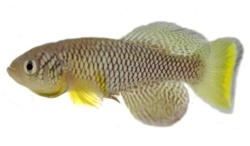 Turquoise KillifishNothobranchius furzeri
-
 Bluefin NothoNothobranchius rachovii
-
 Redtail NothoNothobranchius guentheri
-
 Egger's KillifishNothobranchius eggersi
-
 Nothobranchius foerschi
- Nothobranchius attenboroughi
-
 Nothobranchius flammicomantis
-
 Nothobranchius polli
Compare
Questions and answers
What is the scientific name of the Spotted Killifish?
The scientific name of the Spotted Killifish is Nothobranchius orthonotus. Written with its author, the full name is Nothobranchius orthonotus (Peters, 1844).
Which family does the Spotted Killifish belong to?
Nothobranchius orthonotus belongs to the family Nothobranchiidae, in the order Cyprinodontiformes and the class Teleostei.
Where is the Spotted Killifish found?
Checklists and occurrence records place Nothobranchius orthonotus in 5 countries: Mozambique, South Africa, Malawi, Tanzania and Zimbabwe.
What is the conservation status of the Spotted Killifish?
The IUCN Red List category recorded for Nothobranchius orthonotus is Least Concern (LC).
Sources
Passages the profile rests on
- Adult males have bright coloration, whereas females have dull coloration. Source passage: “Fish with the genus Nothobranchius show a striking level of sexual dichomatism, where the males portray bright colors, and the females are dull.” — English Wikipedia
- Adults can reach a maximum length of 10 centimetres. Source passage: “The adult spotted killifish is one of the largest of its genus, and can grow up to 10 centimetres (3.9 in) in length.” — English Wikipedia
- The species inhabits isolated freshwater pools in savannah depressions. Source passage: “These fish are native to many isolated freshwater pools located in the savannah depressions of east Africa” — English Wikipedia
- The species occurs in temporary freshwater environments. Source passage: “This species of fish occurs in ephemeral waters” — English Wikipedia
- Its habitats range from shallow, unvegetated pools with cloudy water to deeper, densely vegetated pools with clear water. Source passage: “The natural environments inhabited can range from non-vegetated and shallow with cloudy water, all the way to densely overgrown pools, that are fairly deep and have clear water.” — English Wikipedia
- Temporary pools are identified as its habitat. Source passage: “habitat is temporary pools.” — inaturalist.org
- The species may also inhabit swamps that are intermittently connected to floodplains. Source passage: “This species may also be present in swamps intermittently connected to floodplains.” — English Wikipedia
- The species consumes aquatic invertebrates and vertebrates. Source passage: “The spotted killifish consumes both aquatic invertebrates and vertebrates” — English Wikipedia
- Juvenile lungfish and larval amphibians constitute major components of its diet. Source passage: “its diet consists mainly of juvenile lungfish (Protopterus annectens) and larval amphibia.” — English Wikipedia
- The species also consumes insect larvae belonging to Odonata, Coleoptera and Ephemeroptera. Source passage: “this species also consumes a relatively high proportion of insect larvae from the orders Odonata, Coleoptera and Ephemeroptera.” — English Wikipedia
- The species is adapted to habitats that undergo annual drying. Source passage: “The spotted killifish, typically of the genus Nothobranchius, are adapted to annual desiccation of their habitat.” — English Wikipedia
- Individuals hatch at the beginning of each rainy season. Source passage: “The fishes hatch at the start of each rainy season” — English Wikipedia
- Individuals grow rapidly after hatching. Source passage: “and continue to grow very quickly.” — English Wikipedia
- Individuals reach sexual maturity within a few weeks of hatching. Source passage: “Within a matter of a few weeks, these fish reach sexual maturity” — English Wikipedia
- Females can lay up to 50 eggs per day. Source passage: “with females laying up to 50 eggs each day.” — English Wikipedia
- Eggs are deposited in a layer of rock or soil beneath the ground surface. Source passage: “the eggs are spawned into a layer of rock or soil beneath the surface of the ground” — English Wikipedia
- Embryos can remain in developmental suspension during dry conditions until the next wet season. Source passage: “the embryos are able to exist in developmental suspension until the starts of the next wet season.” — English Wikipedia
- The eggs can survive prolonged periods without water. Source passage: “killifish eggs can survive long periods of dehydration.” — English Wikipedia
- Populations are threatened by anti-malarial and tsetse fly spraying programmes. Source passage: “due to recent anti-malarial and tsetse fly spraying programs, the populations of spotted killifish are becoming threatened.” — English Wikipedia
- The species is considered at relatively lower risk despite localized threats. Source passage: “Though this species is threatened, it is at lower risk, and not yet in need of acts of conservation given that the threats are localized.” — English Wikipedia
- Insecticides are identified as a local threat to the species. Source passage: “It is locally threatened by insecticides and ...” — inaturalist.org
- The species shares its natural pools with Nothobranchius furzeri, Nothobranchius kadleci and Nothobranchius rachovii. Source passage: “This species was found to share these pools with N. furzeri, N. kadleci and N.rachovii, all congeners.” — English Wikipedia
Data
- Catalogue of Life, 2026-10-16 XR cc by
- Global Biodiversity Information Facility CC BY 4.0
- Wikidata CC0
- GeoNames CC BY 4.0
- Wikimedia Commons per image; credit shown with each image
- Within the Catalogue of Life, this name comes from World Register of Marine Species cc by
This species in other databases
- Catalogue of Life 47SND
- Wikidata Q2249572
- iNaturalist 107138
- WoRMS urn:lsid:marinespecies.org:taxname:1015406
- ITIS 647447
Page built on 28 November 2026. See how the catalog is made and all sources and licences.
Cite this page
ScientificNames.org. (2026). Nothobranchius orthonotus (Spotted Killifish). Retrieved November 28, 2026, from https://scientificnames.org/species/nothobranchius-orthonotus
“Nothobranchius orthonotus (Spotted Killifish).” ScientificNames.org, 2026, scientificnames.org/species/nothobranchius-orthonotus. Accessed 28 Nov. 2026.
ScientificNames.org. “Nothobranchius orthonotus (Spotted Killifish).” Accessed November 28, 2026. https://scientificnames.org/species/nothobranchius-orthonotus.
@misc{scientificnames_nothobranchius_orthonotus_spotted_killifish,
  author = {{ScientificNames.org}},
  title = {Nothobranchius orthonotus (Spotted Killifish)},
  year = {2026},
  url = {https://scientificnames.org/species/nothobranchius-orthonotus},
  note = {Accessed 2026-11-28}
}