Species · Fishes
Bluefin Notho Nothobranchius rachovii
The scientific name of the Bluefin Notho is Nothobranchius rachovii. It is a species of fish in the family Nothobranchiidae (african rivulines), order Cyprinodontiformes. The name dates from 1926.
- Scientific name
- Nothobranchius rachovii Ahl, 1926
- Common name
- Bluefin Notho
- Genus
- Nothobranchius
- Family
- Nothobranchiidae (African Rivulines)
- Order
- Cyprinodontiformes
- Class
- Teleostei
- Red List category
- LC Least Concern
- Environment
- freshwater
- Recorded in
- 1 country
- Name status
- accepted in the Catalogue of Life

Overview
Nothobranchius rachovii sensu stricto occurs in the floodplains of the lower Zambezi River and the Pungwe River. The species exhibits sexual dimorphism and has orange and blue, red and turquoise, and dark-colored variants.
Written 26 November 2026 from the sources listed below. Each statement was checked against the passage it cites; statements that could not be supported were removed.
Appearance
The typical color variant has orange and blue coloration. The Red variant has a red head with turquoise highlights.[1][2]
A dark-colored variant known as Nothobranchius rachovii KNP Black was collected in Kruger National Park, South Africa, in 1984.[3]
The species exhibits sexual dimorphism. Females of all varieties have more neutral coloration than males.[4][5]
The species can reach a maximum length of 6 cm.[6]
Habitat
The species naturally inhabits flat plains and water depressions that dry up annually. It inhabits temporary pools that depend on rainfall.[7][8]
Nothobranchius rachovii sensu stricto occurs in the floodplain of the lower Zambezi River and the floodplain of the Pungwe River.[9][10]
Diet
The species feeds on zooplankton and small organisms living on the bottom of the water.[11][12]
Behaviour
The species tends to remain near the bottom of the water, just above the benthic zone.[13]
Males are aggressive toward other males of the same species.[14]
Reproduction and life cycle
The species reproduces by burying its eggs in the river or lake bed before its habitat dries out. It deposits its eggs in mud as water levels decline.[15][16]
The eggs remain preserved in mud until water returns. They develop while buried and hatch when rainfall refills the pools.[17][18]
Uses
The species is commonly traded in the pet trade. It is popular among killifish enthusiasts who raise it from eggs in aquaria.[19][20]
Classification of the Bluefin Notho
| Kingdom | Animalia |
|---|---|
| Phylum | Chordata |
| Subphylum | Vertebrata |
| Infraphylum | Gnathostomata |
| Parvphylum | Osteichthyes |
| Gigaclass | Actinopterygii |
| Superclass | Actinopteri |
| Class | Teleostei (Teleost) |
| Order | Cyprinodontiformes |
| Family | Nothobranchiidae (African Rivulines) |
| Genus | Nothobranchius (Nothobranchs) |
| Species | Nothobranchius rachovii Ahl, 1926 |
Where the Bluefin Notho is found
Checklists and occurrence records place Nothobranchius rachovii in 1 country. GBIF holds 30 georeferenced records of it.
Countries
Regions and cities with the most records
A number beside a place is its count of GBIF occurrence records. A place without a number comes from a checklist alone. Records show where a species has been observed or collected, which can include escapes and vagrants.
Common names
English
- Bluefin Notho
- Blueband Killifish
- Common Rainbow Killifish
- Rachov's Nothobranchius
- Rachow's Notho
- Rachow's Nothobranch
- Rainbow Kilifish
- Rainbow Notho
- Rainbow Killifish
Names in 10 other languages
- Afrikaans
- Blouband-kuilvissie, Gewone Reënboogkuilvissie, Reënboog-kuilvissie
- Czech
- halančík Rachovův
- Danish
- Rachows killi
- Finnish
- Loistoviuhkapyrstö
- German
- Rachovs Prachtfundulus
- Mandarin Chinese
- 拉氏假鰓鮰, 拉氏假鳃鮰
- Polish
- Suszec rachowa a. zagrzebka afrykanska, zagrzebka Rachowa
- Russian
- Нотобранх Рахова
- Swedish
- Rachows Praktkilli, Rachows notho, blåfenad notho
- Thai
- ปลาคิลลี่ฟิชราโชวี่อาย
Synonyms
4 other scientific names have been used for this species and are now treated as synonyms of Nothobranchius rachovii.
- Adiniops rachovi (Ahl, 1926)
- Nothobranchius rachovi Ahl, 1926
- Nothobranchius rachowi Ahl, 1926
- Notobranchius rachovii Ahl, 1926
Related species
-
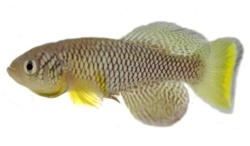 Turquoise KillifishNothobranchius furzeri
-
 Redtail NothoNothobranchius guentheri
-
 Spotted KillifishNothobranchius orthonotus
-
 Egger's KillifishNothobranchius eggersi
-
 Nothobranchius foerschi
- Nothobranchius attenboroughi
-
 Nothobranchius flammicomantis
-
 Nothobranchius polli
Compare
Questions and answers
What is the scientific name of the Bluefin Notho?
The scientific name of the Bluefin Notho is Nothobranchius rachovii. Written with its author, the full name is Nothobranchius rachovii Ahl, 1926.
Which family does the Bluefin Notho belong to?
Nothobranchius rachovii belongs to the family Nothobranchiidae, in the order Cyprinodontiformes and the class Teleostei.
Where is the Bluefin Notho found?
Checklists and occurrence records place Nothobranchius rachovii in 1 country: Mozambique.
What is the conservation status of the Bluefin Notho?
The IUCN Red List category recorded for Nothobranchius rachovii is Least Concern (LC).
What other names does the Bluefin Notho have?
Nothobranchius rachovii is also known in English as Blueband Killifish, Common Rainbow Killifish, Rachov's Nothobranchius, Rachow's Notho, Rachow's Nothobranch and Rainbow Kilifish.
How big do Rachovii killifish get?
The bluefin notho can reach a maximum length of 6 cm.[6]
Are Rachovii killifish aggressive?
Males are aggressive toward other males of the same species.[14]
How do I care for a Nothobranchius rachovii killifish?
The species can be maintained in aquaria with capacities of 40–60 litres. It can be kept in community aquaria with similarly sized, peaceful freshwater tropical fish, thrives in heavily planted aquaria, and prefers soft water conditions.[21][22][23][24]
Sources
Passages the profile rests on
- The typical color variant has orange and blue coloration. Source passage: “Aside from the typical orange and blue variant,” — English Wikipedia
- The Red variant has a red head with turquoise highlights. Source passage: “Nothobranchius rachovii "Red", which has a red head with turquoise highlights.” — English Wikipedia
- A dark-colored variant known as Nothobranchius rachovii KNP Black was collected in Kruger National Park, South Africa, in 1984. Source passage: “there is Nothobranchius rachovii KNP Black. which has much darker colors, and was collected from the wild in Kruger National Park, South Africa, in 1984,” — English Wikipedia
- Females of all varieties have more neutral coloration than males. Source passage: “The females of all varieties are more neutrally colored.” — English Wikipedia
- The species exhibits sexual dimorphism. Source passage: “This shows sexual dimorphism among these fish.” — English Wikipedia
- The species can reach a maximum length of 6 cm. Source passage: “It can grow up to 6 cm (2.4").” — English Wikipedia
- The species naturally inhabits flat plains and water depressions that dry up annually. Source passage: “N. rachovii are naturally found in flat plains or water depressions that dry up annually.” — English Wikipedia
- The species inhabits temporary pools that depend on rainfall. Source passage: “they live in temporary pools dependent on rainfall.” — English Wikipedia
- Nothobranchius rachovii sensu stricto occurs in the floodplain of the lower Zambezi River. Source passage: “Nothobranchius rachovii sensu stricto is found in the floodplain of the lower Zambezi” — English Wikipedia
- Nothobranchius rachovii sensu stricto also occurs in the floodplain of the Pungwe River. Source passage: “and also in the floodplain of the Pungwe River.” — English Wikipedia
- The species feeds on zooplankton. Source passage: “feeding on zooplankton” — English Wikipedia
- The species consumes small organisms living on the bottom of the water. Source passage: “and other small organisms living at the bottom of the water (benthos).” — English Wikipedia
- The species tends to remain near the bottom of the water, just above the benthic zone. Source passage: “N. rachovii prefer to stay at the bottom of the water, right above the benthic zone.” — English Wikipedia
- Males are aggressive toward other males of the same species. Source passage: “Males are aggressive toward other males of the same species.” — English Wikipedia
- The species deposits its eggs in mud as water levels decline. Source passage: “They lay their eggs in mud as the water level decreases,” — English Wikipedia
- The species reproduces by burying its eggs in the river or lake bed before its habitat dries out. Source passage: “They are able to have offspring by burying their eggs in the river/ lake bed before their habitat dries up-” — English Wikipedia
- Eggs deposited in mud remain preserved until water returns. Source passage: “which preserves them until the water returns.” — English Wikipedia
- The eggs develop while buried in mud and hatch when rainfall refills the pools. Source passage: “These eggs develop while buried in the mud and then hatch once the pools are refilled with water from rainfall.” — English Wikipedia
- The species is commonly traded in the pet trade. Source passage: “N. rachovii are of commercial importance, being commonly found in the pet trade.” — English Wikipedia
- The species is popular among killifish enthusiasts who raise it from eggs in aquaria. Source passage: “It is popular among killifish enthusiasts, who raise them from eggs in aquaria.” — English Wikipedia
- The species can be maintained in aquaria with capacities of 40–60 litres. Source passage: “They can be housed in a 40–60 litre (10–15 gallons) aquarium.” — English Wikipedia
- The species can be kept in community aquaria with similarly sized, peaceful freshwater tropical fish. Source passage: “They can be kept in a community tank of similar-sized peaceful freshwater tropical fish,” — English Wikipedia
- The species thrives in heavily planted aquaria. Source passage: “They thrive in a heavily planted tank” — English Wikipedia
- The species prefers soft water conditions in aquaria. Source passage: “and prefer soft water conditions.” — English Wikipedia
- The species can live for up to one year or one and a half years. Source passage: “live for up to a year or year and a half,” — English Wikipedia
- Individuals die at the end of the breeding season. Source passage: “then die at the end of the breeding season” — English Wikipedia
Data
- Catalogue of Life, 2026-10-16 XR cc by
- Global Biodiversity Information Facility CC BY 4.0
- Wikidata CC0
- GeoNames CC BY 4.0
- Wikimedia Commons per image; credit shown with each image
- Within the Catalogue of Life, this name comes from World Register of Marine Species cc by
References
- Ahl, E. (1926). Einige neue Fische der Familie Cichlidae aus dem Nyassa-See. Sitzungsberichte Der Gesellschaft Naturforschender Freunde Zu Berlin 1926, 51–62. where the name was published
This species in other databases
- Catalogue of Life 47SNR
- Wikidata Q133330
- iNaturalist 107142
- WoRMS urn:lsid:marinespecies.org:taxname:1016248
- ITIS 646907
Page built on 29 November 2026. See how the catalog is made and all sources and licences.
Cite this page
ScientificNames.org. (2026). Nothobranchius rachovii (Bluefin Notho). Retrieved November 29, 2026, from https://scientificnames.org/species/nothobranchius-rachovii
“Nothobranchius rachovii (Bluefin Notho).” ScientificNames.org, 2026, scientificnames.org/species/nothobranchius-rachovii. Accessed 29 Nov. 2026.
ScientificNames.org. “Nothobranchius rachovii (Bluefin Notho).” Accessed November 29, 2026. https://scientificnames.org/species/nothobranchius-rachovii.
@misc{scientificnames_nothobranchius_rachovii_bluefin_notho,
  author = {{ScientificNames.org}},
  title = {Nothobranchius rachovii (Bluefin Notho)},
  year = {2026},
  url = {https://scientificnames.org/species/nothobranchius-rachovii},
  note = {Accessed 2026-11-29}
}