Species · Birds
Spotted Nothura Nothura maculosa
The scientific name of the Spotted Nothura is Nothura maculosa. It is a species of bird in the family Tinamidae (tinamou), order Tinamiformes. The name dates from 1815.
- Scientific name
- Nothura maculosa (Temminck, 1815)
- Common name
- Spotted Nothura
- Genus
- Nothura
- Family
- Tinamidae (Tinamou)
- Order
- Tinamiformes
- Class
- Aves
- Red List category
- LC Least Concern
- Recorded in
- 6 countries
- Name status
- accepted in the Catalogue of Life

Overview
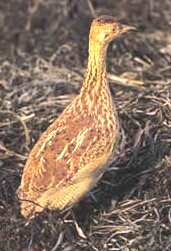
The Spotted Nothura is a small tinamou with a body length of approximately 24–25.5 cm. It inhabits dry savanna, temperate grasslands and pasturelands, and feeds and nests in open habitats. It has brown upperparts with buff streaking, buff underparts with dark streaks, a black crown with buff streaks, and a white throat.
Written 26 November 2026 from the sources listed below. Each statement was checked against the passage it cites; statements that could not be supported were removed.
Conservation
The Spotted Nothura is classified as Least Concern by the IUCN. Its occurrence range covers approximately 3,900,000 km².[1][2]
Appearance
The upperparts are brown with buff streaking. The underparts are buff, with black and brown streaks on the breast and bars on the flanks.[3][4]
The crown is black with buff streaks, and the throat is white. The legs are dull yellowish-grey or brown.[5][6]
Its overall coloration varies considerably across its geographic range, partly because of differences in local soil. It is described as a small, sandy-colored tinamou that is largely yellow.[7][8]
It has barring on both webs of the primary feathers, a feature it shares with the Chaco Nothura.[9]
Habitat
The Spotted Nothura inhabits dry savanna at elevations up to 2,300 m. It also occurs in temperate grasslands and pasturelands.[10][11]
It feeds and nests in a diverse range of open habitats.[12]
Diet
Its diet includes plants, particularly seeds, as well as animal matter. Individuals in Argentina appear to consume a greater proportion of animal matter than individuals elsewhere.[13][14]
Behaviour
Its vocalization consists of a series of brief, high-pitched notes.[15]
Reproduction and life cycle
Females reach reproductive maturity within two months and can produce five to six broods annually. Males mature more slowly than females.[16][17][18]
Males incubate the eggs and raise the chicks. Each clutch contains four to six eggs.[19][20]
The eggs have glossy, porcelain-like shells and are rich maroon or chocolate brown.[21][22]
Similar species
The Spotted Nothura shares barring on both webs of the primary feathers with the Chaco Nothura.[9]
Classification of the Spotted Nothura
| Kingdom | Animalia |
|---|---|
| Phylum | Chordata |
| Subphylum | Vertebrata |
| Infraphylum | Gnathostomata |
| Parvphylum | Osteichthyes |
| Megaclass | Tetrapoda |
| Class | Aves (Bird) |
| Order | Tinamiformes (Tinamou) |
| Family | Tinamidae (Tinamou) |
| Genus | Nothura (Nothuras) |
| Species | Nothura maculosa (Temminck, 1815) |
Where the Spotted Nothura is found
Checklists and occurrence records place Nothura maculosa in 6 countries across South America. GBIF holds 48,580 georeferenced records of it.
Countries
Regions and cities with the most records
- Buenos Aires, Argentina 8,174
- Cordoba, Argentina 5,288
- Entre Rios, Argentina 3,890
- Corrientes, Argentina 3,727
- Santa Fe, Argentina 3,547
- Rio Grande do Sul, Brazil 2,523
- Minas Gerais, Brazil 1,402
- Rocha Department, Uruguay 1,269
- La Pampa, Argentina 1,007
- São Paulo, Brazil 958
- Paraná, Brazil 843
- Salto Department, Uruguay 681
- Lavalleja, Uruguay 659
- Misiones, Argentina 653
- Cerro Largo, Uruguay 630
- San Luis, Argentina 623
- Esperanza, Argentina 600
- Paraná, Argentina 588
- Maldonado, Uruguay 574
- Goiás, Brazil 535
- Chaco, Argentina 520
- Mato Grosso do Sul, Brazil 514
- Paysandú Department, Uruguay 492
- Artigas, Uruguay 473
- Formosa, Argentina 439
- Itapúa, Paraguay 424
- Salta, Argentina 404
- Berisso, Argentina 402
- Santa Catarina, Brazil 401
- Flores Department, Uruguay 399
- Río Cuarto, Argentina 394
- Garupá, Argentina 390
- Ensenada, Argentina 378
- La Plata, Argentina 372
- Canelones, Uruguay 365
- Colonia, Uruguay 354
Range as the checklists state it
South America
A number beside a place is its count of GBIF occurrence records. A place without a number comes from a checklist alone. Records show where a species has been observed or collected, which can include escapes and vagrants.
Common names
English
- Spotted Nothura
Names in 29 other languages
- Arabic
- تنام منقط
- Catalan
- tinamú tacat
- Chinese
- 斑拟䳍, 斑擬(共鳥)
- Croatian
- pjegavokrili tinamu
- Czech
- tinama skvrnitá
- Danish
- Plettet Vagteltinamu
- Dutch
- Gevlekte Nothura
- Esperanto
- makula tinamo
- Estonian
- nurm-triiptinamu
- Finnish
- viirutinami
- French
- Tinamou tacheté
- German
- Fleckensteißhuhn, Fleckentinamu
- Hungarian
- foltos tinamu
- Icelandic
- Flekkutínamúi
- Italian
- Tinamo macchiato
- Japanese
- マダラシギダチョウ
- Lithuanian
- dėmėtoji notura
- Norwegian
- flekktinamu
- Polish
- kusacz kreskowany
- Portuguese
- Codorna-do-campo, Perdiz, codorna-amarela, tinamu-malhado
- Russian
- Пятнистая нотура, Пятнистый нотура
- Serbian
- Pegavi notura tinamu
- Slovak
- inambu čiarkový
- Spanish
- Inambú campestre, Inambú común, Perdiz chica, Tinamú manchado
- Swedish
- fläckig tinamo
- Turkish
- Benekli Notura Tinamusu
- Ukrainian
- нотура строкатий
- Welsh
- nothwra brych
- grn
- Ynambu'i
Synonyms
2 other scientific names have been used for this species and are now treated as synonyms of Nothura maculosa.
- Nothoprocta maculosa Temminck, CJ, 1815
- Tinamus maculosa Temminck, CJ, 1815
Subspecies and varieties
- Nothura maculosa annectens subspecies
- Nothura maculosa cearensis subspecies
- Nothura maculosa maculosa subspecies
- Nothura maculosa major subspecies
- Nothura maculosa nigroguttata subspecies
- Nothura maculosa pallida subspecies
- Nothura maculosa paludivaga subspecies
- Nothura maculosa submontana subspecies
Related species
-
 Lesser NothuraNothura minor
-
 White-bellied NothuraNothura boraquira
-
 Darwin's NothuraNothura darwinii
- Chaco NothuraNothura chacoensis
-
 Great TinamouTinamus major
-
 Elegant Crested TinamouEudromia elegans
-
 Little TinamouCrypturellus soui
-
 Dwarf TinamouTaoniscus nanus
Compare
Questions and answers
What is the scientific name of the Spotted Nothura?
The scientific name of the Spotted Nothura is Nothura maculosa. Written with its author, the full name is Nothura maculosa (Temminck, 1815).
Which family does the Spotted Nothura belong to?
Nothura maculosa belongs to the family Tinamidae, in the order Tinamiformes and the class Aves.
Where is the Spotted Nothura found?
Checklists and occurrence records place Nothura maculosa in 6 countries: Argentina, Brazil, Uruguay, Paraguay, Bolivia and Peru.
What is the conservation status of the Spotted Nothura?
The IUCN Red List category recorded for Nothura maculosa is Least Concern (LC).
Sources
Passages the profile rests on
- The species is classified as Least Concern by the IUCN. Source passage: “The IUCN list this tinamou as Least Concern” — English Wikipedia
- Its occurrence range covers approximately 3,900,000 km². Source passage: “It has an occurrence range of 3,900,000 km2 (1,500,000 sq mi).” — English Wikipedia
- The upperparts are brown with buff streaking. Source passage: “The upper parts are brown with streaked buff.” — English Wikipedia
- The underparts are buff, with black and brown streaks on the breast and bars on the flanks. Source passage: “The under parts are buff streaked with black and brown on the breast, with barring to the flanks.” — English Wikipedia
- Its crown is black with buff streaks, and its throat is white. Source passage: “Its crown is black streaked with buff and the throat is white.” — English Wikipedia
- Its legs are dull yellowish-grey or brown. Source passage: “The legs are dull yellowish-grey or brown.” — English Wikipedia
- Its overall coloration varies considerably across its geographic range, partly because of differences in local soil. Source passage: “The overall hue in colour varies greatly over its range; in part caused by the differences in soil at the specific localities.” — English Wikipedia
- It is described as a small, sandy-colored tinamou that is largely yellow. Source passage: “Small sandy-colored tinamou; largely yellow.” — ebird.org
- It has barring on both webs of the primary feathers, a feature it shares with the Chaco Nothura. Source passage: “It and the closely related Chaco nothura, N. chacoensis, are the only nothuras with barring to both webs of the primaries.” — English Wikipedia
- It inhabits dry savanna at elevations up to 2,300 m. Source passage: “It lives in dry savanna habitat up to 2,300 m (7,500 ft)” — English Wikipedia
- It occurs in temperate grasslands and pasturelands. Source passage: “and temperate grassland, as well as pasture land.” — English Wikipedia
- It feeds and nests in a diverse range of open habitats. Source passage: “This species is a generalist, feeding and nesting in a diverse range of open habitats” — datazone.birdlife.org
- Its diet includes plants, particularly seeds, as well as animal matter. Source passage: “The spotted nothura eats plants, typically seeds, and animal matter.” — English Wikipedia
- Individuals in Argentina appear to consume a greater proportion of animal matter than individuals elsewhere. Source passage: “In Argentina they seem to eat more of the animal matter then they do in other locations.” — English Wikipedia
- Its vocalization consists of a series of brief, high-pitched notes. Source passage: “The call of the spotted nothura is a series of brief high-pitched notes.” — English Wikipedia
- Females reach reproductive maturity within two months. Source passage: “the female is mature within 2 months” — English Wikipedia
- Females can produce five to six broods annually. Source passage: “can have five to six broods per year.” — English Wikipedia
- Males mature more slowly than females. Source passage: “The male does not mature as fast.” — English Wikipedia
- Males incubate the eggs and raise the chicks. Source passage: “The male will incubate the eggs and raise the chicks.” — English Wikipedia
- Its clutch contains four to six eggs. Source passage: “The clutch contains 4-6 eggs.” — English Wikipedia
- Its eggs have glossy, porcelain-like shells. Source passage: “Like most tinamous, its eggs have a spectacular glossy porcelain-like shell.” — English Wikipedia
- Its eggs are rich maroon or chocolate brown. Source passage: “This is colored a rich maroon or chocolate brown in this species.” — English Wikipedia
Data
- Catalogue of Life, 2026-10-16 XR cc by
- Global Biodiversity Information Facility CC BY 4.0
- Wikidata CC0
- GeoNames CC BY 4.0
- Wikimedia Commons per image; credit shown with each image
- Within the Catalogue of Life, this name comes from The Integrated Taxonomic Information System cc0
References
- Dickinson, Edward C., ed. (2003). The Howard and Moore Complete Checklist of the Birds of the World, 3rd Edition.
- Gill, Frank, & and Minturn Wright. (2006). Birds of the World: Recommended English Names.
This species in other databases
Page built on 28 November 2026. See how the catalog is made and all sources and licences.
Cite this page
ScientificNames.org. (2026). Nothura maculosa (Spotted Nothura). Retrieved November 28, 2026, from https://scientificnames.org/species/nothura-maculosa
“Nothura maculosa (Spotted Nothura).” ScientificNames.org, 2026, scientificnames.org/species/nothura-maculosa. Accessed 28 Nov. 2026.
ScientificNames.org. “Nothura maculosa (Spotted Nothura).” Accessed November 28, 2026. https://scientificnames.org/species/nothura-maculosa.
@misc{scientificnames_nothura_maculosa_spotted_nothura,
  author = {{ScientificNames.org}},
  title = {Nothura maculosa (Spotted Nothura)},
  year = {2026},
  url = {https://scientificnames.org/species/nothura-maculosa},
  note = {Accessed 2026-11-28}
}