Species · Birds
Great Tinamou Tinamus major
The scientific name of the Great Tinamou is Tinamus major. It is a species of bird in the family Tinamidae (tinamou), order Tinamiformes. The name dates from 1789.
- Scientific name
- Tinamus major (J. F. Gmelin, 1789)
- Common name
- Great Tinamou
- Genus
- Tinamus
- Family
- Tinamidae (Tinamou)
- Order
- Tinamiformes
- Class
- Aves
- Red List category
- LC Least Concern
- Environment
- terrestrial
- Recorded in
- 16 countries
- Name status
- accepted in the Catalogue of Life

Overview
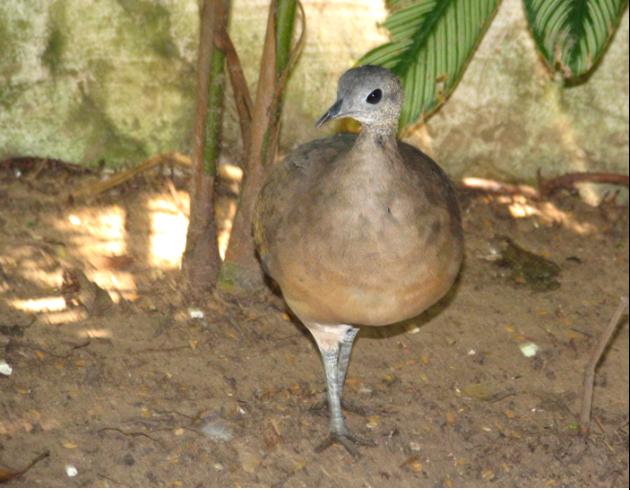
The Great Tinamou is a bird belonging to the genus Tinamus, which includes four other species. It inhabits subtropical and tropical forests in Central and South America, including forests at elevations of approximately 300–1,500 m. It has olive-green plumage, a large almost tailless body, and blue-grey legs.
Written 26 November 2026 from the sources listed below. Each statement was checked against the passage it cites; statements that could not be supported were removed.
Appearance
The Great Tinamou has olive-green plumage ranging from light to dark shades, a whitish throat and belly, black-barred flanks, and a cinnamon undertail. Its crown and neck are rufous, while its occipital crest and supercilium are blackish.[1][2]
The Great Tinamou has blue-grey legs and a large, almost tailless body. It measures approximately 38–46 cm in total length, with a mean length of 44 cm.[3][4][5]
Male Great Tinamous weigh between 700 and 1,142 g, with a mean weight of 960 g. Females weigh between 945 and 1,249 g, with a mean weight of 1,097 g.[6][7]
Habitat
The Great Tinamou inhabits subtropical and tropical forests, including rainforests, lowland evergreen forests, river-edge forests, swamp forests, and cloud forests. It occurs in forests at elevations of approximately 300–1,500 m.[8][9]
The Great Tinamou lives on the ground in humid tropical lowlands. Its nest can be located at the base of a tree.[10][11]
Diet
The Great Tinamou feeds on seeds, fruit, insects, spiders, frogs, and small lizards found in leaf litter. It shows a particular preference for plants in the families Lauraceae, Annonaceae, Myrtaceae, and Sapotaceae.[12][13]
Behaviour
The Great Tinamou is generally solitary outside the mating period and moves alone through the forest understory. It produces a distinctive call consisting of three short, tremulous, powerful piping notes, which can be heard in its rainforest habitat during the early evening.[14][15][16]
The Great Tinamou is less affected by forest fragmentation than some other tinamou species. It is hunted, with no major effect on its population reported.[17][18]
Reproduction and life cycle
The Great Tinamou has a polygynandrous mating system. A female may establish nests with five or six males during one breeding season, which extends from mid-winter to late summer.[19][20][21]
A female Great Tinamou lays an average of four eggs after mating with a male. The eggs are large, shiny, and bright blue or violet.[22][23]
Male Great Tinamous provide exclusive parental care and incubate the eggs until they hatch. Each male cares for the chicks for approximately three weeks after hatching.[24][25][26]
Great Tinamou nests are usually rudimentary scrapes among the buttress roots of trees.[27]
Conservation
The Great Tinamou is classified as Least Concern on the IUCN Red List. Its most recent assessment was conducted in 2020.[28][29][30]
Classification of the Great Tinamou
| Kingdom | Animalia |
|---|---|
| Phylum | Chordata |
| Subphylum | Vertebrata |
| Infraphylum | Gnathostomata |
| Parvphylum | Osteichthyes |
| Megaclass | Tetrapoda |
| Class | Aves (Bird) |
| Order | Tinamiformes (Tinamou) |
| Family | Tinamidae (Tinamou) |
| Genus | Tinamus (Greater Tinamous) |
| Species | Tinamus major (J. F. Gmelin, 1789) |
Where the Great Tinamou is found
Checklists and occurrence records place Tinamus major in 16 countries across North America and South America. GBIF holds 100,468 georeferenced records of it.
Countries
- Belize 10,093
- Bolivia 351
- Brazil 2,759
- Colombia 10,892
- Costa Rica 41,823
- Ecuador 5,756
- French Guiana 1,181
- Guatemala 3,233
- Guyana 950
- Honduras 1,044
- Mexico 1,923
- Nicaragua 330
- Panama 14,087
- Peru 5,121
- Suriname 557
- Venezuela 368
Regions and cities with the most records
- Puntarenas Province, Costa Rica 18,520
- Heredia Province, Costa Rica 10,346
- Alcalde Díaz, Panama 9,679
- Chilibre, Panama 9,464
- Colón, Panama 6,472
- Cayo District, Belize 4,478
- Limón Province, Costa Rica 4,368
- Panamá, Panama 4,259
- Madre de Dios, Peru 4,021
- Alajuela Province, Costa Rica 3,766
- Panama City, Panama 3,392
- Arraiján, Panama 3,165
- Curundú, Panama 3,162
- Ancón, Panama 3,154
- San Miguelito, Panama 2,869
- San Ignacio, Belize 2,801
- Petén, Guatemala 2,503
- San José, Costa Rica 2,399
- Orellana Province, Ecuador 2,393
- Chocó, Colombia 2,235
- Orange Walk District, Belize 2,021
- Antioquia, Colombia 1,893
- Turrialba, Costa Rica 1,747
- Toledo District, Belize 1,723
- Valle del Cauca Department, Colombia 1,682
- Stann Creek, Belize 1,669
- Cartago Province, Costa Rica 1,586
- Chiapas, Mexico 1,478
- San Isidro, Costa Rica 1,454
- Sucumbíos, Ecuador 1,429
- Darién, Panama 1,320
- Amazonas, Brazil 1,102
- Guápiles, Costa Rica 1,100
- Panamá Oeste Province, Panama 904
- Siquirres, Costa Rica 866
- Limón, Costa Rica 865
Range as the checklists state it
Middle America
South America
A number beside a place is its count of GBIF occurrence records. A place without a number comes from a checklist alone. Records show where a species has been observed or collected, which can include escapes and vagrants.
Common names
English
- Great Tinamou
Names in 27 other languages
- Arabic
- تنام كبير
- Catalan
- tinamú olivaci
- Chinese
- 大(共鳥), 大䳍
- Croatian
- maslinasti tinamu
- Czech
- tinama větší
- Danish
- Stor Tinamu
- Dutch
- Grote Tinamoe
- Esperanto
- granda tinamo
- Estonian
- suurtinamu
- Finnish
- isotinami
- French
- Grand Tinamou
- German
- Großtao, Großtinamu
- Hungarian
- nagy tinamu
- Italian
- Tinamo gigante, Tinamo grosso
- Japanese
- オオシギダチョウ
- Lithuanian
- didysis tinamas
- Polish
- kusacz duży
- Portuguese
- Inhambu-de-cabeça-vermelha, inambu-serra, inhambu-serra, tinamu-grande
- Russian
- Большой тинаму
- Serbian
- Veliki tinamu
- Slovak
- tinama veľká
- Spanish
- Gallina de monte, Perdiz Grande, Tinamú mayor, Tinamú oliváceo, tinamú grande
- Swedish
- större tinamo
- Turkish
- Büyük Tinamu
- Ukrainian
- тинаму великий
- Welsh
- tinamŵ mawr cyffredin
- srm
- anamú
Synonyms
2 other scientific names have been used for this species and are now treated as synonyms of Tinamus major.
- Tetrao major Gmelin, JF, 1789
- Tinamus brasiliensis Latham, J, 1790
Subspecies and varieties
- Tinamus major brunneiventris (Aldrich's Great Tinamou) subspecies
- Tinamus major castaneiceps (Costa Rican Great Tinamou) subspecies
- Tinamus major fuscipennis (Salvadori's Great Tinamou) subspecies
- Tinamus major latifrons (Ecuador Great Tinamou) subspecies
- Tinamus major major subspecies
- Tinamus major olivascens (Olive Great Tinamou) subspecies
- Tinamus major percautus (Belize Great Tinamou) subspecies
- Tinamus major peruvianus (Bona Great Tinamou) subspecies
- Tinamus major robustus (Sclater's Great Tinamou) subspecies
- Tinamus major saturatus (Panamanian Great Tinamou) subspecies
- Tinamus major serratus (Spix's Great Tinamou) subspecies
- Tinamus major zuliensis (Colombian Great Tinamou) subspecies
Related species
-
 Solitary TinamouTinamus solitarius
-
 Grey TinamouTinamus tao
-
 White-throated TinamouTinamus guttatus
-
 Black TinamouTinamus osgoodi
-
 Slaty-masked TinamouTinamus resonans
-
 Elegant Crested TinamouEudromia elegans
-
 Little TinamouCrypturellus soui
-
 Dwarf TinamouTaoniscus nanus
Compare
Questions and answers
What is the scientific name of the Great Tinamou?
The scientific name of the Great Tinamou is Tinamus major. Written with its author, the full name is Tinamus major (J. F. Gmelin, 1789).
Which family does the Great Tinamou belong to?
Tinamus major belongs to the family Tinamidae, in the order Tinamiformes and the class Aves.
Where is the Great Tinamou found?
Checklists and occurrence records place Tinamus major in 16 countries, including Costa Rica, Panama, Colombia, Belize, Ecuador and Peru.
What is the conservation status of the Great Tinamou?
The IUCN Red List category recorded for Tinamus major is Least Concern (LC).
Where is tinamou found?
The Great Tinamou is native to Central and South America. Recognized subspecies include populations in northeastern Brazil, and its reported range covers approximately 6,600,000 km².[31][32][33]
What do tinamou eat?
The Great Tinamou feeds on seeds, fruit, insects, spiders, frogs, and small lizards found in leaf litter. It particularly prefers plants in the families Lauraceae, Annonaceae, Myrtaceae, and Sapotaceae.[12][13]
What is a tinamou bird?
The Great Tinamou is a bird belonging to the genus Tinamus, which includes four other species.[34]
Sources
Passages the profile rests on
- The Great Tinamou has olive-green plumage ranging from light to dark shades, a whitish throat and belly, black-barred flanks, and a cinnamon undertail. Source passage: “It ranges from light to dark olive-green in color with a whitish throat and belly, flanks barred black, and undertail cinnamon.” — English Wikipedia
- The crown and neck are rufous, while the occipital crest and supercilium are blackish. Source passage: “Crown and neck rufous, occipital crest and supercilium blackish.” — English Wikipedia
- The Great Tinamou has blue-grey legs. Source passage: “Its legs are blue-grey in color.” — English Wikipedia
- The Great Tinamou has a large, almost tailless body. Source passage: “Large, almost tailless game bird” — ebird.org
- The Great Tinamou measures approximately 38–46 cm in total length, with a mean length of 44 cm. Source passage: “measuring in total length at approximately 38 to 46 cm (15 to 18 in), with a mean of 44 cm (17 in)” — English Wikipedia
- Male Great Tinamous weigh between 700 and 1,142 g, with a mean weight of 960 g. Source passage: “weighing from 700 to 1,142 g (1.543 to 2.518 lb) in males, with a mean of 960 g (2.12 lb)” — English Wikipedia
- Female Great Tinamous weigh between 945 and 1,249 g, with a mean weight of 1,097 g. Source passage: “from 945 to 1,249 g (2.083 to 2.754 lb) in females, with a mean of 1,097 g (2.418 lb)” — English Wikipedia
- The Great Tinamou inhabits subtropical and tropical forests, including rainforests, lowland evergreen forests, river-edge forests, swamp forests, and cloud forests. Source passage: “Great tinamou lives in subtropical and tropical forest such as rainforest, lowland evergreen forest, river-edge forest, swamp forest and cloud forest” — English Wikipedia
- The Great Tinamou occurs in forests at elevations of approximately 300–1,500 m. Source passage: “at altitudes from 300 to 1,500 m (1,000–4,900 ft).” — English Wikipedia
- The Great Tinamou lives on the ground in humid tropical lowlands. Source passage: “Large, almost tailless game bird that lives on the ground in humid tropical lowlands.” — ebird.org
- The Great Tinamou's nest can be located at the base of a tree. Source passage: “Its nest can be found at the base of a tree.” — English Wikipedia
- The Great Tinamou feeds on seeds, fruit, insects, spiders, frogs, and small lizards found in leaf litter. Source passage: “seeking seeds, fruit, and small animals such as insects, spiders, frogs and small lizards in the leaf litter.” — English Wikipedia
- The Great Tinamou shows a particular preference for plants in the families Lauraceae, Annonaceae, Myrtaceae, and Sapotaceae. Source passage: “They are especially fond of Lauraceae, annonaceae, myrtaceae, sapotaceae.” — English Wikipedia
- The Great Tinamou is generally solitary outside the mating period and moves alone through the forest understory. Source passage: “Except during mating, when a pair stay together until the eggs are laid, great tinamous are solitary and roam the dark understory alone” — English Wikipedia
- The Great Tinamou produces a distinctive call consisting of three short, tremulous, powerful piping notes. Source passage: “three short, tremulous but powerful piping notes” — English Wikipedia
- The Great Tinamou's call can be heard in its rainforest habitat during the early evening. Source passage: “which can be heard in its rainforest habitat in the early evenings.” — English Wikipedia
- The Great Tinamou is less affected by forest fragmentation than some other tinamou species. Source passage: “Unlike some other tinamous, the great tinamou isn't as affected by forest fragmentation.” — English Wikipedia
- The Great Tinamou is hunted, with no major effect on its population reported in the document. Source passage: “They are hunted with no major effect on their population.” — English Wikipedia
- The Great Tinamou has a polygynandrous mating system. Source passage: “The great tinamou is a polygynandrous species” — English Wikipedia
- A female Great Tinamou may establish nests with five or six males during one breeding season. Source passage: “She may start nests with five or six males during each breeding season” — English Wikipedia
- The breeding season extends from mid-winter to late summer. Source passage: “The breeding season is long, lasting from mid-winter to late summer.” — English Wikipedia
- A female Great Tinamou lays an average of four eggs after mating with a male. Source passage: “A female will mate with a male and lay an average of four eggs” — English Wikipedia
- Great Tinamou eggs are large, shiny, and bright blue or violet. Source passage: “The eggs are large, shiny, and bright blue or violet in color” — English Wikipedia
- Male Great Tinamous provide exclusive parental care. Source passage: “and one that features exclusive male parental care.” — English Wikipedia
- The male incubates the eggs until they hatch. Source passage: “which he then incubates until hatching.” — English Wikipedia
- The male cares for the chicks for approximately three weeks after hatching. Source passage: “He cares for the chicks for approximately 3 weeks” — English Wikipedia
- Great Tinamou nests are usually rudimentary scrapes among the buttress roots of trees. Source passage: “the nests are usually rudimentary scrapings in the buttress roots of trees.” — English Wikipedia
- The Great Tinamou is classified as Least Concern on the IUCN Red List. Source passage: “it is evaluated as Least Concern on the IUCN Red List of Threatened Species.” — English Wikipedia
- The Great Tinamou was most recently assessed for the IUCN Red List in 2020. Source passage: “Great Tinamou Tinamus major has most recently been assessed for The IUCN Red List of Threatened Species in 2020.” — iucnredlist.org
- The IUCN Red List lists Tinamus major as Least Concern. Source passage: “Tinamus major is listed as Least Concern.” — iucnredlist.org
- The Great Tinamou is native to Central and South America. Source passage: “native to Central and South America.” — English Wikipedia
- The recognized subspecies include populations in northeastern Brazil. Source passage: “T. m. major (Gmelin, JF, 1789) – east Venezuela to northeast Brazil” — English Wikipedia
- The Great Tinamou has a reported range covering approximately 6,600,000 km². Source passage: “large range (6,600,000 km2 (2,500,000 sq mi))” — English Wikipedia
- The Great Tinamou belongs to the genus Tinamus, which includes four other species. Source passage: “The great tinamou is now placed with four other species in the genus Tinamus” — English Wikipedia
Data
- Catalogue of Life, 2026-10-16 XR cc by
- Global Biodiversity Information Facility CC BY 4.0
- Wikidata CC0
- GeoNames CC BY 4.0
- Wikimedia Commons per image; credit shown with each image
- iNaturalist per image; credit shown with each image
- Within the Catalogue of Life, this name comes from The Integrated Taxonomic Information System cc0
References
- Syst. Nat., 1(2): 767. 1789 where the name was published
- Dickinson, Edward C., ed. (2003). The Howard and Moore Complete Checklist of the Birds of the World, 3rd Edition.
- Gill, Frank, & and Minturn Wright. (2006). Birds of the World: Recommended English Names.
This species in other databases
Page built on 28 November 2026. See how the catalog is made and all sources and licences.
Cite this page
ScientificNames.org. (2026). Tinamus major (Great Tinamou). Retrieved November 28, 2026, from https://scientificnames.org/species/tinamus-major
“Tinamus major (Great Tinamou).” ScientificNames.org, 2026, scientificnames.org/species/tinamus-major. Accessed 28 Nov. 2026.
ScientificNames.org. “Tinamus major (Great Tinamou).” Accessed November 28, 2026. https://scientificnames.org/species/tinamus-major.
@misc{scientificnames_tinamus_major_great_tinamou,
  author = {{ScientificNames.org}},
  title = {Tinamus major (Great Tinamou)},
  year = {2026},
  url = {https://scientificnames.org/species/tinamus-major},
  note = {Accessed 2026-11-28}
}