Species · Spiders and other arachnids
Notoedric Mange Notoedres cati
The scientific name of the Notoedric Mange is Notoedres cati. It is a species of arachnid in the family Sarcoptidae (itch mites), order Sarcoptiformes. The name dates from 1838.
- Scientific name
- Notoedres cati (Hering, 1838)
- Common name
- Notoedric Mange
- Genus
- Notoedres
- Family
- Sarcoptidae (Itch Mites)
- Order
- Sarcoptiformes
- Class
- Arachnida
- Recorded in
- 8 countries
- Name status
- accepted in the Catalogue of Life

Overview
Notoedres cati inhabits the skin of host animals, burrowing beneath the surface. It primarily infests felids and can also infest other animals and humans.
Written 26 November 2026 from the sources listed below. Each statement was checked against the passage it cites; statements that could not be supported were removed.
Habitat
Notoedres cati inhabits the skin of its host animals, where it burrows beneath the surface. Preferred infestation sites include the head, face, ears, neck and distal legs.[1][2]
Behaviour
Notoedres cati is an ectoparasitic mite that primarily parasitizes felids but can also infest rodents, lagomorphs, dogs and foxes. It can infest humans as well as non-felid animal hosts.[3][4][5]
Infestation can spread through direct contact with an infested animal and can spread rapidly among cats. The mite can survive outside a host for between one and three days.[6][7][8]
Classification of the Notoedric Mange
| Kingdom | Animalia |
|---|---|
| Phylum | Arthropoda |
| Subphylum | Chelicerata |
| Class | Arachnida (Arachnid) |
| Superorder | Acariformes |
| Order | Sarcoptiformes |
| Suborder | Astigmata |
| Superfamily | Sarcoptoidea |
| Family | Sarcoptidae (Itch Mites) |
| Genus | Notoedres |
| Species | Notoedres cati (Hering, 1838) |
This name was added to the Catalogue of Life from a contributing dataset by automated merging and has not yet been reviewed by its editors.
Where the Notoedric Mange is found
Checklists and occurrence records place Notoedres cati in 8 countries. GBIF holds 75 georeferenced records of it.
Countries
- Belgium 3
- French Polynesia 3
- Japan 4
- New Caledonia 3
- Philippines 15
- South Africa 17
- The Netherlands 6
- United States 24
Regions and cities with the most records
- Baybay, Philippines 15
- Ann Arbor, United States 4
- Michigan, United States 4
- Ypsilanti, United States 4
- Hiratsuka, Japan 3
- Kanagawa, Japan 3
- Ninomiya, Japan 3
- Ōiso, Japan 3
A number beside a place is its count of GBIF occurrence records. A place without a number comes from a checklist alone. Records show where a species has been observed or collected, which can include escapes and vagrants.
Common names
English
- Notoedric Mange
- Cat Mange Mite
Names in 3 other languages
- Chinese
- 貓節痂蟎
- Czech
- svrabovka kočičí
- Polish
- świerzbowiec koci
Synonyms
One other scientific name has been used for this species and is now treated as a synonym of Notoedres cati.
- Sarcoptes cati Hering, 1838
Related species
- Rat Ear Itch MiteNotoedres muris
-
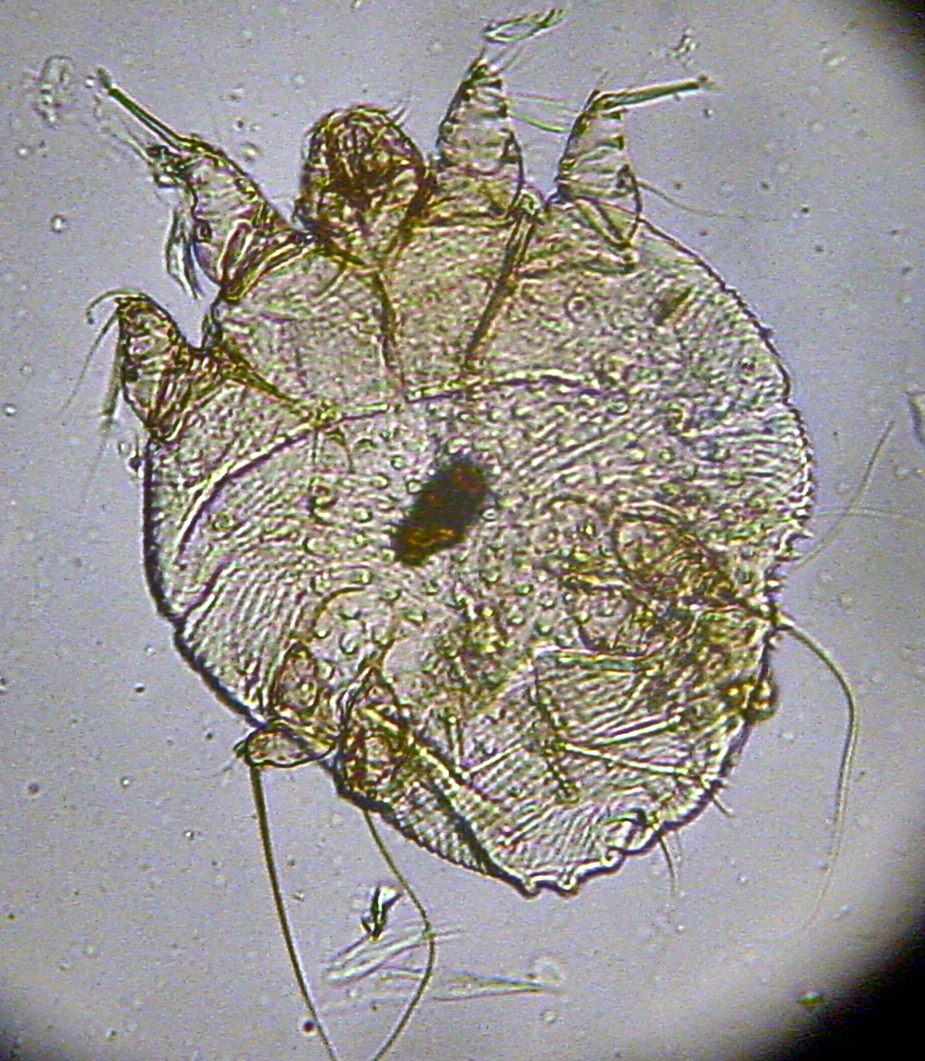 Scabies MiteSarcoptes scabiei
- Trixacarus caviae
- Nycteridocoptes poppei
Compare
Questions and answers
What is the scientific name of the Notoedric Mange?
The scientific name of the Notoedric Mange is Notoedres cati. Written with its author, the full name is Notoedres cati (Hering, 1838).
Which family does the Notoedric Mange belong to?
Notoedres cati belongs to the family Sarcoptidae, in the order Sarcoptiformes and the class Arachnida.
Where is the Notoedric Mange found?
Checklists and occurrence records place Notoedres cati in 8 countries, including United States, South Africa, Philippines, The Netherlands, Japan and Belgium.
What other names does the Notoedric Mange have?
Notoedres cati is also known in English as Cat Mange Mite.
Can a human get feline scabies?
Yes. Notoedres cati can infest humans and produce temporary itchy skin lesions.[5][9]
Is Notoedres cati a mite?
Yes. Notoedres cati is an ectoparasitic mite.[3]
Sources
Passages the profile rests on
- Notoedres cati inhabits the skin of its host animals, where it burrows beneath the surface. Source passage: “N. cati burrows its way through the skin of the host animal” — English Wikipedia
- Preferred infestation sites include the head, face, ears, neck and distal legs. Source passage: “Predilected sites of infestation are the head including face, ears, neck and distal legs” — pmc.ncbi.nlm.nih.gov
- Notoedres cati is an ectoparasitic mite that burrows into the skin of its host. Source passage: “an ectoparasitic and skin burrowing mite Notoedres cati” — English Wikipedia
- Notoedres cati is primarily a parasite of felids but can also infest rodents, lagomorphs, dogs and foxes. Source passage: “N. cati is primarily a parasite of felids, but it can also infest rodents, lagomorphs, and occasionally also dogs and foxes.” — English Wikipedia
- Notoedres cati can infest humans as well as non-felid animal hosts. Source passage: “N. cati has also been reported to infest non-felid hosts, including humans [4].” — pmc.ncbi.nlm.nih.gov
- Notoedres cati infestation can spread through direct contact with an infested animal. Source passage: “it is primarily transferred by direct contact with an infested animal.” — English Wikipedia
- Notoedres cati can survive outside a host for between one and three days. Source passage: “N. cati can survive for 1–3 days outside a host” — English Wikipedia
- Notoedres cati infestation can spread rapidly among cats. Source passage: “Infestation is transmitted by direct contact and may spread rapidly among cats.” — pmc.ncbi.nlm.nih.gov
- Human infestation by Notoedres cati can produce temporary itchy skin lesions. Source passage: “In humans, infestation of N.cati can result in transient pruritic lesions.” — English Wikipedia
Data
- Catalogue of Life, 2026-10-16 XR cc by
- Global Biodiversity Information Facility CC BY 4.0
- Wikidata CC0
- GeoNames CC BY 4.0
- Wikimedia Commons per image; credit shown with each image
- iNaturalist per image; credit shown with each image
- Within the Catalogue of Life, this name comes from TAXREF cc by
References
- Checklist of Norwegian ticks and mites (Acari). Fauna norv. Ser. B 26:31-45 where the name was published
This species in other databases
Page built on 26 November 2026. See how the catalog is made and all sources and licences.
Cite this page
ScientificNames.org. (2026). Notoedres cati (Notoedric Mange). Retrieved November 26, 2026, from https://scientificnames.org/species/notoedres-cati
“Notoedres cati (Notoedric Mange).” ScientificNames.org, 2026, scientificnames.org/species/notoedres-cati. Accessed 26 Nov. 2026.
ScientificNames.org. “Notoedres cati (Notoedric Mange).” Accessed November 26, 2026. https://scientificnames.org/species/notoedres-cati.
@misc{scientificnames_notoedres_cati_notoedric_mange,
  author = {{ScientificNames.org}},
  title = {Notoedres cati (Notoedric Mange)},
  year = {2026},
  url = {https://scientificnames.org/species/notoedres-cati},
  note = {Accessed 2026-11-26}
}