Species · Spiders and other arachnids
Scabies Mite Sarcoptes scabiei
The scientific name of the Scabies Mite is Sarcoptes scabiei. It is a species of arachnid in the family Sarcoptidae (itch mites), order Sarcoptiformes. The name dates from 1778.
- Scientific name
- Sarcoptes scabiei (DeGeer, 1778)
- Common name
- Scabies Mite
- Genus
- Sarcoptes
- Family
- Sarcoptidae (Itch Mites)
- Order
- Sarcoptiformes
- Class
- Arachnida
- Environment
- terrestrial
- Recorded in
- 10 countries
- Name status
- accepted in the Catalogue of Life
Overview
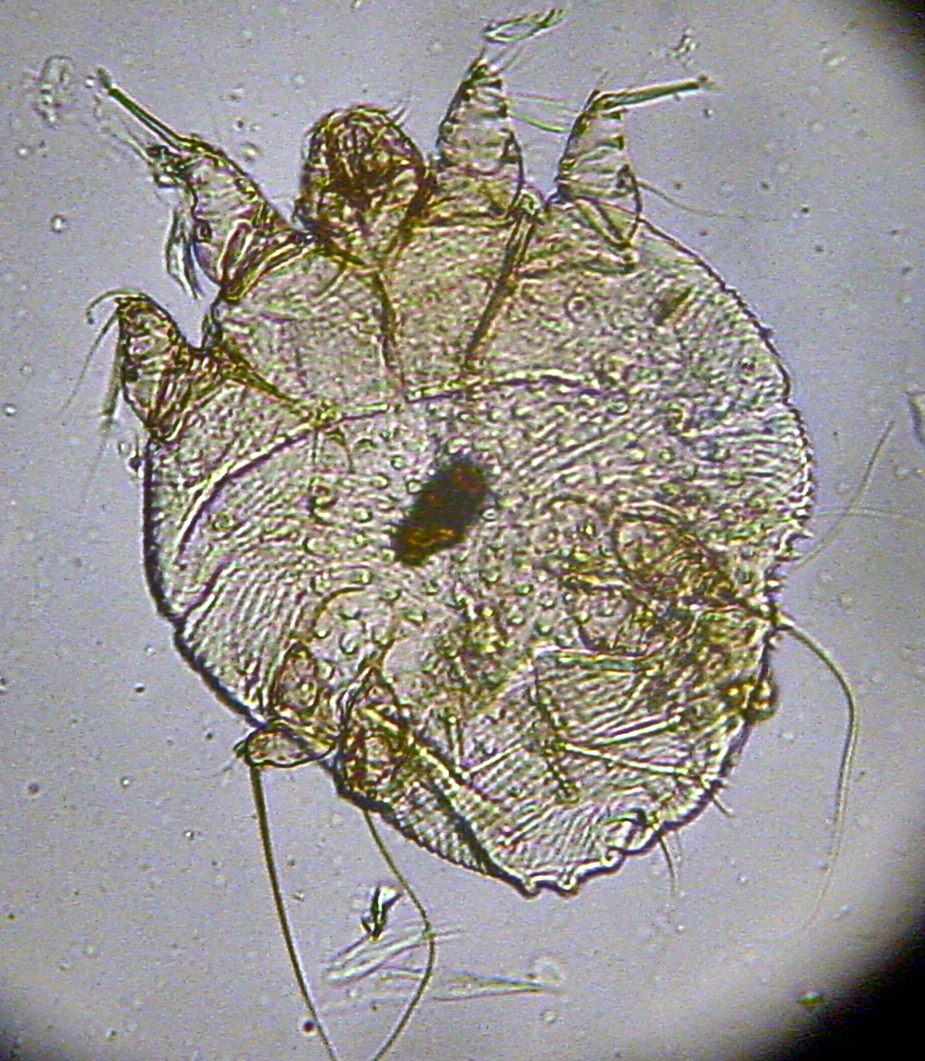
The Scabies Mite (Sarcoptes scabiei) is an arachnid in the family Sarcoptidae, order Sarcoptiformes and class Arachnida. It parasitizes humans and various other mammals and causes the skin disease known as scabies. It inhabits the upper layer of host skin and does not burrow below the stratum corneum. Adult mites are eyeless, have four pairs of legs and bear multiple cuticular spines on their dorsal surface.
Written 26 November 2026 from the sources listed below. Each statement was checked against the passage it cites; statements that could not be supported were removed.
Appearance
Adult Scabies Mites have oval bodies that are flattened on the ventral side and convex on the dorsal side. Their body surfaces have folds covered with short bristles, and their dorsal surfaces bear multiple cuticular spines.[1][2][3]
Adults are eyeless and have four pairs of legs. The front legs terminate in tubular suckers, while the hind legs terminate in long bristles.[4][5]
Males have suckers on all legs except the third pair, distinguishing them from females. Adult females measure 0.3–0.45 mm in length and 0.25–0.35 mm in width, while adult males are slightly more than half the size of females.[6][7][8]
Habitat
Scabies Mites inhabit the upper layer of host skin and do not burrow below the stratum corneum. They can also occur in hair follicles and molting pouches.[9][10]
Diet
Scabies Mites consume host skin cells and cellular liquids.[11]
Behaviour
Scabies Mites burrow into host skin using their mouthparts and specialized cutting surfaces on their front legs. They use suckers on their feet to anchor themselves to the skin during burrowing.[12][13]
Impregnated females leave their molting pouches to search for suitable locations for permanent burrows. Females construct serpentine burrows while laying eggs, whereas males create temporary shallow pits in the skin while searching for female burrows.[14][15][16]
Transmission between hosts occurs primarily through direct skin-to-skin contact. The mites generally do not exhibit social or colonial behaviour.[17][18]
Reproduction and life cycle
The species has separate male and female individuals. Females typically deposit two to three eggs daily and can remain fertile for their entire lives after mating once.[19][20][21]
Eggs measure 0.10–0.15 mm in length and hatch into larvae after three to four days. Larvae have three pairs of legs and develop into nymphs with four pairs of legs after moulting.[22][23][24][25]
Under favourable conditions, approximately 10% of eggs develop into adults. The species exhibits no parental investment.[26][27]
Conservation
The species has a very large and widely dispersed population. It has not been assessed for conservation status by any agency.[28][29]
Classification of the Scabies Mite
| Kingdom | Animalia |
|---|---|
| Phylum | Arthropoda |
| Subphylum | Chelicerata |
| Class | Arachnida (Arachnid) |
| Superorder | Acariformes |
| Order | Sarcoptiformes |
| Suborder | Astigmata |
| Superfamily | Sarcoptoidea |
| Family | Sarcoptidae (Itch Mites) |
| Genus | Sarcoptes (Scabies Or Itch Mite) |
| Species | Sarcoptes scabiei (DeGeer, 1778) |
This name was added to the Catalogue of Life from a contributing dataset by automated merging and has not yet been reviewed by its editors.
Where the Scabies Mite is found
Checklists and occurrence records place Sarcoptes scabiei in 10 countries across Asia. GBIF holds 1,607 georeferenced records of it.
Countries
- Benin 879
- China 39
- India 10
- Indonesia 14
- Iraq 16
- Israel 45
- Japan 42
- South Korea 139
- Taiwan
- United States 423
Regions and cities with the most records
- Ganvié, Benin 482
- Atlantique, Benin 417
- Zinvié, Benin 399
- Zé, Benin 270
- Abomey-Calavi, Benin 161
- Kouffo, Benin 156
- Godomè, Benin 153
- Klouékanmè, Benin 148
- Toviklin, Benin 148
- Collines, Benin 96
- Cotonou, Benin 96
- Indiana, United States 90
- Lafayette, United States 90
- West Lafayette, United States 90
- Ouinhi, Benin 68
- Missérété, Benin 64
- Ouémé, Benin 61
- Ouidah, Benin 59
- Adjaouèrè, Benin 58
- Plateau, Benin 55
- Pobé, Benin 55
- Allada, Benin 53
- Zou, Benin 43
- Ekpé, Benin 31
- New York, United States 28
- Borgou, Benin 27
- Missouri, United States 26
- Massachusetts, United States 23
- Marlborough, United States 20
- Sudbury, United States 19
- Be’er Ya‘aqov, Israel 18
- Gedera, Israel 18
- Lod, Israel 18
- Mazkeret Batya, Israel 18
- Ness Ziona, Israel 18
- Ramla, Israel 18
25 more countries have a few records outside this range
These countries hold a few records of Sarcoptes scabiei but lie outside the range the checklists give for it. Such records are often zoo or garden specimens, museum material or vagrants, so the species is not counted as occurring there.
- Argentina 33
- Australia 209
- Belgium 89
- Brazil 19
- Canada 92
- Chile 4
- Colombia 4
- Democratic Republic of the Congo 100
- Egypt 36
- Finland 55
- France 29
- French Polynesia 15
- Germany 4
- Italy 5
- Mexico 6
- New Caledonia 9
- Norway 12
- Papua New Guinea 4
- Peru 163
- South Africa 110
- Spain 8
- Sweden 69
- Tanzania 5
- The Netherlands 169
- United Kingdom 31
A number beside a place is its count of GBIF occurrence records. A place without a number comes from a checklist alone. Records show where a species has been observed or collected, which can include escapes and vagrants.
Common names
English
- Scabies Mite
- Itch Mite
- Sarcoptic Mange Mite
Names in 17 other languages
- Afrikaans
- Skurftemyt
- Arabic
- القارمة الجربية, سوس الحكة
- Czech
- zákožka svrabová
- Danish
- Fnatmide
- Dutch
- siere or sierken
- French
- Acarien de la gale, Sarcopte, ciron
- German
- Krätzemilbe
- Hebrew
- קרדית סקביאס
- Italian
- bacolino
- Japanese
- ヒゼンダニ
- Korean
- 옴진드기
- Polish
- świerzbowiec drążący
- Portuguese
- Ácaro-da-sarna
- Russian
- Чесоточный зудень
- Spanish
- Arador de la sarna, arador de la mano, Ácaro de la escabiosis, Ácaro de la sarna
- Swedish
- rävskabb
- Turkish
- Uyuz Akarı
Synonyms
6 other scientific names have been used for this species and are now treated as synonyms of Sarcoptes scabiei.
- Acarus scabiei Linnaeus, 1758
- Acarus sira scabiei Linnaeus, 1758
- Sarcoptes equi Rainbow, 1906
- Sarcoptes homines Raspail, 1834
- Sarcoptes suis Seddon, 1952
- Sarcoptes wombati Railliet, 1893
Subspecies and varieties
- Sarcoptes scabiei var. bovis (Bovine Scabies Mite) variety
- Sarcoptes scabiei var. canis variety
- Sarcoptes scabiei var. hominis (Human Scabies Mite) variety
- Sarcoptes scabiei var. suis (Swine Scabies Mite) variety
Related species
-
 Notoedric MangeNotoedres cati
- Rat Ear Itch MiteNotoedres muris
- Trixacarus caviae
- Nycteridocoptes poppei
Compare
Questions and answers
What is the scientific name of the Scabies Mite?
The scientific name of the Scabies Mite is Sarcoptes scabiei. Written with its author, the full name is Sarcoptes scabiei (DeGeer, 1778).
Which family does the Scabies Mite belong to?
Sarcoptes scabiei belongs to the family Sarcoptidae, in the order Sarcoptiformes and the class Arachnida.
Where is the Scabies Mite found?
Checklists and occurrence records place Sarcoptes scabiei in 10 countries, including Benin, United States, South Korea, Israel, Japan and China.
What other names does the Scabies Mite have?
Sarcoptes scabiei is also known in English as Itch Mite and Sarcoptic Mange Mite.
What do scabies mites eat?
Scabies Mites consume host skin cells and cellular liquids.[11]
Sources
Passages the profile rests on
- Adult mites have oval bodies that are flattened on the ventral side and convex on the dorsal side. Source passage: “their oval, ventrally flattened and dorsally convex tortoise-like bodies” — English Wikipedia
- The dorsal body surface bears multiple cuticular spines. Source passage: “multiple cuticular spines.” — English Wikipedia
- The body surface has folds covered with short bristles. Source passage: “the mite's surface has folds covered with short bristles.” — English Wikipedia
- Adult mites are eyeless and have four pairs of legs. Source passage: “Adult scabies mites are round, eyeless mites with four pairs of legs” — English Wikipedia
- The front legs terminate in tubular suckers, while the hind legs terminate in long bristles. Source passage: “The front legs end in long, tubular processes known as suckers, and the hind legs end in long bristles.” — English Wikipedia
- The male has suckers on all legs except the third pair, distinguishing it from the female. Source passage: “The male has suckers on all legs except the third pair, which distinguishes it from the female.” — English Wikipedia
- Adult females measure 0.3–0.45 mm in length and 0.25–0.35 mm in width. Source passage: “Females are 0.3–0.45 mm (0.012–0.018 in) long and 0.25–0.35 mm (0.0098–0.0138 in) wide” — English Wikipedia
- Adult males are slightly more than half the size of females. Source passage: “males are slightly more than half that size.” — cdc.gov
- The mites inhabit the upper layer of host skin and do not burrow below the stratum corneum. Source passage: “The mites burrow into the upper layer of the skin but never below the stratum corneum.” — cdc.gov
- Mites can also occur in hair follicles and molting pouches. Source passage: “Larvae and nymphs may often be found in molting pouches or in hair follicles” — cdc.gov
- The mites consume host skin cells and cellular liquids. Source passage: “Scabies mites ingest cell liquids and skin cells from their hosts.” — animaldiversity.org
- The mites burrow into host skin using their mouthparts and specialized cutting surfaces on their front legs. Source passage: “The burrowing is carried out using the mouth parts and special cutting surfaces on the front legs.” — English Wikipedia
- Mites use suckers on their feet to anchor themselves to the skin during burrowing. Source passage: “While these are being used, the mite anchors itself with suckers on its feet.” — English Wikipedia
- Impregnated females leave their molting pouches to search for suitable locations for permanent burrows. Source passage: “Impregnated females leave their molting pouches and wander on the surface of the skin until they find a suitable site for a permanent burrow.” — cdc.gov
- Females construct serpentine burrows while laying eggs. Source passage: “When the impregnated female mite finds a suitable location, it begins to make its characteristic serpentine burrow, laying eggs in the process.” — cdc.gov
- Males create temporary shallow pits in the skin while searching for female burrows. Source passage: “Males are rarely seen; they make temporary shallow pits in the skin to feed until they locate a female’s burrow and mate.” — cdc.gov
- Transmission between hosts occurs primarily through direct skin-to-skin contact. Source passage: “The home range of these mites is generally confined to one host; transmission between hosts is possible mainly via skin-to-skin contact.” — animaldiversity.org
- The mites generally do not exhibit social or colonial behaviour. Source passage: “Although multiple mites will infect a host, they do not exhibit any social or colonial behavior.” — animaldiversity.org
- The species has separate male and female individuals. Source passage: “gonochoric/gonochoristic/dioecious (sexes separate)” — animaldiversity.org
- Females typically deposit two to three eggs daily. Source passage: “Females deposit 2-3 eggs per day as they burrow under the skin .” — cdc.gov
- Females can remain fertile for their entire lives after mating once. Source passage: “Mating takes place only once and leaves the female fertile for the rest of her life.” — cdc.gov
- The eggs measure 0.10–0.15 mm in length. Source passage: “Eggs are oval and 0.10 to 0.15 mm in length” — cdc.gov
- Eggs hatch into larvae after three to four days. Source passage: “Eggs are oval and 0.10 to 0.15 mm in length and hatch in 3 to 4 days.” — cdc.gov
- The larval stage has three pairs of legs. Source passage: “The larval stage, which emerges from the eggs, has only 3 pairs of legs” — cdc.gov
- After moulting, larvae develop into nymphs with four pairs of legs. Source passage: “After the larvae molt, the resulting nymphs have 4 pairs of legs .” — cdc.gov
- Under favourable conditions, approximately 10% of eggs develop into adults. Source passage: “Under the most favorable of conditions, about 10% of her eggs eventually give rise to adult mites.” — cdc.gov
- The species exhibits no parental investment. Source passage: “This species exhibits no parental investment.” — animaldiversity.org
- The species has a very large and widely dispersed population. Source passage: “The worldwide population size of this species is very large and dispersed.” — animaldiversity.org
- The species has not been assessed for conservation status by any agency. Source passage: “It has not been considered for conservation status by any agency.” — animaldiversity.org
- The species causes the skin disease known as scabies. Source passage: “Scabies is a skin disease caused by a microscopic burrowing mite called Sarcoptes scabiei (S. scabiei).” — pmc.ncbi.nlm.nih.gov
Data
- Catalogue of Life, 2026-10-16 XR cc by
- Global Biodiversity Information Facility CC BY 4.0
- Wikidata CC0
- GeoNames CC BY 4.0
- Wikimedia Commons per image; credit shown with each image
- Within the Catalogue of Life, this name comes from World Register of Marine Species cc by
This species in other databases
- Catalogue of Life SQHRX
- Wikidata Q500869
- iNaturalist 262979
- WoRMS urn:lsid:marinespecies.org:taxname:1513110
- NCBI Taxonomy txid52283
Page built on 28 November 2026. See how the catalog is made and all sources and licences.
Cite this page
ScientificNames.org. (2026). Sarcoptes scabiei (Scabies Mite). Retrieved November 28, 2026, from https://scientificnames.org/species/sarcoptes-scabiei
“Sarcoptes scabiei (Scabies Mite).” ScientificNames.org, 2026, scientificnames.org/species/sarcoptes-scabiei. Accessed 28 Nov. 2026.
ScientificNames.org. “Sarcoptes scabiei (Scabies Mite).” Accessed November 28, 2026. https://scientificnames.org/species/sarcoptes-scabiei.
@misc{scientificnames_sarcoptes_scabiei_scabies_mite,
  author = {{ScientificNames.org}},
  title = {Sarcoptes scabiei (Scabies Mite)},
  year = {2026},
  url = {https://scientificnames.org/species/sarcoptes-scabiei},
  note = {Accessed 2026-11-28}
}