Species · Mammals
Philippine Slow Loris Nycticebus menagensis
The scientific name of the Philippine Slow Loris is Nycticebus menagensis. It is a species of mammal in the family Lorisidae (pottos), order Primates. The name dates from 1893.
- Scientific name
- Nycticebus menagensis Lydekker, 1893
- Common name
- Philippine Slow Loris
- Genus
- Nycticebus
- Family
- Lorisidae (Pottos)
- Order
- Primates
- Class
- Mammalia
- Red List category
- VU Vulnerable
- Recorded in
- 4 countries
- Name status
- accepted in the Catalogue of Life

Overview
Nycticebus menagensis occurs primarily in coastal and lowland areas of northern and eastern Borneo and in the Sulu Archipelago in the southern Philippines.
Written 26 November 2026 from the sources listed below. Each statement was checked against the passage it cites; statements that could not be supported were removed.
Appearance
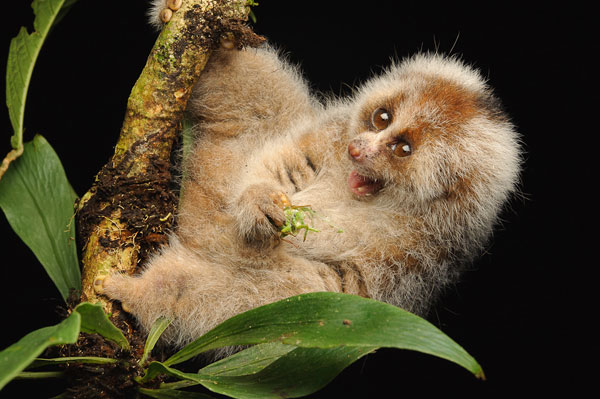
Its second hind-foot toe has a curved grooming claw, while its other nails are straight. It has a toothcomb formed by specialized lower front teeth.[1][2]
A brachial gland on the underside of its elbow secretes a pungent, clear oily toxin.[3]
Its typical body weight ranges from 265 to 325 grams, and recorded individuals have weighed as much as 700 grams. Its average body length is 274.2 millimeters, and its skull length ranges from 54.5 to 56.5 millimeters.[4][5][6][7]
Habitat
The species inhabits primary and secondary lowland forests, gardens, and plantations. It occurs at elevations between 35 and 100 meters.[8][9]
Diet
The species is suspected to be among the more insectivorous slow lorises. It has also been observed feeding on gum from an unidentified woody vine.[10][11]
Two observed trios were encountered on fruiting Calophyllum hosei and Syzygium cf. nigricans trees.[12]
Behaviour
The Philippine Slow Loris is nocturnal and almost entirely arboreal. It occurs at low densities and is difficult to locate.[13][14]
Observed individuals have been encountered alone, in mother-offspring pairs, or in groups of three adults.[15]
The species uses its oily brachial gland secretion defensively by wiping it onto its toothcomb.[16]
Penan respondents in Sarawak demonstrated more detailed knowledge of slow loris behavior, habitat, and distribution than Iban respondents.[17]
Similar species
The Philippine Slow Loris is among three slow loris species occurring in Borneo. Its range overlaps with that of Nycticebus kayan in East Kalimantan and Sabah.[18][19]
Conservation
The species is included in CITES Appendix I, which restricts international commercial trade. It is protected by Indonesian law.[20][21]
Its main documented threats include illegal exotic pet trading and habitat loss caused by burning and conversion to palm oil plantations. Uncontrolled releases of captive pets are also identified as a threat.[22][23]
The IUCN Red List page identifies 2008 as the most recent assessment year for the species.[24]
Uses
Penan communities in Sarawak hunt, eat, or keep Philippine Slow Lorises as pets. Iban communities in Sarawak regard slow lorises as sacred animals and signs of good luck.[25][26]
A study of local ecological knowledge about the Philippine Slow Loris in Sarawak involved 111 semi-structured interviews.[27]
Classification of the Philippine Slow Loris
| Kingdom | Animalia |
|---|---|
| Phylum | Chordata |
| Subphylum | Vertebrata |
| Infraphylum | Gnathostomata |
| Parvphylum | Osteichthyes |
| Megaclass | Tetrapoda |
| Class | Mammalia (Mammal) |
| Subclass | Theria |
| Infraclass | Eutheria |
| Order | Primates (Primate) |
| Suborder | Strepsirrhini |
| Infraorder | Lorisiformes |
| Family | Lorisidae (Pottos) |
| Subfamily | Lorisinae |
| Genus | Nycticebus (Slow Loris) |
| Species | Nycticebus menagensis Lydekker, 1893 |
Where the Philippine Slow Loris is found
Checklists and occurrence records place Nycticebus menagensis in 4 countries across Asia. GBIF holds 357 georeferenced records of it.
Countries
Regions and cities with the most records
- Sabah, Malaysia 220
- Sarawak, Malaysia 28
- Sandakan, Malaysia 27
- Kuching, Malaysia 10
- Bandar Seri Begawan, Brunei 3
- Mentiri, Brunei 3
- Ranau, Malaysia 3
- Sengkurong, Brunei 3
- Sibu, Malaysia 3
Range as the checklists state it
Southern Asia
A number beside a place is its count of GBIF occurrence records. A place without a number comes from a checklist alone. Records show where a species has been observed or collected, which can include escapes and vagrants.
Common names
English
- Philippine Slow Loris
Names in 12 other languages
- Arabic
- لوريس بطئ فلبيني
- Chinese
- 菲律賓懶猴
- Czech
- outloň bornejský
- Dutch
- Borneose Plompe Lori
- German
- Philippinen-Plumplori
- Greek
- Λόρις του Βόρνεο
- Italian
- Lori lento delle Filippine
- Japanese
- ボルネオスローロリス
- Polish
- kukang borneański
- Russian
- Калимантанский лори
- Spanish
- Loris Perezoso de Kalimantan
- Turkish
- Filipin Yavaş Lorisi
Synonyms
6 other scientific names have been used for this species and are now treated as synonyms of Nycticebus menagensis.
- Lemur menagensis Lydekker, 1893
- Nycticebus coucang menagensis Lydekker, 1893
- Nycticebus coucang natunae Stone & Rehn, 1902
- Nycticebus menagensis menagensis Lydekker, 1893
- Nycticebus menagensis philippinus Cabrera, 1908
- Nycticebus natunae Stone & Rehn, 1902
Related species
-
 Bangka Slow LorisNycticebus bancanus
-
 Bengal Slow LorisNycticebus bengalensis
-
 Sunda Slow LorisNycticebus coucang
-
 Bornean Slow LorisNycticebus borneanus
-
 Javan Slow LorisNycticebus javanicus
-
 Sumatran Slow LorisNycticebus hilleri
-
 Kayan River Slow LorisNycticebus kayan
-
 Pygmy Slow LorisXanthonycticebus pygmaeus
Compare
Questions and answers
What is the scientific name of the Philippine Slow Loris?
The scientific name of the Philippine Slow Loris is Nycticebus menagensis. Written with its author, the full name is Nycticebus menagensis Lydekker, 1893.
Which family does the Philippine Slow Loris belong to?
Nycticebus menagensis belongs to the family Lorisidae, in the order Primates and the class Mammalia.
Where is the Philippine Slow Loris found?
Checklists and occurrence records place Nycticebus menagensis in 4 countries: Malaysia, Indonesia, Philippines and Brunei.
What is the conservation status of the Philippine Slow Loris?
The IUCN Red List category recorded for Nycticebus menagensis is Vulnerable (VU).
How venomous is a slow loris?
The Philippine Slow Loris has a brachial gland on the underside of its elbow that secretes a pungent, clear oily toxin. It uses this secretion defensively by wiping it onto its toothcomb.[3][16]
What is a slow loris habitat?
The Philippine Slow Loris inhabits primary and secondary lowland forests, gardens, and plantations. It occurs at elevations between 35 and 100 meters.[8][9]
Sources
Passages the profile rests on
- Its second hind-foot toe has a curved grooming claw, while its other nails are straight. Source passage: “Its second toe on the hind foot has a curved grooming claw that the animal uses for scratching and grooming, while the other nails are straight.” — English Wikipedia
- The species has a toothcomb formed by specialized lower front teeth. Source passage: “It also possesses a specialized arrangement of lower front teeth, called a toothcomb, which is also used for grooming” — English Wikipedia
- The species has a brachial gland on the underside of its elbow that secretes a pungent, clear oily toxin. Source passage: “It also has a small swelling on the ventral side of its elbow called the brachial gland, which secretes a pungent, clear oily toxin” — English Wikipedia
- Its typical body weight ranges from 265 to 325 grams. Source passage: “The body weight of this species is typically in the range of 265–325 grams (9.3–11.5 oz)” — English Wikipedia
- Recorded individuals have weighed as much as 700 grams. Source passage: “although weights of up to 700 grams (25 oz) have been recorded.” — English Wikipedia
- Its average body length is 274.2 millimeters. Source passage: “The body length averages 274.2 mm (10.80 in)” — English Wikipedia
- Its skull length ranges from 54.5 to 56.5 millimeters. Source passage: “its skull length ranges between 54.5 and 56.5 mm (2.15 and 2.22 in)” — English Wikipedia
- The species inhabits primary and secondary lowland forests, gardens, and plantations. Source passage: “The species occurs in primary and secondary lowland forest, gardens, and plantations” — English Wikipedia
- It occurs at elevations between 35 and 100 meters. Source passage: “at elevations between 35–100 m (115–328 ft).” — English Wikipedia
- The species is suspected to be among the more insectivorous slow lorises. Source passage: “the Philippine slow loris is suspected to be one of the more insectivorous slow loris species.” — English Wikipedia
- It has been observed feeding on gum from an unidentified woody vine. Source passage: “It has also been observed feeding on the gum from an unidentified liana (a long-stemmed woody vine).” — English Wikipedia
- Two observed trios were encountered on fruiting Calophyllum hosei and Syzygium cf. nigricans trees. Source passage: “Of the two trios, both were on fruiting trees, Calophyllum hosei and Syzygium cf. nigricans.” — English Wikipedia
- The species is nocturnal and almost entirely arboreal. Source passage: “It is nocturnal, and almost entirely arboreal.” — English Wikipedia
- The species occurs at low densities and is difficult to locate. Source passage: “Other surveys confirm that the animal is difficult to locate, and occurs in low densities.” — English Wikipedia
- Observed individuals have been encountered alone, in mother-offspring pairs, or in groups of three adults. Source passage: “They were encountered singly, as mother and offspring, or in adult trios.” — English Wikipedia
- The species uses its oily brachial gland secretion defensively by wiping it onto its toothcomb. Source passage: “that the animal uses defensively by wiping it on its toothcomb.” — English Wikipedia
- Penan respondents in Sarawak demonstrated more detailed knowledge of slow loris behavior, habitat, and distribution than Iban respondents. Source passage: “Overall, the Penan have a more detailed knowledge of slow loris behaviors, habitat, and distribution than the Iban.” — pmc.ncbi.nlm.nih.gov
- Its range overlaps with that of Nycticebus kayan in East Kalimantan and Sabah. Source passage: “with ranges that overlap in East Kalimantan and Sabah.” — English Wikipedia
- The species is among three slow loris species occurring in Borneo. Source passage: “Three species of slow loris occur in Borneo (Nycticebus menagensis, N. kayan, N. borneanus)” — pmc.ncbi.nlm.nih.gov
- The species is included in CITES Appendix I, which restricts international commercial trade. Source passage: “N. menagensis is listed in CITES Appendix I, which prevents international commercial trade” — English Wikipedia
- The species is protected by Indonesian law. Source passage: “it is also protected by Indonesian law.” — English Wikipedia
- Its main documented threats include illegal exotic pet trading and habitat loss caused by burning and conversion to palm oil plantations. Source passage: “Threats to the species include the illegal local exotic pet trade and habitat loss due to burning and conversion to palm oil plantations.” — English Wikipedia
- Uncontrolled releases of captive pets are also identified as a threat. Source passage: “Additionally, uncontrolled release of pets in some areas is also a threat to the species.” — English Wikipedia
- The IUCN Red List page identifies 2008 as the most recent assessment year for the species. Source passage: “has most recently been assessed for The IUCN Red List of Threatened Species in 2008.” — iucnredlist.org
- Penan communities in Sarawak hunt, eat, or keep Philippine slow lorises as pets. Source passage: “the Penan hunt, eat, or keep them as pets” — pmc.ncbi.nlm.nih.gov
- Iban communities in Sarawak regard slow lorises as sacred animals and signs of good luck. Source passage: “the Iban consider them sacred and signifiers of good luck.” — pmc.ncbi.nlm.nih.gov
- A study of local ecological knowledge about the Philippine slow loris in Sarawak involved 111 semi-structured interviews. Source passage: “We conducted 111 semi-structured interviews in Sarawak, Malaysia, to collect local knowledge about the behavior and distribution of the Philippine slow loris” — pmc.ncbi.nlm.nih.gov
Data
- Catalogue of Life, 2026-10-16 XR cc by
- Global Biodiversity Information Facility CC BY 4.0
- Wikidata CC0
- GeoNames CC BY 4.0
- Wikimedia Commons per image; credit shown with each image
- Within the Catalogue of Life, this name comes from The Integrated Taxonomic Information System cc0
References
- Lyon, Marcus Ward, Jr. (1909). The authority for the name Nycticebus menagensis. Proceedings of the Biological Society of Washington, Vol. 22.
- Mittermeier, Rusell A., Anthony B. Rylands, and Don E. Wilson, eds. (2013). Handbook of the Mammals of the World. Volume 3. Primates.
- Blair, Mary E., Giang T. H. Cao, Elora H. López-Nandam, Daniel A. Veronese-Paniagua, et al. (2023). Molecular Phylogenetic Relationships and Unveiling Novel Genetic Diversity among Slow and Pygmy Lorises, including Resurrection of Xanthonycticebus intermedius. Genes, Vol. 14, No. 3, Article 643.
This species in other databases
Page built on 29 November 2026. See how the catalog is made and all sources and licences.
Cite this page
ScientificNames.org. (2026). Nycticebus menagensis (Philippine Slow Loris). Retrieved November 29, 2026, from https://scientificnames.org/species/nycticebus-menagensis
“Nycticebus menagensis (Philippine Slow Loris).” ScientificNames.org, 2026, scientificnames.org/species/nycticebus-menagensis. Accessed 29 Nov. 2026.
ScientificNames.org. “Nycticebus menagensis (Philippine Slow Loris).” Accessed November 29, 2026. https://scientificnames.org/species/nycticebus-menagensis.
@misc{scientificnames_nycticebus_menagensis_philippine_slow_loris,
  author = {{ScientificNames.org}},
  title = {Nycticebus menagensis (Philippine Slow Loris)},
  year = {2026},
  url = {https://scientificnames.org/species/nycticebus-menagensis},
  note = {Accessed 2026-11-29}
}