Species · Birds
Band-tailed Nighthawk Nyctiprogne leucopyga
The scientific name of the Band-tailed Nighthawk is Nyctiprogne leucopyga. It is a species of bird in the family Caprimulgidae (nightjar), order Caprimulgiformes. The name dates from 1825.
- Scientific name
- Nyctiprogne leucopyga (von Spix, 1825)
- Common name
- Band-tailed Nighthawk
- Genus
- Nyctiprogne
- Family
- Caprimulgidae (Nightjar)
- Order
- Caprimulgiformes
- Class
- Aves
- Red List category
- LC Least Concern
- Recorded in
- 9 countries
- Name status
- accepted in the Catalogue of Life

Overview
The Band-tailed Nighthawk is a bird in the family Caprimulgidae, order Caprimulgiformes, class Aves, and genus Nyctiprogne. It inhabits subtropical and tropical areas near rivers, streams, marshes, and lakes, across northern South America. It has cryptically patterned brown plumage, white throat patches, and a white band across its three outermost tail feathers.
Written 26 November 2026 from the sources listed below. Each statement was checked against the passage it cites; statements that could not be supported were removed.
Appearance
The Band-tailed Nighthawk has cryptically patterned brown plumage that helps it blend in with tree bark and leaves. It has white patches on both sides of its throat and a white band across its three outermost tail feathers.[1][2]
Its wings are long, with pointed wingtips and no white markings. Its tail is short and somewhat forked, and its bill is short, very wide, and hooked at the tip.[3][4][5]
Adults have a black bill, dark brown irises, and pinkish-gray tarsi and feet. Both sexes have similar plumage and colouring, with very little sexual dimorphism.[6][7]
Juveniles resemble mature adults but have slightly plainer and paler plumage.[8]
The species measures 16.5–19 cm in body length, with a wingspan ranging from 12.9 to 14.1 cm. Adults weigh between 23 and 28 grams.[9][10][11]
Females have a greater average weight and wingspan than males.[12]
Habitat
The Band-tailed Nighthawk inhabits subtropical and tropical areas near rivers, streams, marshes, and lakes. Its habitats include lowland forests, savannahs, grasslands, and swamps.[13][14]
The species has only been reported at elevations below approximately 200–300 metres. During daylight, it roosts near the ground in dense thickets of bushes and trees.[15][16]
The species occurs across much of northern South America, east of the Andes, extending from Venezuela to central Brazil. Its range includes northern Bolivia and northeastern Paraguay, as well as Peru, Ecuador, and Guyana.[17][18][19]
Its range extends from northern Venezuela and eastern Colombia eastward to French Guiana and eastern Brazil.[20]
Diet
The Band-tailed Nighthawk is an insectivore that primarily consumes aerial arthropods. Recorded prey includes beetles, ants, true bugs, and flying termites.[21][22]
Behaviour
The Band-tailed Nighthawk is nocturnal and is most active during late evening, early morning, and nighttime. It feeds mainly at dusk, when flying insects are abundant, and feeding takes place around sunset and resumes shortly before dawn.[23][24][25]
It catches flying prey while continuously flying with rapid, shallow wingbeats and periods of gliding.[26]
Between feeding periods, the species roosts on thin horizontal branches close to vegetation and water. It roosts perpendicular to branches, either alone or in groups of two to ten individuals.[27][28]
Its recorded territorial call is a repeated, low-volume vocalization described as gole-kwoik-kwak.[29]
Reproduction and life cycle
The breeding season begins between July and August, coinciding with the end of the dry season. The nesting period occurs during September and October, when the wet season begins.[30][31]
The species nests in shallow holes on the ground, generally in relatively open locations. The nest is lined with leaves and other vegetation, and eggs are laid directly on the ground.[32][33][34]
Its eggs are cream or white and bear small dark blotches.[35]
Conservation
The Band-tailed Nighthawk is classified as Least Concern on the IUCN Red List. It is considered fairly common and has a large geographic range.[36][37]
Amazonian deforestation is predicted to reduce the species' population.[38]
Similar species
Five subspecies are recognized within the Band-tailed Nighthawk. The subspecies N. l. exigua occurs in eastern Colombia and southern Venezuela, the nominate subspecies N. l. leucopyga occurs in eastern Venezuela, the Guianas, and northern Brazil, and N. l. latifascia occurs in extreme southern Venezuela.[39][40][41][42]
Classification of the Band-tailed Nighthawk
| Kingdom | Animalia |
|---|---|
| Phylum | Chordata |
| Subphylum | Vertebrata |
| Infraphylum | Gnathostomata |
| Parvphylum | Osteichthyes |
| Megaclass | Tetrapoda |
| Class | Aves (Bird) |
| Order | Caprimulgiformes (Nightjar) |
| Family | Caprimulgidae (Nightjar) |
| Genus | Nyctiprogne (Band-tailed and Bahian Nighthawks) |
| Species | Nyctiprogne leucopyga (von Spix, 1825) |
Where the Band-tailed Nighthawk is found
Checklists and occurrence records place Nyctiprogne leucopyga in 9 countries across South America. GBIF holds 5,988 georeferenced records of it.
Countries
- Bolivia 173
- Brazil 4,171
- Colombia 646
- Ecuador 7
- French Guiana 66
- Guyana 303
- Paraguay 58
- Peru 180
- Venezuela 384
Regions and cities with the most records
- Mato Grosso, Brazil 2,265
- Amazonas, Brazil 890
- Tocantins, Brazil 324
- Upper Takutu-Upper Essequibo, Guyana 287
- Mato Grosso do Sul, Brazil 264
- Casanare Department, Colombia 256
- Apure, Venezuela 193
- Novo Airão, Brazil 184
- Loreto, Peru 170
- Poconé, Brazil 170
- Beni Department, Bolivia 128
- Pará, Brazil 123
- Roraima, Brazil 123
- Guainía Department, Colombia 95
- Meta Department, Colombia 91
- Vichada Department, Colombia 85
- Conceição do Araguaia, Brazil 68
- Vaupés, Colombia 67
- Amazonas, Venezuela 61
- Mitú, Colombia 60
- Alto Paraguay, Paraguay 58
- Maranhão, Brazil 45
- Lucas, Brazil 37
- Atalaia do Norte, Brazil 35
- Goiás, Brazil 32
- Cojedes, Venezuela 31
- Manaus, Brazil 31
- Arari, Brazil 30
- Iquitos, Peru 30
- Vitória do Mearim, Brazil 30
- San Juan, Peru 29
- Careiro da Várzea, Brazil 26
- Santa Cruz Department, Bolivia 25
- Guárico, Venezuela 24
- Boa Vista, Brazil 23
- Iranduba, Brazil 19
Range as the checklists state it
South America
A number beside a place is its count of GBIF occurrence records. A place without a number comes from a checklist alone. Records show where a species has been observed or collected, which can include escapes and vagrants.
Common names
English
- Band-tailed Nighthawk
Names in 26 other languages
- Catalan
- enganyapastors cuabarrat
- Chinese
- 斑尾夜鷹, 斑尾夜鹰
- Croatian
- tamnogrli leganj
- Czech
- lelek pruhoocasý
- Danish
- Amazonnathøg
- Dutch
- Staartbandnachtzwaluw
- Esperanto
- strivosta kaprimulgo
- Estonian
- laiksaba-videvikusorr
- Finnish
- juovapyrstökehrääjä
- French
- Engoulevent leucopyge
- German
- Bindenschwanz-Nachtschwalbe, Bindenschwanznachtschwalbe
- Hungarian
- csíkosfarkú lappantyú
- Italian
- Succiacapre codabarrata
- Japanese
- オビオヨタカ
- Lithuanian
- dryžauodegis lėlys
- Norwegian
- dryadenatthauk
- Polish
- lelkowiec amazoński
- Portuguese
- bacurau-de-cauda-barrada, noitibó-de-cauda-barrada
- Russian
- Амазонский сумеречник, Ленточный козодой
- Serbian
- Trakorepi leganj
- Slovak
- lelek pásochvostý, súmračník pásochvostý
- Spanish
- Añapero colibandeado, Chotacabras de Cola Bandeada, Guardacaminos colibandeado
- Swedish
- Bandstjärtad falknattskärra, bandstjärtad nattskärra
- Turkish
- Bant Kuyruklu Gecedoğanı
- Ukrainian
- анаперо смугастохвостий
- Welsh
- cudylldroellwr cynffonresog
Synonyms
2 other scientific names have been used for this species and are now treated as synonyms of Nyctiprogne leucopyga.
- Caprimulgus leucopygus von Spix, 1825
- Caprimulgus minutus Bonaparte, CLJL, 1850
Subspecies and varieties
- Nyctiprogne leucopyga exigua subspecies
- Nyctiprogne leucopyga latifascia subspecies
- Nyctiprogne leucopyga leucopyga subspecies
- Nyctiprogne leucopyga majuscula subspecies
- Nyctiprogne leucopyga pallida subspecies
Related species
-
 Plain-tailed NighthawkNyctiprogne vielliardi
-
 Pennant-winged NightjarCaprimulgus vexillarius
-
 Great Eared NightjarLyncornis macrotis
-
 Eastern Whip-poor-willAntrostomus vociferus
-
 European NightjarCaprimulgus europaeus
-
 Common NighthawkChordeiles minor
-
 Standard-winged NightjarCaprimulgus longipennis
-
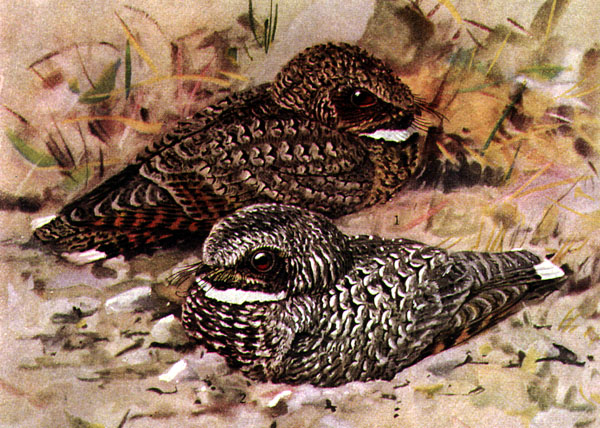 Common PoorwillPhalaenoptilus nuttallii
Compare
Questions and answers
What is the scientific name of the Band-tailed Nighthawk?
The scientific name of the Band-tailed Nighthawk is Nyctiprogne leucopyga. Written with its author, the full name is Nyctiprogne leucopyga (von Spix, 1825).
Which family does the Band-tailed Nighthawk belong to?
Nyctiprogne leucopyga belongs to the family Caprimulgidae, in the order Caprimulgiformes and the class Aves.
Where is the Band-tailed Nighthawk found?
Checklists and occurrence records place Nyctiprogne leucopyga in 9 countries, including Brazil, Colombia, Venezuela, Guyana, Peru and Bolivia.
What is the conservation status of the Band-tailed Nighthawk?
The IUCN Red List category recorded for Nyctiprogne leucopyga is Least Concern (LC).
Is it rare to see a nighthawk?
The Band-tailed Nighthawk is considered fairly common and has a large geographic range.[37]
Sources
Passages the profile rests on
- The species has cryptically patterned brown plumage that helps it blend in with tree bark and leaves. Source passage: “It has cryptically patterned brown plumage, used to blend in with tree bark and leaves.” — English Wikipedia
- The species has white patches on both sides of its throat and a white band across its three outermost tail feathers. Source passage: “It has white patches on either side of the throat, and a white band on the mid-tail, across its three outermost tail feathers.” — English Wikipedia
- Its wings are long and have pointed wingtips without white markings. Source passage: “Its wings are long with pointed wingtips, and have no white markings.” — English Wikipedia
- The species has a short, very wide bill with a hooked tip. Source passage: “The bill is very wide but short, with a length of 0.9 to 0.97 cm (0.35 to 0.38 in), and is hooked at the tip.” — English Wikipedia
- The species has a short, somewhat forked tail. Source passage: “The tail itself is short, and somewhat forked, at 8.2 to 9.7 cm (3.2 to 3.8 in).” — English Wikipedia
- Adults have a black bill, dark brown irises, and pinkish-gray tarsi and feet. Source passage: “It has a black bill, dark brown irises, and pinkish-gray tarsus and feet.” — English Wikipedia
- Both sexes have similar plumage and colouring, with very little sexual dimorphism. Source passage: “It has very weak sexual dimorphism, with both sexes presenting similar plumage and colouring.” — English Wikipedia
- Juveniles resemble mature adults but have slightly plainer and paler plumage. Source passage: “The immature and juvenile phases are also similar to the mature adult, although are slightly more plain and paler.” — English Wikipedia
- The species measures 16.5–19 cm in body length. Source passage: “The band-tailed nighthawks is a small species, with a body length of 16.5 to 19 cm (6.5 to 7.5 in)” — English Wikipedia
- Its wingspan ranges from 12.9 to 14.1 cm. Source passage: “and a wingspan of 12.9 to 14.1 cm (5.1 to 5.6 in).” — English Wikipedia
- Adults weigh between 23 and 28 grams. Source passage: “Adults weigh from 0.023 to 0.028 kg (0.051 to 0.062 lb).” — English Wikipedia
- Females have a greater average weight and wingspan than males. Source passage: “The female has a larger average weight and wingspan than the male.” — English Wikipedia
- The species inhabits subtropical and tropical areas near rivers, streams, marshes, and lakes. Source passage: “Its natural habitat is in subtropical and tropical areas located near water, along rivers, streams, marshes, and lakes.” — English Wikipedia
- Its habitats include lowland forests, savannahs, grasslands, and swamps. Source passage: “These habitats include lowland forests, savannahs, grasslands, and swamps.” — English Wikipedia
- The species has only been reported at elevations below approximately 200–300 metres. Source passage: “It is only reported in areas of elevation below 200 to 300m.” — English Wikipedia
- The species roosts during daylight near the ground in dense thickets of bushes and trees. Source passage: “During the day, it roosts near the ground in locations with dense thickets of bushes and trees.” — English Wikipedia
- The species occurs across much of northern South America, east of the Andes, extending from Venezuela to central Brazil. Source passage: “It is located through much of the northern parts of South America, from east of the Andes to Venezuela and central Brazil.” — English Wikipedia
- The species' southern range reaches northern Bolivia and northeastern Paraguay. Source passage: “Its range then extends south to northern Bolivia and northeastern Paraguay.” — English Wikipedia
- The species is also recorded in Peru, Ecuador, and Guyana. Source passage: “It is also found in Peru, Ecuador, and Guyana.” — English Wikipedia
- Its range extends from northern Venezuela and eastern Colombia eastward to French Guiana and eastern Brazil. Source passage: “It is found from northern Venezuela and eastern Colombia, east to French Guiana and eastern Brazil.” — English Wikipedia
- The species is an insectivore that primarily consumes aerial arthropods. Source passage: “The band-tailed nighthawk is an insectivore that feeds primarily on aerial arthropods” — English Wikipedia
- Its recorded prey includes beetles, ants, true bugs, and flying termites. Source passage: “Its diet includes beetles, ants, true bugs, and flying termites, amongst other arthropods.” — English Wikipedia
- The species is nocturnal and is most active during late evening, early morning, and nighttime. Source passage: “The band-tailed nighthawk is a nocturnal species, and is the most active during the late evening, early morning, and at night.” — English Wikipedia
- The species feeds mainly at dusk when flying insects are abundant. Source passage: “It feeds mostly at dusk, when there are high amounts of flying insects.” — English Wikipedia
- Feeding takes place around sunset and resumes shortly before dawn. Source passage: “Feeding occurs around sunset and stops once it becomes too dark for the bird to see its prey, and then occurs once more just before dawn.” — English Wikipedia
- It catches flying prey while continuously flying with rapid, shallow wingbeats and periods of gliding. Source passage: “It forages in continuous flight, with rapid, shallow wingbeats and gliding to keep it aloft.” — English Wikipedia
- Between feeding periods, the species roosts on thin horizontal branches close to vegetation and water. Source passage: “In between feeding sessions, it roosts in the same area, on thin horizontal branches close to vegetation and water.” — English Wikipedia
- The species roosts perpendicular to branches, either alone or in groups of two to ten individuals. Source passage: “The band-tailed nighthawk roosts perpendicular to the branch, either by itself or in groups of 2-10 individuals.” — English Wikipedia
- Its recorded territorial call is a repeated, low-volume vocalization described as gole-kwoik-kwak. Source passage: “It has a gole-kwoik-kwak call that is at a similar pitch to a frog's ribbit, and is repeated steadily and at a low, subtle volume; it is considered a territorial call.” — English Wikipedia
- The breeding season begins between July and August, coinciding with the end of the dry season. Source passage: “The breeding season begins between July and August, when the maximum singing activity occurs, and the dry season ends.” — English Wikipedia
- The nesting period occurs during September and October, when the wet season begins. Source passage: “The nesting period occurs between September and October, when the wet season begins and there is a high amount of food availability.” — English Wikipedia
- The species nests in shallow holes on the ground, generally in relatively open locations. Source passage: “The nest is a shallow hole on the ground, usually in open areas with little coverage, such as gravel beaches or forest floors.” — English Wikipedia
- The nest is lined with leaves and other vegetation. Source passage: “The nest is lined with leaves and other vegetation.” — English Wikipedia
- The species lays its eggs directly on the ground. Source passage: “As with almost all nightjars, they lay their eggs directly on the ground” — English Wikipedia
- Its eggs are cream or white and bear small dark blotches. Source passage: “The eggs are cream or white, with small dark blotches.” — English Wikipedia
- The species is classified as Least Concern on the IUCN Red List. Source passage: “The IUCN Red List lists the status of the band-tailed nighthawk as of Least Concern.” — English Wikipedia
- The species is considered fairly common and has a large geographic range. Source passage: “it has a large geographic range and is a fairly common species.” — English Wikipedia
- Amazonian deforestation is predicted to reduce the species' population. Source passage: “While Amazonian deforestation is predicted to cause a decrease in its population” — English Wikipedia
- Five subspecies are recognized within the species. Source passage: “There are 5 recognized subspecies which differ in size, colour and vocalizations.” — English Wikipedia
- The subspecies N. l. exigua occurs in eastern Colombia and southern Venezuela. Source passage: “N. l. exigua Friedmann, 1945 – east Colombia and south Venezuela.” — English Wikipedia
- The nominate subspecies N. l. leucopyga occurs in eastern Venezuela, the Guianas, and northern Brazil. Source passage: “N. l. leucopyga (Spix, 1825) – east Venezuela, the Guianas and north Brazil” — English Wikipedia
- The subspecies N. l. latifascia occurs in extreme southern Venezuela. Source passage: “N. l. latifascia Friedmann, 1945 – extreme south Venezuela” — English Wikipedia
Data
- Catalogue of Life, 2026-10-16 XR cc by
- Global Biodiversity Information Facility CC BY 4.0
- Wikidata CC0
- GeoNames CC BY 4.0
- Wikimedia Commons per image; credit shown with each image
- Within the Catalogue of Life, this name comes from The Integrated Taxonomic Information System cc0
References
- Gill, Frank, & and Minturn Wright. (2006). Birds of the World: Recommended English Names.
This species in other databases
Page built on 27 November 2026. See how the catalog is made and all sources and licences.
Cite this page
ScientificNames.org. (2026). Nyctiprogne leucopyga (Band-tailed Nighthawk). Retrieved November 27, 2026, from https://scientificnames.org/species/nyctiprogne-leucopyga
“Nyctiprogne leucopyga (Band-tailed Nighthawk).” ScientificNames.org, 2026, scientificnames.org/species/nyctiprogne-leucopyga. Accessed 27 Nov. 2026.
ScientificNames.org. “Nyctiprogne leucopyga (Band-tailed Nighthawk).” Accessed November 27, 2026. https://scientificnames.org/species/nyctiprogne-leucopyga.
@misc{scientificnames_nyctiprogne_leucopyga_band_tailed_nighthawk,
  author = {{ScientificNames.org}},
  title = {Nyctiprogne leucopyga (Band-tailed Nighthawk)},
  year = {2026},
  url = {https://scientificnames.org/species/nyctiprogne-leucopyga},
  note = {Accessed 2026-11-27}
}