Species · Amphibians
Bolivian Cochran Frog Nymphargus bejaranoi
The scientific name of the Bolivian Cochran Frog is Nymphargus bejaranoi. It is a species of amphibian in the family Centrolenidae (glass frog), order Anura. The name dates from 1980.
- Scientific name
- Nymphargus bejaranoi (Cannatella, 1980)
- Common name
- Bolivian Cochran Frog
- Genus
- Nymphargus
- Family
- Centrolenidae (Glass Frog)
- Order
- Anura
- Class
- Amphibia
- Red List category
- EN Endangered
- Recorded in
- 1 country
- Name status
- accepted in the Catalogue of Life
Overview
Nymphargus bejaranoi is endemic to the eastern slopes of the Bolivian Andes in the departments of Cochabamba, Chuquisaca, La Paz, and Santa Cruz. Males develop off-white spicules across their dark green dorsal surface when reproductively active.
Written 27 November 2026 from the sources listed below. Each statement was checked against the passage it cites; statements that could not be supported were removed.
Appearance
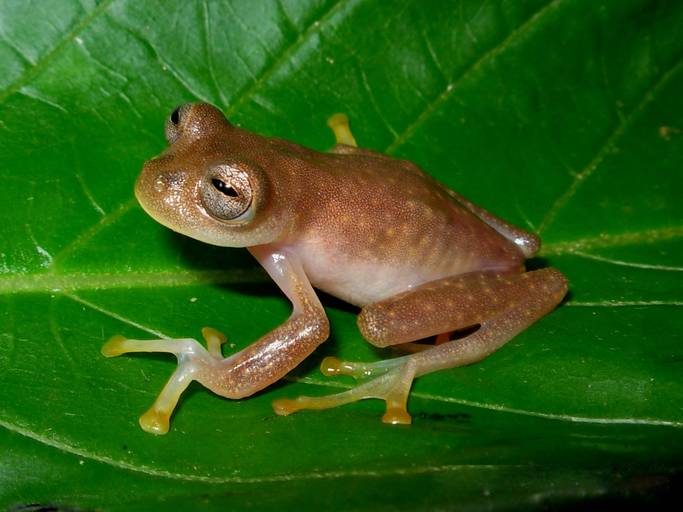
The Bolivian Cochran Frog has a short snout that appears truncate or rounded from above and truncate or sloping from the side. Its eyes are moderately large, and its tympanum is distinct, although its upper portion is hidden by the supra-tympanic fold.[1][2][3][4]
Its fingers have broad discs and partial webbing between the two outermost fingers. Its toes are approximately half-webbed and have discs slightly smaller than those on its fingers.[5][6]
Adult males measure 23.6–24.4 mm in snout–vent length. Adult females measure approximately 26.5 mm in snout–vent length.[7][8]
Males develop spicules across their dorsal surface when reproductively active. The dorsal surface is dark green, and the spicules appear off-white in living specimens.[9][10]
Habitat
The Bolivian Cochran Frog inhabits wet montane forests, including cloud forests and Yungas forests. Its natural habitats include subtropical or tropical moist environments.[11][12]
It occurs at elevations between 1,600 and 2,400 metres above sea level. The species is arboreal and inhabits vegetation near streams and small waterfalls.[13][14]
Conservation
The Bolivian Cochran Frog is classified as endangered on the IUCN Red List. It was formerly common but experienced a substantial population decline associated with agricultural development, pollution, and road construction threatening its habitat.[15][16][17]
Following its population decline, the species became extremely rare. It was rediscovered in 2020 in Carrasco National Park after more than 18 years without a recorded sighting following 2002.[18][19]
The 2020 rediscovery took place during a rescue mission for reptiles and amphibians threatened by a planned hydroelectric project. Three individuals were transferred to an amphibian conservation centre for captive breeding.[20][21]
The species' geographical range includes several national parks.[22]
Classification of the Bolivian Cochran Frog
| Kingdom | Animalia |
|---|---|
| Phylum | Chordata |
| Subphylum | Vertebrata |
| Infraphylum | Gnathostomata |
| Parvphylum | Osteichthyes |
| Megaclass | Tetrapoda |
| Class | Amphibia (Amphibians) |
| Order | Anura (Frogs) |
| Family | Centrolenidae (Glass Frog) |
| Subfamily | Centroleninae |
| Genus | Nymphargus (Cochran Frogs) |
| Species | Nymphargus bejaranoi (Cannatella, 1980) |
Where the Bolivian Cochran Frog is found
Checklists and occurrence records place Nymphargus bejaranoi in 1 country. GBIF holds 74 georeferenced records of it.
Countries
Regions and cities with the most records
A number beside a place is its count of GBIF occurrence records. A place without a number comes from a checklist alone. Records show where a species has been observed or collected, which can include escapes and vagrants.
Common names
English
- Bolivian Cochran Frog
Names in 2 other languages
- Czech
- rosněnka bolivijská
- Russian
- Боливийская стеклянная лягушка
Synonyms
4 other scientific names have been used for this species and are now treated as synonyms of Nymphargus bejaranoi.
- Centrolenella bejaranoi Cannatella, 1980
- Centrolenella flavidigitata Reynolds & Foster, 1992
- Cochranella bejaranoi (Cannatella, 1980)
- Cochranella flavidigitata (Reynolds & Foster, 1992)
Related species
- Dajomes GlassfrogNymphargus dajomesae
-
 Cochran FrogNymphargus rosada
-
 Red-spotted GlassfrogNymphargus grandisonae
-
 Napo Cochran FrogNymphargus anomalus
- Trueb's Cochran FrogNymphargus truebae
- Siren GlassfrogNymphargus siren
-
 Pepper GlassfrogNymphargus griffithsi
-
 Cochran FrogNymphargus cochranae
Compare
Questions and answers
What is the scientific name of the Bolivian Cochran Frog?
The scientific name of the Bolivian Cochran Frog is Nymphargus bejaranoi. Written with its author, the full name is Nymphargus bejaranoi (Cannatella, 1980).
Which family does the Bolivian Cochran Frog belong to?
Nymphargus bejaranoi belongs to the family Centrolenidae, in the order Anura and the class Amphibia.
Where is the Bolivian Cochran Frog found?
Checklists and occurrence records place Nymphargus bejaranoi in 1 country: Bolivia.
What is the conservation status of the Bolivian Cochran Frog?
The IUCN Red List category recorded for Nymphargus bejaranoi is Endangered (EN).
Sources
Passages the profile rests on
- The species has a short snout that appears truncate or rounded from above. Source passage: “The snout is short and truncate or rounded in dorsal view” — English Wikipedia
- The snout appears truncate or sloping when viewed from the side. Source passage: “truncate or sloping in lateral profile.” — English Wikipedia
- The species has moderately large eyes. Source passage: “The eyes are moderately large.” — English Wikipedia
- Its tympanum is distinct, although its upper portion is hidden by the supra-tympanic fold. Source passage: “The tympanum is distinct but its upper part is concealed by the supra-tympanic fold.” — English Wikipedia
- Its fingers have broad discs and partial webbing between the two outermost fingers. Source passage: “The fingers have broad discs and some webbing between the last two fingers.” — English Wikipedia
- Its toes are approximately half-webbed and have discs slightly smaller than those on its fingers. Source passage: “The toes are about one-half webbed and have discs that are slightly smaller than those on the fingers.” — English Wikipedia
- Adult males measure 23.6–24.4 mm in snout–vent length. Source passage: “Adult males measure 23.6–24.4 mm (0.9–1.0 in)” — English Wikipedia
- Adult females measure approximately 26.5 mm in snout–vent length. Source passage: “adult females about 26.5 mm (1.04 in) in snout–vent length” — English Wikipedia
- Males develop spicules across their dorsal surface when reproductively active. Source passage: “Males in reproductive state have the dorsum covered by spicules.” — English Wikipedia
- The dorsal surface is dark green, and its spicules appear off-white in living specimens. Source passage: “The dorsum is dark green; the spicules appear off-white in living specimens.” — English Wikipedia
- The species inhabits wet montane forests, including cloud forests and Yungas forests. Source passage: “Nymphargus bejaranoi live in wet montane forest, including cloud forest and Yungas forest” — English Wikipedia
- Its natural habitats include subtropical or tropical moist environments. Source passage: “Its natural habitats are subtropical or tropical moist ...” — inaturalist.org
- It occurs at elevations between 1,600 and 2,400 metres above sea level. Source passage: “at elevations of 1,600–2,400 m (5,200–7,900 ft) above sea level.” — English Wikipedia
- The species is arboreal and inhabits vegetation near streams and small waterfalls. Source passage: “It is an arboreal species found in vegetation close to streams and small waterfalls.” — English Wikipedia
- The species has experienced a substantial population decline associated with agricultural development, pollution, and road construction threatening its habitat. Source passage: “has massively decline as its habitat has become threatened by agricultural development and pollution as well as the development of roads.” — English Wikipedia
- The species is classified as endangered on the IUCN Red List. Source passage: “Being ranked as "endangered" on the IUCN Red List” — English Wikipedia
- The species was formerly common before undergoing a major decline. Source passage: “It was formerly a common species” — English Wikipedia
- The species became extremely rare following its population decline. Source passage: “it is now incredibly rare.” — English Wikipedia
- The species was rediscovered in 2020 in Carrasco National Park after more than 18 years without a recorded sighting following 2002. Source passage: “After a sighting in 2002, it was not seen for over 18 years. It was rediscovered in 2020 in Carrasco National Park” — English Wikipedia
- Three individuals were transferred to an amphibian conservation centre for captive breeding. Source passage: “Three frogs were taken to an amphibian conservation center for the purpose of captive breeding.” — English Wikipedia
- The 2020 rediscovery took place during a rescue mission for reptiles and amphibians threatened by a planned hydroelectric project. Source passage: “during a mission to rescue reptiles and amphibians whose habitat would be threatened by a planned hydroelectric project.” — English Wikipedia
- The species' geographical range includes several national parks. Source passage: “Its range includes several national parks.” — English Wikipedia
Data
- Catalogue of Life, 2026-10-16 XR cc by
- Global Biodiversity Information Facility CC BY 4.0
- Wikidata CC0
- GeoNames CC BY 4.0
- Within the Catalogue of Life, this name comes from The Integrated Taxonomic Information System cc0
This species in other databases
Page built on 28 November 2026. See how the catalog is made and all sources and licences.
Cite this page
ScientificNames.org. (2026). Nymphargus bejaranoi (Bolivian Cochran Frog). Retrieved November 28, 2026, from https://scientificnames.org/species/nymphargus-bejaranoi
“Nymphargus bejaranoi (Bolivian Cochran Frog).” ScientificNames.org, 2026, scientificnames.org/species/nymphargus-bejaranoi. Accessed 28 Nov. 2026.
ScientificNames.org. “Nymphargus bejaranoi (Bolivian Cochran Frog).” Accessed November 28, 2026. https://scientificnames.org/species/nymphargus-bejaranoi.
@misc{scientificnames_nymphargus_bejaranoi_bolivian_cochran_frog,
  author = {{ScientificNames.org}},
  title = {Nymphargus bejaranoi (Bolivian Cochran Frog)},
  year = {2026},
  url = {https://scientificnames.org/species/nymphargus-bejaranoi},
  note = {Accessed 2026-11-28}
}