Species · Amphibians
Red-spotted Glassfrog Nymphargus grandisonae
The scientific name of the Red-spotted Glassfrog is Nymphargus grandisonae. It is a species of amphibian in the family Centrolenidae (glass frog), order Anura. The name dates from 1970.
- Scientific name
- Nymphargus grandisonae (Cochran & Goin, 1970)
- Common name
- Red-spotted Glassfrog
- Genus
- Nymphargus
- Family
- Centrolenidae (Glass Frog)
- Order
- Anura
- Class
- Amphibia
- Red List category
- LC Least Concern
- Recorded in
- 2 countries
- Name status
- accepted in the Catalogue of Life

Overview
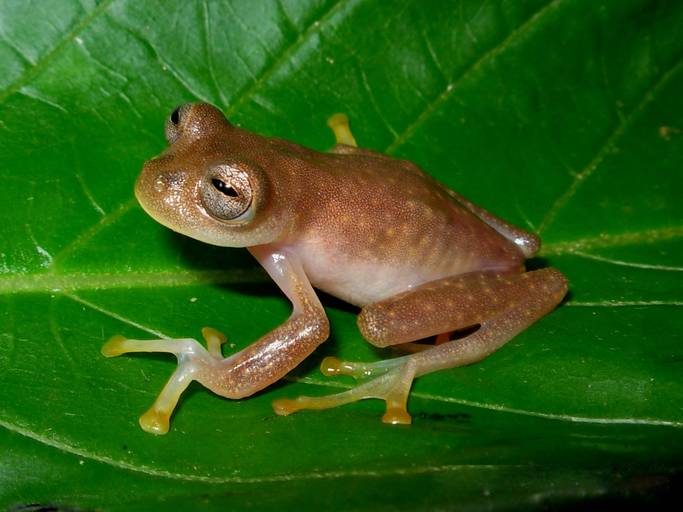
The Red-spotted Glassfrog is an amphibian endemic to Colombia and Ecuador. It inhabits tropical moist montane forests, swamps, streamside foliage, forest edges, and nearby pastures and roads. Its green upper surfaces have numerous small, circular red spots, and its underside is whitish or creamy yellow.
Written 27 November 2026 from the sources listed below. Each statement was checked against the passage it cites; statements that could not be supported were removed.
Appearance
Adults have large, bulbous eyes with yellow irises. Their bodies and limbs are slender, and they have large adhesive discs at the tips of their fingers and toes.[1][2][3]
The upper surfaces of the head and body are green with numerous small, circular red spots. The underside is whitish or creamy yellow.[4][5]
Adult males measure approximately 27 mm in length, while adult females measure approximately 30 mm. Males possess a hooked spur on the upper arm that they use when fighting rivals.[6][7][8]
Habitat
The species inhabits tropical moist montane forests, also known as cloud forests. Individuals occur in foliage in swamps and near streams.[9][10]
It also occurs along forest edges, in pastures, and beside roads, while remaining close to forests. Its altitudinal distribution is between 1,140 and 2,010 metres.[11][12]
The species is endemic to Colombia and Ecuador. In Colombia, it occurs on the western slopes of the Western and Central Cordilleras, while in Ecuador it occurs in Carchi, Cotopaxi, Pichincha, and Santo Domingo de los Tsáchilas provinces.[13][14][15]
The larvae develop in streams and still-water pools.[16]
Behaviour
The species is nocturnal. Males gather in vegetation a few metres above water bodies and call to attract females.[17][18]
Males may continue calling from preferred locations for periods ranging from a few days to three months.[19]
During fights, rival males dangle from twigs and leaves using their hind limbs and engage opponents with their forelimb spurs. Males sometimes sustain injuries during these fights.[20][21]
Reproduction and life cycle
The species breeds in streams and pools. Pairs have been observed in amplexus on the upper surface of large leaves for several hours.[22][23]
Females lay their eggs on the upper surface of leaves near the leaf edge and move forward along the leaf while laying. Males perform various leg movements during egg laying that may help distribute sperm over the eggs.[24][25][26]
An observed clutch contained 61 eggs. The eggs are positioned so that newly hatched tadpoles fall into the water below.[27][28]
After laying eggs, a female was observed covering the clutch with her body for 25 minutes.[29]
Conservation
The species has a restricted geographic range of approximately 20,000 km² or less. It is described as abundant and adaptable, and the IUCN classifies it as Least Concern.[30][31][32]
Deforestation and logging are among the main threats to the species. The introduction of predatory fish into its streams and pollution resulting from agricultural activities are also threats.[33][34][35]
Classification of the Red-spotted Glassfrog
| Kingdom | Animalia |
|---|---|
| Phylum | Chordata |
| Subphylum | Vertebrata |
| Infraphylum | Gnathostomata |
| Parvphylum | Osteichthyes |
| Megaclass | Tetrapoda |
| Class | Amphibia (Amphibians) |
| Order | Anura (Frogs) |
| Family | Centrolenidae (Glass Frog) |
| Subfamily | Centroleninae |
| Genus | Nymphargus (Cochran Frogs) |
| Species | Nymphargus grandisonae (Cochran & Goin, 1970) |
Where the Red-spotted Glassfrog is found
Checklists and occurrence records place Nymphargus grandisonae in 2 countries. GBIF holds 614 georeferenced records of it.
Countries
Regions and cities with the most records
- Pichincha, Ecuador 113
- Risaralda Department, Colombia 85
- Carchi, Ecuador 47
- Antioquia, Colombia 43
- Pereira, Colombia 32
- Santo Domingo de los Tsáchilas, Ecuador 31
- Dosquebradas, Colombia 28
- Circasia, Colombia 27
- Chinchiná, Colombia 26
- Cotopaxi, Ecuador 23
- Quindío Department, Colombia 23
- Armenia, Colombia 22
- Belén de Umbría, Colombia 22
- Calarcá, Colombia 22
- Caldas Department, Colombia 22
- Frontino, Colombia 22
- Montenegro, Colombia 22
- Quimbaya, Colombia 22
- Santa Rosa de Cabal, Colombia 19
- Villamaría, Colombia 18
- El Oro, Ecuador 17
- Manizales, Colombia 17
- Piñas, Ecuador 17
- Nariño, Colombia 15
- Neira, Colombia 15
- Valle del Cauca Department, Colombia 13
- Yarumal, Colombia 9
- Chocó, Colombia 8
- Imbabura, Ecuador 8
- Ciudad Bolívar, Colombia 7
- Manzanares, Colombia 5
- Marsella, Colombia 5
- Pomasqui, Ecuador 5
- Anserma, Colombia 4
- La Virginia, Colombia 4
- Quinchía, Colombia 4
A number beside a place is its count of GBIF occurrence records. A place without a number comes from a checklist alone. Records show where a species has been observed or collected, which can include escapes and vagrants.
Common names
English
- Red-spotted Glassfrog
- Red-dotted Glassfrog
Names in 2 other languages
- Czech
- rosněnka Grandisonové
- Spanish
- Rana de Cristal Sarampiona
Synonyms
2 other scientific names have been used for this species and are now treated as synonyms of Nymphargus grandisonae.
- Centrolene grandisonae (Cochran & Goin, 1970)
- Centrolenella grandisonae Cochran & Goin, 1970
Related species
- Dajomes GlassfrogNymphargus dajomesae
- Bolivian Cochran FrogNymphargus bejaranoi
-
 Cochran FrogNymphargus rosada
-
 Napo Cochran FrogNymphargus anomalus
- Trueb's Cochran FrogNymphargus truebae
- Siren GlassfrogNymphargus siren
-
 Pepper GlassfrogNymphargus griffithsi
-
 Cochran FrogNymphargus cochranae
Compare
Questions and answers
What is the scientific name of the Red-spotted Glassfrog?
The scientific name of the Red-spotted Glassfrog is Nymphargus grandisonae. Written with its author, the full name is Nymphargus grandisonae (Cochran & Goin, 1970).
Which family does the Red-spotted Glassfrog belong to?
Nymphargus grandisonae belongs to the family Centrolenidae, in the order Anura and the class Amphibia.
Where is the Red-spotted Glassfrog found?
Checklists and occurrence records place Nymphargus grandisonae in 2 countries: Ecuador and Colombia.
What is the conservation status of the Red-spotted Glassfrog?
The IUCN Red List category recorded for Nymphargus grandisonae is Least Concern (LC).
What other names does the Red-spotted Glassfrog have?
Nymphargus grandisonae is also known in English as Red-dotted Glassfrog.
How rare is a glass frog?
The Red-spotted Glassfrog is described as abundant and adaptable. It has a restricted geographic range of approximately 20,000 km² or less and is classified as Least Concern by the IUCN.[30][31][32]
What is the habitat of a glass frog?
The Red-spotted Glassfrog inhabits tropical moist montane forests, also known as cloud forests. It occurs in foliage in swamps and near streams, as well as along forest edges, in pastures, and beside roads while remaining close to forests.[9][10][11]
How do glass frogs adapt to their environment?
The Red-spotted Glassfrog has large adhesive discs at the tips of its fingers and toes. Its slender body and limbs, and its nocturnal behaviour, are also characteristic features of the species.[2][3][17]
What are 10 interesting facts about glass frogs?
The Red-spotted Glassfrog has large, bulbous eyes with yellow irises; slender bodies and limbs; large adhesive discs on its fingers and toes; green upper surfaces covered in small circular red spots; and a whitish or creamy yellow underside. It is nocturnal; males have hooked upper-arm spurs; males call from vegetation above water; an observed clutch contained 61 eggs; and a female was observed covering her clutch with her body for 25 minutes.[1][2][3][6][4][5][17][18][27][29]
Sources
Passages the profile rests on
- Adults have large, bulbous eyes with yellow irises. Source passage: “The large, bulbous eyes have yellow irises.” — English Wikipedia
- The body and limbs are slender. Source passage: “The body and limbs are slender” — English Wikipedia
- The frog has large adhesive discs at the tips of its fingers and toes. Source passage: “there are large adhesive discs on the tips of the fingers and toes.” — English Wikipedia
- The upper surfaces of the head and body are green with numerous small, circular red spots. Source passage: “The upper parts of head and body are green with many small red circular spots.” — English Wikipedia
- The underside is whitish or creamy yellow. Source passage: “The underparts are whitish or creamy yellow.” — English Wikipedia
- Males possess a hooked spur on the upper arm that they use when fighting rivals. Source passage: “The male has a hooked spur on the upper arm which is used when fighting rivals.” — English Wikipedia
- Adult males measure approximately 27 mm in length. Source passage: “Adult males of this species are about 27 mm (1.1 in) long” — English Wikipedia
- Adult females measure approximately 30 mm in length. Source passage: “adult females are about 30 mm (1.2 in).” — English Wikipedia
- The species inhabits tropical moist montane forests, also known as cloud forests. Source passage: “Its natural habitat is tropical moist montane forest (cloud forest)” — English Wikipedia
- Individuals occur in foliage in swamps and near streams. Source passage: “It is to be found in foliage in swamps and near streams” — English Wikipedia
- The species also occurs along forest edges, in pastures, and beside roads, while remaining close to forests. Source passage: “in cloud forest, by forest edges, in pastures and by roadsides, but never far from forests.” — English Wikipedia
- The species has an altitudinal distribution between 1,140 and 2,010 metres. Source passage: “Its altitudinal range is between 1,140 and 2,010 m (3,700 and 6,600 ft).” — English Wikipedia
- The species is endemic to Colombia and Ecuador. Source passage: “This frog is endemic to Colombia and Ecuador” — English Wikipedia
- In Colombia, the species occurs on the western slopes of the Western and Central Cordilleras. Source passage: “being found on the western slopes of the Western Cordilleras and the Central Cordilleras in Colombia” — English Wikipedia
- In Ecuador, the species occurs in Carchi, Cotopaxi, Pichincha, and Santo Domingo de los Tsáchilas provinces. Source passage: “in the Ecuadorean provinces of Carchi, Cotopaxi, Pichincha and Santo Domingo de los Tsáchilas.” — English Wikipedia
- The larvae develop in streams and still-water pools. Source passage: “larvae develop in streams and still-water pools.” — English Wikipedia
- The species is nocturnal. Source passage: “This species is nocturnal” — English Wikipedia
- Males gather in vegetation a few metres above water bodies and call to attract females. Source passage: “Males congregate in vegetation a few metres above a water body and call to attract the females.” — English Wikipedia
- Males may continue calling from preferred locations for periods ranging from a few days to three months. Source passage: “They continue to call for a few days, or up to three months, from their favoured locations” — English Wikipedia
- During fights, rival males dangle from twigs and leaves using their hind limbs and engage opponents with their forelimb spurs. Source passage: “dangling from twigs and leaves with their hind limbs while using the spurs on their forelimbs to engage.” — English Wikipedia
- Males sometimes sustain injuries during fights with rivals. Source passage: “They are sometimes injured during these battles.” — English Wikipedia
- The species breeds in streams and pools. Source passage: “breeds in streams and pools.” — English Wikipedia
- Pairs have been observed in amplexus on the upper surface of large leaves for several hours. Source passage: “A pair of frogs was observed in amplexus on the upper surface of a large leaf for several hours” — English Wikipedia
- Females lay their eggs on the upper surface of leaves near the leaf edge. Source passage: “the female positioned herself with the tip of her abdomen near the edge of the leaf and started laying eggs” — English Wikipedia
- Females move forward along the leaf while laying eggs. Source passage: “edging her way forward while doing so.” — English Wikipedia
- Males perform various leg movements during egg laying that may help distribute sperm over the eggs. Source passage: “The male made various leg movements which may have facilitated spreading his sperm over the eggs.” — English Wikipedia
- An observed clutch contained 61 eggs. Source passage: “There were 61 eggs in the clutch” — English Wikipedia
- Eggs are positioned so that newly hatched tadpoles fall into the water below. Source passage: “they would fall into the water below.” — English Wikipedia
- After laying eggs, a female was observed covering the clutch with her body for 25 minutes. Source passage: “the female moved back slowly and covered the eggs with her body for 25 minutes.” — English Wikipedia
- The species has a restricted geographic range of approximately 20,000 km² or less. Source passage: “This frog has a somewhat restricted range extending to about 20,000 km2 (7,700 mi2) or less.” — English Wikipedia
- The species is described as abundant and adaptable. Source passage: “However, it is an abundant and adaptable species” — English Wikipedia
- The IUCN classifies the species as Least Concern. Source passage: “has rated its conservation status as being of "least concern"” — English Wikipedia
- Deforestation and logging are among the main threats to the species. Source passage: “The main threats it faces include deforestation, logging” — English Wikipedia
- The introduction of predatory fish into its streams threatens the species. Source passage: “the introduction of predatory fish into the streams where it lives” — English Wikipedia
- Pollution resulting from agricultural activities is a threat to the species. Source passage: “pollution resulting from agricultural activities.” — English Wikipedia
Data
- Catalogue of Life, 2026-10-16 XR cc by
- Global Biodiversity Information Facility CC BY 4.0
- Wikidata CC0
- GeoNames CC BY 4.0
- Wikimedia Commons per image; credit shown with each image
- Within the Catalogue of Life, this name comes from The Integrated Taxonomic Information System cc0
This species in other databases
Page built on 28 November 2026. See how the catalog is made and all sources and licences.
Cite this page
ScientificNames.org. (2026). Nymphargus grandisonae (Red-spotted Glassfrog). Retrieved November 28, 2026, from https://scientificnames.org/species/nymphargus-grandisonae
“Nymphargus grandisonae (Red-spotted Glassfrog).” ScientificNames.org, 2026, scientificnames.org/species/nymphargus-grandisonae. Accessed 28 Nov. 2026.
ScientificNames.org. “Nymphargus grandisonae (Red-spotted Glassfrog).” Accessed November 28, 2026. https://scientificnames.org/species/nymphargus-grandisonae.
@misc{scientificnames_nymphargus_grandisonae_red_spotted_glassfrog,
  author = {{ScientificNames.org}},
  title = {Nymphargus grandisonae (Red-spotted Glassfrog)},
  year = {2026},
  url = {https://scientificnames.org/species/nymphargus-grandisonae},
  note = {Accessed 2026-11-28}
}