Species · Birds
Pincoya Storm Petrel Oceanites pincoyae
The scientific name of the Pincoya Storm Petrel is Oceanites pincoyae. It is a species of bird in the family Oceanitidae (austral storm petrel), order Procellariiformes. The name dates from 2013.
- Scientific name
- Oceanites pincoyae P. Harrison, Sallaberry, Gaskin, K. Baird, Jaramillo, Metz, Pearman, O'Keeffe et al., 2013
- Common name
- Pincoya Storm Petrel
- Genus
- Oceanites
- Family
- Oceanitidae (Austral Storm Petrel)
- Order
- Procellariiformes
- Class
- Aves
- Red List category
- DD Data Deficient
- Recorded in
- 1 country
- Name status
- accepted in the Catalogue of Life
Overview
The species is recorded from the Puerto Montt and Chacao Channel area of Chile, inland El Bolsón in Argentina, and the Benguela Current off Cape Town, South Africa. Its head, mantle, scapulars, back, and upper rump are blackish-brown, with a silvery-gray wash across several of these areas.
Written 26 November 2026 from the sources listed below. Each statement was checked against the passage it cites; statements that could not be supported were removed.
Appearance
The head, mantle, scapulars, back, and upper rump are blackish-brown. The nape, mantle, scapulars, back, and upper rump have a silvery-gray wash.[1][2]
Some scapular feathers and the longest tertials have narrow, distinct white edges.[3]
Habitat
The species was originally known only from waters near Chiloé Island, Chile, including Reloncavi Sound and the Chacao Channel. It is recorded from the Puerto Montt and Chacao Channel area of Chile.[4][5]
Two specimens have been recorded from inland El Bolsón, Argentina. A Pincoya Storm Petrel was photographed in the Benguela Current off Cape Town, South Africa, in 2021.[6][7]
Similar species
The two paratypes were originally identified as Wilson's storm petrels. They were collected by Argentinian ornithologist Andor Kovács at El Bolsón in 1972 and 1983.[8][9]
Classification of the Pincoya Storm Petrel
| Kingdom | Animalia |
|---|---|
| Phylum | Chordata |
| Subphylum | Vertebrata |
| Infraphylum | Gnathostomata |
| Parvphylum | Osteichthyes |
| Megaclass | Tetrapoda |
| Class | Aves (Bird) |
| Order | Procellariiformes (Petrels) |
| Family | Oceanitidae (Austral Storm Petrel) |
| Genus | Oceanites (Wilson's Storm-Petrels) |
| Species | Oceanites pincoyae P. Harrison, Sallaberry, Gaskin, K. Baird, Jaramillo, Metz, Pearman, O'Keeffe et al., 2013 |
Where the Pincoya Storm Petrel is found
Checklists and occurrence records place Oceanites pincoyae in 1 country across South America. GBIF holds 445 georeferenced records of it.
Countries
Regions and cities with the most records
- Calbuco, Chile 39
- Puerto Montt, Chile 35
- Los Lagos Region, Chile 27
- Maullín, Chile 5
- Puerto Varas, Chile 4
Range as the checklists state it
South America
A number beside a place is its count of GBIF occurrence records. A place without a number comes from a checklist alone. Records show where a species has been observed or collected, which can include escapes and vagrants.
Common names
English
- Pincoya Storm Petrel
- Pincoya Storm-Petrel
Names in 23 other languages
- Arabic
- نوء العاصفة بينكويا
- Bulgarian
- Чилийска вълнолюбка
- Catalan
- ocell de tempesta pincoya
- Chinese
- 平克亞洋海燕, 黑洋海燕
- Croatian
- čilska burnica
- Czech
- buřníček potápivý
- Danish
- Chilensk Stormsvale
- Dutch
- Pincoyastormvogeltje
- Esperanto
- pinkoja ŝtormopetrelo
- French
- Océanite pincoya
- German
- Chilenische Sturmschwalbe, Pincoyasturmschwalbe
- Italian
- Uccello delle tempeste di Pincoya
- Japanese
- ピンコヤウミツバメ
- Lithuanian
- čilinis audrašauklis
- Norwegian
- pincoyastormsvale
- Polish
- oceannik białoskrzydły
- Portuguese
- painho-pincoia, painho-pincoya
- Russian
- Чилийская качурка, Чилийская океанида
- Slovak
- búrkozvest zálivový
- Spanish
- Golondrina de mar pincoya, Paíño pincoya
- Swedish
- pincoyahavslöpare, pincoyastormsvala
- Turkish
- Pinkoya Fırtınakırlangıcı
- Ukrainian
- океанник чилоєський
Related species
-
 Wilson's Storm PetrelOceanites oceanicus
-
 Elliot's Storm PetrelOceanites gracilis
- Andean Storm PetrelOceanites barrosi
-
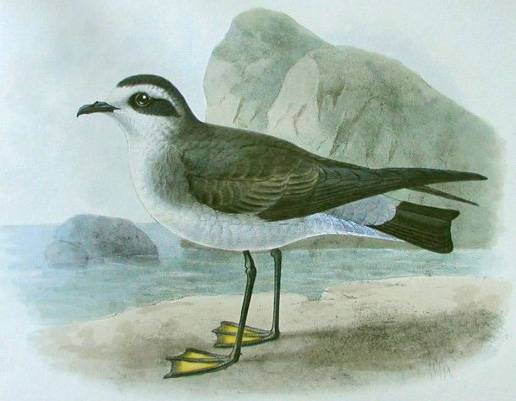 White-faced Storm PetrelPelagodroma marina
-
 New Zealand Storm PetrelFregetta maoriana
-
 Black-bellied Storm PetrelFregetta tropica
-
 White-bellied Storm PetrelFregetta grallaria
-
 Grey-backed Storm PetrelGarrodia nereis
Compare
Questions and answers
What is the scientific name of the Pincoya Storm Petrel?
The scientific name of the Pincoya Storm Petrel is Oceanites pincoyae. Written with its author, the full name is Oceanites pincoyae P. Harrison, Sallaberry, Gaskin, K. Baird, Jaramillo, Metz, Pearman, O'Keeffe et al., 2013.
Which family does the Pincoya Storm Petrel belong to?
Oceanites pincoyae belongs to the family Oceanitidae, in the order Procellariiformes and the class Aves.
Where is the Pincoya Storm Petrel found?
Checklists and occurrence records place Oceanites pincoyae in 1 country: Chile.
What is the conservation status of the Pincoya Storm Petrel?
The IUCN Red List category recorded for Oceanites pincoyae is Data Deficient (DD).
What other names does the Pincoya Storm Petrel have?
Oceanites pincoyae is also known in English as Pincoya Storm-Petrel.
How big is a storm petrel?
The measured female holotype had a head and bill length of 32.9 mm, an exposed culmen length of 11.5 mm, a bill length from gape of 12 mm, a flattened wing length of 134 mm, and a mid-toe length, including claws, of 26.5 mm. The juvenile female paratype had a wing length of 138 mm, tail length of 61 mm, tarsus length of 31.5 mm, culmen length of 9.5 mm, and mid-toe length of 26 mm. The male paratype had a wing length of 137 mm, tarsus length of 30.5 mm, exposed culmen length of 10 mm, and mid-toe length of 27 mm.[10][11][12][13][14][15][16][17][18][19][20][21][22][23]
Sources
Passages the profile rests on
- The species has blackish-brown coloration on its head, mantle, scapulars, back, and upper rump. Source passage: “The head, mantle, scapulars, back and upper rump are blackish-brown.” — English Wikipedia
- The nape, mantle, scapulars, back, and upper rump have a silvery-gray wash. Source passage: “The nape, mantle and scapulars, back and upper rump are washed silvery-gray.” — English Wikipedia
- Some scapular feathers and the longest tertials have narrow, distinct white edges. Source passage: “Some scapulars and the longest tertials have narrow but distinct white edges.” — English Wikipedia
- The species was originally known only from waters near Chiloé Island, Chile, including Reloncavi Sound and the Chacao Channel. Source passage: “It was originally only known from waters near Chiloé Island, Chile, specifically Reloncavi Sound and the Chacao Channel” — English Wikipedia
- The species is recorded from the Puerto Montt and Chacao Channel area of Chile. Source passage: “Oceanites pincoyae is known only from the Puerto Montt and Chacao Channel area, Chile” — datazone.birdlife.org
- A Pincoya Storm Petrel was photographed in the Benguela Current off Cape Town, South Africa, in 2021. Source passage: “in 2021, one was photographed in the Benguela Current off the coast of Cape Town, South Africa” — English Wikipedia
- Two specimens of the species have been recorded from inland El Bolsón, Argentina. Source passage: “and from two specimens taken inland at El Bolson, Argentina.” — datazone.birdlife.org
- The two paratypes were originally identified as Wilson's storm petrels. Source passage: “Two paratypes, a juvenile female and a male which were originally identified as Wilson's storm petrels (Oceanites oceanicus)” — English Wikipedia
- The two paratypes were collected by Argentinian ornithologist Andor Kovács at El Bolsón in 1972 and 1983. Source passage: “collected by Argentinian ornithologist Andor Kovács at El Bolsón, Argentina in 1972 and 1983” — English Wikipedia
- The measured female holotype had a head and bill length of 32.9 mm. Source passage: “head and bill length 32.9 mm” — English Wikipedia
- The female holotype had an exposed culmen length of 11.5 mm. Source passage: “exposed culmen length 11.5 mm” — English Wikipedia
- The female holotype had a bill length from gape of 12 mm. Source passage: “bill length from gape 12 mm” — English Wikipedia
- The female holotype had a flattened wing length of 134 mm. Source passage: “flattened wing length from chord 134 mm” — English Wikipedia
- The female holotype had a mid-toe length, including claws, of 26.5 mm. Source passage: “mid-toe length (with claws) 26.5 mm” — English Wikipedia
- The juvenile female paratype had a wing length of 138 mm. Source passage: “the wing length of the juvenile female is 138 mm” — English Wikipedia
- The juvenile female paratype had a tail length of 61 mm. Source passage: “the tail length 61 mm” — English Wikipedia
- The juvenile female paratype had a tarsus length of 31.5 mm. Source passage: “the tarsus length 31.5 mm” — English Wikipedia
- The juvenile female paratype had a culmen length of 9.5 mm. Source passage: “the culmen length is 9.5 mm” — English Wikipedia
- The juvenile female paratype had a mid-toe length of 26 mm. Source passage: “the mid-toe length is 26 mm” — English Wikipedia
- The male paratype had a wing length of 137 mm. Source passage: “the wing length of the male is 137 mm” — English Wikipedia
- The male paratype had a tarsus length of 30.5 mm. Source passage: “the tarsus length 30.5 mm” — English Wikipedia
- The male paratype had an exposed culmen length of 10 mm. Source passage: “the exposed culmen length is 10 mm” — English Wikipedia
- The male paratype had a mid-toe length of 27 mm. Source passage: “the mid-toe length is 27 mm.” — English Wikipedia
Data
- Catalogue of Life, 2026-10-16 XR cc by
- Global Biodiversity Information Facility CC BY 4.0
- Wikidata CC0
- GeoNames CC BY 4.0
- Within the Catalogue of Life, this name comes from The Integrated Taxonomic Information System cc0
References
- Harrison, Peter, Michel Sallaberry, Chris P. Gaskin, Karen A. Baird, Alvaro Jaramillo, et al. (2013). A New Storm-Petrel Species from Chile. The Auk, Vol. 130, No. 1. Link where the name was published
This species in other databases
Page built on 27 November 2026. See how the catalog is made and all sources and licences.
Cite this page
ScientificNames.org. (2026). Oceanites pincoyae (Pincoya Storm Petrel). Retrieved November 27, 2026, from https://scientificnames.org/species/oceanites-pincoyae
“Oceanites pincoyae (Pincoya Storm Petrel).” ScientificNames.org, 2026, scientificnames.org/species/oceanites-pincoyae. Accessed 27 Nov. 2026.
ScientificNames.org. “Oceanites pincoyae (Pincoya Storm Petrel).” Accessed November 27, 2026. https://scientificnames.org/species/oceanites-pincoyae.
@misc{scientificnames_oceanites_pincoyae_pincoya_storm_petrel,
  author = {{ScientificNames.org}},
  title = {Oceanites pincoyae (Pincoya Storm Petrel)},
  year = {2026},
  url = {https://scientificnames.org/species/oceanites-pincoyae},
  note = {Accessed 2026-11-27}
}