Species · Molluscs
Common Octopus Octopus vulgaris
The scientific name of the Common Octopus is Octopus vulgaris. It is a species of mollusc in the family Octopodidae (scuttles). The name dates from 1797.
- Scientific name
- Octopus vulgaris Cuvier, 1797
- Common name
- Common Octopus
- Genus
- Octopus
- Family
- Octopodidae (Scuttles)
- Class
- Cephalopoda
- Red List category
- LC Least Concern
- Environment
- marine
- Recorded in
- 19 countries
- Name status
- accepted in the Catalogue of Life

Overview
Octopus vulgaris inhabits tropical, subtropical, and temperate marine waters, including relatively shallow rocky coastal seabeds. It can change its colour, skin texture, and posture to conceal itself against its surroundings.
Written 24 November 2026 from the sources listed below. Each statement was checked against the passage it cites; statements that could not be supported were removed.
Appearance
Individuals have eight arms equipped with suckers. The species does not possess an internal shell.[1][2]
The mantle can reach 25 cm in length, while the arms can grow to 1 m. Individuals can weigh as much as 9 kg.[3][4]
Habitat
The Common Octopus inhabits tropical, subtropical, and temperate marine waters. It favors relatively shallow rocky coastal seabeds, generally at depths not exceeding 200 m.[5][6]
It occupies coastal waters and the upper continental shelf, occurring between the sea surface and depths of approximately 100–150 m. It is not found in polar or subpolar environments.[7][8][9]
Diet
The Common Octopus primarily consumes gastropods and bivalves. Its preferred prey includes crabs, lobsters, and bivalve molluscs such as cockles.[10][11]
Behaviour
The Common Octopus can alter its coloration to camouflage itself against its surroundings. It can also conceal itself by changing its colour, skin texture, and posture.[12][13]
Individuals generally live alone and defend their territories. They typically remain in dens during the day, leave around dusk to hunt, and return at dawn.[14][15]
Some individuals retain the same den for extended periods, whereas others change shelters several times within a few days.[16]
The species can learn and distinguish visual, tactile, and chemical signals. It can distinguish brightness, size, shape, and the horizontal or vertical orientation of objects.[17][18]
Reproduction and life cycle
The species has separate male and female individuals. Males transfer spermatophores into the female's mantle cavity using a specialized arm called the hectocotylus.[19][20]
Copulation can continue for several hours. The same mating pair may copulate repeatedly over approximately one week.[21][22]
Females attach their eggs to a substrate in shallow water and can produce between 100,000 and 500,000 eggs. Eggs may be deposited in empty mollusc shells or artificial objects on sandy or muddy seabeds.[23][24][25]
In tropical and subtropical waters, egg laying can occur throughout the year. Females may brood their eggs for as long as four to five months in low-temperature conditions.[26][27]
Embryonic development duration depends on temperature and egg size. Females generally die shortly after the final embryos hatch.[28][29]
Its lifespan is approximately 12–24 months.[30]
Conservation
Overfishing has been identified as a potential threat to the species' continued proliferation. The species was reported as not being at any specific risk in the cited account.[31][32]
Uses
The Common Octopus is commercially harvested by bottom trawling off the northwestern African coast. Annual harvests off northwestern Africa exceed 20,000 tonnes.[33][34]
Reported fisheries catches amounted to approximately 121,000 tonnes in 1975 and reached approximately 137,000 tonnes in 1976.[35][36]
Classification of the Common Octopus
| Kingdom | Animalia |
|---|---|
| Phylum | Mollusca |
| Class | Cephalopoda (Cephalopod) |
| Subclass | Coleoidea |
| Superorder | Octopodiformes |
| Family | Octopodidae (Scuttles) |
| Genus | Octopus |
| Species | Octopus vulgaris Cuvier, 1797 |
Where the Common Octopus is found
Checklists and occurrence records place Octopus vulgaris in 19 countries. GBIF holds 22,156 georeferenced records of it.
Countries
- Albania 25
- Belgium 6
- Croatia 564
- Cyprus 26
- France 5,954
- Gibraltar 7
- Greece 558
- Guernsey 9
- Isle of Man 3
- Italy 551
- Malta 77
- Monaco 3
- Montenegro 19
- Portugal 1,914
- South Africa 572
- Spain 11,005
- The Netherlands 29
- United Kingdom 109
- United States 725
Regions and cities with the most records
- Marseille 09, France 1,345
- Marseille 11, France 1,266
- Marseille 10, France 1,256
- Marseille 12, France 1,245
- Marseille 08, France 1,238
- Marseille, France 1,237
- Marseille 03, France 1,237
- Marseille 05, France 1,235
- Marseille 04, France 1,234
- Marseille 13, France 1,233
- Marseille 14, France 1,223
- Catalonia, Spain 1,066
- Marseille 15, France 1,010
- Provence-Alpes-Côte d'Azur, France 971
- Aubagne, France 650
- Martigues, France 588
- Setúbal, Portugal 534
- Toulon, France 368
- La Seyne-sur-Mer, France 366
- Cagnes-sur-Mer, France 354
- Antibes, France 336
- Benidorm, Spain 330
- Cannes, France 319
- Juan-les-Pins, France 313
- Arrecife, Spain 308
- Fréjus, France 306
- Hyères, France 273
- Canary Islands, Spain 271
- Nice, France 248
- São Domingos de Rana, Portugal 237
- Western Cape, South Africa 230
- Montpellier, France 226
- Rio de Mouro, Portugal 219
- Cacém, Portugal 218
- Algueirão, Portugal 214
- Alicante, Spain 210
48 more countries have a few records outside this range
These countries hold a few records of Octopus vulgaris but lie outside the range the checklists give for it. Such records are often zoo or garden specimens, museum material or vagrants, so the species is not counted as occurring there.
- Algeria 13
- Angola 18
- Australia 4
- Bahamas 25
- Barbados 6
- Bermuda 7
- Bonaire, Saint Eustatius and Saba 16
- Brazil 69
- Cabo Verde 12
- Canada 18
- Chile 66
- China 31
- Colombia 3
- Costa Rica 10
- Egypt 15
- French Guiana 4
- French Southern Territories 4
- Guadeloupe 82
- Guyana 3
- Haiti 3
- Honduras 3
- India 10
- Indonesia 18
- Israel 35
- Ivory Coast 3
- Japan 61
- Madagascar 57
- Maldives 5
- Martinique 32
- Mauritania 8
- Mexico 15
- Morocco 54
- Mozambique 6
- New Zealand 3
- Panama 18
- Puerto Rico 10
- Reunion 5
- Saint Barthelemy 4
- Saint Helena 4
- Senegal 13
- Sierra Leone 5
- South Korea 38
- Suriname 6
- Taiwan 3
- Tunisia 14
- Turkey 117
- U.S. Virgin Islands 6
- Venezuela 11
A number beside a place is its count of GBIF occurrence records. A place without a number comes from a checklist alone. Records show where a species has been observed or collected, which can include escapes and vagrants.
Common names
English
- Common Octopus
- European Common Octopus
- Kolkrabbi
- Mediterranean Octopus
- Octopus
- Common Atlantic Octopus
- Common European Octopus
- Rock Scuttle
- Scuttle
Names in 43 other languages
- Afrikaans
- Gewone Seekat
- Albanian
- Oktapodi, likurishtja, oktapodi i zakonshëm, tetëkëmbëshi
- Arabic
- أخطبوط شائع
- Asturian
- Pulpu
- Basque
- Olagarro Arrunta
- Breton
- Morgazh
- Bulgarian
- Обикновен октопод
- Catalan
- Pop, pop roquer, pop ver
- Chinese
- 真蛸
- Croatian
- Obična hobotnica
- Czech
- chobotnice pobřežní
- Danish
- almindelig ottearmet blæksprutte
- Dutch
- Europese achtarm, achtarm, gewone achtarm, gewone octopus, gewoone octopus, kraak
- Estonian
- Harilik Kaheksajalg
- Finnish
- meritursas
- French
- pieuvre, pieuvre commune, poulpe, poulpe commun, poulpe de roche
- Galician
- Polbo común, polvo
- German
- Gemeiner Octopus, Gewöhnliche Krake, Krake, Oktopus, Polyp, gemeiner Krake, gewöhnlicher Krake
- Greek
- Κοινό χταπόδι, Χταπόδι
- Hebrew
- תְּמָנוּן סְלָעִים, תמנון החוף, תמנון מצוי, תמנון סלעים
- Hungarian
- Közönséges polip
- Irish
- Ochtapas coiteann
- Italian
- piovra, polpo comune, polpo di scoglio
- Japanese
- ma-dako tako, マダコ
- Korean
- 참문어
- Lithuanian
- Paprastasis aštuonkojis
- Luxembourgish
- Gewéinlechen Tëntefësch
- Macedonian
- Обичен октопод
- Occitan
- Pofre
- Papiamento
- Zeekát corá, Zeekát di piédra
- Polish
- ośmiornica zwyczajna
- Portuguese
- Polvo-comum, polvo comum, polvo-vulgar
- Russian
- obiknovenniy osminog, obiknovenniy shprot, Обыкновенный осьминог
- Slovak
- osmonoh obyčajný
- Slovenian
- navadna hobotnica
- Spanish
- Pulpo de roca del Atlántico, Pulpo roquero, pulpo, pulpo común, pulpo de roca
- Swedish
- attaarmade bläckfiskar, jättekrake
- Thai
- ปลาหมึกสายใหญ่
- Turkish
- Adi Ahtapot
- Ukrainian
- Восьминіг звичайний
- Vietnamese
- Bạch tuộc thông thường
- arg
- Polpo común
- mey
- azeiz
Synonyms
32 other scientific names have been used for this species and are now treated as synonyms of Octopus vulgaris.
- Octopus albus Rafinesque, 1814
- Octopus americanus Montfort, 1802
- Octopus bitentaculatus Risso, 1854
- Octopus brevitentaculatus Blainville, 1826
- Octopus cassiopea J. E. Gray, 1849
- Octopus cassiopeia Gray, 1849
- Octopus coerulescentes Fra Piero, 1895
- Octopus coerulescentes Arbanasich, 1895
- Octopus granulatus Lamarck, 1798
- Octopus heteropus Rafinesque, 1814
- Octopus incertus Targioni-Tozzetti, 1869
- Octopus maculatus Rafinesque, 1814
- Octopus niger Rafinesque, 1814
- Octopus niger Risso, 1854
- Octopus octopodia Tryon, 1879
- Octopus pilosus Risso, 1826
- Octopus rabassin Risso, 1854
- Octopus ruber Rafinesque, 1814
- Octopus rugosus (Bosc, 1792)
- Octopus tetradynamus Rafinesque, 1814
- Octopus tritentaculatus Risso, 1854
- Octopus troscheli Targioni-Tozzetti, 1869
- Octopus troschelii Targioni-Tozzetti, 1869
- Octopus tuberculatus Risso, 1826
- Octopus vulgaris americanus D'Orbigny, 1842 In R. de la Sagra, 1838-1857
- Sepia granulata Bosc, 1792
- Sepia octopus Gmelin, 1791
- Sepia polypus Oken, 1815
- Sepia rugosa Bosc, 1792
- Octopus moschatus Rafinesque, 1814 ambiguous synonym
- Octopus tuberculatus Targioni-Tozzetti, 1869 ambiguous synonym
- Octopus tuberculatus Blainville, 1826 ambiguous synonym
Related species
-
 Star-sucker Pygmy OctopusOctopus wolfi
-
 Day OctopusOctopus cyanea
-
 Gloomy OctopusOctopus tetricus
-
 California Two-spot OctopusOctopus bimaculoides
-
 East Pacific Red OctopusOctopus rubescens
-
 Whiparm OctopusOctopus minor
-
 Caribbean Reef OctopusOctopus briareus
-
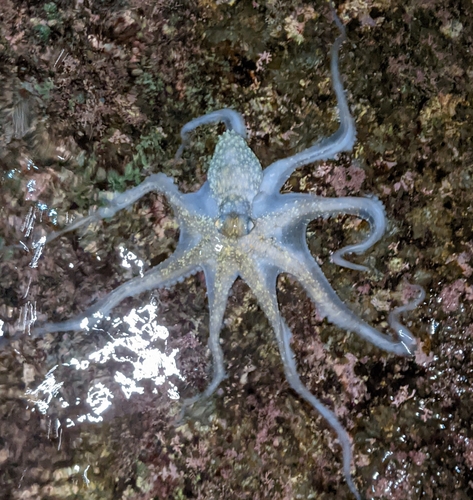 Oliver's OctopusOctopus oliveri
Compare
Questions and answers
What is the scientific name of the Common Octopus?
The scientific name of the Common Octopus is Octopus vulgaris. Written with its author, the full name is Octopus vulgaris Cuvier, 1797.
Which family does the Common Octopus belong to?
Octopus vulgaris belongs to the family Octopodidae and the class Cephalopoda.
Where is the Common Octopus found?
Checklists and occurrence records place Octopus vulgaris in 19 countries, including Spain, France, Portugal, United States, South Africa and Croatia.
What is the conservation status of the Common Octopus?
The IUCN Red List category recorded for Octopus vulgaris is Least Concern (LC).
What other names does the Common Octopus have?
Octopus vulgaris is also known in English as European Common Octopus, Kolkrabbi, Mediterranean Octopus, Octopus, Common Atlantic Octopus and Common European Octopus.
What does Octopus vulgaris eat?
It primarily consumes gastropods and bivalves. Its preferred prey includes crabs, lobsters, and cockles.[10][11]
Sources
Passages the profile rests on
- Individuals have eight arms equipped with suckers. Source passage: “Like other octopuses, members of this species have 8 arms that are lined with suckers, and they lack any internal shell.” — animaldiversity.org
- The species does not possess an internal shell. Source passage: “Like other octopuses, members of this species have 8 arms that are lined with suckers, and they lack any internal shell.” — animaldiversity.org
- Its mantle can reach 25 cm in length, while its arms can grow to 1 m. Source passage: “Octopus vulgaris grows to 25 cm (10 inches) in mantle length with arms up to 1 m (3.3 feet) long.” — English Wikipedia
- Individuals can weigh as much as 9 kg. Source passage: “It lives for 1–2 years and may weigh up to 9 kg (20 pounds).” — English Wikipedia
- The species inhabits tropical, subtropical, and temperate marine waters. Source passage: “The common octopus has worldwide distribution in tropical, subtropical and temperate waters throughout the world.” — English Wikipedia
- It favors relatively shallow rocky coastal seabeds, generally at depths not exceeding 200 m. Source passage: “They prefer the floor of relatively shallow, rocky, coastal waters, often no deeper than 200 m (660 feet).” — English Wikipedia
- It occupies coastal waters and the upper continental shelf. Source passage: “It lives in costal waters and the upper part of the continental shelf.” — animaldiversity.org
- It occurs between the sea surface and depths of approximately 100–150 m. Source passage: “Octopus vulgaris is found in tropical, subtropical, and temperate waters between the surface and a depth of 100 to 150 meters.” — animaldiversity.org
- The species is not found in polar or subpolar environments. Source passage: “It is not found in polar or subpolar regions.” — animaldiversity.org
- Its preferred prey includes crabs, lobsters, and bivalve molluscs such as cockles. Source passage: “Crabs, lobsters, and bivalve mollusks (such as cockles) are preferred, although the octopus eats almost anything it can catch.” — English Wikipedia
- It primarily consumes gastropods and bivalves. Source passage: “Octopus vulgaris are active predators that feed primarily on gastropods and bivalves.” — animaldiversity.org
- It can alter its coloration to camouflage itself against its surroundings. Source passage: “It is able to change colour to blend in with its surroundings” — English Wikipedia
- It can conceal itself by changing its colour, skin texture, and posture. Source passage: “Their capacity to conceal themselves on any substrate by varying colour, skin, texture, and posture is challenged by few other cephalopod species.” — animaldiversity.org
- Individuals generally live alone and defend their territories. Source passage: “Octopus vulgaris is normally solitary and territorial.” — animaldiversity.org
- Individuals typically remain in dens during the day, leave around dusk to hunt, and return at dawn. Source passage: “Underwater observations showed that the animals remain in their dens; they leave them at dusk for hunting trips and return at dawn.” — animaldiversity.org
- Some individuals retain the same den for extended periods, whereas others change shelters several times within a few days. Source passage: “Some octopuses may occupy the same home for a longer period while others change holes several times over a few days.” — animaldiversity.org
- The species can learn and distinguish visual, tactile, and chemical signals. Source passage: “Octopuses can learn. They can make discriminations based on visual, tactile, and chemical cues.” — animaldiversity.org
- It can distinguish brightness, size, shape, and the horizontal or vertical orientation of objects. Source passage: “Training experiments have shown the common octopus can distinguish the brightness, size, shape, and horizontal or vertical orientation of objects.” — English Wikipedia
- The species has separate male and female individuals. Source passage: “Octopus vulgaris has individuals of both sexes.” — animaldiversity.org
- Males transfer spermatophores into the female's mantle cavity using a specialized arm called the hectocotylus. Source passage: “He sits next to her or mounts her, inserting the hectocotylus in her mantle cavity to pass the spermatophores.” — animaldiversity.org
- Copulation can continue for several hours. Source passage: “They may copulate for several hours.” — animaldiversity.org
- The same mating pair may copulate repeatedly over approximately one week. Source passage: “The same pair often repeat mating over a period of a week or so, but a male copulates with other females and a female accepts other males.” — animaldiversity.org
- Females attach their eggs to a substrate in shallow water. Source passage: “Eggs are laid in shallow water. They are always attached to a substrate.” — animaldiversity.org
- A female can produce between 100,000 and 500,000 eggs. Source passage: “The total number of eggs laid by a female varies from 100,000 to 500,000.” — animaldiversity.org
- Eggs may be deposited in empty mollusc shells or artificial objects on sandy or muddy seabeds. Source passage: “On sandy or muddy bottom, eggs are laid in empty mollusc shells or in man-made objects such as cans, tins, bottles, tires, boots, and amphorae” — animaldiversity.org
- In tropical and subtropical waters, egg laying can occur throughout the year. Source passage: “In tropical and subtropical waters, eggs are laid throughout the year.” — animaldiversity.org
- Females may brood their eggs for as long as four to five months in low-temperature conditions. Source passage: “She usually does not feed during the entire period of spawning and brooding, which can be as long as 4-5 months at low temperatures.” — animaldiversity.org
- Females generally die shortly after the final embryos hatch. Source passage: “As a rule, females die shortly after the hatching of the last embryos after losing one-third of their pre-spawning weight.” — animaldiversity.org
- Embryonic development duration depends on temperature and egg size. Source passage: “The duration of embryonic development is related to temperature, as it is in all cephalopods, and it also depends on the size of the egg.” — animaldiversity.org
- Its lifespan is approximately 12–24 months. Source passage: “These animals have a life span of 12 to 24 months.” — animaldiversity.org
- Overfishing has been identified as a potential threat to the species' continued proliferation. Source passage: “There is the potential for the overfishing of these animals, which threatens their proliferation.” — animaldiversity.org
- The species was reported as not being at any specific risk in the cited account. Source passage: “However, at this time, they are not at any specific risk.” — animaldiversity.org
- The species is commercially harvested by bottom trawling off the northwestern African coast. Source passage: “O. vulgaris is caught by bottom trawls on a huge scale off the northwestern coast of Africa.” — English Wikipedia
- Annual harvests off northwestern Africa exceed 20,000 tonnes. Source passage: “More than 20,000 tonnes (22,000 short tons) are harvested annually.” — English Wikipedia
- Reported fisheries catches amounted to approximately 121,000 tonnes in 1975. Source passage: “In 1975, some 121,000 tons of O. vulgaris were caught by fisheries.” — animaldiversity.org
- Reported fisheries catches reached approximately 137,000 tonnes in 1976. Source passage: “In 1976, the number was 137,000 tons.” — animaldiversity.org
Data
- Catalogue of Life, 2026-10-16 XR cc by
- Global Biodiversity Information Facility CC BY 4.0
- Wikidata CC0
- GeoNames CC BY 4.0
- Wikimedia Commons per image; credit shown with each image
- Within the Catalogue of Life, this name comes from World Register of Marine Species cc by
References
- Cuvier, G. (1797). Tableau élémentaire de l’histoire naturelle des animaux. [Elementary Table of the Natural History of Animals.]. Baudoin, Paris, :i–xvi, 1–710, pls 1–14. [Dec 1797]. where the name was published
This species in other databases
Page built on 24 November 2026. See how the catalog is made and all sources and licences.
Cite this page
ScientificNames.org. (2026). Octopus vulgaris (Common Octopus). Retrieved November 24, 2026, from https://scientificnames.org/species/octopus-vulgaris
“Octopus vulgaris (Common Octopus).” ScientificNames.org, 2026, scientificnames.org/species/octopus-vulgaris. Accessed 24 Nov. 2026.
ScientificNames.org. “Octopus vulgaris (Common Octopus).” Accessed November 24, 2026. https://scientificnames.org/species/octopus-vulgaris.
@misc{scientificnames_octopus_vulgaris_common_octopus,
  author = {{ScientificNames.org}},
  title = {Octopus vulgaris (Common Octopus)},
  year = {2026},
  url = {https://scientificnames.org/species/octopus-vulgaris},
  note = {Accessed 2026-11-24}
}