Comparison
Common Octopus vs Mimic Octopus
Common Octopus (Octopus vulgaris) and Mimic Octopus (Thaumoctopus mimicus) both belong to the family Octopodidae (scuttles) and part ways below it.

Common Octopus
Octopus vulgaris
Comingio Merculiano (1845-1915) in Jatta Giuseppe (1860-1903), Public domain, via Wikimedia Commons


How they differ
The Common octopus (Octopus vulgaris) primarily consumes gastropods and bivalves, whereas the Mimic octopus (Thaumoctopus mimicus) feeds on small fish, crabs, and worms. The Common octopus (Octopus vulgaris) inhabits relatively shallow rocky coastal seabeds, generally at depths not exceeding 200 m, whereas the Mimic octopus (Thaumoctopus mimicus) primarily occupies sandy or silty seabeds at depths below 15 meters.
| Common Octopus | Mimic Octopus | |
|---|---|---|
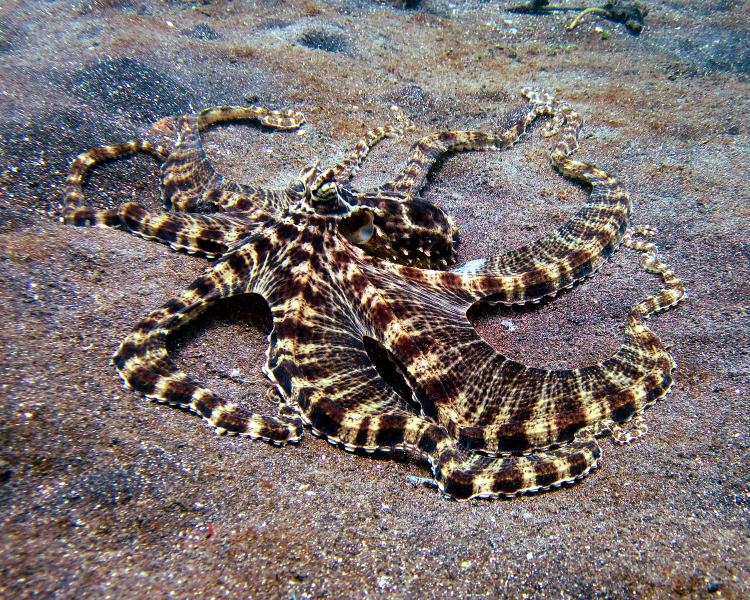
| Appearance | The Common octopus (Octopus vulgaris) has eight arms equipped with suckers and does not possess an internal shell. | The Mimic octopus (Thaumoctopus mimicus) has a slender body, pencil-width arms at their widest, and small horn-like projections above each eye. |
| Camouflage and mimicry | The Common octopus (Octopus vulgaris) conceals itself by changing its colour, skin texture, and posture. | The Mimic octopus (Thaumoctopus mimicus) can imitate as many as 18 different marine animals. |
| Social behaviour | The Common octopus (Octopus vulgaris) generally lives alone and defends its territory. | The Mimic octopus (Thaumoctopus mimicus) can use mimicry to approach wary prey. |
| Diet | The Common octopus (Octopus vulgaris) primarily consumes gastropods and bivalves. | The Mimic octopus (Thaumoctopus mimicus) feeds on small fish, crabs, and worms. |
| Habitat | The Common octopus (Octopus vulgaris) inhabits tropical, subtropical, and temperate marine waters. | The Mimic octopus (Thaumoctopus mimicus) prefers river mouths and estuaries. |
| Seabed | The Common octopus (Octopus vulgaris) favors relatively shallow rocky coastal seabeds, generally at depths not exceeding 200 m. | The Mimic octopus (Thaumoctopus mimicus) primarily occupies sandy or silty seabeds at depths below 15 meters. |
Written from the checked facts listed further down. Statements that the sources did not support were removed.
Side by side
| Common Octopus | Mimic Octopus | |
|---|---|---|
| Scientific name | Octopus vulgaris Cuvier, 1797 | Thaumoctopus mimicus M. Norman & Hochberg, 2005 |
| English name | Common Octopus | Mimic Octopus |
| Group | Molluscs | Molluscs |
| Class | Cephalopoda Cephalopod | Cephalopoda Cephalopod |
| Family | Octopodidae Scuttles | Octopodidae Scuttles |
| Genus | Octopus | Thaumoctopus Mimic Octopus |
| Named in | 1797 | 2005 |
| Red List category | Least Concern | Least Concern |
| Environment | marine | marine |
| Countries on record | 19 countries | 6 countries |
| GBIF occurrence records | 22,156 records | 220 records |
Rows where the two agree are shown in grey.
Where each is found
Only Common Octopus (19)
- Albania
- Belgium
- Croatia
- Cyprus
- France
- Gibraltar
- Greece
- Guernsey
- Isle of Man
- Italy
- Malta
- Monaco
- Montenegro
- Portugal
- South Africa
- Spain
- The Netherlands
- United Kingdom
- United States
Only Mimic Octopus (6)
From Catalogue of Life checklists and GBIF occurrence records. A country missing from a list means no record is held, which is not proof of absence.
Checked facts
| Common Octopus | Mimic Octopus | |
|---|---|---|
| Appearance |
|
|
| Size |
|
|
| Habitat |
|
|
| Diet |
|
|
| Behaviour |
|
|
| Reproduction |
| No checked fact yet |
| Lifespan |
| No checked fact yet |
| Conservation |
| No checked fact yet |
| Uses |
| No checked fact yet |
In brief
Common Octopus
Octopus vulgaris inhabits tropical, subtropical, and temperate marine waters, including relatively shallow rocky coastal seabeds. It can change its colour, skin texture, and posture to conceal itself against its surroundings. Full profile
Mimic Octopus
Thaumoctopus mimicus inhabits muddy river-mouth bottoms, estuaries, and shallow offshore waters, primarily on sandy or silty seabeds at depths below 15 meters. Full profile
Compare something else
Page built on 24 November 2026 from the data on the two species pages, where every source is listed.
Cite this page
ScientificNames.org. (2026). Common Octopus vs Mimic Octopus. Retrieved November 24, 2026, from https://scientificnames.org/compare/common-octopus-vs-mimic-octopus
“Common Octopus vs Mimic Octopus.” ScientificNames.org, 2026, scientificnames.org/compare/common-octopus-vs-mimic-octopus. Accessed 24 Nov. 2026.
ScientificNames.org. “Common Octopus vs Mimic Octopus.” Accessed November 24, 2026. https://scientificnames.org/compare/common-octopus-vs-mimic-octopus.
@misc{scientificnames_common_octopus_vs_mimic_octopus,
  author = {{ScientificNames.org}},
  title = {Common Octopus vs Mimic Octopus},
  year = {2026},
  url = {https://scientificnames.org/compare/common-octopus-vs-mimic-octopus},
  note = {Accessed 2026-11-24}
}