Species · Molluscs
Odostomia canfieldi
Odostomia canfieldi has no English name on record in the checklists used here. It is a species of mollusc in the family Pyramidellidae (pyrams). The name dates from 1908.
- Scientific name
- Odostomia canfieldi Dall, 1908
- Genus
- Odostomia
- Family
- Pyramidellidae (Pyrams)
- Class
- Gastropoda
- Environment
- marine
- Recorded in
- 1 country
- Name status
- accepted in the Catalogue of Life

Overview
The species occurs in the Pacific Ocean off California. It has a large, white, glossy shell with six well-rounded teleoconch whorls and a prominent oblique columellar fold.
Written 27 November 2026 from the sources listed below. Each statement was checked against the passage it cites; statements that could not be supported were removed.
Appearance
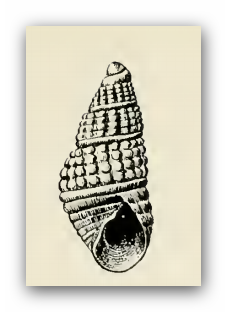
The species has a large, white, glossy shell resembling that of Odostomia (Amaura) avellana in form. It is among the larger species in its genus.[1][2][3]
The protoconch consists of three elevated, helicoid whorls deeply immersed in the first subsequent whorl, with their axis perpendicular to the axis of the later whorls. The teleoconch has six well-rounded whorls with beveled shoulders at their summits.[4][5]
The shell has simple, clearly defined sutures. The periphery and base of the body whorl are rounded and inflated, with the base somewhat elongated.[6][7]
The aperture is somewhat ovate and expanded at its anterior end, with an acute posterior angle. The outer lip is thin at its edge and thick on its inner side.[8][9][10]
The columella is curved and somewhat revolute, with a prominent oblique fold near its insertion. The parietal wall is covered with a thin callus.[11][12]
Similar species
The shell resembles that of Odostomia (Amaura) avellana in form.[2]
Habitat
The species occurs in the Pacific Ocean off California.[13]
Classification of Odostomia canfieldi
| Kingdom | Animalia |
|---|---|
| Phylum | Mollusca |
| Class | Gastropoda (Gastropod) |
| Subclass | Heterobranchia |
| Infraclass | Euthyneura |
| Subterclass | Tectipleura |
| Superorder | Pylopulmonata |
| Superfamily | Pyramidelloidea |
| Family | Pyramidellidae (Pyrams) |
| Subfamily | Odostomiinae |
| Genus | Odostomia |
| Species | Odostomia canfieldi Dall, 1908 |
Where Odostomia canfieldi is found
Checklists and occurrence records place Odostomia canfieldi in 1 country. GBIF holds 20 georeferenced records of it.
Countries
Regions and cities with the most records
- California, United States 7
- El Segundo, United States 7
- Hawthorne, United States 7
- Hermosa Beach, United States 7
- Inglewood, United States 7
- Lawndale, United States 7
- Lennox, United States 7
- Manhattan Beach, United States 7
- Westmont, United States 7
- Santa Monica, United States 6
A number beside a place is its count of GBIF occurrence records. A place without a number comes from a checklist alone. Records show where a species has been observed or collected, which can include escapes and vagrants.
Synonyms
2 other scientific names have been used for this species and are now treated as synonyms of Odostomia canfieldi.
- Odostomia (Amaura) canfieldi Dall, 1908
- Odostomia (Amaura) montereyensis Dall & Bartsch, 1907
Related species
- Odostomia limpida
-
 Odostomia kromi
-
 Odostomia acuta
-
 Odostomia turrita
- Odostomia plicata
-
 Odostomia promeces
-
 Odostomia calliope
-
 Odostomia laevigata
Compare
Questions and answers
Where does Odostomia canfieldi occur?
It occurs in the Pacific Ocean off California.[13]
What does the shell look like?
The shell is large, white and glossy, with six well-rounded teleoconch whorls and beveled shoulders.[1][5]
Which species does its shell resemble?
Its shell resembles that of Odostomia (Amaura) avellana in form.[2]
What characterizes its columella?
The columella is curved and somewhat revolute, with a prominent oblique fold near its insertion.[11]
How large is it relative to other species in its genus?
It is among the larger species in its genus.[3]
Sources
Passages the profile rests on
- The species has a large, white, glossy shell. Source passage: “The large, white, shining shell” — English Wikipedia
- The shell resembles that of Odostomia (Amaura) avellana in form. Source passage: “The large, white, shining shell is similar in form to Odostomia (Amaura) avellana.” — English Wikipedia
- This species is among the larger species in its genus. Source passage: “and is one of the larger species within this genus.” — English Wikipedia
- The protoconch consists of three elevated, helicoid whorls deeply immersed in the first subsequent whorl, with their axis perpendicular to the axis of the later whorls. Source passage: “The three whorls of the protoconch are helicoid, quite elevated, deeply immersed in the first of the succeeding whorls, having their axis at a right angle to the axis of the later whorls.” — English Wikipedia
- The teleoconch has six well-rounded whorls with beveled shoulders at their summits. Source passage: “The six whorls of the teleoconch are well rounded, with a beveled shoulder at the summits.” — English Wikipedia
- The shell has simple, clearly defined sutures. Source passage: “The sutures are simple and well marked.” — English Wikipedia
- The periphery and base of the body whorl are rounded and inflated, with the base somewhat elongated. Source passage: “The periphery and the base of the body whorl are well rounded and inflated, the latter somewhat elongated.” — English Wikipedia
- The aperture is somewhat ovate and expanded at its anterior end. Source passage: “The aperture is subovate, somewhat effuse anteriorly.” — English Wikipedia
- The posterior angle of the aperture is acute. Source passage: “The posterior angle is acute.” — English Wikipedia
- The outer lip is thin at its edge and thick on its inner side. Source passage: “The outer lip is thin at the edge, thick within.” — English Wikipedia
- The columella is curved and somewhat revolute, with a prominent oblique fold near its insertion. Source passage: “The columella is curved and somewhat revolute, having a prominent oblique fold near its insertion.” — English Wikipedia
- The parietal wall is covered with a thin callus. Source passage: “The parietal wall is covered by a thin callus.” — English Wikipedia
- The species occurs in the Pacific Ocean off California. Source passage: “This species occurs in the Pacific Ocean off California.” — English Wikipedia
Data
- Catalogue of Life, 2026-10-16 XR cc by
- Global Biodiversity Information Facility CC BY 4.0
- Wikidata CC0
- GeoNames CC BY 4.0
- Wikimedia Commons per image; credit shown with each image
- Within the Catalogue of Life, this name comes from World Register of Marine Species cc by
This species in other databases
Page built on 29 November 2026. See how the catalog is made and all sources and licences.
Cite this page
ScientificNames.org. (2026). Odostomia canfieldi. Retrieved November 29, 2026, from https://scientificnames.org/species/odostomia-canfieldi
“Odostomia canfieldi.” ScientificNames.org, 2026, scientificnames.org/species/odostomia-canfieldi. Accessed 29 Nov. 2026.
ScientificNames.org. “Odostomia canfieldi.” Accessed November 29, 2026. https://scientificnames.org/species/odostomia-canfieldi.
@misc{scientificnames_odostomia_canfieldi,
  author = {{ScientificNames.org}},
  title = {Odostomia canfieldi},
  year = {2026},
  url = {https://scientificnames.org/species/odostomia-canfieldi},
  note = {Accessed 2026-11-29}
}