Species · Fishes
Rainbow Trout Oncorhynchus mykiss
The scientific name of the Rainbow Trout is Oncorhynchus mykiss. It is a species of fish in the family Salmonidae (trouts), order Salmoniformes. The name dates from 1792.
- Scientific name
- Oncorhynchus mykiss (Walbaum, 1792)
- Common name
- Rainbow Trout
- Genus
- Oncorhynchus
- Family
- Salmonidae (Trouts)
- Order
- Salmoniformes
- Class
- Teleostei
- Environment
- brackish, freshwater, marine
- Recorded in
- 27 countries
- Name status
- accepted in the Catalogue of Life

Overview
The native range extends from the Kamchatka Peninsula in Russia through the Aleutian Islands and Alaska to northern Mexico along the Pacific basin. Adults generally have extensive black body spotting and a broad reddish stripe along the lateral line from the gills to the tail.
Written 24 November 2026 from the sources listed below. Each statement was checked against the passage it cites; statements that could not be supported were removed.
Appearance
Adult freshwater Rainbow Trout are generally blue-green or olive green with extensive black spotting along their bodies. A broad reddish stripe runs along the lateral line from the gills to the tail and is most pronounced in breeding males.[1][2]
Lake-dwelling and anadromous Rainbow Trout are generally more silvery and have a greatly reduced reddish stripe. Juveniles display dark vertical parr marks along their bodies.[3][4]
The caudal fin is squarish and only slightly forked.[5]
In Virginia, Rainbow Trout typically have olive-green backs with brassy to purple iridescence and dark olive to black spots on their backs and sides. Their mid-side band ranges from red to pink or purple and may be continuous or broken into blotches.[6][7][8]
Habitat
Lake-resident Rainbow Trout generally occupy moderately deep, cool lakes with sufficient shallow areas and vegetation to support food production. Self-sustaining lake populations generally require access to streams with gravel bottoms.[9][10]
Wild Rainbow Trout populations in Virginia commonly occur in small rocky streams within forested landscapes.[11]
Diet
Rainbow Trout feed on aquatic insect larvae, pupae and adults, including caddisflies, stoneflies, mayflies and aquatic flies. They also consume terrestrial insects such as ants, beetles, grasshoppers and crickets that fall into the water.[12][13]
Their diet also includes fish eggs, algae and small fish. They may consume crayfish, shrimp and other crustaceans.[14][15]
Adult steelhead primarily feed on other fish, squid and amphipods while in the ocean.[16]
Rainbow Trout in Virginia opportunistically consume aquatic insects carried by flowing water and terrestrial insects that fall into streams. A 12-inch Rainbow Trout captured in Pass Run contained at least 19 cicadas, a longnose dace and several other insects in its stomach.[17][18]
Behaviour
Rainbow Trout are predators that consume a wide variety of prey. They are less piscivorous and aggressive than brown trout and chars.[19][20]
Reproduction and life cycle
Rainbow Trout generally spawn between January and June in the Northern Hemisphere. Spawning generally begins when water temperatures reach at least 6 to 7 degrees Celsius.[21][22]
Females generally produce between 2,000 and 3,000 eggs per kilogram of body weight. Eggs usually hatch approximately four to seven weeks after fertilization.[23][24]
Wild Rainbow Trout in Virginia typically spawn during late winter and spring, with peak activity in March and April. Spawning is associated with water temperatures between 10 and 15 degrees Celsius.[25][26]
Female Rainbow Trout in Virginia excavate spawning nests in gravel runs. Rainbow Trout in Virginia may reach sexual maturity as early as one year of age.[27][28]
Conservation
Introduced Rainbow Trout can negatively affect native fish through predation, competition, disease transmission and hybridization. They are included among the world's 100 most invasive species.[29][30]
Some local populations of Rainbow Trout subspecies and distinct steelhead population segments are listed as threatened or endangered under the Endangered Species Act.[31]
Uses
Rainbow Trout are introduced into non-native waters for food and recreational fishing. They have been artificially propagated in hatcheries since 1870 to restock streams and introduce the species into non-native waters.[32][33]
Rainbow Trout are commercially farmed in numerous countries worldwide. They are among the five most sought-after game fish in North America.[34][35]
Classification of the Rainbow Trout
| Kingdom | Animalia |
|---|---|
| Phylum | Chordata |
| Subphylum | Vertebrata |
| Infraphylum | Gnathostomata |
| Parvphylum | Osteichthyes |
| Gigaclass | Actinopterygii |
| Superclass | Actinopteri |
| Class | Teleostei (Teleost) |
| Order | Salmoniformes |
| Family | Salmonidae (Trouts) |
| Subfamily | Salmoninae |
| Genus | Oncorhynchus (Pacific Salmon) |
| Species | Oncorhynchus mykiss (Walbaum, 1792) |
Where the Rainbow Trout is found
Checklists and occurrence records place Oncorhynchus mykiss in 27 countries across North America. GBIF holds 259,478 georeferenced records of it.
Countries
- Australia 4,256
- Austria 994
- Belgium 466
- Canada 42,527
- Chile 1,282
- Colombia 1,265
- Costa Rica 34
- Denmark 1,830
- France 10,632
- Germany 3,708
- Italy 1,107
- Japan 863
- Mexico 304
- New Zealand 7,842
- Norway 1,327
- Panama 47
- Poland 1,895
- Reunion 1,270
- Russia 518
- Saint Pierre and Miquelon 3
- South Africa 590
- Spain 845
- Sweden 5,169
- Switzerland 3,709
- The Netherlands 986
- United Kingdom 4,322
- United States 161,687
Regions and cities with the most records
- Idaho, United States 75,558
- Montana, United States 14,330
- Wisconsin, United States 12,233
- British Columbia, Canada 10,901
- West Vancouver, Canada 9,006
- Vancouver, Canada 7,912
- North Vancouver, Canada 7,767
- Burnaby, Canada 7,461
- Wyoming, United States 7,154
- Pennsylvania, United States 6,901
- Minnesota, United States 6,772
- Oregon, United States 6,299
- New Hampshire, United States 4,224
- California, United States 4,069
- Meridian, United States 3,815
- Boise, United States 3,399
- Victoria, Australia 3,372
- Richmond, Canada 3,263
- New Westminster, Canada 3,086
- England, United Kingdom 3,018
- Coquitlam, Canada 2,855
- Caldwell, United States 2,507
- Port Coquitlam, Canada 2,507
- Västra Götaland, Sweden 2,479
- Nampa, United States 2,200
- New York, United States 1,870
- Texas, United States 1,758
- Washington, United States 1,704
- Occitanie, France 1,695
- Provence-Alpes-Côte d'Azur, France 1,690
- Canterbury, New Zealand 1,618
- Twin Falls, United States 1,586
- New Jersey, United States 1,540
- Auvergne-Rhône-Alpes, France 1,378
- Hauts-de-France, France 1,367
- Le Tampon, Reunion 1,260
51 more countries have a few records outside this range
These countries hold a few records of Oncorhynchus mykiss but lie outside the range the checklists give for it. Such records are often zoo or garden specimens, museum material or vagrants, so the species is not counted as occurring there.
- Albania 15
- Andorra 33
- Argentina 271
- Armenia 20
- Bolivia 24
- Bosnia and Herzegovina 80
- Brazil 41
- China 80
- Croatia 24
- Cyprus 22
- Czechia 98
- Ecuador 59
- Estonia 6
- Finland 92
- French Polynesia 3
- French Southern Territories 26
- Georgia 14
- Greece 28
- Hungary 5
- India 18
- Iran 29
- Ireland 72
- Isle of Man 23
- Israel 24
- Kazakhstan 9
- Kenya 11
- Kyrgyzstan 3
- Lebanon 7
- Lesotho 55
- Liechtenstein 25
- Luxembourg 58
- Malaysia 3
- Montenegro 24
- Morocco 4
- New Caledonia 3
- North Macedonia 4
- Pakistan 17
- Peru 167
- Portugal 260
- Romania 41
- Serbia 28
- Slovakia 8
- Slovenia 179
- South Korea 56
- Sri Lanka 7
- Taiwan 4
- Turkey 28
- Ukraine 10
- Uzbekistan 4
- Venezuela 6
- Zimbabwe 3
Range as the checklists state it
Europe & Northern Asia (excluding China)
North America
East Pacific
A number beside a place is its count of GBIF occurrence records. A place without a number comes from a checklist alone. Records show where a species has been observed or collected, which can include escapes and vagrants.
Common names
English
- Rainbow Trout
- Steelhead
- Redband Trout
- Steelhead Trout
- Athabasca Rainbow Trout
- Athabasca Trout
- Baiser
- Banana Trout
- Catlow Valley Redband Trout
- Coast Angel Trout
- Columbia River Redband Trout
- Fraser River Redband Trout
- Golden Rainbow Trout
- Hatchery Rainbow
- Kamchatka Salmon
- Kamchatkan Rainbow Trout
- Kamchatkan Salmon
- Kern River Rainbow Trout
- Kern Golden Trout
- Lightning Trout
- Pacific Trout
- Palomino Trout
- Penshine Salmon
- Redband Steelhead
- Skagit Redband
- Coastal Rainbow Trout
- Syeelhead Trout
Names in 70 other languages
- Afrikaans
- Reënboogforel
- Albanian
- Trofta ylberi, Trofte ylberi, trofta e Kalifornisë, trofta e ylbertë
- Arabic
- تروات فولاذي الرأس, تروات قوس قزح, ثروات أحمر الشريط, سلمون قوس قزح
- Armenian
- Ծիածանափայլ իշխան
- Azerbaijani
- Al-əlvan qızılxallı
- Basque
- Ortzadar-amuarrain
- Belarusian
- Стронга радужная
- Bengali
- রেইনবো ট্রাউট
- Breton
- Dluzh kanevedenn
- Bulgarian
- Дъгова пъстърва
- Catalan
- Truita arc de Sant Martí, Truita arc iris, Truita irisada
- Chinese
- 虹鱒, 虹鳟, 麥奇大麻哈魚, 麥奇鉤吻鮭, 麥奇鉤吻鱒
- Croatian
- Kalifornijska pastrva
- Czech
- pstruh duhový
- Danish
- Stålhovedørred, regnbueørred
- Dutch
- Regenboogfore, forel, regenboogforel, regnbågsforell, zalmforel
- Esperanto
- Ĉielarka truto
- Estonian
- Vikerforell
- Faroese
- Ælabogasíl
- Finnish
- kirjolohi
- French
- Truite arc en ciel, truite, truite arc-en-ciel, truite arc-en-ciel anadrome, truite saumonée
- Galician
- Troita arco da vella
- Georgian
- ცისარტყელა კალმახი
- German
- Columbia-River-Redband-Forelle, Forelle, Küsten-Regenbogenforelle, Lachsforelle, Regenbogenforelle
- Greek
- Αμερικάνικη πέστροφα
- Hebrew
- טרוטת עין-הקשת
- Hungarian
- Szivárványos pisztráng
- Icelandic
- Regnbogasilungur, Urriöi
- Italian
- Trota iridea, trotta iridea
- Japanese
- Niji-masu, Nijimasu, ニジマス
- Kannada
- ರೇನ್ಬೋ ಟ್ರೌಟ್
- Kazakh
- Құбылмалы бахтах
- Korean
- 무지개송어
- Latvian
- Varavīksnes forele, varaviksnes forele
- Lithuanian
- Vaivorykštinis upėtakis
- Luxembourgish
- Reeboufrel
- Macedonian
- Калифорниска пастрмка
- Malayalam
- റെയിൻബോ ട്രൗട്ട്
- Mandarin Chinese
- 戡察加鱒, 戡察加鳟, 硬头鳟, 硬頭鱒, 虹硬头鳟, 虹硬頭鱒, 鱒魚, 鳟鱼
- Northern Sami
- girjeluossa
- Norwegian Bokmål
- Aure, Regnbueaure, regnbueørret, Ørret
- Norwegian Nynorsk
- regnbogeaure
- Persian
- Ghezelalla-e-Rangin Kaman, Mahi Qezel Ala, Qezel Ala, Qezel Ala Ranginkaman
- Polish
- pstrąg tęczowy
- Portuguese
- Truta-arco-íris
- Punjabi
- سترنگی ٹراؤٹ
- Romanian
- Pastrav curcubeu, Păstrăv curcubeu
- Russian
- Forel raduzhnaya, Mikizha, Mykizha, Камчатская сёмга, Краснополосая форель, Микижа, Стальноголовый лосось, камчатская семга
- Serbian
- Pastrva, Дужичаста пастрмка
- Slovak
- pstruh dúhový
- Slovenian
- Šarenka
- Spanish
- Cabeza de acero, trucha arcoiris
- Swedish
- Regnbågelax, Regnbågslax, regnbåge
- Tagalog
- Trutsang bahaghari
- Thai
- ปลาเรนโบว์เทราต์
- Turkish
- Alabalik türü, Gökkuşağı alabalığı, Gökkuşağı alabalığı veya Çelikbaş
- Ukrainian
- Пструг райдужний, Форель райдужна
- Vietnamese
- Cá hồi vân
- Welsh
- Brithyll seiethliw, Brithyllod Seithliw, brithyll seithliw
- bos
- Kalifornijska pastrmka
- chr
- ᏧᏂᎶᎸᏗ
- ems
- Mayu'artaq
- esu
- talariiq
- hai
- T'ak'al, Taayingaa, Taaynga, Taiyung
- hbs
- Kalifornijska pastrva / Калифорнијска пастрмка
- kir
- Кубулжума жилингир
- nuk
- Qiwah
- rue
- Пструг дуговый
- tsi
- Meliit
- wln
- Trûte-airdiè
Synonyms
50 other scientific names have been used for this species and are now treated as synonyms of Oncorhynchus mykiss.
- Fario gairdneri (Richardson, 1836)
- Onchorhynchus mykiss (Walbaum, 1792)
- Onchorrhychus mykiss (Walbaum, 1792)
- Onchorynchus mykiss (Walbaum, 1792)
- Oncorhynchus gairdnerii (Richardson, 1836)
- Oncorhynchus kamloops Jordan, 1892
- Oncorhynchus mykiss gairdnerii (Richardson, 1836)
- Oncorhynchus mykiss gibbsi (Suckley, 1859)
- Oncorhynchus mykiss gilberti (Jordan, 1894)
- Oncorhynchus mykiss irideus (Gibbons, 1855)
- Oncorhynchus mykiss nelsoni (Evermann, 1908)
- Oncorhynchus myskis (Walbaum, 1792)
- Oncorhynchus penshinensis (Pallas, 1814)
- Parasalmo gairdneri (Richardson, 1836)
- Parasalmo mykiss (Walbaum, 1792)
- Parasalmo penshinensis (Pallas, 1814)
- Salmo gairdneri Richardson, 1836
- Salmo gairdneri beardsleei Jordan & Seale in Jordan, 1896
- Salmo gairdneri gairdneri (Richardson, 1836)
- Salmo gairdneri irideus Gibbons, 1855
- Salmo gairdneri kamloops (Jordan, 1892)
- Salmo gairdneri shasta Jordan, 1894
- Salmo gairdneri var. gilberti Jordan, 1894
- Salmo gairdneri var. shasta Jordan, 1894
- Salmo gairdnerii Richardson, 1836
- Salmo gairdnerii gairdnerii Richardson, 1836
- Salmo gairdnerii irideus Gibbons, 1855
- Salmo gibbsii Suckley, 1859
- Salmo gilberti Jordan, 1894
- Salmo iridea Gibbons, 1855
- Salmo irideus Gibbons, 1855
- Salmo irideus argentatus Bajkov, 1927
- Salmo irideus morph argentatus Bajkov, 1927
- Salmo irideux Gibbons, 1855
- Salmo kamloops (Jordan, 1892)
- Salmo kamloops whitehousei Dymond, 1931
- Salmo masoni Suckley, 1860
- Salmo muikisi Walbaum, 1792
- Salmo mykiss Walbaum, 1792
- Salmo nelsoni Evermann, 1908
Showing 40 of 50.
Subspecies and varieties
- Oncorhynchus mykiss aquilarum (Eagle Lake Rainbow Trout) subspecies
- Oncorhynchus mykiss calisulat (McCloud Redband Trout) subspecies
- Oncorhynchus mykiss mykiss (Kamchatkan Rainbow Trout) subspecies
- Oncorhynchus mykiss stonei (Sacramento Golden Trout) subspecies
- Oncorhynchus mykiss whitei (Little Kern Golden Trout) subspecies
- Salmo gairdneri crescentis subspecies
Related species
-
 Sockeye SalmonOncorhynchus nerka
-
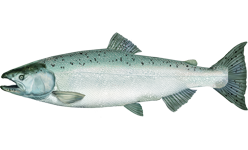 Chinook SalmonOncorhynchus tshawytscha
-
 Coho SalmonOncorhynchus kisutch
-
 Chum SalmonOncorhynchus keta
-
 Pink SalmonOncorhynchus gorbuscha
-
 Cutthroat TroutOncorhynchus clarkii
-
 Golden TroutOncorhynchus aguabonita
-
 Cherry SalmonOncorhynchus masou
Compare
Questions and answers
What is the scientific name of the Rainbow Trout?
The scientific name of the Rainbow Trout is Oncorhynchus mykiss. Written with its author, the full name is Oncorhynchus mykiss (Walbaum, 1792).
Which family does the Rainbow Trout belong to?
Oncorhynchus mykiss belongs to the family Salmonidae, in the order Salmoniformes and the class Teleostei.
Where is the Rainbow Trout found?
Checklists and occurrence records place Oncorhynchus mykiss in 27 countries, including United States, Canada, France, New Zealand, Sweden and United Kingdom.
What other names does the Rainbow Trout have?
Oncorhynchus mykiss is also known in English as Steelhead, Redband Trout, Steelhead Trout, Athabasca Rainbow Trout, Athabasca Trout and Baiser.
What is the diet of a rainbow trout?
Rainbow Trout eat aquatic insects, terrestrial insects, fish eggs, algae and small fish. They may also consume crayfish, shrimp and other crustaceans. Adult steelhead primarily feed on other fish, squid and amphipods while in the ocean.[12][13][14][15][16]
What type of habitat do rainbow trout live in?
Resident freshwater Rainbow Trout commonly inhabit shallow rivers with well-oxygenated water and gravel bottoms. Lake-resident populations generally occupy moderately deep, cool lakes with shallow areas and vegetation, while wild populations in Virginia commonly occur in small rocky streams within forested landscapes.[36][9][11]
Sources
Passages the profile rests on
- Adult freshwater rainbow trout are generally blue-green or olive green with extensive black spotting along their bodies. Source passage: “Adult freshwater forms are generally blue-green or olive green with heavy black spotting over the length of the body.” — English Wikipedia
- Adults have a broad reddish stripe running along the lateral line from the gills to the tail, most pronounced in breeding males. Source passage: “Adult fish have a broad reddish stripe along the lateral line, from gills to the tail, which is most pronounced in breeding males.” — English Wikipedia
- Lake-dwelling and anadromous rainbow trout are generally more silvery and have a greatly reduced reddish stripe. Source passage: “Lake-dwelling and anadromous forms are usually more silvery in color with the reddish stripe almost completely gone.” — English Wikipedia
- Juvenile rainbow trout display dark vertical parr marks along their bodies. Source passage: “Juvenile rainbow trout display parr marks (dark vertical bars) typical of most salmonid juveniles.” — English Wikipedia
- The caudal fin is squarish and only slightly forked. Source passage: “The caudal fin is squarish and only mildly forked.” — English Wikipedia
- Rainbow trout in Virginia typically have olive-green backs with brassy to purple iridescence. Source passage: “Rainbow trout are typically olive-green dorsally with brassy to purple iridescence.” — nps.gov
- Rainbow trout in Virginia have dark olive to black spots on their backs and sides. Source passage: “Back and sides are marked with dark olive to black spots.” — nps.gov
- The mid-side band of Virginia rainbow trout ranges from red to pink or purple and may be continuous or broken into blotches. Source passage: “Mid-side markings include a wide red, pink or purple band that may either be a continuous band or be broken into a blotched pattern.” — nps.gov
- Lake-resident rainbow trout generally occupy moderately deep, cool lakes with sufficient shallow areas and vegetation to support food production. Source passage: “Lake-resident rainbow trout are usually found in moderately deep, cool lakes with adequate shallows and vegetation to support the production of sufficient food sources.” — English Wikipedia
- Self-sustaining lake populations generally require access to streams with gravel bottoms. Source passage: “Lake populations generally require access to gravelly-bottomed streams to be self-sustaining.” — English Wikipedia
- Wild rainbow trout populations in Virginia commonly occur in small rocky streams within forested landscapes. Source passage: “Wild rainbow trout populations within Virginia most often occur in small rocky streams in forested landscapes.” — nps.gov
- Rainbow trout feed on aquatic insect larvae, pupae and adults, including caddisflies, stoneflies, mayflies and aquatic flies. Source passage: “Rainbow trout, including juvenile steelhead in fresh water, routinely feed on larval, pupal, and adult forms of aquatic insects (typically caddisflies, stoneflies, mayflies and aquatic diptera).” — English Wikipedia
- Rainbow trout consume terrestrial insects such as ants, beetles, grasshoppers and crickets that fall into the water. Source passage: “adult forms of terrestrial insects (typically ants, beetles, grasshoppers, and crickets) that fall into the water” — English Wikipedia
- Rainbow trout eat fish eggs, algae and small fish. Source passage: “They also eat fish eggs and adult forms of terrestrial insects (typically ants, beetles, grasshoppers, and crickets) that fall into the water, as well as algae.” — English Wikipedia
- Rainbow trout may consume crayfish, shrimp and other crustaceans. Source passage: “Other prey includes small fish up to one-third of their length, crayfish, shrimp, and other crustaceans.” — English Wikipedia
- Adult steelhead primarily feed on other fish, squid and amphipods while in the ocean. Source passage: “Adult steelhead in the ocean feed primarily on other fish, squid and amphipods.” — English Wikipedia
- Rainbow trout in Virginia opportunistically consume aquatic insects carried by flowing water and terrestrial insects that fall into streams. Source passage: “Rainbow trout are opportunistic feeders, readily taking aquatic insects encountered in drifting water flow and terrestrial insects that fall into the stream.” — nps.gov
- A 12-inch rainbow trout captured in Pass Run contained at least 19 cicadas, a longnose dace and several other insects in its stomach. Source passage: “A 12 inch rainbow captured in Pass Run during June, 1997 had at least 19 partially digested to entire cicadas within its stomach along with a partially digested longnose dace and a number of other smaller insects.” — nps.gov
- Rainbow trout are predators that consume a wide variety of prey. Source passage: “Rainbow trout are predators with a varied diet and will eat nearly anything they can capture.” — English Wikipedia
- Rainbow trout are less piscivorous and aggressive than brown trout and chars. Source passage: “They are not as piscivorous or aggressive as brown trout or chars, though adults still feed heavily on other fish.” — English Wikipedia
- Rainbow trout generally spawn between January and June in the Northern Hemisphere. Source passage: “Rainbow trout, including steelhead forms, generally spawn in early to late spring (January to June in the Northern Hemisphere” — English Wikipedia
- Rainbow trout generally begin spawning when water temperatures reach at least 6 to 7 degrees Celsius. Source passage: “when water temperatures reach at least 6 to 7 °C (42 to 44 °F).” — English Wikipedia
- Female rainbow trout generally produce between 2,000 and 3,000 eggs per kilogram of body weight. Source passage: “Female rainbow trout usually produce 2000 to 3000 4-to-5-millimetre (5⁄32–3⁄16 in) eggs per kilogram of weight.” — English Wikipedia
- Rainbow trout eggs usually hatch approximately four to seven weeks after fertilization. Source passage: “The eggs usually hatch in about four to seven weeks although the time of hatching varies greatly with region and habitat.” — English Wikipedia
- Wild rainbow trout in Virginia typically spawn during late winter and spring, with peak activity in March and April. Source passage: “wild rainbow trout (within their native range) typically spawns during the late winter and spring with peak spawning activity in March and April” — nps.gov
- Rainbow trout spawning in Virginia is associated with water temperatures between 10 and 15 degrees Celsius. Source passage: “peak spawning activity in March and April when water temperature are between 10 and 15°C.” — nps.gov
- Female rainbow trout in Virginia excavate spawning nests in gravel runs. Source passage: “Redds are typically excavated by females in gravel runs” — nps.gov
- Rainbow trout in Virginia may reach sexual maturity as early as one year of age. Source passage: “Maturation begins as early as one year” — nps.gov
- Introduced rainbow trout can negatively affect native fish through predation, competition, disease transmission and hybridization. Source passage: “Introduced populations may affect native species by preying on them, out-competing them, transmitting contagious diseases (such as whirling disease), or hybridizing with closely related species and subspecies.” — English Wikipedia
- Rainbow trout are included among the world's 100 most invasive species. Source passage: “The rainbow trout is included in the list of the top 100 globally invasive species.” — English Wikipedia
- Some local populations of rainbow trout subspecies and distinct steelhead population segments are listed as threatened or endangered under the Endangered Species Act. Source passage: “Some local populations of specific subspecies, or in the case of steelhead, distinct population segments, are listed as either threatened or endangered under the Endangered Species Act.” — English Wikipedia
- Rainbow trout are introduced into non-native waters for food and recreational fishing. Source passage: “Wild-caught and hatchery-reared forms of the species have been transplanted and introduced for food or sport in at least 45 countries” — English Wikipedia
- Rainbow trout have been artificially propagated in hatcheries since 1870 to restock streams and introduce the species into non-native waters. Source passage: “Since 1870, rainbow trout have been artificially propagated in fish hatcheries to restock streams and introduce them into non-native waters.” — English Wikipedia
- Rainbow trout are commercially farmed in numerous countries worldwide. Source passage: “Rainbow trout are commercially farmed in many countries throughout the world.” — English Wikipedia
- Rainbow trout are among the five most sought-after game fish in North America. Source passage: “rainbow trout rank among the top five most sought game fish in North America.” — nps.gov
- Resident freshwater rainbow trout commonly inhabit small to moderately large, shallow rivers with well-oxygenated water and gravel bottoms. Source passage: “Freshwater resident rainbow trout usually inhabit and spawn in small to moderately large, well-oxygenated, shallow rivers with gravel bottoms.” — English Wikipedia
Data
- Catalogue of Life, 2026-10-16 XR cc by
- Global Biodiversity Information Facility CC BY 4.0
- Wikidata CC0
- GeoNames CC BY 4.0
- Wikimedia Commons per image; credit shown with each image
- Within the Catalogue of Life, this name comes from World Register of Marine Species cc by
References
- Walbaum, J. J. (1792) Online Petri Artedi sueci genera piscium. In quibus systema totum ichthyologiae proponitur cum classibus, ordinibus, generum characteribus, specierum differentiis, observationibus plurimis. Redactis speciebus 242 ad genera 52. Ichthyologiae Pars III. Ant. Ferdin. Rose, Grypeswaldiae [Greifswald], viii) + 723 pp., pls. 1 - 3. where the name was published
This species in other databases
- Catalogue of Life 49JFF
- Wikidata Q187986
- iNaturalist 47516
- WoRMS urn:lsid:marinespecies.org:taxname:127185
- ITIS 161989
Page built on 24 November 2026. See how the catalog is made and all sources and licences.
Cite this page
ScientificNames.org. (2026). Oncorhynchus mykiss (Rainbow Trout). Retrieved November 24, 2026, from https://scientificnames.org/species/oncorhynchus-mykiss
“Oncorhynchus mykiss (Rainbow Trout).” ScientificNames.org, 2026, scientificnames.org/species/oncorhynchus-mykiss. Accessed 24 Nov. 2026.
ScientificNames.org. “Oncorhynchus mykiss (Rainbow Trout).” Accessed November 24, 2026. https://scientificnames.org/species/oncorhynchus-mykiss.
@misc{scientificnames_oncorhynchus_mykiss_rainbow_trout,
  author = {{ScientificNames.org}},
  title = {Oncorhynchus mykiss (Rainbow Trout)},
  year = {2026},
  url = {https://scientificnames.org/species/oncorhynchus-mykiss},
  note = {Accessed 2026-11-24}
}