Species · Birds
Red-winged Starling Onychognathus morio
The scientific name of the Red-winged Starling is Onychognathus morio. It is a species of bird in the family Sturnidae (starling), order Passeriformes. The name dates from 1766.
- Scientific name
- Onychognathus morio (Linnaeus, 1766)
- Common name
- Red-winged Starling
- Genus
- Onychognathus
- Family
- Sturnidae (Starling)
- Order
- Passeriformes
- Class
- Aves
- Red List category
- LC Least Concern
- Recorded in
- 16 countries
- Name status
- accepted in the Catalogue of Life

Overview
The species occurs in eastern and southern Africa, ranging from Ethiopia to South Africa. Adult males have iridescent black plumage and chestnut flight feathers.
Written 26 November 2026 from the sources listed below. Each statement was checked against the passage it cites; statements that could not be supported were removed.
Similar species
The Red-winged Starling may be confused with its sister species, the pale-winged starling. The Red-winged Starling has rufous primary feathers, whereas the pale-winged starling has whitish primaries edged with orange.[1][2]
Appearance
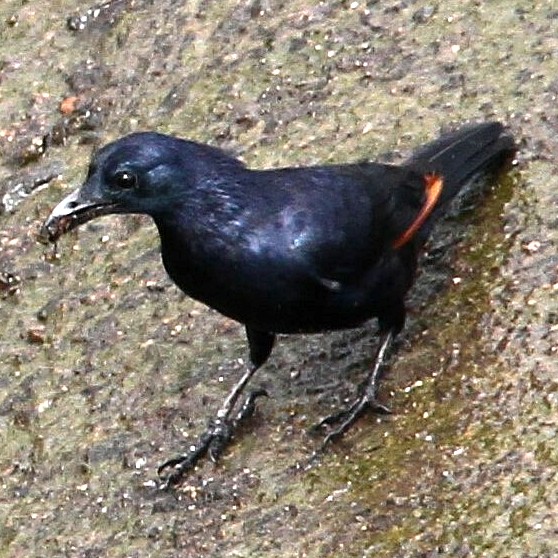
Adult males have predominantly iridescent black plumage and chestnut flight feathers. Adult males measure 27–30 centimetres in length.[3][4]
Females have an ash-grey head and upper breast. The species has dark eyes that are almost black.[5][6]
Juveniles resemble adult males but have less glossy plumage and brown eyes.[7]
The Ethiopian subspecies has a longer tail than the nominate subspecies.[8]
Habitat
The species uses forests, savannahs, grasslands, wetlands and fynbos as habitats. It also occupies farmlands and commercial plantations.[9][10]
Diet
The Red-winged Starling is omnivorous and consumes seeds, berries, nectar and invertebrates. Its diet includes beetles, including Pachnoda sinuata.[11][12]
The species obtains nectar from Aloe ferox and Aloe marlothii. It also feeds on flowers of Strelitzia nicolai and certain Protea species.[13][14]
The species eats figs, marulas, date palm fruits and berries from wild olive and Euphorbia. It also consumes commercial fruits including apples, grapes and citrus fruits.[15][16]
The species sometimes eats nestlings and adult African palm swifts. It also scavenges carrion and human food scraps.[17][18]
Behaviour
The species is territorial, aggressive and intolerant while nesting. Nesting individuals attack other species, including domestic animals and humans.[19][20]
Outside the breeding season, the species is highly gregarious and forms large flocks.[21]
The species produces several whistled calls, including a familiar contact call transcribed as cher-leeeoo.[22]
Reproduction and life cycle
The species builds lined nests from grass and twigs, with a mud base. It places its nest on natural or structural ledges.[23][24]
The species lays between two and four eggs, usually three. Its eggs are blue and spotted with red-brown.[25][26]
The female incubates the eggs for 13–14 days. Young birds take 22–28 days to fledge.[27][28]
The species commonly raises two broods in a breeding season. It may be parasitised by the great spotted cuckoo.[29][30]
Conservation
The species is not considered endangered.[31]
Uses
The species can be considered an agricultural pest because it raids orchards.[32]
Classification of the Red-winged Starling
| Kingdom | Animalia |
|---|---|
| Phylum | Chordata |
| Subphylum | Vertebrata |
| Infraphylum | Gnathostomata |
| Parvphylum | Osteichthyes |
| Megaclass | Tetrapoda |
| Class | Aves (Bird) |
| Order | Passeriformes (Passerine) |
| Family | Sturnidae (Starling) |
| Genus | Onychognathus (Red-winged Starlings) |
| Species | Onychognathus morio (Linnaeus, 1766) |
Where the Red-winged Starling is found
Checklists and occurrence records place Onychognathus morio in 16 countries across Africa. GBIF holds 269,774 georeferenced records of it.
Countries
- Botswana 471
- Democratic Republic of the Congo 3
- Eritrea 46
- Eswatini 1,655
- Ethiopia 1,137
- Kenya 8,925
- Lesotho 1,552
- Malawi 281
- Mozambique 275
- Namibia 50
- Somalia 4
- South Africa 239,965
- Tanzania 5,134
- Uganda 304
- Zambia 1,523
- Zimbabwe 8,449
Regions and cities with the most records
- Western Cape, South Africa 71,342
- KwaZulu-Natal, South Africa 47,763
- Retreat, South Africa 30,436
- Eastern Cape, South Africa 28,254
- Muizenberg, South Africa 27,678
- Rondebosch, South Africa 26,839
- Cape Town, South Africa 24,565
- Gauteng, South Africa 22,144
- Mpumalanga, South Africa 18,857
- Limpopo, South Africa 15,205
- Ntuzuma, South Africa 11,481
- Randburg, South Africa 11,345
- Pinetown, South Africa 10,779
- Johannesburg, South Africa 9,954
- Free State, South Africa 9,367
- Roodepoort, South Africa 9,004
- Durban, South Africa 7,717
- Krugersdorp, South Africa 7,494
- North West, South Africa 6,967
- Edenvale, South Africa 6,598
- Soweto, South Africa 6,375
- Kuils River, South Africa 6,368
- Centurion, South Africa 6,115
- Pretoria, South Africa 6,015
- Midrand, South Africa 5,685
- Mpophomeni, South Africa 5,403
- Pietermaritzburg, South Africa 4,985
- Mpumalanga, South Africa 4,924
- Howick, South Africa 4,838
- Victoria Falls, Zimbabwe 4,497
- Livingstone, Zambia 4,459
- Somerset West, South Africa 4,458
- Midstream, South Africa 4,371
- Kraaifontein, South Africa 4,207
- Tongaat, South Africa 3,745
- Thembisa, South Africa 3,641
1 more country has a few records outside this range
These countries hold a few records of Onychognathus morio but lie outside the range the checklists give for it. Such records are often zoo or garden specimens, museum material or vagrants, so the species is not counted as occurring there.
Range as the checklists state it
Africa
A number beside a place is its count of GBIF occurrence records. A place without a number comes from a checklist alone. Records show where a species has been observed or collected, which can include escapes and vagrants.
Common names
English
- Red-winged Starling
- RWST
Names in 28 other languages
- Afrikaans
- Rooivlerkspreeu
- Arabic
- ازرزور ذو الجناح الأحمر
- Armenian
- Կարմրաթև երկարապոչ սարյակ
- Catalan
- estornell ala-roig
- Chinese
- 南非紅翅椋鳥, 紅翅椋鳥, 红翅椋鸟
- Croatian
- crvenokrili čvorak
- Czech
- špaček rudokřídlý
- Danish
- Rødvinget Sortstær
- Dutch
- Roodvleugelspreeuw
- Esperanto
- ruĝflugila sturno
- Finnish
- kalliorakkeli
- French
- Etourneau à bec robuste, Rufipenne morio
- German
- Rotschwingenstar
- Hungarian
- rőtszárnyú dalosseregély
- Irish
- Druid deargeiteach
- Italian
- Storno alirosse
- Japanese
- アカバネテリムク
- Lithuanian
- raudonsparnis ilgauodegis varnėnas
- Norwegian
- rødvingestær
- Polish
- czarnotek rudoskrzydły
- Portuguese
- Estorninho-de-asas-vermelhas, estorninho-d'asa-castanha, estorninho-d'asa-ruiva, estorninho-de-asa-castanha
- Russian
- Краснокрылый длиннохвостый скворец, Краснокрылый скворец
- Slovak
- liskavec moriónový
- Spanish
- Estornino alirrojo
- Swedish
- rödvingad glansstare
- Turkish
- Kızılkanat
- Ukrainian
- моріо рудокрилий
- Welsh
- drudwen adeingoch
Synonyms
One other scientific name has been used for this species and is now treated as a synonym of Onychognathus morio.
- Turdus morio Linnaeus, 1766
Subspecies and varieties
- Onychognathus morio morio (Southern Redwing Starling) subspecies
- Onychognathus morio rueppellii (Northern Red-winged Starling) subspecies
Related species
-
 Tristram's StarlingOnychognathus tristramii
-
 Socotra StarlingOnychognathus frater
-
 Pale-winged StarlingOnychognathus nabouroup
-
 Somali StarlingOnychognathus blythii
-
 Slender-billed StarlingOnychognathus tenuirostris
-
 Chestnut-winged StarlingOnychognathus fulgidus
-
 Neumann's StarlingOnychognathus neumanni
-
 White-billed StarlingOnychognathus albirostris
Compare
Questions and answers
What is the scientific name of the Red-winged Starling?
The scientific name of the Red-winged Starling is Onychognathus morio. Written with its author, the full name is Onychognathus morio (Linnaeus, 1766).
Which family does the Red-winged Starling belong to?
Onychognathus morio belongs to the family Sturnidae, in the order Passeriformes and the class Aves.
Where is the Red-winged Starling found?
Checklists and occurrence records place Onychognathus morio in 16 countries, including South Africa, Kenya, Zimbabwe, Tanzania, Eswatini and Lesotho.
What is the conservation status of the Red-winged Starling?
The IUCN Red List category recorded for Onychognathus morio is Least Concern (LC).
What other names does the Red-winged Starling have?
Onychognathus morio is also known in English as RWST.
What is a blackbird with red wings called?
The Red-winged Starling has predominantly iridescent black plumage and chestnut flight feathers.[3]
Sources
Passages the profile rests on
- The red-winged starling may be confused with its sister species, the pale-winged starling. Source passage: “This starling may be confused with other similar starling species, such as its sister species the pale-winged starling.” — English Wikipedia
- The red-winged starling has rufous primary feathers, whereas the pale-winged starling has whitish primaries edged with orange. Source passage: “the red-winged has rufous primaries while the pale-winged has whitish primaries edged with orange.” — English Wikipedia
- Adult males have predominantly iridescent black plumage and chestnut flight feathers. Source passage: “The male of this 27–30-centimetre (11–12 in) long starling has mainly iridescent black plumage, with chestnut flight feathers” — English Wikipedia
- Adult males measure 27–30 centimetres in length. Source passage: “The male of this 27–30-centimetre (11–12 in) long starling” — English Wikipedia
- Females have an ash-grey head and upper breast. Source passage: “The female has an ash-grey head and upper breast.” — English Wikipedia
- The species has dark eyes that are almost black. Source passage: “the red-winged's is dark, almost black.” — English Wikipedia
- Juveniles resemble adult males but have less glossy plumage and brown eyes. Source passage: “The juvenile resembles the male, but is less glossy than the adults, and has brown rather than dark red eyes.” — English Wikipedia
- The Ethiopian subspecies has a longer tail than the nominate subspecies. Source passage: “The Ethiopian subspecies O. m. rupellii is longer-tailed than the nominate form” — English Wikipedia
- The species uses forests, savannahs, grasslands, wetlands and fynbos as habitats. Source passage: “It may be found in forest, savannah, grassland, wetlands, fynbos” — English Wikipedia
- The species also occupies farmlands and commercial plantations. Source passage: “farmlands and commercial plantations” — English Wikipedia
- The species is omnivorous and consumes seeds, berries, nectar and invertebrates. Source passage: “the red-winged starling is an omnivore, taking a wide range of seeds, berries, nectar from plants such as Aloe and Schotia brachypetala, and invertebrates” — English Wikipedia
- The species consumes beetles, including Pachnoda sinuata. Source passage: “such as the beetle species Pachnoda sinuata.” — English Wikipedia
- The species obtains nectar from Aloe ferox and Aloe marlothii. Source passage: “such as that of Aloe ferox and Aloe marlothii” — English Wikipedia
- The species feeds on flowers of Strelitzia nicolai and certain Protea species. Source passage: “Large flowers that can support the bird's weight, such as that of Strelitzia nicolai and certain Protea species, are also chosen.” — English Wikipedia
- The species eats figs, marulas, date palm fruits and berries from wild olive and Euphorbia. Source passage: “Fruit species that this species may feed on include figs, such as the sycamore fig and others, marulas, date palm fruit, berries from species such as wild olive Olea europaea subsp. cuspidata and Euphorbia” — English Wikipedia
- The species also consumes commercial fruits including apples, grapes and citrus fruits. Source passage: “and commercial fruit such as apples, grapes, citruses and others.” — English Wikipedia
- The species sometimes eats nestlings and adult African palm swifts. Source passage: “They may take nestlings and adults of certain bird species, such as the African palm swift.” — English Wikipedia
- The species scavenges carrion and human food scraps. Source passage: “It will also scavenge on carrion and human food scrap.” — English Wikipedia
- The species is territorial, aggressive and intolerant while nesting. Source passage: “The red-winged starling is territorial, aggressive and intolerant when nesting” — English Wikipedia
- Nesting individuals attack other species, including domestic animals and humans. Source passage: “will attack other species, including domestic animals and humans.” — English Wikipedia
- Outside the breeding season, the species is highly gregarious and forms large flocks. Source passage: “When not breeding, red-winged starlings are highly gregarious and will associate with other members of their species in large flocks.” — English Wikipedia
- The species produces several whistled calls, including a familiar contact call transcribed as cher-leeeoo. Source passage: “This species has a number of whistled calls, but the most familiar is the contact call, cher-leeeoo.” — English Wikipedia
- The species builds lined nests from grass and twigs, with a mud base. Source passage: “The red-winged starling builds a lined nest of grass and twigs, and with a mud base” — English Wikipedia
- The species places its nest on natural or structural ledges. Source passage: “on a natural or structural ledge.” — English Wikipedia
- The species lays between two and four eggs, usually three. Source passage: “It lays two to four, usually three, blue eggs” — English Wikipedia
- Its eggs are blue and spotted with red-brown. Source passage: “blue eggs, spotted with red-brown.” — English Wikipedia
- The female incubates the eggs for 13–14 days. Source passage: “The female incubates the eggs for 13–14 days” — English Wikipedia
- Young birds take 22–28 days to fledge. Source passage: “with another 22–28 days to fledge.” — English Wikipedia
- The species commonly raises two broods in a breeding season. Source passage: “This starling is commonly double-brooded.” — English Wikipedia
- The species may be parasitised by the great spotted cuckoo. Source passage: “It may be parasitised by the great spotted cuckoo.” — English Wikipedia
- The species is not considered endangered. Source passage: “The red-winged starling is not endangered” — English Wikipedia
- The species can be considered an agricultural pest because it raids orchards. Source passage: “can be a pest in some areas, raiding orchards” — English Wikipedia
Data
- Catalogue of Life, 2026-10-16 XR cc by
- Global Biodiversity Information Facility CC BY 4.0
- Wikidata CC0
- GeoNames CC BY 4.0
- Wikimedia Commons per image; credit shown with each image
- iNaturalist per image; credit shown with each image
- Within the Catalogue of Life, this name comes from The Integrated Taxonomic Information System cc0
References
- Gill, Frank, & and Minturn Wright. (2006). Birds of the World: Recommended English Names.
This species in other databases
Page built on 27 November 2026. See how the catalog is made and all sources and licences.
Cite this page
ScientificNames.org. (2026). Onychognathus morio (Red-winged Starling). Retrieved November 27, 2026, from https://scientificnames.org/species/onychognathus-morio
“Onychognathus morio (Red-winged Starling).” ScientificNames.org, 2026, scientificnames.org/species/onychognathus-morio. Accessed 27 Nov. 2026.
ScientificNames.org. “Onychognathus morio (Red-winged Starling).” Accessed November 27, 2026. https://scientificnames.org/species/onychognathus-morio.
@misc{scientificnames_onychognathus_morio_red_winged_starling,
  author = {{ScientificNames.org}},
  title = {Onychognathus morio (Red-winged Starling)},
  year = {2026},
  url = {https://scientificnames.org/species/onychognathus-morio},
  note = {Accessed 2026-11-27}
}