Species · Birds
Neumann's Starling Onychognathus neumanni
The scientific name of the Neumann's Starling is Onychognathus neumanni. It is a species of bird in the family Sturnidae (starling), order Passeriformes. The name dates from 1908.
- Scientific name
- Onychognathus neumanni (Alexander, 1908)
- Common name
- Neumann's Starling
- Genus
- Onychognathus
- Family
- Sturnidae (Starling)
- Order
- Passeriformes
- Class
- Aves
- Red List category
- LC Least Concern
- Recorded in
- 9 countries
- Name status
- accepted in the Catalogue of Life
Overview
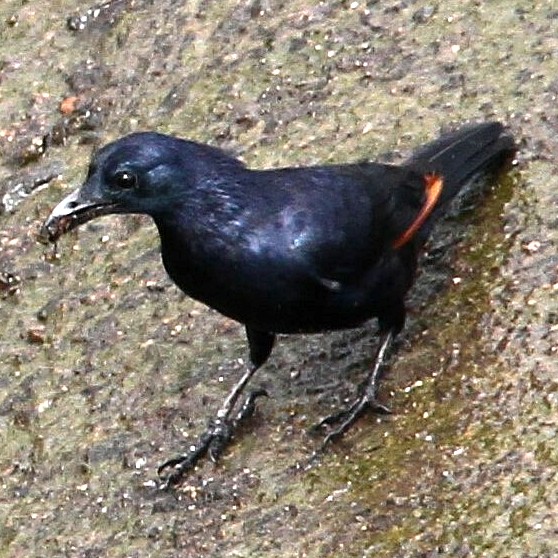
Neumann's Starling is a large, glossy-black starling with a wedge-shaped tail and brick-red wing markings. It is native to Africa, with a breeding range extending mainly across the Sahel from Mauritania and Guinea to western Sudan. Its rufous primary wing feathers are particularly conspicuous during flight.
Written 27 November 2026 from the sources listed below. Each statement was checked against the passage it cites; statements that could not be supported were removed.
Appearance
Adult males have predominantly glossy black plumage, while females have ash-grey plumage with darker streaking. Juveniles resemble adult males but have less glossy plumage and brown eyes.[1][2][3]
The species has a dark red iris, a black bill and black legs. Its rufous primary wing feathers are particularly conspicuous during flight.[4][5]
Western populations from western Mali and Ivory Coast are smaller and have shorter tails than the nominate subspecies. These populations are assigned to the subspecies Onychognathus neumanni modicus.[6][7]
The species measures approximately 25 cm in length.[8]
Habitat
Neumann's Starling breeds on rocky cliffs, outcrops and gorges. Its breeding range extends mainly across the Sahel from Mauritania and Guinea to western Sudan.[9][10]
The species is also associated with human settlements.[11]
Diet
Neumann's Starling is omnivorous and eats a variety of fruits and some invertebrates.[12]
Behaviour
The species is highly gregarious and forms large flocks outside the breeding season.[13]
Its song is described as 'too-whee-oo'. It also produces oriole-like contact calls and a harsh 'air, air' alarm call.[14][15][16]
Neumann's Starling is territorial and aggressive while nesting. It attacks other species, including birds of prey, during nesting.[17][18]
Reproduction and life cycle
The species constructs grass nests on ledges in sheltered locations such as caves.[19]
Conservation
Neumann's Starling was most recently assessed for the IUCN Red List in 2024.[20]
Classification of the Neumann's Starling
| Kingdom | Animalia |
|---|---|
| Phylum | Chordata |
| Subphylum | Vertebrata |
| Infraphylum | Gnathostomata |
| Parvphylum | Osteichthyes |
| Megaclass | Tetrapoda |
| Class | Aves (Bird) |
| Order | Passeriformes (Passerine) |
| Family | Sturnidae (Starling) |
| Genus | Onychognathus (Red-winged Starlings) |
| Species | Onychognathus neumanni (Alexander, 1908) |
Where the Neumann's Starling is found
Checklists and occurrence records place Onychognathus neumanni in 9 countries across Africa. GBIF holds 1,181 georeferenced records of it.
Countries
Regions and cities with the most records
- Plateau State, Nigeria 694
- Bukuru, Nigeria 634
- Jos, Nigeria 616
- Kedougou, Senegal 91
- Dialakorodji, Mali 71
- Moribabougou, Mali 71
- Bamako, Mali 70
- Sangarébougou, Mali 70
- Sirakoro Méguétana, Mali 70
- Bamako, Mali 67
- Kati, Mali 67
- North-West, Cameroon 50
- Kédougou, Senegal 46
- Bamenda, Cameroon 34
- Bauchi, Nigeria 30
- Bafut, Cameroon 24
- Bali, Cameroon 24
- Mamou Region, Guinea 22
- Labé Region, Guinea 21
- Abuja, Nigeria 20
- Mopti, Mali 18
- Koulikoro, Mali 15
- Taraba State, Nigeria 14
- Boké Region, Guinea 13
- Cascades Region, Burkina Faso 13
- Koundara, Guinea 13
- Nasarawa State, Nigeria 13
- Kindia, Guinea 12
- Kaduna State, Nigeria 10
- Kindia, Guinea 10
- Oku, Cameroon 10
- Banfora, Burkina Faso 9
- Ndop, Cameroon 9
- Bandiagara, Mali 8
- Kayes, Mali 8
- Kayes, Mali 7
Range as the checklists state it
Africa
A number beside a place is its count of GBIF occurrence records. A place without a number comes from a checklist alone. Records show where a species has been observed or collected, which can include escapes and vagrants.
Common names
English
- Neumann's Starling
Names in 22 other languages
- Catalan
- estornell de Neumann
- Chinese
- 紐曼氏紅翅椋鳥, 诺氏栗翅椋鸟
- Croatian
- čvorak stjenjak
- Czech
- špaček skalní
- Danish
- Sahelsortstær
- Dutch
- Neumanns Roodvleugelspreeuw
- Esperanto
- dikbeka sturno
- Finnish
- malinrakkeli
- French
- Rufipenne de Neumann
- German
- Neumannstar
- Italian
- Storno di Neumann
- Japanese
- ニシアカバネテリムク
- Lithuanian
- Noimano ilgauodegis varnėnas
- Norwegian
- tykknebbstær
- Polish
- czarnotek grubodzioby
- Portuguese
- estorninho-de-neumann, estorninho-do-sael
- Russian
- Скальный длиннохвостый скворец, Скальный скворец
- Slovak
- liskavec červenokrídly
- Spanish
- Estornino de Neumann
- Swedish
- neumannglansstare, tjocknäbbad glansstare
- Turkish
- Koca Gagalı Kızılkanat
- Ukrainian
- моріо західний
Synonyms
2 other scientific names have been used for this species and are now treated as synonyms of Onychognathus neumanni.
- Amydrus neumanni Alexander, 1908
- Onychoganthus neumanni Alexander, B, 1908
Subspecies and varieties
- Onychognathus neumanni modicus subspecies
- Onychognathus neumanni neumanni subspecies
Related species
-
 Red-winged StarlingOnychognathus morio
-
 Tristram's StarlingOnychognathus tristramii
-
 Socotra StarlingOnychognathus frater
-
 Pale-winged StarlingOnychognathus nabouroup
-
 Somali StarlingOnychognathus blythii
-
 Slender-billed StarlingOnychognathus tenuirostris
-
 Chestnut-winged StarlingOnychognathus fulgidus
-
 White-billed StarlingOnychognathus albirostris
Compare
Questions and answers
What is the scientific name of the Neumann's Starling?
The scientific name of the Neumann's Starling is Onychognathus neumanni. Written with its author, the full name is Onychognathus neumanni (Alexander, 1908).
Which family does the Neumann's Starling belong to?
Onychognathus neumanni belongs to the family Sturnidae, in the order Passeriformes and the class Aves.
Where is the Neumann's Starling found?
Checklists and occurrence records place Onychognathus neumanni in 9 countries, including Nigeria, Mali, Senegal, Guinea, Cameroon and Burkina Faso.
What is the conservation status of the Neumann's Starling?
The IUCN Red List category recorded for Onychognathus neumanni is Least Concern (LC).
What is special about a starling bird?
Neumann's Starling has predominantly glossy-black plumage in adult males and rufous primary wing feathers that are particularly conspicuous during flight. It also has a wedge-shaped tail and brick-red wing markings.[4][1][21]
What does the starling bird eat?
Neumann's Starling is omnivorous and eats a variety of fruits and some invertebrates.[12]
Sources
Passages the profile rests on
- Adult males have predominantly glossy black plumage. Source passage: “The male plumage is otherwise mainly glossy black” — English Wikipedia
- Females have ash-grey plumage with darker streaking. Source passage: “the female is ash grey with darker streaking.” — English Wikipedia
- Juveniles resemble adult males but have less glossy plumage and brown eyes. Source passage: “The juvenile resembles the male, but is less glossy than the adult, and has brown rather than dark red eyes.” — English Wikipedia
- The species has rufous primary wing feathers that are particularly conspicuous during flight. Source passage: “showing the characteristic rufous primary wing feathers, very obvious in flight.” — English Wikipedia
- Its iris is dark red, while its bill and legs are black. Source passage: “The iris is dark red, and the bill and legs are black.” — English Wikipedia
- Western populations from western Mali and Ivory Coast are smaller and have shorter tails than the nominate subspecies. Source passage: “Western populations from western Mali and the Ivory Coast are smaller and shorter-tailed than the nominate form, O. n. neumanni” — English Wikipedia
- The western populations are assigned to the subspecies Onychognathus neumanni modicus. Source passage: “are assigned to the subspecies O. n. modicus.” — English Wikipedia
- The species measures approximately 25 cm in length. Source passage: “This 25 cm long species” — English Wikipedia
- The species breeds on rocky cliffs, outcrops and gorges. Source passage: “This starling breeds on rocky cliffs, outcrops and gorges” — English Wikipedia
- Its breeding range extends mainly across the Sahel from Mauritania and Guinea to western Sudan. Source passage: “mainly in the Sahel from Mauritania and Guinea to western Sudan.” — English Wikipedia
- The species is also associated with human settlements. Source passage: “It is also associated with human settlement” — English Wikipedia
- The species is omnivorous and eats a variety of fruits and some invertebrates. Source passage: “Like other starlings, the Neumann's red-winged starling is an omnivore, taking a wide range of fruit, including figs, and some invertebrates.” — English Wikipedia
- The species is highly gregarious and forms large flocks outside the breeding season. Source passage: “It is highly gregarious, and will form large flocks when not breeding.” — English Wikipedia
- The species produces a song described as 'too-whee-oo'. Source passage: “The song is a too-whee-oo” — English Wikipedia
- Its alarm call is a harsh 'air, air' sound. Source passage: “the alarm call is a harsh air, air.” — English Wikipedia
- The species has oriole-like contact calls. Source passage: “oriole-like contact calls” — ebird.org
- The species is territorial and aggressive while nesting. Source passage: “This species is territorial, aggressive and intolerant when nesting” — English Wikipedia
- It attacks other species, including birds of prey, during nesting. Source passage: “and will attack other species, including birds of prey.” — English Wikipedia
- The species constructs grass nests on ledges in sheltered locations such as caves. Source passage: “The red-winged starling builds a nest of grass on a ledge in a sheltered site such as a cave.” — English Wikipedia
- The species was most recently assessed for the IUCN Red List in 2024. Source passage: “Neumann's Starling Onychognathus neumanni has most recently been assessed for The IUCN Red List of Threatened Species in 2024.” — iucnredlist.org
- The species is described as a large, glossy-black starling with a wedge-shaped tail and brick-red wing markings. Source passage: “A large glossy-black starling with a wedge-shaped tail and brick-red windows.” — ebird.org
Data
- Catalogue of Life, 2026-10-16 XR cc by
- Global Biodiversity Information Facility CC BY 4.0
- Wikidata CC0
- GeoNames CC BY 4.0
- Wikimedia Commons per image; credit shown with each image
- Within the Catalogue of Life, this name comes from The Integrated Taxonomic Information System cc0
This species in other databases
Page built on 27 November 2026. See how the catalog is made and all sources and licences.
Cite this page
ScientificNames.org. (2026). Onychognathus neumanni (Neumann's Starling). Retrieved November 27, 2026, from https://scientificnames.org/species/onychognathus-neumanni
“Onychognathus neumanni (Neumann's Starling).” ScientificNames.org, 2026, scientificnames.org/species/onychognathus-neumanni. Accessed 27 Nov. 2026.
ScientificNames.org. “Onychognathus neumanni (Neumann's Starling).” Accessed November 27, 2026. https://scientificnames.org/species/onychognathus-neumanni.
@misc{scientificnames_onychognathus_neumanni_neumanns_starling,
  author = {{ScientificNames.org}},
  title = {Onychognathus neumanni (Neumann's Starling)},
  year = {2026},
  url = {https://scientificnames.org/species/onychognathus-neumanni},
  note = {Accessed 2026-11-27}
}