Species · Reptiles
Ophiodes enso
Ophiodes enso has no English name on record in the checklists used here. It is a species of reptile in the family Diploglossidae (neotropical forest lizards), order Squamata. The name dates from 2017.
- Scientific name
- Ophiodes enso Entiauspe-Neto, Marques-Quintela, Regnet, Teixeira, Silveira & Loebmann, 2017
- Genus
- Ophiodes
- Family
- Diploglossidae (Neotropical Forest Lizards)
- Order
- Squamata
- Class
- Reptilia
- Recorded in
- 1 country
- Name status
- accepted in the Catalogue of Life
Overview
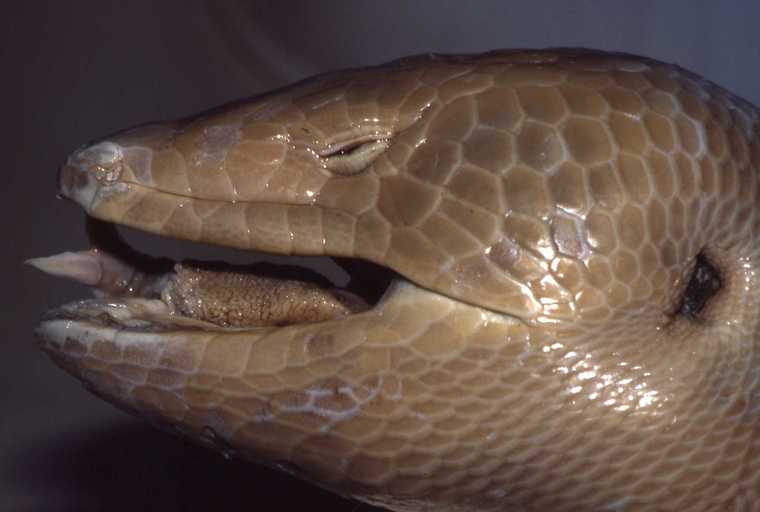
Ophiodes enso is a species of limbless lizard of the Diploglossidae family. It is found in Brazil.
Classification of Ophiodes enso
| Kingdom | Animalia |
|---|---|
| Phylum | Chordata |
| Subphylum | Vertebrata |
| Infraphylum | Gnathostomata |
| Parvphylum | Osteichthyes |
| Megaclass | Tetrapoda |
| Class | Reptilia (Reptile) |
| Order | Squamata (Snakes) |
| Suborder | Autarchoglossa |
| Family | Diploglossidae (Neotropical Forest Lizards) |
| Genus | Ophiodes (Worm Lizards) |
| Species | Ophiodes enso Entiauspe-Neto, Marques-Quintela, Regnet, Teixeira, Silveira & Loebmann, 2017 |
Origin of the name. Etymology. - The species name refers to the Japanese-Buddhism Enso () symbol, a hand-drawn circle made in a single or double brushstroke that closely resembles the silhouette of a Ophiodes specimen (Fig. 2). Also noteworthy is that type series of O. enso sp. n. was discovered during the El Nino Southern Oscillation event of 2015 (popularly known as ENSO, which is marked by heavy rainfall), and that event culminated in the movement of the aforementioned type series into the Lagoa dos Patos shores. This is also the first species to be discovered as a result of the ENSO phenomenon.
Where Ophiodes enso is found
Checklists and occurrence records place Ophiodes enso in 1 country across South America. GBIF holds 4 georeferenced records of it.
Countries
Regions and cities with the most records
Range as the checklists state it
Brazil (Rio Grande do Sul)
A number beside a place is its count of GBIF occurrence records. A place without a number comes from a checklist alone. Records show where a species has been observed or collected, which can include escapes and vagrants.
Synonyms
One other scientific name has been used for this species and is now treated as a synonym of Ophiodes enso.
- Ophiodes vertebralis (Cacciali and Scott, 2015)
Related species
-
 Striped Worm LizardOphiodes striatus
-
 Jointed Worm LizardOphiodes vertebralis
-
 Silver-lined Worm LizardOphiodes intermedius
- Fragile Worm LizardOphiodes fragilis
- Lucy’s Worm LizardOphiodes luciae
-
 Jamaican Giant GalliwaspCelestus occiduus
-
 Brazilian GalliwaspDiploglossus lessonae
- Montserrat GalliwaspDiploglossus montisserrati
Compare
Sources
Data
- Catalogue of Life, 2026-10-16 XR cc by
- Global Biodiversity Information Facility CC BY 4.0
- Wikidata CC0
- English Wikipedia CC BY-SA 4.0
- GeoNames CC BY 4.0
- Within the Catalogue of Life, this name comes from The Reptile Database cc by
References
- Entiauspe-Neto, Omar M., Fernando Marques Quintela, Ruth A. Regnet, Victor H. Teixeira, Franck D. L. Silveira & Daniel Loebmann. 2017. A new and microendemic species of Ophiodes Wagler, 1828 (Sauria: Diploglossinae) from the Lagoa dos Patos Estuary, Southern Brazil. Journal of Herpetology. Link where the name was published
- Lema, Th. de. (1994). Lista comentada dos répteis occorentes nor Rio Grande do Sul, Brasil. Comun. Mus. Cienc. Tecnol. PUCRS, Sér. Zool., Porto Alegre 7: 41-150.
- Marques-Quintela, F., & Daniel Loebmann, N. M. G. (2006). Répteis continentais do município de Rio Grande, Rio Grande do Sul, Brasil. Biociências, Porto Alegre 14 (2): 180-188.
- QUINTELA, F. M., AND D. LOEBMANN. (2009). Os Répteis da Região Costeira do Extremo Sul do Brasil. União Sul-Americana de Estudos Da Biodiversidade, Brazil.
- Quintela, Fernando Marques; Igor Gonçalves Medvedovsky, Chyntia Ibarra, Luís Fernando de Matos Neves and Mario Roberto Chim Figueiredo. (2011). Reptiles recorded in Marinheiros Island, Patos Lagoon estuary, southern Brazil. Herpetology Notes 4: 57-62.
- Entiauspe-Neto, Omar Machado; Fernando Marques Quintela, Ruth Anastasia Regnet, Victor Hugo Teixeira, Franck Silveira, and Daniel Loebmann. (2017). A New and Microendemic Species of Ophiodes Wagler, 1828 (Sauria: Diploglossinae) from the Lagoa dos Patos Estuary, Southern Brazil. Journal of Herpetology 51 (4): 515-522.
- SCHOOLS, MOLLY, & BLAIR HEDGES, S. (2021). Phylogenetics, classification, and biogeography of the Neotropical forest lizards (Squamata, Diploglossidae). Zootaxa 4974 (2): 201–257.
This species in other databases
Page built on 26 November 2026. See how the catalog is made and all sources and licences.
Cite this page
ScientificNames.org. (2026). Ophiodes enso. Retrieved November 26, 2026, from https://scientificnames.org/species/ophiodes-enso
“Ophiodes enso.” ScientificNames.org, 2026, scientificnames.org/species/ophiodes-enso. Accessed 26 Nov. 2026.
ScientificNames.org. “Ophiodes enso.” Accessed November 26, 2026. https://scientificnames.org/species/ophiodes-enso.
@misc{scientificnames_ophiodes_enso,
  author = {{ScientificNames.org}},
  title = {Ophiodes enso},
  year = {2026},
  url = {https://scientificnames.org/species/ophiodes-enso},
  note = {Accessed 2026-11-26}
}