Species · Fishes
Moustache Jawfish Opistognathus lonchurus
The scientific name of the Moustache Jawfish is Opistognathus lonchurus. It is a species of fish in the family Opistognathidae (smilers), order Perciformes. The name dates from 1882.
- Scientific name
- Opistognathus lonchurus Jordan & Gilbert, 1882
- Common name
- Moustache Jawfish
- Genus
- Opistognathus
- Family
- Opistognathidae (Smilers)
- Order
- Perciformes
- Class
- Teleostei
- Red List category
- LC Least Concern
- Environment
- marine
- Recorded in
- 2 countries
- Name status
- accepted in the Catalogue of Life

Overview
Opistognathus lonchurus inhabits reefs and lives in burrows on silty sand and rubble bottoms. It is distinguished by its yellowish-brown body, blue stripes, blue upper lips, and blue iris.
Written 27 November 2026 from the sources listed below. Each statement was checked against the passage it cites; statements that could not be supported were removed.
Appearance
The Moustache Jawfish has an elongated, laterally compressed body that tapers toward the rear. Its large terminal mouth extends well behind the eye, and its rounded tail is approximately 25% of the standard length, making it shorter than the head.[1][2][3]
Its lateral line is positioned high and restricted to the front half of the body. Its scales are small and smooth, while its head is scaleless.[4][5]
Its head and body are yellowish-brown, with blue upper lips and a blue iris. A blue stripe runs along the cheek and onto the operculum, while two thin blue stripes extend along the middle of each flank from the operculum to the base of the tail fin.[6][7][8][9]
Its dorsal and anal fins are pale orange, with blue stripes along their bases, edges, and centers. The tail has orange-yellow rays, blue membranes between the rays, and blue upper and lower edges.[10][11]
The maximum reported total length is 10 centimetres.[12]
Habitat
The Moustache Jawfish inhabits reefs and lives in burrows on silty sand and rubble bottoms.[13][14]
It is associated with soft-bottom environments including mud, sand, gravel, beaches, estuaries, mangroves, and seagrass.[15]
Its native range is the western Atlantic Ocean. Its recorded distribution includes the Gulf of Mexico and the Caribbean Sea.[16][17][18]
Diet
The Moustache Jawfish feeds on mobile benthic crustaceans, including shrimps and crabs.[19]
Uses
The Moustache Jawfish is traded in the aquarium industry.[20]
Classification of the Moustache Jawfish
| Kingdom | Animalia |
|---|---|
| Phylum | Chordata |
| Subphylum | Vertebrata |
| Infraphylum | Gnathostomata |
| Parvphylum | Osteichthyes |
| Gigaclass | Actinopterygii |
| Superclass | Actinopteri |
| Class | Teleostei (Teleost) |
| Order | Perciformes |
| Suborder | Percoidei |
| Family | Opistognathidae (Smilers) |
| Genus | Opistognathus (Spotfin Jawfishes) |
| Species | Opistognathus lonchurus Jordan & Gilbert, 1882 |
Where the Moustache Jawfish is found
Checklists and occurrence records place Opistognathus lonchurus in 2 countries. GBIF holds 49 georeferenced records of it.
Countries
Regions and cities with the most records
- Pensacola, United States 8
- West Pensacola, United States 8
- Myrtle Grove, United States 7
- Bellview, United States 6
- East Pensacola Heights, United States 5
- Brent, United States 4
A number beside a place is its count of GBIF occurrence records. A place without a number comes from a checklist alone. Records show where a species has been observed or collected, which can include escapes and vagrants.
Common names
English
- Moustache Jawfish
Names in 4 other languages
- Albanian
- Troftë e cemit
- Czech
- studnař floridský
- Portuguese
- Bocão-de-contorno-azul
- Spanish
- bocón bigote, guardián verdoso
Synonyms
2 other scientific names have been used for this species and are now treated as synonyms of Opistognathus lonchurus.
- Gnathypops mystacinus Jordan, 1884
- Opisthognathus lonchurus Jordan & Gilbert, 1882
Related species
-
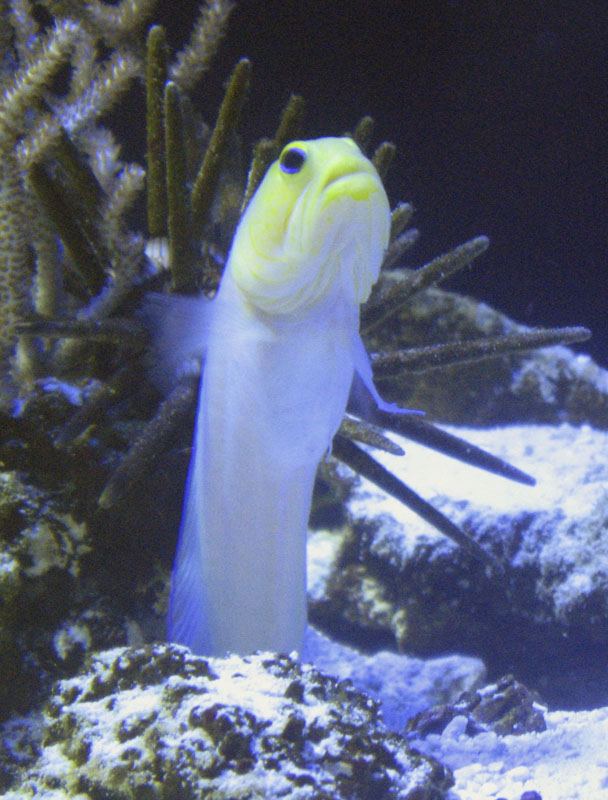 Yellowhead JawfishOpistognathus aurifrons
-
 Blue-spotted JawfishOpistognathus rosenblatti
-
 Bartail JawfishOpistognathus cuvierii
-
 Dusky JawfishOpistognathus whitehursti
-
 Robust JawfishOpistognathus muscatensis
-
 Goldspecs JawfishOpistognathus randalli
-
 Finespotted JawfishOpistognathus punctatus
-
 Spotfin JawfishOpistognathus robinsi
Compare
Questions and answers
What is the scientific name of the Moustache Jawfish?
The scientific name of the Moustache Jawfish is Opistognathus lonchurus. Written with its author, the full name is Opistognathus lonchurus Jordan & Gilbert, 1882.
Which family does the Moustache Jawfish belong to?
Opistognathus lonchurus belongs to the family Opistognathidae, in the order Perciformes and the class Teleostei.
Where is the Moustache Jawfish found?
Checklists and occurrence records place Opistognathus lonchurus in 2 countries: United States and Brazil.
What is the conservation status of the Moustache Jawfish?
The IUCN Red List category recorded for Opistognathus lonchurus is Least Concern (LC).
How big do jawfish get?
The Moustache Jawfish reaches a maximum reported total length of 10 centimetres.[12]
Sources
Passages the profile rests on
- The species has an elongated, laterally compressed body that tapers toward the rear. Source passage: “Elongate, compressed, tapering body” — biogeodb.stri.si.edu
- Its mouth is large, terminally positioned, and extends well behind the eye. Source passage: “mouth terminal, large, extends well to rear of eye” — biogeodb.stri.si.edu
- Its tail is rounded and approximately 25% of the standard length, making it shorter than the head. Source passage: “tail rounded, shorter than head, ~25% of SL” — biogeodb.stri.si.edu
- Its lateral line is restricted to the front half of the body and is positioned high. Source passage: “lateral line on front half of body only, high” — biogeodb.stri.si.edu
- Its scales are small and smooth, and its head is scaleless. Source passage: “scales small, smooth, none on head.” — biogeodb.stri.si.edu
- Its head and body are yellowish-brown. Source passage: “Head and body yellowish-brown” — biogeodb.stri.si.edu
- Its upper lips and iris are blue. Source passage: “top lips and iris blue” — biogeodb.stri.si.edu
- A blue stripe runs along its cheek and onto the operculum. Source passage: “a blue stripe along cheek onto operculum” — biogeodb.stri.si.edu
- Two thin blue stripes extend along the middle of each flank from the operculum to the base of the tail fin. Source passage: “two thin blue stripes along mid flank from the operculum to the base of the tail fin” — biogeodb.stri.si.edu
- Its dorsal and anal fins are pale orange with blue stripes along their bases, edges, and centers. Source passage: “dorsal and anal fins pale orange with blue stripes along their bases, edges and centers” — biogeodb.stri.si.edu
- Its tail has orange-yellow rays, blue membranes between the rays, and blue upper and lower edges. Source passage: “tail with orange-yellow rays, blue membranes between the rays, and blue top and bottom edges” — biogeodb.stri.si.edu
- The species reaches a maximum reported total length of 10 centimetres. Source passage: “This species can reach a length of 10 centimetres (3.9 in) TL.” — English Wikipedia
- The species inhabits reefs. Source passage: “It is a reef inhabitant.” — English Wikipedia
- The species lives in burrows on silty sand and rubble bottoms. Source passage: “In burrows on silty sand and rubble bottoms.” — biogeodb.stri.si.edu
- The species is associated with soft-bottom environments including mud, sand, gravel, beaches, estuaries, mangroves, and seagrass. Source passage: “Soft bottom (mud/sand/gravel/beach/estuary/mangrove/seagrass)” — biogeodb.stri.si.edu
- The species is native to the western Atlantic Ocean. Source passage: “native to the western Atlantic Ocean” — English Wikipedia
- Its recorded distribution includes the Gulf of Mexico. Source passage: “where it occurs in the Gulf of Mexico and the Caribbean Sea.” — English Wikipedia
- Its recorded distribution includes the Caribbean Sea. Source passage: “where it occurs in the Gulf of Mexico and the Caribbean Sea.” — English Wikipedia
- The species feeds on mobile benthic crustaceans, including shrimps and crabs. Source passage: “Mobile benthic crustacea (shrimps/crabs)” — biogeodb.stri.si.edu
- The species is traded in the aquarium industry. Source passage: “It can also be found in the aquarium trade.” — English Wikipedia
Data
- Catalogue of Life, 2026-10-16 XR cc by
- Global Biodiversity Information Facility CC BY 4.0
- Wikidata CC0
- GeoNames CC BY 4.0
- Wikimedia Commons per image; credit shown with each image
- Within the Catalogue of Life, this name comes from World Register of Marine Species cc by
References
- Jordan, D. S., & Gilbert, C. H. (1882). Notes on fishes observed about Pensacola, Florida, and Galveston, Texas, with description of new species. Proceedings of the United States National Museum, v. 5 (no. 282): 241–307. [Pp. 241–272. https://doi.org/10.5479/si.00963801.5-282.241 Link where the name was published
This species in other databases
- Catalogue of Life 74QH4
- Wikidata Q2599992
- iNaturalist 317260
- WoRMS urn:lsid:marinespecies.org:taxname:276462
- ITIS 170926
Page built on 28 November 2026. See how the catalog is made and all sources and licences.
Cite this page
ScientificNames.org. (2026). Opistognathus lonchurus (Moustache Jawfish). Retrieved November 28, 2026, from https://scientificnames.org/species/opistognathus-lonchurus
“Opistognathus lonchurus (Moustache Jawfish).” ScientificNames.org, 2026, scientificnames.org/species/opistognathus-lonchurus. Accessed 28 Nov. 2026.
ScientificNames.org. “Opistognathus lonchurus (Moustache Jawfish).” Accessed November 28, 2026. https://scientificnames.org/species/opistognathus-lonchurus.
@misc{scientificnames_opistognathus_lonchurus_moustache_jawfish,
  author = {{ScientificNames.org}},
  title = {Opistognathus lonchurus (Moustache Jawfish)},
  year = {2026},
  url = {https://scientificnames.org/species/opistognathus-lonchurus},
  note = {Accessed 2026-11-28}
}