Species · Fishes
Fine-spotted Jawfish Opistognathus punctatus
The scientific name of the Fine-spotted Jawfish is Opistognathus punctatus. It is a species of fish in the family Opistognathidae (smilers), order Perciformes. The name dates from 1869.
- Scientific name
- Opistognathus punctatus Peters, 1869
- Common name
- Fine-spotted Jawfish
- Genus
- Opistognathus
- Family
- Opistognathidae (Smilers)
- Order
- Perciformes
- Class
- Teleostei
- Red List category
- LC Least Concern
- Environment
- marine
- Recorded in
- 2 countries
- Name status
- accepted in the Catalogue of Life

Overview
The Fine-spotted Jawfish (Opistognathus punctatus Peters, 1869) is a fish in the family Opistognathidae, order Perciformes, and class Teleostei. It occurs from southern Baja and the Gulf of California southward to Gorgona Island in Colombia and Malpelo, in the Tropical Eastern Pacific. Its light grey to brownish body has numerous fine dark spots, with larger blackish spots and blotches on the sides and fins.
Written 28 November 2026 from the sources listed below. Each statement was checked against the passage it cites; statements that could not be supported were removed.
Appearance
The Fine-spotted Jawfish has an elongated, compressed body that tapers toward the tail. Its head is large and bulbous, with a large eye positioned high on the head and a simple cirrus at the front nostril.[1][2][3]
In large males, the upper jaw is nearly as long as the head. The front of the mouth roof bears two teeth.[4][5]
The dorsal fin has 11 spines and 16–17 soft rays. The tail is rounded and considerably shorter than the head.[6][7]
The lateral line extends only along the front half of the body and is positioned high. The species has small, smooth scales, lacks scales on its head, and has between 128 and 150 oblique scale rows on the body.[8][9][10]
Body coloration ranges from light grey to brownish and includes numerous fine dark spots. The sides and fins also bear larger blackish spots and blotches.[11][12]
Juveniles have fewer but larger spots than adults, and the number of spots increases as individuals grow. Juveniles shorter than approximately 15 cm have an elongated black spot on the dorsal fin between the fourth and eighth spines.[13][14][15]
In very small individuals, the elongated dorsal-fin spot forms an ocellus. Males have two black V-shaped marks inside the lower jaw.[16][17]
Habitat
The Fine-spotted Jawfish inhabits soft-bottom environments, including mud, sand, gravel, beaches, estuaries, mangroves, and seagrass.[18]
Diet
The Fine-spotted Jawfish feeds on mobile benthic crustaceans, including shrimps and crabs. Its recorded food categories also include mobile benthic gastropods and bivalves.[19][20]
Similar species
The juvenile form of the Fine-spotted Jawfish was described under the name Opistognathus mexicanus.[21]
Classification of the Fine-spotted Jawfish
| Kingdom | Animalia |
|---|---|
| Phylum | Chordata |
| Subphylum | Vertebrata |
| Infraphylum | Gnathostomata |
| Parvphylum | Osteichthyes |
| Gigaclass | Actinopterygii |
| Superclass | Actinopteri |
| Class | Teleostei (Teleost) |
| Order | Perciformes |
| Suborder | Percoidei |
| Family | Opistognathidae (Smilers) |
| Genus | Opistognathus (Spotfin Jawfishes) |
| Species | Opistognathus punctatus Peters, 1869 |
Where the Fine-spotted Jawfish is found
Checklists and occurrence records place Opistognathus punctatus in 2 countries. GBIF holds 109 georeferenced records of it.
Countries
Regions and cities with the most records
- Baja California Sur, Mexico 18
- La Paz, Mexico 7
- Nuku‘alofa, Tonga 6
- Baja California, Mexico 5
- Empalme, Mexico 5
- Heroica Guaymas, Mexico 5
- Puerto Peñasco, Mexico 4
A number beside a place is its count of GBIF occurrence records. A place without a number comes from a checklist alone. Records show where a species has been observed or collected, which can include escapes and vagrants.
Common names
English
- Fine-spotted Jawfish
- Finespotted Jawfish
Names in 4 other languages
- Czech
- studnař drobnoskvrnný
- Mandarin Chinese
- 斑后颌鰧, 斑後頜鰧
- Portuguese
- Bocão-de-pintinhas-pretas
- Spanish
- Boca grande, bocón punteado
Synonyms
One other scientific name has been used for this species and is now treated as a synonym of Opistognathus punctatus.
- Opisthognathus punctatus Peters, 1869
Related species
-
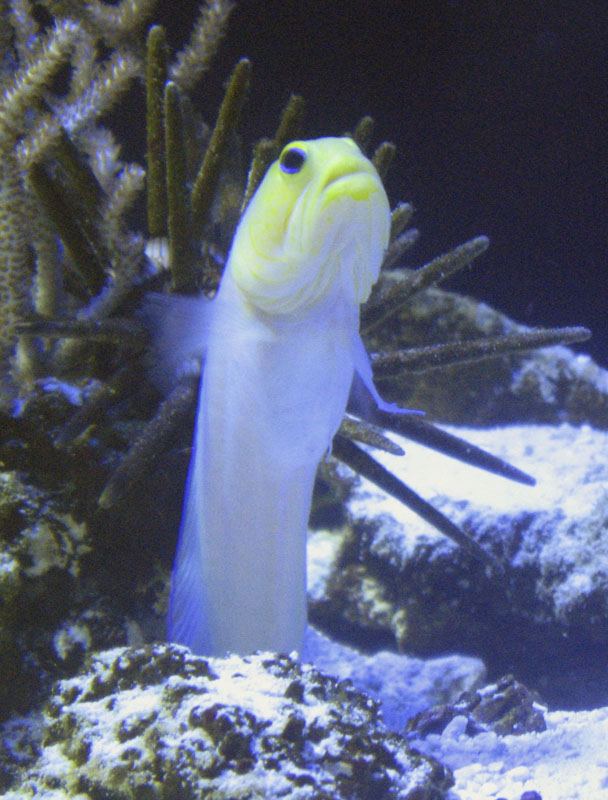 Yellowhead JawfishOpistognathus aurifrons
-
 Blue-spotted JawfishOpistognathus rosenblatti
-
 Bartail JawfishOpistognathus cuvierii
-
 Dusky JawfishOpistognathus whitehursti
-
 Moustache JawfishOpistognathus lonchurus
-
 Robust JawfishOpistognathus muscatensis
-
 Goldspecs JawfishOpistognathus randalli
-
 Spotfin JawfishOpistognathus robinsi
Compare
Questions and answers
What is the scientific name of the Fine-spotted Jawfish?
The scientific name of the Fine-spotted Jawfish is Opistognathus punctatus. Written with its author, the full name is Opistognathus punctatus Peters, 1869.
Which family does the Fine-spotted Jawfish belong to?
Opistognathus punctatus belongs to the family Opistognathidae, in the order Perciformes and the class Teleostei.
Where is the Fine-spotted Jawfish found?
Checklists and occurrence records place Opistognathus punctatus in 2 countries: Mexico and Tonga.
What is the conservation status of the Fine-spotted Jawfish?
The IUCN Red List category recorded for Opistognathus punctatus is Least Concern (LC).
What other names does the Fine-spotted Jawfish have?
Opistognathus punctatus is also known in English as Finespotted Jawfish.
What type of fish is a jawfish?
The Fine-spotted Jawfish is a fish belonging to the family Opistognathidae, order Perciformes, and class Teleostei.[22]
Sources
Passages the profile rests on
- The species has an elongated, compressed body that tapers toward the tail. Source passage: “Elongate, compressed, tapering body” — biogeodb.stri.si.edu
- The species has a large, bulbous head and a large eye positioned high on the head. Source passage: “large bulbous head; eye large, high” — biogeodb.stri.si.edu
- A simple cirrus is present at the front nostril. Source passage: “a simple cirrus at front nostril” — biogeodb.stri.si.edu
- In large males, the upper jaw is nearly as long as the head. Source passage: “top jaw nearly as long as head in large males” — biogeodb.stri.si.edu
- The front of the mouth roof bears two teeth. Source passage: “front of roof of mouth with 2 teeth” — biogeodb.stri.si.edu
- The dorsal fin has 11 spines and 16–17 soft rays. Source passage: “dorsal rays XI, 16-17” — biogeodb.stri.si.edu
- The tail is rounded and considerably shorter than the head. Source passage: “tail rounded, much shorter than head” — biogeodb.stri.si.edu
- The lateral line extends only along the front half of the body and is positioned high. Source passage: “lateral line on front half of body only, high” — biogeodb.stri.si.edu
- The species has small, smooth scales and lacks scales on its head. Source passage: “Scales small, smooth, none on head” — biogeodb.stri.si.edu
- The body has between 128 and 150 oblique scale rows. Source passage: “body with 128-150 oblique scale rows.” — biogeodb.stri.si.edu
- The body coloration ranges from light grey to brownish and includes numerous fine dark spots. Source passage: “Light grey or brownish with numerous fine dark spots on head and body” — biogeodb.stri.si.edu
- The sides and fins also bear larger blackish spots and blotches. Source passage: “also larger blackish spots and blotches on side and fins” — biogeodb.stri.si.edu
- Juveniles have fewer but larger spots than adults. Source passage: “juveniles have fewer larger spots than adult” — biogeodb.stri.si.edu
- The number of spots increases as individuals grow. Source passage: “become increasingly more spotted with growth” — biogeodb.stri.si.edu
- Juveniles shorter than approximately 15 cm have an elongated black spot on the dorsal fin between the fourth and eighth spines. Source passage: “juveniles under about 15 cm with an elongate black spot on middle of dorsal fin between 4th and 8th spines” — biogeodb.stri.si.edu
- In very small individuals, the elongated dorsal-fin spot forms an ocellus. Source passage: “this spot an ocellus in very small individuals” — biogeodb.stri.si.edu
- Males have two black V-shaped marks inside the lower jaw. Source passage: “inside lower jaw of male with two black V shaped marks.” — biogeodb.stri.si.edu
- Its documented soft-bottom habitats include mud, sand, gravel, beaches, estuaries, mangroves, and seagrass. Source passage: “Soft bottom (mud/sand/gravel/beach/estuary/mangrove/seagrass)” — biogeodb.stri.si.edu
- The species feeds on mobile benthic crustaceans, including shrimps and crabs. Source passage: “Mobile benthic crustacea (shrimps/crabs)” — biogeodb.stri.si.edu
- Its recorded food categories include mobile benthic gastropods and bivalves. Source passage: “Mobile benthic gastropods/bivalves” — biogeodb.stri.si.edu
- The juvenile form of this species was described under the name Opistognathus mexicanus. Source passage: “The juvenile of this species was described as O. mexicanus by Allen and Robertson (1991).” — biogeodb.stri.si.edu
- The species was described by Peters in 1869. Source passage: “Opistognathus punctatus Peters, 1869” — fishbase.se
Data
- Catalogue of Life, 2026-10-16 XR cc by
- Global Biodiversity Information Facility CC BY 4.0
- Wikidata CC0
- GeoNames CC BY 4.0
- Wikimedia Commons per image; credit shown with each image
- Within the Catalogue of Life, this name comes from World Register of Marine Species cc by
References
- Peters, W. (C. H.). (1869). Über neue oder weniger bekannte Fische des Berliner Zoologischen Museums. Monatsberichte Der Königlichen Preussischen Akademie Der Wissenschaften Zu Berlin 1869, : 703–711. where the name was published
This species in other databases
- Catalogue of Life 74QJ2
- Wikidata Q5236223
- iNaturalist 107719
- WoRMS urn:lsid:marinespecies.org:taxname:276471
- ITIS 645845
Page built on 29 November 2026. See how the catalog is made and all sources and licences.
Cite this page
ScientificNames.org. (2026). Opistognathus punctatus (Fine-spotted Jawfish). Retrieved November 29, 2026, from https://scientificnames.org/species/opistognathus-punctatus
“Opistognathus punctatus (Fine-spotted Jawfish).” ScientificNames.org, 2026, scientificnames.org/species/opistognathus-punctatus. Accessed 29 Nov. 2026.
ScientificNames.org. “Opistognathus punctatus (Fine-spotted Jawfish).” Accessed November 29, 2026. https://scientificnames.org/species/opistognathus-punctatus.
@misc{scientificnames_opistognathus_punctatus_fine_spotted_jawfish,
  author = {{ScientificNames.org}},
  title = {Opistognathus punctatus (Fine-spotted Jawfish)},
  year = {2026},
  url = {https://scientificnames.org/species/opistognathus-punctatus},
  note = {Accessed 2026-11-29}
}