Species · Birds
White-lored Tyrannulet Ornithion inerme
The scientific name of the White-lored Tyrannulet is Ornithion inerme. It is a species of bird in the family Tyrannidae (tyrant flycatcher), order Passeriformes. The name dates from 1853.
- Scientific name
- Ornithion inerme Hartlaub, 1853
- Common name
- White-lored Tyrannulet
- Genus
- Ornithion
- Family
- Tyrannidae (Tyrant Flycatcher)
- Order
- Passeriformes
- Class
- Aves
- Red List category
- LC Least Concern
- Recorded in
- 9 countries
- Name status
- accepted in the Catalogue of Life

Overview
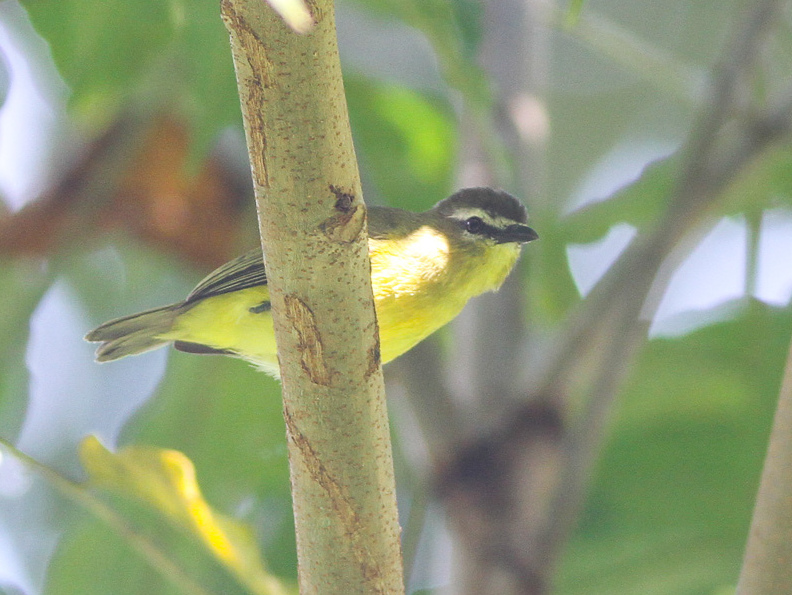
The White-lored Tyrannulet (Ornithion inerme Hartlaub, 1853) is a monotypic species of flycatcher in the family Tyrannidae, order Passeriformes, class Aves. It occurs in Bolivia, Brazil, Colombia, Ecuador, French Guiana, Guyana, Peru, Suriname, and Venezuela. It is distinguished by a white line extending across the forehead between the eyes, olive upperparts, and mostly pale yellow underparts.
Written 27 November 2026 from the sources listed below. Each statement was checked against the passage it cites; statements that could not be supported were removed.
Appearance
The White-lored Tyrannulet is a small flycatcher with a relatively thick bill. It measures 8–9 cm in length and weighs approximately 6–8 g.[1][2][3]
Adult males and females have identical plumage. Adults have a gray crown and nape and a white line extending across the forehead from beyond one eye to beyond the other.[4][5]
The adult bird has an olive face with gray lores and olive upperparts. Its wings are blackish, with thin greenish-yellow edges on the secondaries.[6][7][8]
The greater and median wing coverts have pale yellow tips that form two rows of spots when the wing is closed. The tail is grayish, with green edges on the outer feathers.[9][10]
The throat is whitish, while the remaining underparts are mostly pale yellow with a light olive wash on the breast and sides. Both sexes have dark brown irises, black bills, and dark gray or black legs and feet.[11][12]
Juveniles have ochraceous wing bars and otherwise resemble adults.[13]
Habitat
The White-lored Tyrannulet inhabits tropical lowland evergreen forest and is associated with subtropical or tropical moist natural habitats. It is a small flycatcher of the rainforest canopy.[14][15][16]
The species favors the forest canopy but is apparently more abundant along edges near watercourses, lakes, and openings created by fallen trees. In Colombia, it frequently occurs in terra firme forest, while in Brazil it occurs in várzea forest.[17][18][19]
In Brazil, the species occurs from sea level to elevations of 1,000 m. In Colombia it occurs up to 500 m, in Ecuador up to 600 m, in Peru up to 1,000 m, and in Venezuela up to 950 m.[20][21][22][23][24]
Behaviour
The White-lored Tyrannulet remains in its range throughout the year. It is highly vocal and is more frequently heard than seen.[25][26]
The species usually forages alone or in pairs in the forest canopy and frequently joins mixed-species feeding flocks.[27][28]
It captures prey by gleaning from leaves, twigs, and stems while perched, sometimes hanging to reach its prey. It also captures prey through short upward fluttering flights and brief hovering.[29][30]
Diet
The White-lored Tyrannulet feeds almost exclusively on arthropods.[31]
Reproduction and life cycle
The species' breeding biology is almost completely unknown. Available evidence indicates that its breeding season includes December in Peru.[32][33]
Conservation
The IUCN classifies the White-lored Tyrannulet as Least Concern. It has an extremely large geographic range and was most recently assessed for the IUCN Red List in 2024.[34][35][36]
The population size is unknown, and the population is believed to be decreasing. No immediate threats to the species have been identified.[37][38][39]
The species is fairly common in Colombia, fairly common in Peru and Venezuela, and uncommon to locally fairly common in Ecuador.[40][41][42]
Human activity has little direct short-term effect on the species apart from localized habitat destruction.[43]
Classification of the White-lored Tyrannulet
| Kingdom | Animalia |
|---|---|
| Phylum | Chordata |
| Subphylum | Vertebrata |
| Infraphylum | Gnathostomata |
| Parvphylum | Osteichthyes |
| Megaclass | Tetrapoda |
| Class | Aves (Bird) |
| Order | Passeriformes (Passerine) |
| Family | Tyrannidae (Tyrant Flycatcher) |
| Genus | Ornithion (Tyrannulet) |
| Species | Ornithion inerme Hartlaub, 1853 |
Where the White-lored Tyrannulet is found
Checklists and occurrence records place Ornithion inerme in 9 countries across South America. GBIF holds 10,637 georeferenced records of it.
Countries
- Bolivia 319
- Brazil 5,105
- Colombia 443
- Ecuador 952
- French Guiana 314
- Guyana 379
- Peru 2,767
- Suriname 149
- Venezuela 209
Regions and cities with the most records
- Mato Grosso, Brazil 1,420
- Madre de Dios, Peru 1,150
- Pará, Brazil 853
- Amazonas, Brazil 768
- San Martín Department, Peru 653
- Bahia, Brazil 471
- Loreto, Peru 396
- Rondônia, Brazil 349
- La Banda, Peru 348
- Cuzco Department, Peru 343
- Orellana Province, Ecuador 333
- Sucumbíos, Ecuador 322
- Potaro-Siparuni, Guyana 235
- Moyobamba, Peru 212
- Acre, Brazil 211
- Pernambuco, Brazil 209
- Espírito Santo, Brazil 206
- Tocantins, Brazil 198
- Bolívar, Venezuela 176
- Sooretama, Brazil 171
- Tambopata, Peru 138
- Itacaré, Brazil 136
- Vaupés, Colombia 131
- Porto Seguro, Brazil 130
- Presidente Figueiredo, Brazil 126
- Puerto Maldonado, Peru 122
- Rioja, Peru 122
- Santa Cruz Cabrália, Brazil 121
- La Paz Department, Bolivia 117
- Abreu e Lima, Brazil 115
- Camaragibe, Brazil 114
- São Lourenço da Mata, Brazil 114
- Napo, Ecuador 113
- Guainía Department, Colombia 112
- Mitú, Colombia 105
- Ucayali, Peru 105
Range as the checklists state it
South America
A number beside a place is its count of GBIF occurrence records. A place without a number comes from a checklist alone. Records show where a species has been observed or collected, which can include escapes and vagrants.
Common names
English
- White-lored Tyrannulet
Names in 24 other languages
- Catalan
- tiranulet tacat
- Chinese
- 白眼先小霸鶲, 白眼先小霸鹟
- Croatian
- biserastokrila elenija
- Czech
- tyrančík krůpějový
- Danish
- Hvidtøjlet Tyrannulet
- Dutch
- Witteugelvliegenpikker
- Esperanto
- blankbrida tiraneto
- Finnish
- helmisiipinapsija
- French
- Tyranneau minute
- German
- Weißzügel-Fliegenstecher, Weißzügel-Kleintyrann
- Italian
- Tirannetto redini bianche
- Japanese
- タンビコタイランチョウ
- Lithuanian
- šviesiagurklis nykštukinis tironiukas
- Norwegian
- perlebåndtyrannulett
- Polish
- brewinek amazoński
- Portuguese
- Poaieiro-de-sobrancelha, Poiaeiro-de-sobrancelha, poaieiro-de-sobrancelhas, tiraninho-de-loros-brancos
- Russian
- Белобровый москитолов, Белопоясный тиранн-карлик
- Serbian
- Beloobrvasta tirančica
- Slovak
- moskytár uzdičkový
- Spanish
- Mosquerito moteado
- Swedish
- vittyglad dvärgtyrann
- Turkish
- Benek Şeritli Tiranulet
- Ukrainian
- тиран-карлик амазонійський
- Welsh
- teyrn bach llygadwyn
Synonyms
2 other scientific names have been used for this species and are now treated as synonyms of Ornithion inerme.
- Microtriccus fasciatus Carriker, MA, 1934
- Ornithion fasciatus Carriker, MA, 1934
Related species
-
 Yellow-bellied TyrannuletOrnithion semiflavum
-
 Brown-capped TyrannuletOrnithion brunneicapillus
-
 Great KiskadeePitangus sulphuratus
-
 Eastern PhoebeSayornis phoebe
-
 Cinnamon FlycatcherPyrrhomyias cinnamomeus
-
 Dusky-capped FlycatcherMyiarchus tuberculifer
-
 Vermilion FlycatcherPyrocephalus obscurus
-
 Black PhoebeSayornis nigricans
Compare
Questions and answers
What is the scientific name of the White-lored Tyrannulet?
The scientific name of the White-lored Tyrannulet is Ornithion inerme. Written with its author, the full name is Ornithion inerme Hartlaub, 1853.
Which family does the White-lored Tyrannulet belong to?
Ornithion inerme belongs to the family Tyrannidae, in the order Passeriformes and the class Aves.
Where is the White-lored Tyrannulet found?
Checklists and occurrence records place Ornithion inerme in 9 countries, including Brazil, Peru, Ecuador, Colombia, Guyana and Bolivia.
What is the conservation status of the White-lored Tyrannulet?
The IUCN Red List category recorded for Ornithion inerme is Least Concern (LC).
Sources
Passages the profile rests on
- The White-lored Tyrannulet measures 8–9 cm in length. Source passage: “The white-lored tyrannulet is 8 to 9 cm (3.1 to 3.5 in) long” — English Wikipedia
- The White-lored Tyrannulet weighs approximately 6–8 g. Source passage: “weighs about 6 to 8 g (0.21 to 0.28 oz).” — English Wikipedia
- The White-lored Tyrannulet is a small flycatcher with a relatively thick bill. Source passage: “It is a small flycatcher with a rather thick bill.” — English Wikipedia
- Adult males and females have identical plumage. Source passage: “The sexes have the same plumage.” — English Wikipedia
- Adults have a gray crown and nape and a white line extending across the forehead from beyond one eye to beyond the other. Source passage: “Adults have a gray crown and nape with a white line from past the eye to past the eye across the forehead” — English Wikipedia
- The adult bird has an olive face with gray lores. Source passage: “and gray lores on an otherwise olive face.” — English Wikipedia
- The adult White-lored Tyrannulet has olive upperparts. Source passage: “Their upperparts are olive.” — English Wikipedia
- Its wings are blackish and have thin greenish-yellow edges on the secondaries. Source passage: “Their wings are blackish with thin greenish yellow edges on the secondaries.” — English Wikipedia
- Its greater and median wing coverts have pale yellow tips that form two rows of spots when the wing is closed. Source passage: “Their greater and median wing coverts have pale yellow tips that show as two rows of spots on the closed wing.” — English Wikipedia
- Its tail is grayish, with green edges on the outer feathers. Source passage: “Their tail is grayish with green edges on the outer feathers.” — English Wikipedia
- Its throat is whitish, while the remaining underparts are mostly pale yellow with a light olive wash on the breast and sides. Source passage: “Their throat is whitish and the rest of their underparts mostly pale yellow with a light olivaceous wash on the breast and sides.” — English Wikipedia
- Both sexes have dark brown irises, black bills, and dark gray or black legs and feet. Source passage: “Both sexes have a dark brown iris, a black bill, and dark gray or black legs and feet.” — English Wikipedia
- Juveniles have ochraceous wing bars and otherwise resemble adults. Source passage: “Juveniles have ochraceous wing bars and are otherwise like adults.” — English Wikipedia
- The White-lored Tyrannulet inhabits tropical lowland evergreen forest. Source passage: “The white-lored tyrannulet inhabits tropical lowland evergreen forest.” — English Wikipedia
- The species is associated with subtropical or tropical moist natural habitats. Source passage: “Its natural habitats are subtropical or tropical moist ...” — inaturalist.org
- The White-lored Tyrannulet is described as a small flycatcher of the rainforest canopy. Source passage: “Small flycatcher of rainforest canopy.” — ebird.org
- The species favors the forest canopy but is apparently more abundant along edges near watercourses, lakes, and openings created by fallen trees. Source passage: “It favors the canopy but apparently is more abundant at edges such as along watercourses, lakes, and openings caused by fallen trees.” — English Wikipedia
- In Colombia, the species frequently occurs in terra firme forest. Source passage: “In Colombia it often occurs in terra firme forest” — English Wikipedia
- In Brazil, the species occurs in várzea forest. Source passage: “and in Brazil in várzea forest.” — English Wikipedia
- In Brazil, the species occurs from sea level to elevations of 1,000 m. Source passage: “In elevation it ranges from sea level to 1,000 m (3,300 ft) in Brazil” — English Wikipedia
- In Colombia, the species occurs at elevations up to 500 m. Source passage: “to 500 m (1,600 ft) in Colombia” — English Wikipedia
- In Ecuador, the species occurs at elevations up to 600 m. Source passage: “600 m (2,000 ft) in Ecuador” — English Wikipedia
- In Peru, the species occurs at elevations up to 1,000 m. Source passage: “1,000 m (3,300 ft) in Peru” — English Wikipedia
- In Venezuela, the species occurs at elevations up to 950 m. Source passage: “and 950 m (3,100 ft) in Venezuela.” — English Wikipedia
- The White-lored Tyrannulet remains in its range throughout the year. Source passage: “The white-lored tyrannulet is a year-round resident throughout its range.” — English Wikipedia
- The White-lored Tyrannulet is highly vocal and is more frequently heard than seen. Source passage: “Many authors note that the white-lored tyrannulet is highly vocal and is heard more often than seen.” — English Wikipedia
- The species usually forages alone or in pairs in the forest canopy. Source passage: “It usually forages singly or in pairs in the forest canopy” — English Wikipedia
- The White-lored Tyrannulet frequently joins mixed-species feeding flocks. Source passage: “and often joins mixed-species feeding flocks.” — English Wikipedia
- The species captures prey by gleaning from leaves, twigs, and stems while perched, sometimes hanging to reach its prey. Source passage: “It takes prey by gleaning from leaves, twigs, and stems while perched, sometimes hanging to reach them.” — English Wikipedia
- The White-lored Tyrannulet also captures prey through short upward fluttering flights and brief hovering. Source passage: “It also feeds by short upward flutter flights and by briefly hovering.” — English Wikipedia
- The White-lored Tyrannulet feeds almost exclusively on arthropods. Source passage: “It feeds almost exclusively on arthropods though details are lacking.” — English Wikipedia
- The species' breeding biology is almost completely unknown. Source passage: “The white-lored tyrannulet's breeding biology is almost completely unknown.” — English Wikipedia
- Available evidence indicates that the species' breeding season includes December in Peru. Source passage: “The only data point to its breeding season including December in Peru.” — English Wikipedia
- The IUCN classifies the White-lored Tyrannulet as Least Concern. Source passage: “The IUCN has assessed the white-lored tyrannulet as being of Least Concern.” — English Wikipedia
- The species has an extremely large geographic range. Source passage: “It has an extremely large range;” — English Wikipedia
- The White-lored Tyrannulet was most recently assessed for the IUCN Red List in 2024. Source passage: “White-lored Tyrannulet Ornithion inerme has most recently been assessed for The IUCN Red List of Threatened Species in 2024.” — iucnredlist.org
- The population size of the White-lored Tyrannulet is unknown. Source passage: “its population size is not known” — English Wikipedia
- The species' population is believed to be decreasing. Source passage: “and is believed to be decreasing.” — English Wikipedia
- No immediate threats to the White-lored Tyrannulet have been identified. Source passage: “No immediate threats have been identified.” — English Wikipedia
- The species is considered fairly common in Colombia. Source passage: “It is considered fairly common in Colombia” — English Wikipedia
- The species is uncommon to locally fairly common in Ecuador. Source passage: “uncommon to locally fairly common in Ecuador” — English Wikipedia
- The species is fairly common in Peru and Venezuela. Source passage: “and fairly common in Peru and Venezuela.” — English Wikipedia
- Human activity has little direct short-term effect on the species apart from localized habitat destruction. Source passage: “Human activity has little short-term direct effect on White-lored Tyrannulet, other than the local effects of habitat destruction.” — English Wikipedia
Data
- Catalogue of Life, 2026-10-16 XR cc by
- Global Biodiversity Information Facility CC BY 4.0
- Wikidata CC0
- GeoNames CC BY 4.0
- Wikimedia Commons per image; credit shown with each image
- Within the Catalogue of Life, this name comes from The Integrated Taxonomic Information System cc0
References
- Gill, Frank, & and Minturn Wright. (2006). Birds of the World: Recommended English Names.
This species in other databases
Page built on 29 November 2026. See how the catalog is made and all sources and licences.
Cite this page
ScientificNames.org. (2026). Ornithion inerme (White-lored Tyrannulet). Retrieved November 29, 2026, from https://scientificnames.org/species/ornithion-inerme
“Ornithion inerme (White-lored Tyrannulet).” ScientificNames.org, 2026, scientificnames.org/species/ornithion-inerme. Accessed 29 Nov. 2026.
ScientificNames.org. “Ornithion inerme (White-lored Tyrannulet).” Accessed November 29, 2026. https://scientificnames.org/species/ornithion-inerme.
@misc{scientificnames_ornithion_inerme_white_lored_tyrannulet,
  author = {{ScientificNames.org}},
  title = {Ornithion inerme (White-lored Tyrannulet)},
  year = {2026},
  url = {https://scientificnames.org/species/ornithion-inerme},
  note = {Accessed 2026-11-29}
}