Species · Birds
Yellow-bellied Tyrannulet Ornithion semiflavum
The scientific name of the Yellow-bellied Tyrannulet is Ornithion semiflavum. It is a species of bird in the family Tyrannidae (tyrant flycatcher), order Passeriformes. The name dates from 1860.
- Scientific name
- Ornithion semiflavum (P. L. Sclater & Salvin, 1860)
- Common name
- Yellow-bellied Tyrannulet
- Genus
- Ornithion
- Family
- Tyrannidae (Tyrant Flycatcher)
- Order
- Passeriformes
- Class
- Aves
- Red List category
- LC Least Concern
- Environment
- terrestrial
- Recorded in
- 7 countries
- Name status
- accepted in the Catalogue of Life

Overview
The Yellow-bellied Tyrannulet is a small flycatcher in the family Tyrannidae and order Passeriformes. It occurs from southern Mexico through Central America to extreme western Panama. Adults have bright yellow underparts with faint olive streaks across the breast and flanks.
Written 27 November 2026 from the sources listed below. Each statement was checked against the passage it cites; statements that could not be supported were removed.
Appearance
The Yellow-bellied Tyrannulet is a small flycatcher with a pointed bill. It measures 8–9 cm in length and weighs approximately 7–8 g.[1][2][3]
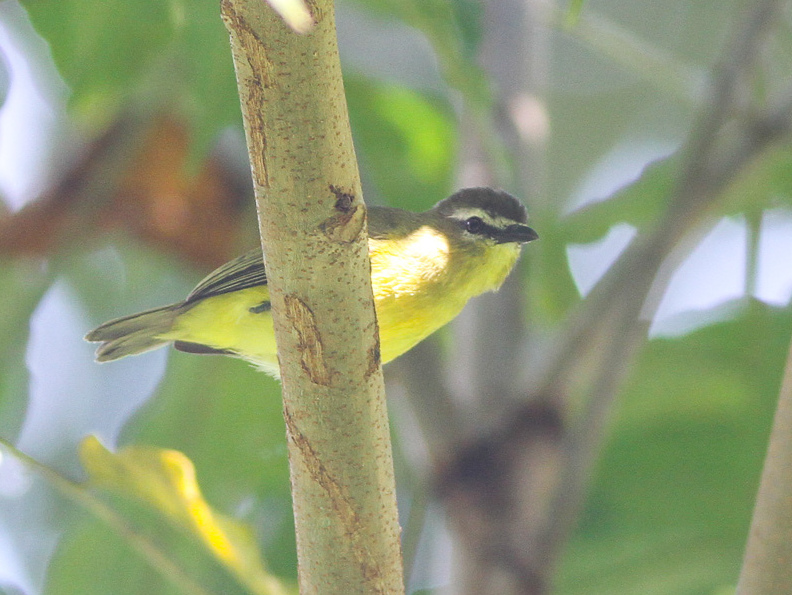
Adults have a slate-grey crown, white forehead, lores and supercilium, and an otherwise olive-brown face. Their upperparts are bright olive, while the wings and tail are dusky olive.[4][5]
Adults have bright yellow underparts with faint olive streaks across the breast and flanks. Both sexes have brown irises, black bills with arched maxillae, and dark gray legs and feet.[6][7]
Males and females have the same plumage. Juveniles have brown-tinged crowns and upperparts and paler yellow underparts than adults.[8][9]
Habitat
The species primarily inhabits the interior and edges of humid evergreen forests. It also occurs in mature secondary forests, plantations, gardens with tall trees, and taller semi-deciduous scrublands.[10][11]
The Yellow-bellied Tyrannulet inhabits the tropical zone, generally from sea level to elevations of 1,500 m. Its Costa Rican range reaches only 600 m.[12][13]
The species occurs in Belize, Costa Rica, Guatemala, Honduras, Mexico, Nicaragua, and Panama. Its range extends from Veracruz and Oaxaca in southern Mexico through Central America to extreme western Panama, and it is absent from the Yucatán Peninsula and El Salvador.[14][15][16]
It occupies the Caribbean slope from Mexico to northern Costa Rica. Its Pacific-slope distribution extends from central Costa Rica into Panama.[17][18]
Diet
The Yellow-bellied Tyrannulet feeds almost exclusively on arthropods.[19]
Behaviour
The species usually forages alone or in pairs and occasionally participates in mixed-species feeding flocks. It typically forages from the middle levels of forests to the canopy, but feeds lower down along forest edges.[20][21][22]
It captures most prey by gleaning from leaves, twigs, and stems while perched. Its feeding behaviour resembles that of warblers and vireos.[23][24]
The species remains resident throughout its range year-round.[25]
Reproduction and life cycle
The species apparently breeds between March and June. Its nest is thought to be globe-shaped and concealed in bromeliad clumps or large dead, curled leaves.[26][27]
Similar species
The Yellow-bellied Tyrannulet and Brown-capped Tyrannulet were formerly treated as the same species. They are now considered a superspecies, and both are currently treated as monotypic.[28][29][30]
Conservation
The IUCN classifies the Yellow-bellied Tyrannulet as Least Concern. Its estimated population is at least 50,000 mature individuals, although the population is believed to be decreasing.[31][32][33]
No immediate threats to the species have been identified. It is considered uncommon in northern Central America and very uncommon in Costa Rica.[34][35]
The species occurs in several protected areas in Belize, Guatemala, and Costa Rica.[36]
Classification of the Yellow-bellied Tyrannulet
| Kingdom | Animalia |
|---|---|
| Phylum | Chordata |
| Subphylum | Vertebrata |
| Infraphylum | Gnathostomata |
| Parvphylum | Osteichthyes |
| Megaclass | Tetrapoda |
| Class | Aves (Bird) |
| Order | Passeriformes (Passerine) |
| Family | Tyrannidae (Tyrant Flycatcher) |
| Genus | Ornithion (Tyrannulet) |
| Species | Ornithion semiflavum (P. L. Sclater & Salvin, 1860) |
Where the Yellow-bellied Tyrannulet is found
Checklists and occurrence records place Ornithion semiflavum in 7 countries across North America. GBIF holds 13,478 georeferenced records of it.
Countries
Regions and cities with the most records
- Cayo District, Belize 4,375
- San Ignacio, Belize 2,577
- Orange Walk District, Belize 1,433
- Puntarenas Province, Costa Rica 1,394
- Petén, Guatemala 1,207
- Belmopan, Belize 1,131
- Toledo District, Belize 941
- Alajuela Province, Costa Rica 633
- Chiapas, Mexico 598
- Atlántida Department, Honduras 591
- Stann Creek, Belize 584
- Izabal Department, Guatemala 338
- La Ceiba, Honduras 338
- La Ceiba, Honduras 326
- San José, Costa Rica 283
- Veracruz, Mexico 206
- San Isidro, Costa Rica 200
- Palenque, Mexico 193
- Morales, Guatemala 152
- Catemaco, Mexico 140
- Oaxaca, Mexico 134
- Cortés Department, Honduras 132
- Tela, Honduras 115
- Belize District, Belize 110
- Arizona, Honduras 101
- Santa Cruz de Yojoa, Honduras 100
- San Francisco de Yojoa, Honduras 99
- Lívingston, Guatemala 98
- Puerto Barrios, Guatemala 86
- San Andrés Tuxtla, Mexico 72
- Alta Verapaz, Guatemala 68
- Guanacaste Province, Costa Rica 63
- Flores, Guatemala 55
- Campeche, Mexico 54
- San Benito, Guatemala 54
- Heredia Province, Costa Rica 50
1 more country has a few records outside this range
These countries hold a few records of Ornithion semiflavum but lie outside the range the checklists give for it. Such records are often zoo or garden specimens, museum material or vagrants, so the species is not counted as occurring there.
Range as the checklists state it
Middle America
A number beside a place is its count of GBIF occurrence records. A place without a number comes from a checklist alone. Records show where a species has been observed or collected, which can include escapes and vagrants.
Common names
English
- Yellow-bellied Tyrannulet
Names in 24 other languages
- Catalan
- tiranulet de panxa groga
- Chinese
- 黃腹小霸鶲, 黄腹小霸鹟
- Croatian
- škriljastokapa elenija
- Czech
- tyrančík středoamerický
- Danish
- Gulbuget Tyrannulet
- Dutch
- Geelbuikvliegenpikker
- Esperanto
- flavaventra tiraneto
- Finnish
- tiaisnapsija
- French
- Tyranneau à ventre jaune
- German
- Gelbbauch-Fliegenstecher, Gelbbauch-Kleintyrann
- Italian
- Tirannetto panciagialla, Tiranno piccolo pettogiallo
- Japanese
- キバラコタイランチョウ
- Lithuanian
- geltonpilvis nykštukinis tironiukas
- Norwegian
- gulbuktyrannulett
- Polish
- brewinek żółtobrzuchy
- Portuguese
- poaieiro-de-coroa-cinzenta, tiraninho-de-barriga-amarela
- Russian
- Желтобрюхий тиранн-карлик, Златобрюхий москитолов
- Serbian
- Žutotrba tirančica
- Slovak
- moskytár zlatobruchý
- Spanish
- Mosquerito Enano, Mosquerito ventriamarillo, Mosquero ceja blanca, mosquerito cejiblanco
- Swedish
- gulbukig dvärgtyrann
- Turkish
- Sarı Karınlı Tiranulet
- Ukrainian
- тиран-карлик жовточеревий
- Welsh
- teyrn bach torfelyn y Gogledd
Synonyms
One other scientific name has been used for this species and is now treated as a synonym of Ornithion semiflavum.
- Tyrannulus semiflavus P. L. Sclater & Salvin, 1860
Related species
-
 Brown-capped TyrannuletOrnithion brunneicapillus
-
 White-lored TyrannuletOrnithion inerme
-
 Great KiskadeePitangus sulphuratus
-
 Eastern PhoebeSayornis phoebe
-
 Cinnamon FlycatcherPyrrhomyias cinnamomeus
-
 Dusky-capped FlycatcherMyiarchus tuberculifer
-
 Vermilion FlycatcherPyrocephalus obscurus
-
 Black PhoebeSayornis nigricans
Compare
Questions and answers
What is the scientific name of the Yellow-bellied Tyrannulet?
The scientific name of the Yellow-bellied Tyrannulet is Ornithion semiflavum. Written with its author, the full name is Ornithion semiflavum (P. L. Sclater & Salvin, 1860).
Which family does the Yellow-bellied Tyrannulet belong to?
Ornithion semiflavum belongs to the family Tyrannidae, in the order Passeriformes and the class Aves.
Where is the Yellow-bellied Tyrannulet found?
Checklists and occurrence records place Ornithion semiflavum in 7 countries, including Belize, Costa Rica, Guatemala, Mexico, Honduras and Nicaragua.
What is the conservation status of the Yellow-bellied Tyrannulet?
The IUCN Red List category recorded for Ornithion semiflavum is Least Concern (LC).
What do yellow-bellied flycatchers eat?
The Yellow-bellied Tyrannulet feeds almost exclusively on arthropods.[19]
Where do yellow-bellied flycatchers live?
The Yellow-bellied Tyrannulet occurs in Belize, Costa Rica, Guatemala, Honduras, Mexico, Nicaragua, and Panama. It inhabits humid evergreen forests and also occurs in mature secondary forests, plantations, gardens with tall trees, and taller semi-deciduous scrublands.[14][10][11]
Sources
Passages the profile rests on
- The Yellow-bellied Tyrannulet is a small flycatcher with a pointed bill. Source passage: “It is a small flycatcher with a pointed bill.” — English Wikipedia
- The Yellow-bellied Tyrannulet measures 8–9 cm in length. Source passage: “The yellow-bellied tyrannulet is 8 to 9 cm (3.1 to 3.5 in) long” — English Wikipedia
- The species weighs approximately 7–8 g. Source passage: “weighs about 7 to 8 g (0.25 to 0.28 oz).” — English Wikipedia
- Adults have a slate-grey crown, white forehead, lores and supercilium, and an otherwise olive-brown face. Source passage: “Adults have a slate-grey crown with a white forehead, lores, and supercilium on an otherwise olive-brown face.” — English Wikipedia
- The adult's upperparts are bright olive, while its wings and tail are dusky olive. Source passage: “Their upperparts are bright olive. Their wings and tail are dusky olive.” — English Wikipedia
- Adults have bright yellow underparts with faint olive streaks across the breast and flanks. Source passage: “Their underparts are bright yellow with faint olive streaks on the breast and flanks.” — English Wikipedia
- Both sexes have brown irises, black bills with arched maxillae, and dark gray legs and feet. Source passage: “Both sexes have a brown iris, a black bill with an arched maxilla, and dark gray legs and feet.” — English Wikipedia
- Juveniles have brown-tinged crowns and upperparts and paler yellow underparts than adults. Source passage: “Juveniles have a brown tinge on their crown and upperparts and paler yellow underparts than adults.” — English Wikipedia
- Males and females have the same plumage. Source passage: “The sexes have the same plumage.” — English Wikipedia
- The species primarily inhabits the interior and edges of humid evergreen forests. Source passage: “primarily the interior and edges of humid evergreen forest” — English Wikipedia
- It also inhabits mature secondary forests, plantations, gardens with tall trees, and taller semi-deciduous scrublands. Source passage: “mature secondary forest, plantations, gardens with tall trees, and taller semi-deciduous scrublands.” — English Wikipedia
- The species generally occurs from sea level to elevations of 1,500 m, although its Costa Rican range reaches only 600 m. Source passage: “In elevation it ranges from sea level to 1,500 m (4,900 ft) in most of its range but reaches only 600 m (2,000 ft) in Costa Rica.” — English Wikipedia
- The species inhabits the tropical zone. Source passage: “The species inhabits the tropical zone” — English Wikipedia
- The species occurs in Belize, Costa Rica, Guatemala, Honduras, Mexico, Nicaragua, and Panama. Source passage: “It is found in Belize, Costa Rica, Guatemala, Honduras, Mexico, Nicaragua, and Panama.” — English Wikipedia
- Its range extends from Veracruz and Oaxaca in southern Mexico through Central America to extreme western Panama. Source passage: “The yellow-bellied tyrannulet is found from Veracruz and Oaxaca in southern Mexico south through Guatemala, Belize, Honduras, Nicaragua, and Costa Rica into extreme western Panama.” — English Wikipedia
- The species is absent from the Yucatán Peninsula and El Salvador. Source passage: “It is not found on the Yucatán Peninsula or in El Salvador.” — English Wikipedia
- It occupies the Caribbean slope from Mexico to northern Costa Rica. Source passage: “It occurs on the Caribbean slope from Mexico into northern Costa Rica” — English Wikipedia
- Its Pacific-slope distribution extends from central Costa Rica into Panama. Source passage: “on the Pacific slope from central Costa Rica into Panama.” — English Wikipedia
- The Yellow-bellied Tyrannulet feeds almost exclusively on arthropods. Source passage: “It feeds almost exclusively on arthropods.” — English Wikipedia
- The species usually forages alone or in pairs. Source passage: “It usually forages singly or in pairs” — English Wikipedia
- It typically forages from the middle levels of forests to the canopy, but feeds lower down along forest edges. Source passage: “from the forest's mid-level to the canopy but lower on its edges.” — English Wikipedia
- The species occasionally participates in mixed-species feeding flocks. Source passage: “It occasionally joins mixed-species feeding flocks.” — English Wikipedia
- It captures most prey by gleaning from leaves, twigs, and stems while perched. Source passage: “It takes most prey by gleaning from leaves, twigs, and stems while perched.” — English Wikipedia
- Its feeding behaviour resembles that of warblers and vireos. Source passage: “The yellow-bellied tyrannulet's behavior is much like that of a warbler (Parulidae) or vireo (Vireonidae).” — English Wikipedia
- The species remains resident throughout its range year-round. Source passage: “The yellow-bellied tyrannulet is a year-round resident throughout its range.” — English Wikipedia
- The species apparently breeds between March and June. Source passage: “The yellow-bellied tyrannulet apparently breeds between March and June.” — English Wikipedia
- Its nest is thought to be globe-shaped and concealed in bromeliad clumps or large dead, curled leaves. Source passage: “Its nest is thought to be globe-shaped and hidden in a clump of bromeliads or in a large dead and curled leaf.” — English Wikipedia
- The Yellow-bellied Tyrannulet and Brown-capped Tyrannulet were formerly treated as the same species. Source passage: “The yellow-bellied tyrannulet and the brown-capped tyrannulet (O. brunneicapillus) were for a time considered to be conspecific” — English Wikipedia
- The Yellow-bellied Tyrannulet and Brown-capped Tyrannulet are now considered a superspecies. Source passage: “and now are deemed a superspecies.” — English Wikipedia
- Both the Yellow-bellied Tyrannulet and Brown-capped Tyrannulet are currently treated as monotypic. Source passage: “Both are now monotypic.” — English Wikipedia
- The IUCN classifies the Yellow-bellied Tyrannulet as Least Concern. Source passage: “The IUCN has assessed the yellow-bellied tyrannulet as being of Least Concern.” — English Wikipedia
- The species has an estimated population of at least 50,000 mature individuals. Source passage: “its estimated population of at least 50,000 mature individuals” — English Wikipedia
- The species' population is believed to be decreasing. Source passage: “is believed to be decreasing.” — English Wikipedia
- No immediate threats to the species have been identified. Source passage: “No immediate threats have been identified.” — English Wikipedia
- The species is considered uncommon in northern Central America and very uncommon in Costa Rica. Source passage: “It is considered uncommon in northern Central America and very uncommon in Costa Rica.” — English Wikipedia
- The species occurs in several protected areas in Belize, Guatemala, and Costa Rica. Source passage: “It is found in several protected areas in Belize, Guatemala, and Costa Rica.” — English Wikipedia
Data
- Catalogue of Life, 2026-10-16 XR cc by
- Global Biodiversity Information Facility CC BY 4.0
- Wikidata CC0
- GeoNames CC BY 4.0
- Wikimedia Commons per image; credit shown with each image
- Within the Catalogue of Life, this name comes from The Integrated Taxonomic Information System cc0
References
- Proc. Zool. Soc. London: 300. 1860 where the name was published
- Gill, Frank, & and Minturn Wright. (2006). Birds of the World: Recommended English Names.
This species in other databases
Page built on 29 November 2026. See how the catalog is made and all sources and licences.
Cite this page
ScientificNames.org. (2026). Ornithion semiflavum (Yellow-bellied Tyrannulet). Retrieved November 29, 2026, from https://scientificnames.org/species/ornithion-semiflavum
“Ornithion semiflavum (Yellow-bellied Tyrannulet).” ScientificNames.org, 2026, scientificnames.org/species/ornithion-semiflavum. Accessed 29 Nov. 2026.
ScientificNames.org. “Ornithion semiflavum (Yellow-bellied Tyrannulet).” Accessed November 29, 2026. https://scientificnames.org/species/ornithion-semiflavum.
@misc{scientificnames_ornithion_semiflavum_yellow_bellied_tyrannulet,
  author = {{ScientificNames.org}},
  title = {Ornithion semiflavum (Yellow-bellied Tyrannulet)},
  year = {2026},
  url = {https://scientificnames.org/species/ornithion-semiflavum},
  note = {Accessed 2026-11-29}
}