Species · Birds
Red-bellied Macaw Orthopsittaca manilatus
The scientific name of the Red-bellied Macaw is Orthopsittaca manilatus. It is a species of bird in the family Psittacidae (macaws), order Psittaciformes. The name dates from 1783.
- Scientific name
- Orthopsittaca manilatus (Boddaert, 1783)
- Common name
- Red-bellied Macaw
- Genus
- Orthopsittaca
- Family
- Psittacidae (Macaws)
- Order
- Psittaciformes
- Class
- Aves
- Red List category
- LC Least Concern
- Recorded in
- 10 countries
- Name status
- accepted in the Catalogue of Life
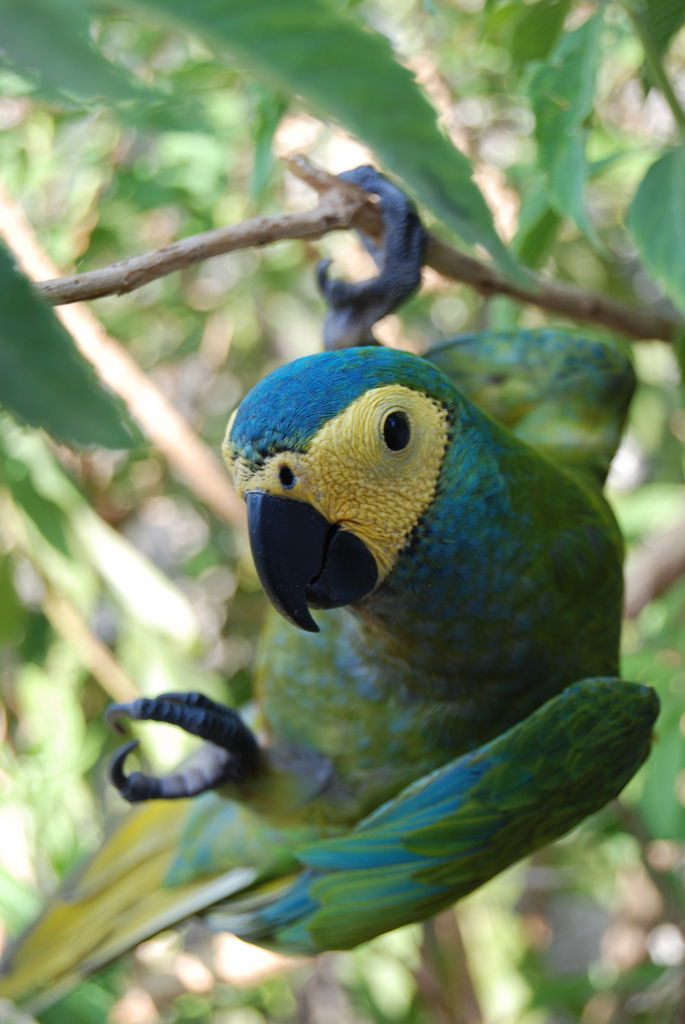
Overview
Orthopsittaca manilatus is native to tropical Amazonian South America and the Caribbean island of Trinidad.
Written 26 November 2026 from the sources listed below. Each statement was checked against the passage it cites; statements that could not be supported were removed.
Appearance
Its chin, throat, and upper chest are greyish with green scalloping. Adults have dark-grey beaks, legs, and feet, while juveniles have grey beaks with a conspicuous white stripe along the upper beak and duller plumage.[1][2][3]
The species has zygodactyl feet, with two toes pointing forward and two backward.[4]
Habitat
The Red-bellied Macaw inhabits moriche palm swamp forests and sandy savannahs containing palm groves. It also favors swampy areas within lowland rainforest habitats.[5][6]
The species depends critically on moriche palms for roosting, feeding, and nesting.[7]
Diet
The Red-bellied Macaw feeds almost exclusively on the fruits and seeds of moriche palms. In Trinidad, it also feeds on the fruits and seeds of Caribbean royal palms.[8][9]
Behaviour
Red-bellied Macaws produce high-pitched, reedy screams. They roost communally in moriche palms, with large numbers gathering at dawn and dusk.[10][11]
They select large stands of moriche palms containing abundant woodpecker holes as roosting sites. Between five and ten individuals may sleep together in a single tree hollow.[12][13]
At dusk, individuals enter communal hollows and sleep close together.[14]
Reproduction and life cycle
The Red-bellied Macaw nests in cavities of dead moriche palm trees. A typical clutch contains two to four white eggs.[15][16]
The female incubates the eggs for approximately 27 days. Chicks leave the nest approximately 77 days after hatching.[17][18]
Juveniles reach sexual maturity between two and three years of age.[19]
Conservation
The Red-bellied Macaw is classified as Least Concern by the IUCN. Wild populations appear to be declining, although population numbers have not been estimated.[20][21]
Clearing moriche palms for posts and cattle ranching has adversely affected some local populations. Capture for the pet trade is another identified threat.[22][23]
Uses
Moriche palms are cleared in some areas to provide posts.[24]
Similar species
The African red-bellied parrot has a similar common name but is a different species and is smaller than the Red-bellied Macaw.[25]
Juvenile Spix's macaws are the only other macaws described as having a similar white stripe along the upper beak.[26]
Classification of the Red-bellied Macaw
| Kingdom | Animalia |
|---|---|
| Phylum | Chordata |
| Subphylum | Vertebrata |
| Infraphylum | Gnathostomata |
| Parvphylum | Osteichthyes |
| Megaclass | Tetrapoda |
| Class | Aves (Bird) |
| Order | Psittaciformes (Parrot) |
| Family | Psittacidae (Macaws) |
| Genus | Orthopsittaca |
| Species | Orthopsittaca manilatus (Boddaert, 1783) |
Where the Red-bellied Macaw is found
Checklists and occurrence records place Orthopsittaca manilatus in 10 countries across South America. GBIF holds 44,373 georeferenced records of it.
Countries
- Bolivia 719
- Brazil 12,271
- Colombia 10,949
- Ecuador 6,812
- French Guiana 415
- Guyana 1,118
- Peru 10,227
- Suriname 544
- Trinidad and Tobago 827
- Venezuela 491
Regions and cities with the most records
- Madre de Dios, Peru 6,485
- Meta Department, Colombia 6,186
- Sucumbíos, Ecuador 3,825
- Loreto, Peru 3,003
- Amazonas, Brazil 2,971
- Puerto Maldonado, Peru 2,732
- Orellana Province, Ecuador 2,554
- Mato Grosso, Brazil 2,443
- Villavicencio, Colombia 2,443
- Manaus, Brazil 1,804
- Restrepo, Colombia 1,592
- Putumayo Department, Colombia 1,277
- Minas Gerais, Brazil 1,101
- Amazonas Department, Colombia 901
- Tocantins, Brazil 869
- Mato Grosso do Sul, Brazil 846
- Goiás, Brazil 808
- Tambopata, Peru 761
- Puerto Asís, Colombia 752
- Vaupés, Colombia 707
- Mitú, Colombia 686
- Plano Piloto, Brazil 671
- Cruzeiro, Brazil 663
- Rondônia, Brazil 650
- Casanare Department, Colombia 644
- Acacías, Colombia 643
- Brasília, Brazil 640
- Lago Norte, Brazil 631
- Pará, Brazil 625
- Itapoã, Brazil 618
- Setor Complementar de Indústria e Abastecimento, Brazil 607
- Paranoá, Brazil 602
- Leticia, Colombia 575
- Campo Grande, Brazil 568
- Tabatinga, Brazil 568
- Upper Takutu-Upper Essequibo, Guyana 568
2 more countries have a few records outside this range
These countries hold a few records of Orthopsittaca manilatus but lie outside the range the checklists give for it. Such records are often zoo or garden specimens, museum material or vagrants, so the species is not counted as occurring there.
Range as the checklists state it
South America
A number beside a place is its count of GBIF occurrence records. A place without a number comes from a checklist alone. Records show where a species has been observed or collected, which can include escapes and vagrants.
Common names
English
- Red-bellied Macaw
Names in 28 other languages
- Arabic
- مكاو أحمر البطن
- Bulgarian
- Тъмнозелен ара
- Catalan
- Guacamai de ventre vermell, guacamai caragroc
- Chinese
- 紅腹麥鷍, 红腹金刚鹦鹉
- Croatian
- žutolica ara
- Czech
- ara rudobřichý
- Danish
- Rødbuget Dværgara
- Dutch
- Roodbuikara
- Esperanto
- ruĝventra arao
- Estonian
- palmi-aara
- Finnish
- savanniara
- French
- Ara macavouanne
- German
- Rotbauchara
- Hungarian
- sárgaarcú ara, vöröshasú ara
- Italian
- Ara panciarossa
- Japanese
- ズグロヒメコンゴウインコ
- Lithuanian
- rausvapilvė ara
- Norwegian
- rustbukara
- Polish
- ara żółtolica
- Portuguese
- Maracanã-de-cara-amarela, arara-de-barriga-ruiva, maracanã-do-buriti
- Russian
- Краснобрюхий ара
- Serbian
- Crvenotrba ara
- Slovak
- ara červenobruchá
- Spanish
- Guacamayo de Vientre Rojo, Guacamayo ventrirrojo
- Swedish
- rödbukig ara
- Turkish
- Kırmızı Karınlı Ara
- Ukrainian
- ара жовтощокий
- pnb
- لال ٹڈ والے میکاع
Synonyms
6 other scientific names have been used for this species and are now treated as synonyms of Orthopsittaca manilatus.
- Ara manilata (Boddaert, 1783)
- Ara manilata BirdLife International (2004)
- Ara manilata Sibley & Monroe (1990, 1993)
- Ara manilata Stotz et al. (1996)
- Orthopsittaca manilata (Boddaert, 1783)
- Psittacus manilatus Boddaert, 1783
Related species
-
 Spix's MacawCyanopsitta spixii
-
 Grey ParrotPsittacus erithacus
-
 Scarlet MacawAra macao
-
 Hyacinth MacawAnodorhynchus hyacinthinus
-
 Blue-and-yellow MacawAra ararauna
-
 Sun ConureAratinga solstitialis
-
 Green ParakeetPsittacara holochlorus
-
 Green-cheeked ParakeetPyrrhura molinae
Compare
Questions and answers
What is the scientific name of the Red-bellied Macaw?
The scientific name of the Red-bellied Macaw is Orthopsittaca manilatus. Written with its author, the full name is Orthopsittaca manilatus (Boddaert, 1783).
Which family does the Red-bellied Macaw belong to?
Orthopsittaca manilatus belongs to the family Psittacidae, in the order Psittaciformes and the class Aves.
Where is the Red-bellied Macaw found?
Checklists and occurrence records place Orthopsittaca manilatus in 10 countries, including Brazil, Colombia, Peru, Ecuador, Guyana and Trinidad and Tobago.
What is the conservation status of the Red-bellied Macaw?
The IUCN Red List category recorded for Orthopsittaca manilatus is Least Concern (LC).
Sources
Passages the profile rests on
- Its chin, throat, and upper chest are greyish with green scalloping. Source passage: “The chin, throat and upper chest are greyish with some green scalloping” — English Wikipedia
- Adults have dark-grey beaks, legs, and feet. Source passage: “Adults have dark-grey beaks. The legs and feet are dark grey.” — English Wikipedia
- Juveniles are duller in colour than adults and have grey beaks with a conspicuous white stripe along the upper beak. Source passage: “Juveniles are duller in colour than adults and have a grey beak with a conspicuous white mid-line stripe” — English Wikipedia
- The species has zygodactyl feet, with two toes pointing forward and two backward. Source passage: “they have zygodactyl feet, two toes pointing forward and two backward.” — English Wikipedia
- The species inhabits moriche palm swamp forests and sandy savannahs containing palm groves. Source passage: “Its habitat is moriche (or buriti) palm (Mauritia flexuosa) swamp forests and sandy savannahs with palm groves.” — English Wikipedia
- The species favors swampy areas within lowland rainforest habitats. Source passage: “Small green macaw of lowland rainforest. Favors swampy areas, especially” — ebird.org
- The red-bellied macaw depends critically on moriche palms for roosting, feeding, and nesting. Source passage: “They are critically dependent on the Moriche palm for roosting, feeding and nesting.” — English Wikipedia
- The red-bellied macaw feeds almost exclusively on the fruits and seeds of moriche palms. Source passage: “Their diet consists almost exclusively of the fruit and seeds of the moriche palm” — English Wikipedia
- In Trinidad, the species also feeds on the fruits and seeds of Caribbean royal palms. Source passage: “and the Caribbean royal palm (in Trinidad)” — English Wikipedia
- Red-bellied macaws produce high-pitched, reedy screams. Source passage: “Red-bellied macaws make reedy, high-pitched screams.” — English Wikipedia
- The species roosts communally in moriche palms, with large numbers gathering at dawn and dusk. Source passage: “They roost communally in the moriche palms, and large numbers can be seen at the roost sites at dawn and dusk” — English Wikipedia
- Red-bellied macaws select large stands of moriche palms containing abundant woodpecker holes as roosting sites. Source passage: “They choose large stands of these palms that have an overabundance of woodpecker holes as roosting sites.” — English Wikipedia
- Between five and ten red-bellied macaws may sleep together in a single tree hollow. Source passage: “Depending on the size of the hollow, between five and 10 birds sleep together.” — English Wikipedia
- At dusk, individuals enter communal hollows and sleep close together. Source passage: “As dusk approaches, they all pile into these dormitories and sleep shoulder to shoulder.” — English Wikipedia
- The species nests in cavities of dead moriche palm trees. Source passage: “Red-bellied macaws nest in cavities of dead moriche palm trees.” — English Wikipedia
- A typical clutch contains two to four white eggs. Source passage: “There are usually two to four white eggs in a clutch.” — English Wikipedia
- The female incubates the eggs for approximately 27 days. Source passage: “The female incubates the eggs for about 27 days” — English Wikipedia
- Chicks leave the nest approximately 77 days after hatching. Source passage: “the chicks fledge from the nest about 77 days after hatching.” — English Wikipedia
- Juveniles reach sexual maturity between two and three years of age. Source passage: “Juveniles reach sexual maturity in 2–3 years.” — English Wikipedia
- The red-bellied macaw is classified as Least Concern by the IUCN. Source passage: “Red-bellied macaws are listed as "least concern" by the IUCN.” — English Wikipedia
- Wild populations of the species appear to be declining, although population numbers have not been estimated. Source passage: “Population numbers have not been estimated, but wild populations seem to be declining.” — English Wikipedia
- Clearing moriche palms for posts and cattle ranching has adversely affected some local populations. Source passage: “in places it has been adversely affected by clearing of the palms for use as posts, or to allow cattle ranching” — English Wikipedia
- Capture for the pet trade is identified as another threat to the species. Source passage: “also by capture for the pet trade.” — English Wikipedia
- Moriche palms are cleared in some areas to provide posts. Source passage: “clearing of the palms for use as posts” — English Wikipedia
- The African red-bellied parrot is a smaller parrot with a similar common name but is a different species. Source passage: “Not to be confused with the African red-bellied parrot (Poicephalus rufiventris), a similarly named smaller parrot.” — English Wikipedia
- Juvenile Spix's macaws are the only other macaws described as having a similar white stripe along the upper beak. Source passage: “The Spix's macaw is the only other macaw in which juveniles have a similar white culmen.” — English Wikipedia
Data
- Catalogue of Life, 2026-10-16 XR cc by
- Global Biodiversity Information Facility CC BY 4.0
- Wikidata CC0
- GeoNames CC BY 4.0
- Wikimedia Commons per image; credit shown with each image
- Within the Catalogue of Life, this name comes from The Integrated Taxonomic Information System cc0
References
- Dickinson, E. C., and L. Christidis, eds. (2014). The Howard and Moore Complete Checklist of the Birds of the World, 4th Edition, Vol. 2 Passerines.
This species in other databases
Page built on 26 November 2026. See how the catalog is made and all sources and licences.
Cite this page
ScientificNames.org. (2026). Orthopsittaca manilatus (Red-bellied Macaw). Retrieved November 26, 2026, from https://scientificnames.org/species/orthopsittaca-manilatus
“Orthopsittaca manilatus (Red-bellied Macaw).” ScientificNames.org, 2026, scientificnames.org/species/orthopsittaca-manilatus. Accessed 26 Nov. 2026.
ScientificNames.org. “Orthopsittaca manilatus (Red-bellied Macaw).” Accessed November 26, 2026. https://scientificnames.org/species/orthopsittaca-manilatus.
@misc{scientificnames_orthopsittaca_manilatus_red_bellied_macaw,
  author = {{ScientificNames.org}},
  title = {Orthopsittaca manilatus (Red-bellied Macaw)},
  year = {2026},
  url = {https://scientificnames.org/species/orthopsittaca-manilatus},
  note = {Accessed 2026-11-26}
}