Species · Birds
Black-headed Tailorbird Orthotomus nigriceps
The scientific name of the Black-headed Tailorbird is Orthotomus nigriceps. It is a species of bird in the family Cisticolidae (cisticolas & allies), order Passeriformes. The name dates from 1878.
- Scientific name
- Orthotomus nigriceps Tweeddale, 1878
- Common name
- Black-headed Tailorbird
- Genus
- Orthotomus
- Family
- Cisticolidae (Cisticolas & Allies)
- Order
- Passeriformes
- Class
- Aves
- Red List category
- LC Least Concern
- Recorded in
- 1 country
- Name status
- accepted in the Catalogue of Life

Overview
Orthotomus nigriceps inhabits dense undergrowth in lowland forests in the southeastern Philippines, occurring on Mindanao, Dinagat and Siargao. Adults are distinguished by dull black heads, necks, throats and chests, prominent white facial markings and olive-green upperparts.
Written 27 November 2026 from the sources listed below. Each statement was checked against the passage it cites; statements that could not be supported were removed.
Similar species
The Black-headed Tailorbird can be distinguished from the white-eared tailorbird by its white supercilium, lack of a white ear spot and paler legs.[1]
Appearance
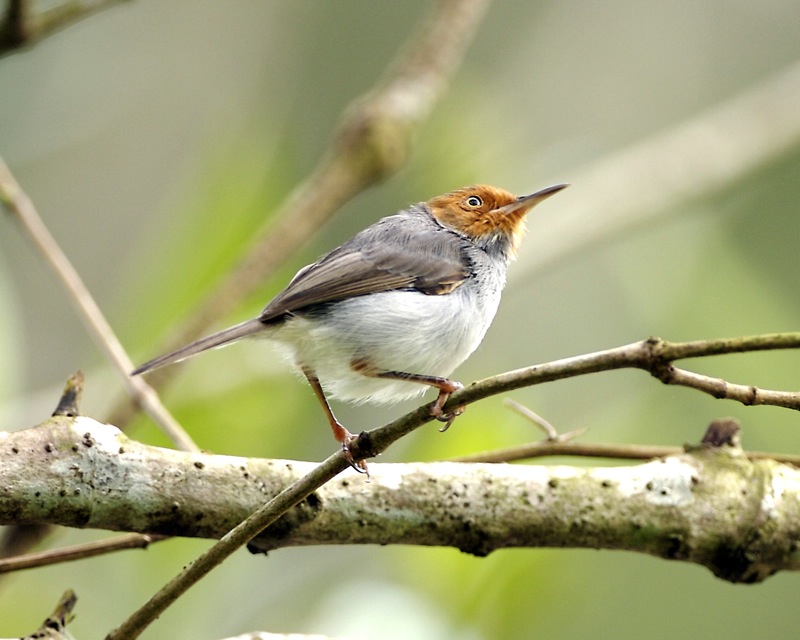
Adult birds have dull black heads, necks, throats and chests, accompanied by a prominent white eyebrow stripe, a white line beneath the eye and a white chin patch. Their lower breasts and bellies are dull grey, while their upperparts, flanks and undertail coverts are olive-green and their tails are darker olive-green.[2][3]
Immature birds have whitish chins, throats and upper breasts with light grey and black mottling, while juveniles have plain grey chins, throats and upper breasts. The species exhibits three plumage phenotypes associated with maturity: black in adults, mottled in immature birds and grey in juveniles.[4][5][6]
The iris is chestnut-brown and the legs are pale pink. The upper mandible is blackish and the lower mandible is whitish.[7][8]
Habitat
The species inhabits dense undergrowth in lowland forests at elevations reaching 1,000 m.[9][10]
Diet
The Black-headed Tailorbird feeds on small invertebrates.[11]
Behaviour
The species is elusive and reclusive, and is most frequently observed in pairs in undergrowth. It is seldom observed in open areas.[12][13]
An additional call is an anxious, descending ssiirrrrpppppp sound.[14]
Reproduction and life cycle
The species' breeding biology is poorly known. Males with enlarged testicles have been observed in March, April and May.[15][16]
Conservation
The Black-headed Tailorbird is classified as Least Concern on the IUCN Red List. This classification is based on a presumed stable population despite its restricted range.[17][18]
The species is generally considered uncommon or rare, although its elusive behaviour may contribute to this perception. It was reported as quite common on Siargao and Dinagat in 1973.[19][20]
No threats to the species are currently known.[21]
Classification of the Black-headed Tailorbird
| Kingdom | Animalia |
|---|---|
| Phylum | Chordata |
| Subphylum | Vertebrata |
| Infraphylum | Gnathostomata |
| Parvphylum | Osteichthyes |
| Megaclass | Tetrapoda |
| Class | Aves (Bird) |
| Order | Passeriformes (Passerine) |
| Family | Cisticolidae (Cisticolas & Allies) |
| Genus | Orthotomus (Tailorbird) |
| Species | Orthotomus nigriceps Tweeddale, 1878 |
Where the Black-headed Tailorbird is found
Checklists and occurrence records place Orthotomus nigriceps in 1 country across Asia. GBIF holds 894 georeferenced records of it.
Countries
Regions and cities with the most records
- Bislig, Philippines 477
- Tagbina, Philippines 303
- Hinatuan, Philippines 222
- Cabadbaran, Philippines 11
- Manay, Philippines 11
- Bah-Bah, Philippines 9
- Prosperidad, Philippines 9
- San Francisco, Philippines 9
- Bunawan, Philippines 7
- Butuan, Philippines 7
- Mati, Philippines 7
- Trento, Philippines 7
- Bayugan, Philippines 5
- Gingoog, Philippines 5
- Monkayo, Philippines 5
- Mariano, Philippines 4
- Compostela, Philippines 3
- Nabunturan, Philippines 3
- San Jose, Philippines 3
A number beside a place is its count of GBIF occurrence records. A place without a number comes from a checklist alone. Records show where a species has been observed or collected, which can include escapes and vagrants.
Common names
English
- Black-headed Tailorbird
- White-browed Tailorbird
Names in 23 other languages
- Catalan
- ocell sastre cellut
- Chinese
- 黑头缝叶莺, 黑頭縫葉鶯
- Croatian
- crnoglava šivalica
- Czech
- krejčiřík černohlavý
- Danish
- Sorthovedet Skrædderfugl
- Dutch
- Zwartkopsnijdervogel
- Esperanto
- nigrakapa tajlorbirdo
- Finnish
- mindanaonräätäli
- French
- Couturière à tête noire
- German
- Schwarzkopf-Schneidervogel, Schwarzkopfschneidervogel
- Italian
- Uccello sarto dai sopraccigli
- Japanese
- カオグロサイホウチョウ
- Lithuanian
- juodagalvė nendrinukė siuvėja
- Norwegian
- svarthodeskredderfugl
- Polish
- krawczyk czarnogłowy
- Portuguese
- costureiro-de-cabeça-preta
- Russian
- Черноголовая портниха
- Serbian
- Ptica krojač sa belom obrvom
- Slovak
- krajčírik čiernohlavý
- Spanish
- Sastrecillo cabecinegro
- Swedish
- vitbrynad skräddarfågel
- Turkish
- Kara Başlı Terzikuşu
- Ukrainian
- кравчик чорноголовий
Synonyms
One other scientific name has been used for this species and is now treated as a synonym of Orthotomus nigriceps.
- Orthotomus nigrogularis Hachisuka, M, 1944
Subspecies and varieties
- Orthotomus nigriceps luminosus subspecies
- Orthotomus nigriceps nigriceps subspecies
Related species
-
 Common TailorbirdOrthotomus sutorius
-
 Ashy TailorbirdOrthotomus ruficeps
-
 Dark-necked TailorbirdOrthotomus atrogularis
-
 Rufous-tailed TailorbirdOrthotomus sericeus
-
 Cambodian TailorbirdOrthotomus chaktomuk
-
 Olive-backed TailorbirdOrthotomus sepium
-
 Visayan TailorbirdOrthotomus castaneiceps
-
 Yellow-breasted TailorbirdOrthotomus samarensis
Compare
Questions and answers
What is the scientific name of the Black-headed Tailorbird?
The scientific name of the Black-headed Tailorbird is Orthotomus nigriceps. Written with its author, the full name is Orthotomus nigriceps Tweeddale, 1878.
Which family does the Black-headed Tailorbird belong to?
Orthotomus nigriceps belongs to the family Cisticolidae, in the order Passeriformes and the class Aves.
Where is the Black-headed Tailorbird found?
Checklists and occurrence records place Orthotomus nigriceps in 1 country: Philippines.
What is the conservation status of the Black-headed Tailorbird?
The IUCN Red List category recorded for Orthotomus nigriceps is Least Concern (LC).
What other names does the Black-headed Tailorbird have?
Orthotomus nigriceps is also known in English as White-browed Tailorbird.
Are black-headed grosbeaks rare?
This species is the Black-headed Tailorbird, not a black-headed grosbeak. It is generally considered uncommon or rare.[19]
Why is tailorbird so called?
The genus name Orthotomus derives from the Ancient Greek orthotomeō, meaning to cut straight.[22]
What do tailor birds eat?
The Black-headed Tailorbird feeds on small invertebrates.[11]
What are 10 interesting facts about the tailorbird?
The Black-headed Tailorbird has three plumage phenotypes associated with maturity: black in adults, mottled in immature birds and grey in juveniles. Adults average 12 cm in body length, and body mass averages 10.3 g. The species feeds on small invertebrates, is non-migratory, is most frequently observed in pairs in undergrowth, and has lengthy, stuttering calls. It inhabits lowland forests, occurs on Mindanao, Dinagat and Siargao, is genetically distinct from the white-eared and yellow-breasted tailorbirds, and is classified as Least Concern.[6][23][24][11][12][25][26][9][27][28][17]
Sources
Passages the profile rests on
- The species can be distinguished from the white-eared tailorbird by its white supercilium, lack of a white ear spot and paler legs. Source passage: “The species can be told apart from the white-eared tailorbird by its white supercilium, the absence of a white ear-spot, and its paler legs.” — English Wikipedia
- Adult birds have dull black heads, necks, throats and chests, accompanied by a prominent white eyebrow stripe, a white line beneath the eye and a white chin patch. Source passage: “Adults have dull black heads, necks, throats, and chests with a prominent white supercilium, line beneath the eye, and chin patch” — English Wikipedia
- Adult birds have dull grey lower breasts and bellies, olive-green upperparts, flanks and undertail coverts, and darker olive-green tails. Source passage: “The lower breast and belly are dull grey, while the upperparts, flanks, and undertail coverts are olive-green, and the tail is darker olive-green.” — English Wikipedia
- Immature birds have whitish chins, throats and upper breasts with light grey and black mottling. Source passage: “Immature birds have the chin, throat, and upper breast whitish with light grey and black mottling” — English Wikipedia
- Juvenile birds have plain grey chins, throats and upper breasts. Source passage: “Juveniles have plain grey chins, throats, and upper breasts.” — English Wikipedia
- The species exhibits three plumage phenotypes associated with maturity: black in adults, mottled in immature birds and grey in juveniles. Source passage: “Black-headed tailorbirds show three distinct phenotypes, which correspond to different stages of maturity: adults have a 'black phenotype', immatures have a 'mottled phenotype', and juveniles have a 'grey phenotype'.” — English Wikipedia
- The iris is chestnut-brown and the legs are pale pink. Source passage: “The iris is chestnut-brown, the legs are pale pink” — English Wikipedia
- The upper and lower mandibles are blackish and whitish, respectively. Source passage: “upper and lower mandibles of the bill are blackish and whitish, respectively.” — English Wikipedia
- The species inhabits dense undergrowth in lowland forests. Source passage: “It inhabits dense undergrowth in lowland forests at elevations of up to 1,000 m (3,300 ft)” — English Wikipedia
- The species occurs in lowland forest habitats at elevations reaching 1,000 m. Source passage: “at elevations of up to 1,000 m (3,300 ft).” — English Wikipedia
- The species feeds on small invertebrates. Source passage: “It feeds on small invertebrates.” — English Wikipedia
- The species is elusive and reclusive, and is most frequently observed in pairs in undergrowth. Source passage: “The species is elusive and reclusive, most commonly being seen in pairs in the undergrowth” — English Wikipedia
- The species is seldom observed in open areas. Source passage: “and seldom in the open.” — English Wikipedia
- One additional call is an anxious, descending ssiirrrrpppppp sound. Source passage: “Other calls include an anxious, falling ssiirrrrpppppp” — English Wikipedia
- Males with enlarged testicles have been observed in March, April and May. Source passage: “Males with enlarged testicles have been seen in March, April, and May” — English Wikipedia
- The species' breeding biology is poorly known. Source passage: “Little is known of the species' breeding” — English Wikipedia
- The species is classified as Least Concern on the IUCN Red List. Source passage: “The black-headed tailorbird is listed as being of least concern on the IUCN Red List” — English Wikipedia
- Its Least Concern classification is based on a presumed stable population despite its restricted range. Source passage: “despite its restricted range, due to its presumed stable population.” — English Wikipedia
- The species is generally considered uncommon or rare, although its elusive behaviour may contribute to this perception. Source passage: “It is usually thought to be uncommon or rare, but this perception may be affected by its retiring nature.” — English Wikipedia
- The species was reported as quite common on Siargao and Dinagat in 1973. Source passage: “The species was reported as being "quite common" on Siargao and Dinagat in 1973.” — English Wikipedia
- No threats to the species are currently known. Source passage: “No threats to the species are known.” — English Wikipedia
- The genus name Orthotomus derives from the Ancient Greek orthotomeō, meaning to cut straight. Source passage: “The name of the genus is derived from the Ancient Greek orthotomeō, meaning 'to cut straight'.” — English Wikipedia
- Adult birds have an average body length of 12 cm. Source passage: “The average adult length is 12 cm (4.7 in).” — English Wikipedia
- Body mass ranges from 8 to 14 g, averaging 10.3 g. Source passage: “The body mass ranges from 8–14 g (0.28–0.49 oz), with an average of 10.3 g (0.36 oz)” — English Wikipedia
- The species is non-migratory. Source passage: “and is non-migratory.” — English Wikipedia
- Its call consists of lengthy, stuttering trills that gradually slow and flatten out. Source passage: “The tailorbird's call is a series of lengthy, stuttering trills that slows as it flattens out.” — English Wikipedia
- The species occurs on Mindanao, Dinagat and Siargao. Source passage: “where it is found on the islands of Mindanao, Dinagat, and Siargao.” — English Wikipedia
- The black-headed tailorbird is genetically distinct from the white-eared and yellow-breasted tailorbirds, although the three form a superspecies. Source passage: “these three species are genetically distinct, although they form a superspecies.” — English Wikipedia
- The species is endemic to the southeastern Philippines. Source passage: “it is endemic to the southeastern Philippines” — English Wikipedia
Data
- Catalogue of Life, 2026-10-16 XR cc by
- Global Biodiversity Information Facility CC BY 4.0
- Wikidata CC0
- GeoNames CC BY 4.0
- Wikimedia Commons per image; credit shown with each image
- Within the Catalogue of Life, this name comes from The Integrated Taxonomic Information System cc0
References
- Gill, Frank, & and Minturn Wright. (2006). Birds of the World: Recommended English Names.
This species in other databases
Page built on 29 November 2026. See how the catalog is made and all sources and licences.
Cite this page
ScientificNames.org. (2026). Orthotomus nigriceps (Black-headed Tailorbird). Retrieved November 29, 2026, from https://scientificnames.org/species/orthotomus-nigriceps
“Orthotomus nigriceps (Black-headed Tailorbird).” ScientificNames.org, 2026, scientificnames.org/species/orthotomus-nigriceps. Accessed 29 Nov. 2026.
ScientificNames.org. “Orthotomus nigriceps (Black-headed Tailorbird).” Accessed November 29, 2026. https://scientificnames.org/species/orthotomus-nigriceps.
@misc{scientificnames_orthotomus_nigriceps_black_headed_tailorbird,
  author = {{ScientificNames.org}},
  title = {Orthotomus nigriceps (Black-headed Tailorbird)},
  year = {2026},
  url = {https://scientificnames.org/species/orthotomus-nigriceps},
  note = {Accessed 2026-11-29}
}