Species · Fishes
Luzon Ricefish Oryzias luzonensis
The scientific name of the Luzon Ricefish is Oryzias luzonensis. It is a species of fish in the family Adrianichthyidae (ricefish), order Beloniformes. The name dates from 1934.
- Scientific name
- Oryzias luzonensis (Herre & Ablan, 1934)
- Common name
- Luzon Ricefish
- Genus
- Oryzias
- Family
- Adrianichthyidae (Ricefish)
- Order
- Beloniformes
- Class
- Teleostei
- Red List category
- EN Endangered
- Environment
- freshwater
- Recorded in
- 1 country
- Name status
- accepted in the Catalogue of Life
Overview
Oryzias luzonensis is endemic to the Laoag and Padsan watersheds of Ilocos Norte in northern Luzon, Philippines. It is the only ricefish recorded in the Philippines.
Written 27 November 2026 from the sources listed below. Each statement was checked against the passage it cites; statements that could not be supported were removed.
Habitat
The Luzon Ricefish inhabits freshwater creeks and rice paddies in northern Luzon. It prefers shallow, slow-moving waters with abundant vegetation along their banks.[1][2]
Colocasia esculenta is a particularly associated riparian plant in its preferred habitat.[3]
Appearance
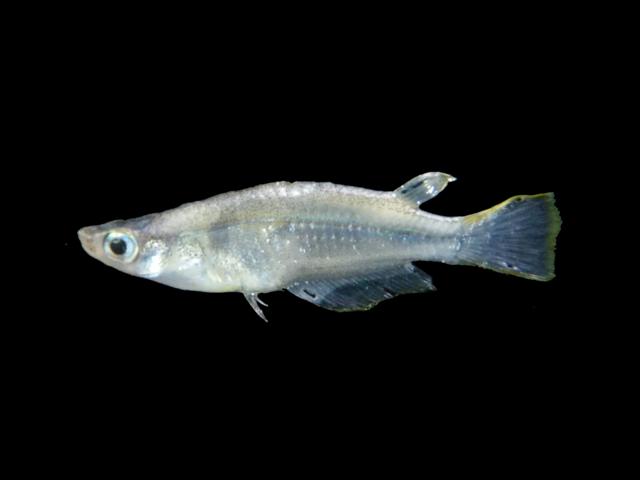
The Luzon Ricefish has a laterally compressed body with semi-transparent gray coloration. The bases of its fins are pale yellow.[4][5]
A dark stripe extends from the upper gill cover to the base of the tail fin.[6]
Individuals average 2.52 ± 0.21 cm in length, and the species can attain a maximum length of 4 cm.[7][8]
Behaviour
The Luzon Ricefish is non-migratory.[9]
Reproduction and life cycle
The Luzon Ricefish is a non-annual breeder.[10]
Uses
The Luzon Ricefish is not generally regarded as a food fish, although it is occasionally consumed as famine food.[11][12]
Its small size gives it potential for sale in the aquarium trade, but it is considered difficult to maintain in captivity.[13][14]
The species is useful for controlling mosquito populations.[15]
Conservation
The Luzon Ricefish is classified as Endangered on the IUCN Red List. It was assessed as Endangered in the 2020 IUCN Red List assessment.[16][17]
The species had not been documented since 1985 before surviving populations were rediscovered in 2023. Don Mariano Marcos Memorial State University has undertaken captive breeding for its conservation.[18][19]
Habitat fragmentation is a threat to the species. Water pollution, particularly pollution associated with mining industries, also threatens it.[20][21]
Introduced invasive species, particularly Gambusia affinis and Oreochromis species, are identified as threats.[22]
Classification of the Luzon Ricefish
| Kingdom | Animalia |
|---|---|
| Phylum | Chordata |
| Subphylum | Vertebrata |
| Infraphylum | Gnathostomata |
| Parvphylum | Osteichthyes |
| Gigaclass | Actinopterygii |
| Superclass | Actinopteri |
| Class | Teleostei (Teleost) |
| Order | Beloniformes |
| Family | Adrianichthyidae (Ricefish) |
| Genus | Oryzias |
| Species | Oryzias luzonensis (Herre & Ablan, 1934) |
Where the Luzon Ricefish is found
Checklists and occurrence records place Oryzias luzonensis in 1 country. GBIF holds 10 georeferenced records of it.
Countries
A number beside a place is its count of GBIF occurrence records. A place without a number comes from a checklist alone. Records show where a species has been observed or collected, which can include escapes and vagrants.
Common names
English
- Luzon Ricefish
- Philippine Medaka
Names in 3 other languages
- Chinese
- 呂宋青鱂
- Czech
- medaka luzonská
- Japanese
- ルソンメダカ
Synonyms
2 other scientific names have been used for this species and are now treated as synonyms of Oryzias luzonensis.
- Aplocheilus luzonensis Herre & Ablan, 1934
- Nemachilus luzonensis Herre & Ablan, 1934
Related species
-
 Japanese Rice FishOryzias latipes
-
 Chinese Rice FishOryzias sinensis
-
 Javanese RicefishOryzias javanicus
- Indian RicefishOryzias dancena
-
 Sarasins MinnowOryzias sarasinorum
-
 Oryzias melastigma
- Celebes MedakaOryzias celebensis
-
 Mekong RicefishOryzias mekongensis
Compare
Questions and answers
What is the scientific name of the Luzon Ricefish?
The scientific name of the Luzon Ricefish is Oryzias luzonensis. Written with its author, the full name is Oryzias luzonensis (Herre & Ablan, 1934).
Which family does the Luzon Ricefish belong to?
Oryzias luzonensis belongs to the family Adrianichthyidae, in the order Beloniformes and the class Teleostei.
Where is the Luzon Ricefish found?
Checklists and occurrence records place Oryzias luzonensis in 1 country: Philippines.
What is the conservation status of the Luzon Ricefish?
The IUCN Red List category recorded for Oryzias luzonensis is Endangered (EN).
What other names does the Luzon Ricefish have?
Oryzias luzonensis is also known in English as Philippine Medaka.
What is the Luzon ricefish?
The Luzon Ricefish (Oryzias luzonensis) is a fish in the family Adrianichthyidae. It is endemic to the Laoag and Padsan watersheds of Ilocos Norte in northern Luzon, Philippines.[23]
Sources
Passages the profile rests on
- The species inhabits freshwater creeks and rice paddies in northern Luzon. Source passage: “It is endemic to freshwater creeks and rice paddies in northern Luzon in the Philippines.” — English Wikipedia
- The species prefers shallow, slow-moving waters with abundant vegetation along their banks. Source passage: “They prefer slow-moving shallow bodies of water with lots of riparian vegetation” — English Wikipedia
- Colocasia esculenta is a particularly associated riparian plant in the species' preferred habitat. Source passage: “particularly Colocasia esculenta.” — English Wikipedia
- The species has a laterally compressed body with semi-transparent gray coloration. Source passage: “They have laterally-compressed bodies that are a semi-transparent gray.” — English Wikipedia
- The bases of the fins are pale yellow. Source passage: “The bases of the fins have pale yellow coloration.” — English Wikipedia
- A dark stripe extends from the upper gill cover to the base of the tail fin. Source passage: “A dark stripe extrens from the top of the gill cover to the base of the tail fin.” — English Wikipedia
- Individuals average 2.52 ± 0.21 cm in length. Source passage: “averaging at 2.52 ± 0.21 cm (0.992 ± 0.083 in) in length.” — English Wikipedia
- The species can attain a maximum length of 4 cm. Source passage: “They can reach a maximum length of 4 cm (1.6 in).” — English Wikipedia
- The species is non-migratory. Source passage: “Oryzias luzonensis is recorded to be a non-migratory species.” — English Wikipedia
- The species is a non-annual breeder. Source passage: “It is a non-annual breeder.” — English Wikipedia
- The species is not generally regarded as a food fish. Source passage: “Oryzias luzonensis is not considered a food fish” — English Wikipedia
- The species is occasionally consumed as famine food. Source passage: “though it is sometimes eaten as famine food.” — English Wikipedia
- The species has potential for sale in the aquarium trade because of its small size. Source passage: “Due to its small size, it has potential to be sold in the aquarium trade” — English Wikipedia
- The species is considered difficult to maintain in captivity. Source passage: “though it is considered a difficult fish to keep in captivity.” — English Wikipedia
- The species is useful for controlling mosquito populations. Source passage: “It is useful for keeping mosquito populations in check.” — English Wikipedia
- The species is classified as Endangered on the IUCN Red List. Source passage: “It is classified as Endangered in the IUCN Red List.” — English Wikipedia
- The species was assessed as Endangered in the 2020 IUCN Red List assessment. Source passage: “Philippine Medaka Oryzias luzonensis has most recently been assessed for The IUCN Red List of Threatened Species in 2020. listed as Endangered” — iucnredlist.org
- The species had not been documented since 1985 before surviving populations were rediscovered in 2023. Source passage: “after it had not been documented since 1985. Surviving populations were rediscovered in 2023.” — English Wikipedia
- Don Mariano Marcos Memorial State University has undertaken captive breeding of the species for conservation. Source passage: “The Don Mariano Marcos Memorial State University has since captive-bred the species in an effort to conserve the species.” — English Wikipedia
- Habitat fragmentation is identified as a threat to the species. Source passage: “Threats include habitat fragmentation” — English Wikipedia
- Water pollution, particularly pollution associated with mining industries, threatens the species. Source passage: “water pollution (particularly from mining industries)” — English Wikipedia
- Introduced invasive species, particularly Gambusia affinis and Oreochromis species, are identified as threats. Source passage: “the introduction of non-native invasive species (particularly Gambusia affinis and Oreochromis spp.).” — English Wikipedia
- The species is endemic to the Laoag and Padsan watersheds of Ilocos Norte in northern Luzon, Philippines. Source passage: “It is endemic to the Laoag and Padsan watersheds of Ilocos Norte, northern Luzon, the Philippines.” — English Wikipedia
Data
- Catalogue of Life, 2026-10-16 XR cc by
- Global Biodiversity Information Facility CC BY 4.0
- Wikidata CC0
- GeoNames CC BY 4.0
- Within the Catalogue of Life, this name comes from World Register of Marine Species cc by
This species in other databases
- Catalogue of Life 74ZHL
- Wikidata Q6414062
- iNaturalist 607861
- WoRMS urn:lsid:marinespecies.org:taxname:1015560
- ITIS 645219
Page built on 29 November 2026. See how the catalog is made and all sources and licences.
Cite this page
ScientificNames.org. (2026). Oryzias luzonensis (Luzon Ricefish). Retrieved November 29, 2026, from https://scientificnames.org/species/oryzias-luzonensis
“Oryzias luzonensis (Luzon Ricefish).” ScientificNames.org, 2026, scientificnames.org/species/oryzias-luzonensis. Accessed 29 Nov. 2026.
ScientificNames.org. “Oryzias luzonensis (Luzon Ricefish).” Accessed November 29, 2026. https://scientificnames.org/species/oryzias-luzonensis.
@misc{scientificnames_oryzias_luzonensis_luzon_ricefish,
  author = {{ScientificNames.org}},
  title = {Oryzias luzonensis (Luzon Ricefish)},
  year = {2026},
  url = {https://scientificnames.org/species/oryzias-luzonensis},
  note = {Accessed 2026-11-29}
}