Species · Fishes
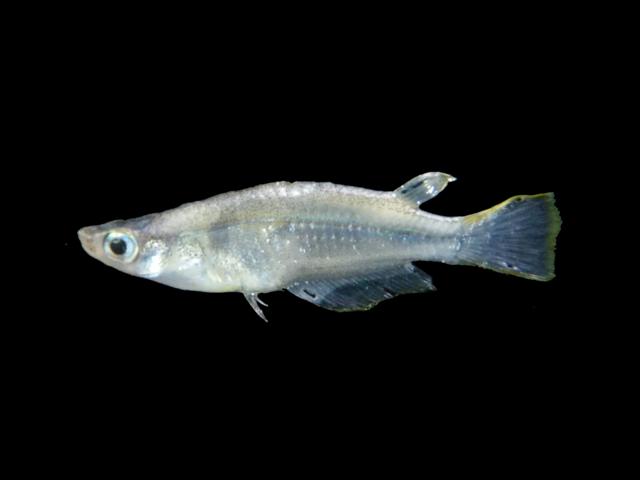
Chinese Rice Fish Oryzias sinensis
The scientific name of the Chinese Rice Fish is Oryzias sinensis. It is a species of fish in the family Adrianichthyidae (ricefish), order Beloniformes. The name dates from 1989.
- Scientific name
- Oryzias sinensis Chen, Uwa & Chu, 1989
- Common name
- Chinese Rice Fish
- Genus
- Oryzias
- Family
- Adrianichthyidae (Ricefish)
- Order
- Beloniformes
- Class
- Teleostei
- Red List category
- LC Least Concern
- Environment
- freshwater
- Recorded in
- 5 countries
- Name status
- accepted in the Catalogue of Life

Overview
The natural range extends across East and Southeast Asia, including the Yangtze, Mekong, Irrawaddy, Salween, Red River, and Nanpangjiang basins. It reaches a maximum reported length of 3.1 cm (1.2 inches) and has been used in rice-farming systems for hundreds of years.
Written 26 November 2026 from the sources listed below. Each statement was checked against the passage it cites; statements that could not be supported were removed.
Habitat
The Chinese Rice Fish inhabits shallow, slow-moving inland freshwater and wetland environments, particularly near shorelines with vegetation. Its habitats include freshwater swamps, stagnant stream sections, rice fields, marshes, ponds, and farming channels.[1][2][3]
Diet
The Chinese Rice Fish is omnivorous and consumes both plant and animal matter. Its diet includes zooplankton, algae, and parts of insects.[4][5][6]
Behaviour
The species exhibits hibernation-like behaviour when water temperatures become cool. It is preyed upon by dragonfly larvae, other fish, and birds.[7][8]
Reproduction and life cycle
The species has short generation times and produces transparent eggs.[9][10]
Conservation
The species is considered at high risk of becoming invasive. It received a high CCA score indicating a potential benefit from global warming.[11][12]
Uses
The species contributes to pest population control in rice fields through its feeding activities. It is also used as a model organism in research and is considered easy to rear because its dietary and habitat requirements are undemanding.[13][14][15]
Similar species
The Chinese Rice Fish was formerly classified as a subspecies of the Japanese rice fish (Oryzias latipes). Mitochondrial data indicate phylogenetic differences between Oryzias latipes and rice fish populations from Taiwan and the China-West Korean area.[16][17]
Distinguishing the species from other rice fish populations in Eastern Asia remains difficult. Chinese rice fish are still commonly called Japanese rice fish.[18][19]
Classification of the Chinese Rice Fish
| Kingdom | Animalia |
|---|---|
| Phylum | Chordata |
| Subphylum | Vertebrata |
| Infraphylum | Gnathostomata |
| Parvphylum | Osteichthyes |
| Gigaclass | Actinopterygii |
| Superclass | Actinopteri |
| Class | Teleostei (Teleost) |
| Order | Beloniformes |
| Family | Adrianichthyidae (Ricefish) |
| Genus | Oryzias |
| Species | Oryzias sinensis Chen, Uwa & Chu, 1989 |
Where the Chinese Rice Fish is found
Checklists and occurrence records place Oryzias sinensis in 5 countries. GBIF holds 6,297 georeferenced records of it.
Countries
Regions and cities with the most records
- Chungcheongnam-do, South Korea 4,111
- Gunsan, South Korea 3,889
- Gyeonggi-do, South Korea 374
- Jeollabuk-do, South Korea 330
- Incheon, South Korea 321
- Ganghwa-gun, South Korea 284
- Gimpo-si, South Korea 196
- Paju, South Korea 163
- Iksan, South Korea 148
- Kimje, South Korea 148
- Bucheon-si, South Korea 142
- Goyang-si, South Korea 125
- Incheon, South Korea 122
- Gwangmyeong, South Korea 111
- Ansan-si, South Korea 103
- Buyeo, South Korea 102
- Nonsan, South Korea 102
- Munsan, South Korea 98
- Anyang-si, South Korea 97
- Jeollanam-do, South Korea 94
- Buan, South Korea 93
- Namsa, South Korea 90
- Gunpo, South Korea 89
- Uiwang, South Korea 89
- Yŏnmu, South Korea 89
- Beijing, China 79
- Sejong, South Korea 79
- Gongju, South Korea 78
- Cheongju-si, South Korea 76
- Hwaseong-si, South Korea 74
- Boryeong, South Korea 62
- Seonghwan, South Korea 61
- Tangjin, South Korea 56
- Beijing, China 55
- Pyeongtaek, South Korea 55
- Wanju, South Korea 53
1 more country has a few records outside this range
These countries hold a few records of Oryzias sinensis but lie outside the range the checklists give for it. Such records are often zoo or garden specimens, museum material or vagrants, so the species is not counted as occurring there.
A number beside a place is its count of GBIF occurrence records. A place without a number comes from a checklist alone. Records show where a species has been observed or collected, which can include escapes and vagrants.
Common names
English
- Chinese Rice Fish
Names in 8 other languages
- Chinese
- 中華青鱂, 青鳉
- Czech
- medaka čínská
- Finnish
- kiinanmedaka
- German
- Reisfisch
- Japanese
- チュウゴクメダカ
- Korean
- 대륙송사리
- Russian
- Китайская медака
- Ukrainian
- Медака китайська
Synonyms
6 other scientific names have been used for this species and are now treated as synonyms of Oryzias sinensis.
- Aplocheilus latipes Mori,1927
- Haplochilus javanicus Karoli,1882
- Haplochilus latipes Kreyenberg & Pappenheim,1908
- Oryzias latipes Oshima,1926
- Oryzias latipes iliensis Baensch & Riehl,1997
- Oryzias latipes sinensis Chen, Uwa & Chu, 1989
Related species
-
 Japanese Rice FishOryzias latipes
-
 Javanese RicefishOryzias javanicus
- Indian RicefishOryzias dancena
-
 Sarasins MinnowOryzias sarasinorum
- Luzon RicefishOryzias luzonensis
-
 Oryzias melastigma
- Celebes MedakaOryzias celebensis
-
 Mekong RicefishOryzias mekongensis
Compare
Questions and answers
What is the scientific name of the Chinese Rice Fish?
The scientific name of the Chinese Rice Fish is Oryzias sinensis. Written with its author, the full name is Oryzias sinensis Chen, Uwa & Chu, 1989.
Which family does the Chinese Rice Fish belong to?
Oryzias sinensis belongs to the family Adrianichthyidae, in the order Beloniformes and the class Teleostei.
Where is the Chinese Rice Fish found?
Checklists and occurrence records place Oryzias sinensis in 5 countries: South Korea, China, Taiwan, Indonesia and Japan.
What is the conservation status of the Chinese Rice Fish?
The IUCN Red List category recorded for Oryzias sinensis is Least Concern (LC).
Sources
Passages the profile rests on
- The species inhabits freshwater swamps, stagnant stream sections, rice fields, and marshes. Source passage: “This freshwater fish occurs in swamps, stagnant parts of streams, rice fields and marshes” — English Wikipedia
- The species occupies shallow, slow-moving inland freshwater and wetland environments, particularly near shorelines with vegetation. Source passage: “The ideal environment for Chinese Rice Fish are inland freshwater and wetlands areas of shallow, slow moving water sources, especially those close to shorelines that contain vegetative cover.” — English Wikipedia
- Rice paddies, ponds, and farming channels provide suitable habitats for the species. Source passage: “Rice paddies, ponds, and farming channels tend to harbor these ideal environments.” — English Wikipedia
- The species is omnivorous and consumes both plant and animal matter. Source passage: “Diet consists of both plants and animals. These omnivores consume plants” — English Wikipedia
- Its diet includes zooplankton and algae. Source passage: “microscopic organisms including zooplankton and algae” — English Wikipedia
- The species also consumes parts of insects. Source passage: “and parts of insects.” — English Wikipedia
- The species exhibits hibernation-like behaviour when water temperatures become cool. Source passage: “When water temperatures cool, Chinese Rice Fish exhibit behaviors of hibernation.” — English Wikipedia
- The species is preyed upon by dragonfly larvae, other fish, and birds. Source passage: “they are primarily preyed on by dragonfly larvae, other fish, and birds.” — English Wikipedia
- The species has short generation times. Source passage: “Their short generation times and transparent eggs also make them ideal for observing.” — English Wikipedia
- The species produces transparent eggs. Source passage: “Their short generation times and transparent eggs also make them ideal for observing.” — English Wikipedia
- The species is considered at high risk of becoming invasive. Source passage: “Chinese Rice Fish are seen as high risk for becoming an invasive species.” — English Wikipedia
- The species received a high CCA score indicating a potential benefit from global warming. Source passage: “Chinese Rice fish also received a high CCA score, indicating they benefit from global warming” — English Wikipedia
- The species contributes to pest population control in rice fields through its feeding activities. Source passage: “This introduces another biological role Chinese Rice fish play, controlling the pest population within the rice fields.” — English Wikipedia
- The species is used as a model organism in research. Source passage: “Chinese rice fish are noted to be model organisms.” — English Wikipedia
- The species is considered easy to rear because its dietary and habitat requirements are undemanding. Source passage: “They are generally easy to raise due to their undemanding diet and habitat needs.” — English Wikipedia
- The species was formerly classified as a subspecies of the Japanese rice fish (Oryzias latipes). Source passage: “It was formerly considered a subspecies of the Japanese rice fish (Oryzias latipes).” — English Wikipedia
- Mitochondrial data indicate phylogenetic differences between Oryzias latipes and rice fish populations from Taiwan and the China-West Korean area. Source passage: “Mitochondrial data suggest that populations of rice fish found in Taiwan and the China-West Korean area have phylogenetic differences from latipes.” — English Wikipedia
- Distinguishing the species from other rice fish populations in Eastern Asia remains difficult. Source passage: “There is still difficulty distinguishing which populations of rice fish in Eastern Asia belong to which species” — English Wikipedia
- Chinese rice fish are still commonly called Japanese rice fish. Source passage: “Chinese Rice Fish are still commonly referred to as Japanese Rice Fish.” — English Wikipedia
- Wild individuals typically live for approximately one year. Source passage: “Most live for roughly one year in the wild” — English Wikipedia
- Individuals kept in captivity can live for four years or longer. Source passage: “in captivity, they can live for four years or more.” — English Wikipedia
Data
- Catalogue of Life, 2026-10-16 XR cc by
- Global Biodiversity Information Facility CC BY 4.0
- Wikidata CC0
- GeoNames CC BY 4.0
- Wikimedia Commons per image; credit shown with each image
- Within the Catalogue of Life, this name comes from World Register of Marine Species cc by
References
- Chen, Y.-R.; Uwa, H.; Chu, X.-L. (1989). Taxonomy and distribution of the genus Oryzias in Yunnan, China (Cyprinodontiformes: Oryziidae). Acta Zootaxonomica Sinica, 14 (2): 239–246. [In Chinese, English summary.]. where the name was published
This species in other databases
- Catalogue of Life 74ZHW
- Wikidata Q2750509
- iNaturalist 119408
- WoRMS urn:lsid:marinespecies.org:taxname:1011586
Page built on 27 November 2026. See how the catalog is made and all sources and licences.
Cite this page
ScientificNames.org. (2026). Oryzias sinensis (Chinese Rice Fish). Retrieved November 27, 2026, from https://scientificnames.org/species/oryzias-sinensis
“Oryzias sinensis (Chinese Rice Fish).” ScientificNames.org, 2026, scientificnames.org/species/oryzias-sinensis. Accessed 27 Nov. 2026.
ScientificNames.org. “Oryzias sinensis (Chinese Rice Fish).” Accessed November 27, 2026. https://scientificnames.org/species/oryzias-sinensis.
@misc{scientificnames_oryzias_sinensis_chinese_rice_fish,
  author = {{ScientificNames.org}},
  title = {Oryzias sinensis (Chinese Rice Fish)},
  year = {2026},
  url = {https://scientificnames.org/species/oryzias-sinensis},
  note = {Accessed 2026-11-27}
}