Species · Other invertebrates
Osedax frankpressi
Osedax frankpressi has no English name on record in the checklists used here. It is a species of animal in the family Siboglinidae (beard worms), order Sabellida. The name dates from 2004.
- Scientific name
- Osedax frankpressi Rouse, Goffredi & Vrijenhoek, 2004
- Genus
- Osedax
- Family
- Siboglinidae (Beard Worms)
- Order
- Sabellida
- Class
- Polychaeta
- Environment
- marine
- Recorded in
- 2 countries
- Name status
- accepted in the Catalogue of Life
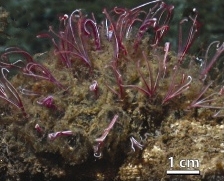
Overview
Osedax frankpressi inhabits the seabed and colonizes the skeletons of dead whales. It has a pinkish trunk, red and white plumes, and greenish root-like structures, and lacks a mouth and digestive tract.
Written 26 November 2026 from the sources listed below. Each statement was checked against the passage it cites; statements that could not be supported were removed.
Appearance
The worm has a pinkish trunk and a tuft of red and white plumes at its tip. Its body includes greenish root-like structures and white ovaries hidden beneath the surface of the bone.[1][2]
The species lacks a mouth and digestive tract.[3]
Diet
The species obtains nutrients from the bone marrow of carcasses by means of root-like threads. Its root structures contain symbiotic bacteria belonging to the order Oceanospirillales.[4][5]
Reproduction and life cycle
Larvae settling on carcasses are thought to develop into females, whereas larvae settling on females develop into microscopic males. These males become incorporated into female tissues and remain there.[6][7]
Individual females may contain as many as 100 males. Female worms produce offspring continuously.[8][9]
Classification of Osedax frankpressi
| Kingdom | Animalia |
|---|---|
| Phylum | Annelida |
| Class | Polychaeta |
| Subclass | Sedentaria |
| Infraclass | Canalipalpata |
| Order | Sabellida |
| Family | Siboglinidae (Beard Worms) |
| Genus | Osedax (Boneworms) |
| Species | Osedax frankpressi Rouse, Goffredi & Vrijenhoek, 2004 |
Where Osedax frankpressi is found
Checklists and occurrence records place Osedax frankpressi in 2 countries. GBIF holds 102 georeferenced records of it.
Countries
A number beside a place is its count of GBIF occurrence records. A place without a number comes from a checklist alone. Records show where a species has been observed or collected, which can include escapes and vagrants.
Related species
- Bone-eating Snot Flower WormOsedax mucofloris
- Osedax priapus
- Osedax japonicus
-
 Osedax roseus
-
 Osedax rubiplumus
-
 Osedax deceptionensis
- Osedax antarcticus
- Osedax braziliensis
Compare
Questions and answers
What do Osedax eat?
Osedax frankpressi obtains nutrients from the bone marrow of carcasses using root-like threads. Its root structures contain symbiotic bacteria belonging to the order Oceanospirillales.[4][5]
Where do Osedax worms live?
Osedax frankpressi inhabits the seabed and colonizes the skeletons of dead whales.[10]
What do polychaete worms eat?
Osedax frankpressi obtains nutrients from the bone marrow of carcasses by means of root-like threads.[4]
How do osedax worms reproduce?
Larvae settling on carcasses are thought to develop into females, while larvae settling on females develop into microscopic males. The males become incorporated into female tissues and remain there. Individual females may contain as many as 100 males and produce offspring continuously.[6][7][8][9]
Sources
Passages the profile rests on
- The worm has a pinkish trunk and a tuft of red and white plumes at its tip. Source passage: “O. frankpressi has a pinkish trunk with a tuft of red and white plumes on the tip, somewhat resembling a flower.” — English Wikipedia
- Its body includes greenish root-like structures and white ovaries hidden beneath the surface of the bone. Source passage: “Hidden below the surface of the carcase are greenish root-like structures and white ovaries.” — English Wikipedia
- The species lacks a mouth and digestive tract. Source passage: “Like other species of Osedax, these worms have no mouth and no gut.” — English Wikipedia
- The species obtains nutrients from the bone marrow of carcasses by means of root-like threads. Source passage: “sending out root-like threads that force their way into the bone marrow and absorb the nutrients.” — English Wikipedia
- The species has a symbiotic relationship with bacteria belonging to the order Oceanospirillales in its root structures. Source passage: “Inside these root structures are bacteria in the order Oceanospirillales with which the worm is in symbiosis.” — English Wikipedia
- Larvae settling on carcasses are thought to develop into females, whereas larvae settling on females develop into microscopic males. Source passage: “It is thought that larvae that settle on carcases all develop into female worms, while larvae that settle on the female worms develop into microscopic males” — English Wikipedia
- Microscopic males become incorporated into female tissues and remain there. Source passage: “and are incorporated into the female worms' tissues. Here they remain” — English Wikipedia
- Individual females may contain as many as 100 males. Source passage: “with up to 100 males per female worm” — English Wikipedia
- Female worms produce offspring continuously. Source passage: “The female worms produce offspring continually.” — English Wikipedia
- The species inhabits the seabed and colonizes the skeletons of dead whales. Source passage: “lives on the seabed and sustains itself on the bones of dead whales.” — English Wikipedia
Data
- Catalogue of Life, 2026-10-16 XR cc by
- Global Biodiversity Information Facility CC BY 4.0
- Wikidata CC0
- GeoNames CC BY 4.0
- Wikimedia Commons per image; credit shown with each image
- Within the Catalogue of Life, this name comes from World Register of Marine Species cc by
References
- Rouse, Greg W.; Goffredi, Shana K.; Vrijenhoek, Robert C. (2004). Osedax: Bone-eating marine worms with dwarf males. Science (Washington D.C.), 305. https://doi.org/10.1126/science.1098650 Link where the name was published
This species in other databases
- Catalogue of Life 6SYVS
- Wikidata Q2003827
- iNaturalist 63593
- WoRMS urn:lsid:marinespecies.org:taxname:265979
Page built on 27 November 2026. See how the catalog is made and all sources and licences.
Cite this page
ScientificNames.org. (2026). Osedax frankpressi. Retrieved November 27, 2026, from https://scientificnames.org/species/osedax-frankpressi
“Osedax frankpressi.” ScientificNames.org, 2026, scientificnames.org/species/osedax-frankpressi. Accessed 27 Nov. 2026.
ScientificNames.org. “Osedax frankpressi.” Accessed November 27, 2026. https://scientificnames.org/species/osedax-frankpressi.
@misc{scientificnames_osedax_frankpressi,
  author = {{ScientificNames.org}},
  title = {Osedax frankpressi},
  year = {2026},
  url = {https://scientificnames.org/species/osedax-frankpressi},
  note = {Accessed 2026-11-27}
}