Species · Flowering plants
Emu Apple Owenia acidula
The scientific name of the Emu Apple is Owenia acidula. It is a species of flowering plant in the family Meliaceae (mahogany family), order Sapindales.
- Scientific name
- Owenia acidula F.Muell.
- Common name
- Emu Apple
- Genus
- Owenia
- Family
- Meliaceae (Mahogany Family)
- Order
- Sapindales
- Class
- Magnoliopsida
- Red List category
- LC Least Concern
- Recorded in
- 1 country
- Name status
- accepted in the Catalogue of Life

Overview
Emu Apple (Owenia acidula) is a small to medium-sized tree native to Australia. The species occurs in outback woodlands and dry sclerophyll forests, typically on plains with sandy soils. It can be distinguished from Owenia venosa by having seven or more pairs of light green leaflets per leaf.
Written 26 November 2026 from the sources listed below. Each statement was checked against the passage it cites; statements that could not be supported were removed.
Appearance
Emu Apple is a small to medium-sized tree that can reach a height of ten metres. Its branches typically droop downwards and extend away from the trunk, and broken twigs release sticky, milky sap.[1][2][3][4]
The leaves are hairless, pinnate, bright green and shiny, measuring between two and five centimetres in length. Each leaf has seven or more pairs of light green leaflets.[5][6][7]
The flower buds are viscous. The flowers are cream-coloured and loosely arranged, with petals approximately four millimetres long and stamens approximately three millimetres long.[8][9][10][11]
The fruits are purplish red, spherical and marked with faded speckles. They have a slightly sour taste, and the fruit seeds have a diameter of two to four centimetres.[12][13][14]
Habitat
Emu Apple occurs in outback woodlands and dry sclerophyll forests. It typically grows on plains and favours sandy soils.[15][16][17][18]
The species occurs in South Australia, Queensland and New South Wales. It also occurs, to a lesser extent, in Western Australia and the Northern Territory.[19][20]
Behaviour
Emu Apple produces suckers.[21]
Reproduction and life cycle
Emu Apple is dioecious, with male and female reproductive structures developing on separate plants. Reproduction requires both a male and a female specimen.[22][23]
The species produces fruit prolifically. The fruit ripens after falling from the tree.[24][25]
Uses
The fruit of Emu Apple is edible, and its pulp is used as Aboriginal bushfood. The fruit pulp is believed to cause hallucinations.[26][27][28]
The leaves and branches are sometimes used as livestock fodder. The species has a reported digestibility of 53.29% in goats and is considered a favourable forage resource for goat producers.[29][30][31]
The seeds are commonly requested for coal mine rehabilitation.[32]
Conservation
Emu Apple is classified as poorly known and of least concern (LC). Additional surveys are needed before the species can be reclassified.[33][34]
Similar species
Owenia venosa is recorded alongside Emu Apple in Queensland. Emu Apple can be distinguished from Owenia venosa by having seven or more pairs of light green leaflets per leaf.[35][7]
Classification of the Emu Apple
| Kingdom | Plantae |
|---|---|
| Subkingdom | Pteridobiotina |
| Phylum | Tracheophyta |
| Class | Magnoliopsida |
| Order | Sapindales |
| Family | Meliaceae (Mahogany Family) |
| Subfamily | Melioideae |
| Tribe | Melieae |
| Genus | Owenia |
| Species | Owenia acidula F.Muell. |
Where the Emu Apple is found
Checklists and occurrence records place Owenia acidula in 1 country across Oceania. GBIF holds 1,020 georeferenced records of it.
Countries
Regions and cities with the most records
- Queensland, Australia 577
- New South Wales, Australia 193
- South Australia, Australia 91
- Northern Territory, Australia 50
- Western Australia, Australia 17
Range as the checklists state it
Australia (NE-Western Australia: Mardie Stn, C-Northern Territory, E-South Australia, Queensland, New South Wales: Moree area)
A number beside a place is its count of GBIF occurrence records. A place without a number comes from a checklist alone. Records show where a species has been observed or collected, which can include escapes and vagrants.
Common names
English
- Emu Apple
- Emu-apple
- Sour-apple
- Sour-plum
- Tulipwood
Names in 1 other language
- Chinese
- 酸味鴯鶓果
Related species
-
 Onion CedarOwenia cepiodora
- Owenia vernicosa
- Sour-plumOwenia venosa
- Desert NutOwenia reticulata
- Owenia × reliqua
-
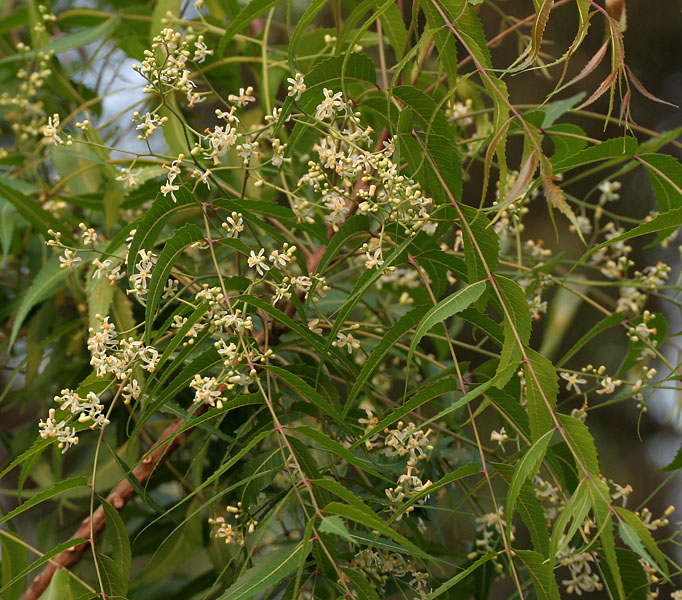 NeemAzadirachta indica
-
 ChinaberryMelia azedarach
-
 Lansium domesticum
Compare
Questions and answers
What is the scientific name of the Emu Apple?
The scientific name of the Emu Apple is Owenia acidula. Written with its author, the full name is Owenia acidula F.Muell..
Which family does the Emu Apple belong to?
Owenia acidula belongs to the family Meliaceae, in the order Sapindales and the class Magnoliopsida.
Where is the Emu Apple found?
Checklists and occurrence records place Owenia acidula in 1 country: Australia.
What is the conservation status of the Emu Apple?
The IUCN Red List category recorded for Owenia acidula is Least Concern (LC).
What other names does the Emu Apple have?
Owenia acidula is also known in English as Emu-apple, Sour-apple, Sour-plum and Tulipwood.
Are emu apples edible?
Yes. The fruit of Emu Apple is edible, and its pulp is used as Aboriginal bushfood.[26][27]
What is an emu apple?
Emu Apple is Owenia acidula, a small to medium-sized tree native to Australia.[1]
Sources
Passages the profile rests on
- Owenia acidula is a small to medium-sized tree native to Australia. Source passage: “Owenia acidula, commonly known as emu apple, is a small to medium-sized Australian native tree” — English Wikipedia
- The branches typically droop downwards and extend away from the trunk. Source passage: “The branches typically hang downwards and away from the trunk.” — English Wikipedia
- Broken twigs release a sticky, milky sap. Source passage: “When the twigs are broken, they ooze a sticky, milky sap.” — English Wikipedia
- The tree can reach a height of ten metres. Source passage: “It may grow to ten metres tall.” — inaturalist.org
- The leaves are hairless, pinnate, bright green and shiny. Source passage: “The hairless pinnate leaves are a vibrant green” — English Wikipedia
- The leaves measure between two and five centimetres in length. Source passage: “two to five centimetres in length, with a shiny coating.” — English Wikipedia
- Owenia acidula can be distinguished from Owenia venosa by having seven or more pairs of light green leaflets per leaf. Source passage: “O. acidula possessing seven or more pairs of light green leaflets per leaf.” — English Wikipedia
- The flower buds are viscous. Source passage: “The buds of O. acidula are viscous.” — English Wikipedia
- The flowers are cream-coloured and loosely arranged. Source passage: “The cream coloured flowers have a loosely arranged structure” — English Wikipedia
- The flower petals are approximately four millimetres long. Source passage: “four millimetre long petals” — English Wikipedia
- The stamens are approximately three millimetres long. Source passage: “three millimetre long stamen.” — English Wikipedia
- The fruits are purplish red, spherical and marked with faded speckles. Source passage: “The fruits are a purplish red in colour, with faded speckles, and is spherical in shape.” — English Wikipedia
- The fruit has a slightly sour taste. Source passage: “and is slightly sour in taste.” — English Wikipedia
- The fruit seeds have a diameter of two to four centimetres. Source passage: “The seeds of the fruit have a diameter of two to four centimetres” — English Wikipedia
- The species occurs in outback woodlands. Source passage: “small or medium-sized tree of outback woodlands native to Australia.” — inaturalist.org
- The species favours sandy soils. Source passage: “This species favours sandy soil” — English Wikipedia
- The species typically occurs on plains. Source passage: “typically found on plains or in dry sclerophyll forest.” — English Wikipedia
- The species occurs in dry sclerophyll forests. Source passage: “typically found on plains or in dry sclerophyll forest.” — English Wikipedia
- The species occurs in South Australia, Queensland and New South Wales. Source passage: “can be found in South Australia, Queensland, New South Wales” — English Wikipedia
- The species also occurs, to a lesser extent, in Western Australia and the Northern Territory. Source passage: “and to a lesser extent, Western Australia and the Northern Territory.” — English Wikipedia
- Owenia acidula produces suckers. Source passage: “O. acidula does sucker” — English Wikipedia
- Owenia acidula is dioecious, with male and female reproductive structures developing on separate plants. Source passage: “Owenia acidula is dioecious. A plant is classified as dioecious when the male and female reproductive units develop on completely different organisms.” — English Wikipedia
- Reproduction requires both a male and a female specimen. Source passage: “Therefore, a male and female O. acidula specimen is required for reproduction to occur.” — English Wikipedia
- The species produces fruit prolifically. Source passage: “Owenia acidula fruits prolifically.” — English Wikipedia
- The fruit ripens after falling from the tree. Source passage: “The fruit ripens after it falls off the tree” — English Wikipedia
- The fruit of Owenia acidula is edible. Source passage: “The fruit of O. acidula can be eaten” — English Wikipedia
- The fruit pulp is used as Aboriginal bushfood. Source passage: “the pulp is an Aboriginal bushfood” — English Wikipedia
- The fruit pulp is believed to cause hallucinations. Source passage: “which is believed to cause hallucinations.” — English Wikipedia
- The leaves and branches are sometimes used as livestock fodder. Source passage: “The leaves and branches are sometimes used as stock fodder.” — English Wikipedia
- Owenia acidula has a reported digestibility of 53.29% in goats. Source passage: “In goats, O. acidula has a high level of digestibility of 53.29%” — English Wikipedia
- The species is considered a favourable forage resource for goat producers. Source passage: “making it a favourable forage resource for goat producers.” — English Wikipedia
- The seeds are commonly requested for coal mine rehabilitation. Source passage: “The seed of Owenia acidula is commonly requested for coal mine rehabilitation.” — English Wikipedia
- Owenia acidula is classified as poorly known and of least concern (LC) in the cited document. Source passage: “it is currently classified as poorly known species, least concern (LC).” — English Wikipedia
- The cited document states that additional surveys are needed before the species can be reclassified. Source passage: “More surveys need to be undertaken before this species can be reclassified.” — English Wikipedia
- Owenia venosa is recorded alongside Owenia acidula in Queensland. Source passage: “In Queensland, Owenia venosa has been recorded alongside Owenia acidula.” — English Wikipedia
Data
- Catalogue of Life, 2026-10-16 XR cc by
- Global Biodiversity Information Facility CC BY 4.0
- Wikidata CC0
- GeoNames CC BY 4.0
- Wikimedia Commons per image; credit shown with each image
- Within the Catalogue of Life, this name comes from Synonymic Checklists of the Vascular Plants of the World cc by
References
- F.Muell. (1857). Hooker’s J. Bot. Kew Gard. Misc. 9: 304 (1857). where the name was published
This species in other databases
- Catalogue of Life 75DH8
- Wikidata Q7114726
- iNaturalist 207944
- World Flora Online wfo-0000388724
- GRIN 26187
Page built on 28 November 2026. See how the catalog is made and all sources and licences.
Cite this page
ScientificNames.org. (2026). Owenia acidula (Emu Apple). Retrieved November 28, 2026, from https://scientificnames.org/species/owenia-acidula
“Owenia acidula (Emu Apple).” ScientificNames.org, 2026, scientificnames.org/species/owenia-acidula. Accessed 28 Nov. 2026.
ScientificNames.org. “Owenia acidula (Emu Apple).” Accessed November 28, 2026. https://scientificnames.org/species/owenia-acidula.
@misc{scientificnames_owenia_acidula_emu_apple,
  author = {{ScientificNames.org}},
  title = {Owenia acidula (Emu Apple)},
  year = {2026},
  url = {https://scientificnames.org/species/owenia-acidula},
  note = {Accessed 2026-11-28}
}