Species · Flowering plants
Onion Cedar Owenia cepiodora
The scientific name of the Onion Cedar is Owenia cepiodora. It is a species of flowering plant in the family Meliaceae (mahogany family), order Sapindales.
- Scientific name
- Owenia cepiodora F.Muell.
- Common name
- Onion Cedar
- Genus
- Owenia
- Family
- Meliaceae (Mahogany Family)
- Order
- Sapindales
- Class
- Magnoliopsida
- Recorded in
- 1 country
- Name status
- accepted in the Catalogue of Life

Overview
The onion cedar (Owenia cepiodora F.Muell.) is a medium to large Australian tree in the family Meliaceae, order Sapindales and class Magnoliopsida. It occurs in rainforests of northeastern New South Wales and adjacent areas of Queensland, mostly in drier hoop pine rainforests along the Queensland–New South Wales border. Its new leaves have a garlic scent, and it produces round red fruits with white pulp.
Written 27 November 2026 from the sources listed below. Each statement was checked against the passage it cites; statements that could not be supported were removed.
Appearance
The onion cedar has a cylindrical trunk with brown bark marked by vertical cracks and lines. Its crown resembles that of the dark glossy green black bean tree, and its small branches are thick, smooth and pale brown, with leaf scars.[1][2][3]
Its compound leaves measure 30 to 60 cm long and have 17 to 25 leaflets arranged sub-oppositely along the main leaf stem, without a terminal leaflet. The main leaf stalks measure 20 to 30 cm long, and the leaflet stalks measure 2 to 5 mm long.[4][5][6][7]
The leaflets are broad lanceolate and measure 7 to 14 cm long and 1.5 to 3.5 cm wide. Their upper surfaces are glossy green, while their undersides are paler and duller; the midrib is raised on both surfaces.[8][9][10]
New leaves have a garlic scent, whereas older foliage has no distinct odour. The tree produces white flowers with five petals and round red fruits with white pulp.[11][12][13]
The onion cedar can reach 30 metres in height and have a stem diameter of 75 cm. Its flower petals are approximately 4 mm long, and its fruits measure 1.5 to 2 cm in diameter.[14][15][16]
Habitat
The onion cedar occurs in rainforests of northeastern New South Wales and adjacent areas of Queensland. Its habitat consists mostly of drier hoop pine rainforests along the Queensland–New South Wales border.[17][18]
Its distribution extends from the Richmond River in the south to Canungra in the Gold Coast hinterland in the north.[19]
Reproduction and life cycle
The onion cedar produces white flowers on panicles from November to December. Each flower has five petals approximately 4 mm long.[12][15][20][21]
Its round red fruits are drupes measuring 1.5 to 2 cm in diameter. They contain two, three or four cells, each usually containing two seeds, and mature between January and March.[13][16][22][23]
Regeneration is unreliable but occurs around November to January.[24]
Conservation
The onion cedar is considered vulnerable and has a ROTAP rating of 2VCi. Only small regrowth trees remain following extensive historical logging.[25][26]
Uses
The onion cedar produces timber that resembles valuable Australian red cedar. Its logs were soaked to remove their characteristic onion scent before being sold as red cedar.[27][28]
Similar species
The crown of the onion cedar resembles that of the dark glossy green black bean tree. Its timber resembles Australian red cedar.[2][27]
Classification of the Onion Cedar
| Kingdom | Plantae |
|---|---|
| Subkingdom | Pteridobiotina |
| Phylum | Tracheophyta |
| Class | Magnoliopsida |
| Order | Sapindales |
| Family | Meliaceae (Mahogany Family) |
| Subfamily | Melioideae |
| Tribe | Melieae |
| Genus | Owenia |
| Species | Owenia cepiodora F.Muell. |
Where the Onion Cedar is found
Checklists and occurrence records place Owenia cepiodora in 1 country across Oceania. GBIF holds 817 georeferenced records of it.
Countries
Regions and cities with the most records
Range as the checklists state it
Australia (SE-Queensland, NE-New South Wales)
A number beside a place is its count of GBIF occurrence records. A place without a number comes from a checklist alone. Records show where a species has been observed or collected, which can include escapes and vagrants.
Common names
English
- Onion Cedar
- Bog Onion
- Onionwood
Names in 2 other languages
- Chinese
- 洋葱木
- Slovak
- ovénia cibuľová
Related species
-
 Emu AppleOwenia acidula
- Owenia vernicosa
- Sour-plumOwenia venosa
- Desert NutOwenia reticulata
- Owenia × reliqua
-
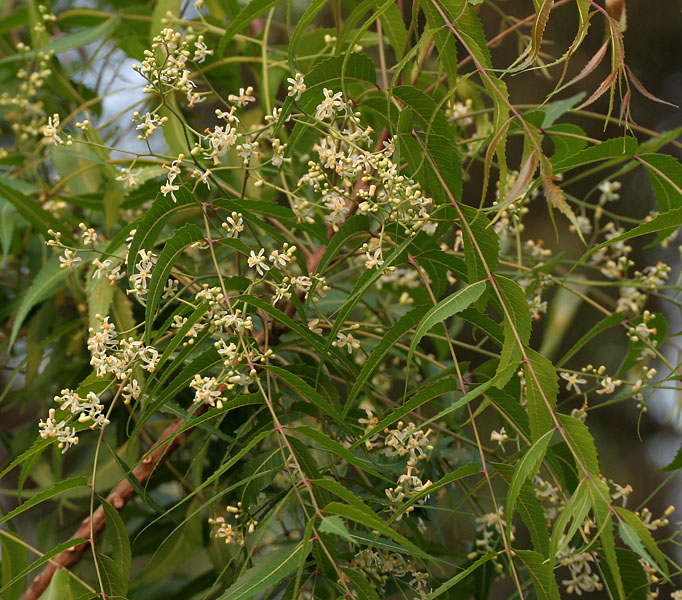 NeemAzadirachta indica
-
 ChinaberryMelia azedarach
-
 Lansium domesticum
Compare
Questions and answers
What is the scientific name of the Onion Cedar?
The scientific name of the Onion Cedar is Owenia cepiodora. Written with its author, the full name is Owenia cepiodora F.Muell..
Which family does the Onion Cedar belong to?
Owenia cepiodora belongs to the family Meliaceae, in the order Sapindales and the class Magnoliopsida.
Where is the Onion Cedar found?
Checklists and occurrence records place Owenia cepiodora in 1 country: Australia.
What other names does the Onion Cedar have?
Owenia cepiodora is also known in English as Bog Onion and Onionwood.
Can you provide a botanical description of the onion?
The onion cedar is a medium to large tree with a cylindrical trunk and brown bark marked by vertical cracks and lines. Its compound leaves have 17 to 25 broad lanceolate leaflets, and it produces white flowers with five petals and round red drupes with white pulp.[29][1][4][8][12][13]
Sources
Passages the profile rests on
- The tree has a cylindrical trunk with brown bark marked by vertical cracks and lines. Source passage: “A cylindrical trunk with brown bark with vertical cracks and lines.” — English Wikipedia
- Its crown resembles that of the dark glossy green black bean tree. Source passage: “The crown of the tree resembles the dark glossy green black bean tree.” — English Wikipedia
- Its small branches have leaf scars and are thick, smooth and pale brown. Source passage: “Small branches are marked with leaf scars; thick smooth and pale brown.” — English Wikipedia
- Its compound leaves have 17 to 25 leaflets arranged sub-oppositely along the main leaf stem, without a terminal leaflet. Source passage: “Compound leaves are between 30 and 60 cm long with 17 to 25 leaflets, sub opposite on the main leaf stem. Notably, there is no terminal leaflet.” — English Wikipedia
- Its compound leaves measure 30 to 60 cm in length. Source passage: “Compound leaves are between 30 and 60 cm long” — English Wikipedia
- Its main leaf stalks measure 20 to 30 cm long. Source passage: “The main leaf stalk is 20 to 30 cm long” — English Wikipedia
- Its leaflet stalks measure 2 to 5 mm long. Source passage: “the leaflet stalks are 2 to 5 mm long.” — English Wikipedia
- Its leaflets are broad lanceolate and measure 7 to 14 cm long and 1.5 to 3.5 cm wide. Source passage: “Leaflets 7 to 14 cm long, and 1.5 to 3.5 cm wide, broad lanceolate in shape.” — English Wikipedia
- The leaflets are glossy green on their upper surfaces and paler and duller underneath. Source passage: “Glossy green above, paler and more dull beneath.” — English Wikipedia
- The leaflet midrib is raised on both the upper and lower surfaces. Source passage: “The midrib is raised above and below on the leaflet.” — English Wikipedia
- New leaves have a garlic scent, whereas older foliage has no distinct odour. Source passage: “Older foliage without a distinct odour, however, new leaves have a garlic scent.” — English Wikipedia
- The species produces white flowers with five petals per flower. Source passage: “White flowers form on panicles in the months of November to December. Petals five in number per flower” — English Wikipedia
- Its fruit is a round red drupe with white pulp. Source passage: “The fruit is round red drupe, with white pulp.” — English Wikipedia
- The tree can reach 30 metres in height and have a stem diameter of 75 cm. Source passage: “A tree up to 30 metres tall with a stem diameter of 75 cm.” — English Wikipedia
- Its flower petals are approximately 4 mm long. Source passage: “Petals five in number per flower, around 4 mm long.” — English Wikipedia
- Its fruits measure 1.5 to 2 cm in diameter. Source passage: “1.5 to 2 cm in diameter” — English Wikipedia
- The species occurs in rainforests of northeastern New South Wales and adjacent areas of Queensland. Source passage: “It occurs in the rainforests of north eastern New South Wales and adjacent areas in Queensland.” — English Wikipedia
- Its habitat consists mostly of drier hoop pine rainforests along the Queensland–New South Wales border. Source passage: “The habitat is mostly the drier hoop pine rainforests along the state border.” — English Wikipedia
- The species occurs as far south as the Richmond River and as far north as Canungra in the Gold Coast hinterland. Source passage: “It is found as far south as the Richmond River and as far north as Canungra, in the Gold Coast hinterland.” — English Wikipedia
- The species produces white flowers on panicles from November to December. Source passage: “White flowers form on panicles in the months of November to December.” — English Wikipedia
- Each flower has five petals. Source passage: “Petals five in number per flower” — English Wikipedia
- The fruits contain two, three or four cells, each usually containing two seeds. Source passage: “with two, three or four cells, each with usually two seeds.” — English Wikipedia
- The fruits mature between January and March. Source passage: “Fruit matures from January to March.” — English Wikipedia
- Regeneration is unreliable but occurs around November to January. Source passage: “Regeneration is unreliable, however it occurs around November to January.” — English Wikipedia
- The species is considered vulnerable and has a ROTAP rating of 2VCi. Source passage: “Its status is now considered vulnerable with a ROTAP rating of 2VCi.” — English Wikipedia
- Only small regrowth trees remain following extensive historical logging. Source passage: “Only small regrowth trees remain, as it was heavily logged in earlier times.” — English Wikipedia
- The species produces timber that resembles valuable Australian red cedar. Source passage: “The timber resembles the valuable Australian red cedar.” — English Wikipedia
- Its logs were soaked to remove their characteristic onion scent before being sold as red cedar. Source passage: “Logs were soaked to remove the characteristic onion scent and sold as red cedar.” — English Wikipedia
- Owenia cepiodora is a medium to large Australian tree. Source passage: “Owenia cepiodora is a medium to large Australian tree” — English Wikipedia
Data
- Catalogue of Life, 2026-10-16 XR cc by
- Global Biodiversity Information Facility CC BY 4.0
- Wikidata CC0
- GeoNames CC BY 4.0
- Wikimedia Commons per image; credit shown with each image
- Within the Catalogue of Life, this name comes from Synonymic Checklists of the Vascular Plants of the World cc by
References
- F.Muell. (1878). Fragm. [Mueller] 11: 82 (1878). where the name was published
This species in other databases
Page built on 28 November 2026. See how the catalog is made and all sources and licences.
Cite this page
ScientificNames.org. (2026). Owenia cepiodora (Onion Cedar). Retrieved November 28, 2026, from https://scientificnames.org/species/owenia-cepiodora
“Owenia cepiodora (Onion Cedar).” ScientificNames.org, 2026, scientificnames.org/species/owenia-cepiodora. Accessed 28 Nov. 2026.
ScientificNames.org. “Owenia cepiodora (Onion Cedar).” Accessed November 28, 2026. https://scientificnames.org/species/owenia-cepiodora.
@misc{scientificnames_owenia_cepiodora_onion_cedar,
  author = {{ScientificNames.org}},
  title = {Owenia cepiodora (Onion Cedar)},
  year = {2026},
  url = {https://scientificnames.org/species/owenia-cepiodora},
  note = {Accessed 2026-11-28}
}