Species · Other invertebrates
Elephant's Hide Sponge Pachymatisma johnstonia
The scientific name of the Elephant's Hide Sponge is Pachymatisma johnstonia. It is a species of animal in the family Geodiidae, order Tetractinellida. The name dates from 1842.
- Scientific name
- Pachymatisma johnstonia (Bowerbank in Johnston, 1842)
- Common name
- Elephant's Hide Sponge
- Genus
- Pachymatisma
- Family
- Geodiidae
- Order
- Tetractinellida
- Class
- Demospongiae
- Environment
- marine
- Recorded in
- 13 countries
- Name status
- accepted in the Catalogue of Life

Overview
The species occurs along the north-eastern Atlantic coasts, with recorded occurrences in Britain and Ireland. It is usually grey, with a smooth outer surface, prominent exhalant openings and yellow-white internal tissue.
Written 27 November 2026 from the sources listed below. Each statement was checked against the passage it cites; statements that could not be supported were removed.
Appearance
Elephant's Hide Sponge has a firm to hard consistency but can be compressed slightly. Its outer surface is smooth and bluish or violet-grey, with extensive perforations formed by inhalant orifices.[1][2][3]
The larger exhalant openings are distinct and typically arranged in lines or clusters. The sponge has a distinct cortex approximately 1 mm thick, with yellow-white tissue beneath the surface.[4][5][6]
The species is usually grey and grows in an encrusting form with prominent oscula and a pale yellow interior.[7]
Habitat
Elephant's Hide Sponge occurs in locations exposed to varying degrees of wave action.[8]
Classification of the Elephant's Hide Sponge
| Kingdom | Animalia |
|---|---|
| Phylum | Porifera |
| Class | Demospongiae (Demosponge) |
| Subclass | Heteroscleromorpha |
| Order | Tetractinellida |
| Suborder | Astrophorina |
| Family | Geodiidae |
| Subfamily | Erylinae |
| Genus | Pachymatisma |
| Species | Pachymatisma johnstonia (Bowerbank in Johnston, 1842) |
Where the Elephant's Hide Sponge is found
Checklists and occurrence records place Pachymatisma johnstonia in 13 countries. GBIF holds 10,301 georeferenced records of it.
Countries
- Croatia 7
- Denmark 9
- France 796
- Germany 5
- Guernsey 188
- Ireland 1,556
- Isle of Man 274
- Italy 3
- Jersey 166
- Portugal 17
- Spain 22
- The Netherlands 27
- United Kingdom 7,231
Regions and cities with the most records
- Christchurch, United Kingdom 973
- New Milton, United Kingdom 847
- Plymstock, United Kingdom 610
- Plymouth, United Kingdom 503
- Newport, United Kingdom 429
- Saltash, United Kingdom 397
- Poole, United Kingdom 317
- Weymouth, United Kingdom 313
- Bournemouth, United Kingdom 248
- Wales, United Kingdom 246
- Cowes, United Kingdom 201
- Torquay, United Kingdom 178
- Brixham, United Kingdom 177
- Paignton, United Kingdom 177
- Dorchester, United Kingdom 171
- Scotland, United Kingdom 165
- Coleraine, United Kingdom 153
- Saint Peter Port, Guernsey 146
- Newton Abbot, United Kingdom 143
- England, United Kingdom 122
- Saint Helier, Jersey 121
- Douglas, Isle of Man 117
- Waterford, Ireland 92
- Falmouth, United Kingdom 89
- Exmouth, United Kingdom 79
- Larne, United Kingdom 78
- Northern Ireland, United Kingdom 72
- Wimborne Minster, United Kingdom 72
- Brest, France 71
- Truro, United Kingdom 68
- Vannes, France 65
- Bognor Regis, United Kingdom 59
- Littlehampton, United Kingdom 56
- Worthing, United Kingdom 46
- Saint-Malo, France 44
- Chichester, United Kingdom 40
A number beside a place is its count of GBIF occurrence records. A place without a number comes from a checklist alone. Records show where a species has been observed or collected, which can include escapes and vagrants.
Common names
English
- Elephant's Hide Sponge
- Elephant Ear Sponge
- Elephant Hide Sponge
Names in 4 other languages
- Czech
- houba hřebenitá
- French
- Fesse d'éléphant
- German
- Elefantenhaut-Schwamm
- Portuguese
- Esponja-pele-de-elefante
Synonyms
3 other scientific names have been used for this species and are now treated as synonyms of Pachymatisma johnstonia.
- Caminus osculosus Grübe, 1872
- Halichondria johnstonia Bowerbank in Johnston, 1842
- Pachymatisma johnstoni (Bowerbank, 1842)
Related species
- Pachymatisma areolata
- Pachymatisma bifida
- Pachymatisma monaena
- Pachymatisma normani
-
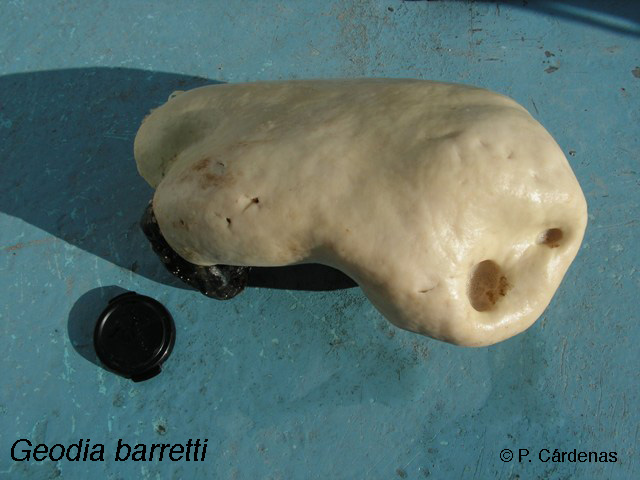 Barrett's Horny SpongeGeodia barretti
- White Encrusting SpongeGeodia gibberosa
-
 Geodia megastrella
-
 Rhabdastrella globostellata
Compare
Questions and answers
What is the scientific name of the Elephant's Hide Sponge?
The scientific name of the Elephant's Hide Sponge is Pachymatisma johnstonia. Written with its author, the full name is Pachymatisma johnstonia (Bowerbank in Johnston, 1842).
Which family does the Elephant's Hide Sponge belong to?
Pachymatisma johnstonia belongs to the family Geodiidae, in the order Tetractinellida and the class Demospongiae.
Where is the Elephant's Hide Sponge found?
Checklists and occurrence records place Pachymatisma johnstonia in 13 countries, including United Kingdom, Ireland, France, Isle of Man, Guernsey and Jersey.
What other names does the Elephant's Hide Sponge have?
Pachymatisma johnstonia is also known in English as Elephant Ear Sponge and Elephant Hide Sponge.
Sources
Passages the profile rests on
- The sponge has a firm to hard consistency but can be compressed slightly. Source passage: “The consistency is firm-hard, but slightly compressible.” — marlin.ac.uk
- The sponge has a smooth bluish or violet-grey outer surface. Source passage: “The smooth surface is bluish or violet-grey” — marlin.ac.uk
- The outer surface is extensively perforated by inhalant orifices. Source passage: “extensively perforated with inhalant orifices.” — marlin.ac.uk
- The larger exhalant openings are distinct and typically arranged in lines or clusters. Source passage: “Larger exhalant openings (osculum) are distinct and usually in lines or arranged in clusters.” — marlin.ac.uk
- The sponge has a distinct cortex approximately 1 mm thick. Source passage: “The skin (cortex) is distinct and 1 mm thick” — marlin.ac.uk
- The tissue beneath the surface is yellow-white. Source passage: “underneath the surface the colour is yellow-white.” — marlin.ac.uk
- The species is usually grey and grows in an encrusting form with prominent oscula and a pale yellow interior. Source passage: “usually grey encrusting sponge with large prominent oscula and a pale yellow interior.” — English Wikipedia
- The sponge occurs in locations exposed to varying degrees of wave action. Source passage: “The size and form depends largely on the extent of its exposure to waves.” — English Wikipedia
Data
- Catalogue of Life, 2026-10-16 XR cc by
- Global Biodiversity Information Facility CC BY 4.0
- Wikidata CC0
- GeoNames CC BY 4.0
- Wikimedia Commons per image; credit shown with each image
- Within the Catalogue of Life, this name comes from World Porifera Database cc by
References
- Johnston, 1842 where the name was published
This species in other databases
- Catalogue of Life 4BSQW
- Wikidata Q1844789
- iNaturalist 337982
- WoRMS urn:lsid:marinespecies.org:taxname:134057
Page built on 28 November 2026. See how the catalog is made and all sources and licences.
Cite this page
ScientificNames.org. (2026). Pachymatisma johnstonia (Elephant's Hide Sponge). Retrieved November 28, 2026, from https://scientificnames.org/species/pachymatisma-johnstonia
“Pachymatisma johnstonia (Elephant's Hide Sponge).” ScientificNames.org, 2026, scientificnames.org/species/pachymatisma-johnstonia. Accessed 28 Nov. 2026.
ScientificNames.org. “Pachymatisma johnstonia (Elephant's Hide Sponge).” Accessed November 28, 2026. https://scientificnames.org/species/pachymatisma-johnstonia.
@misc{scientificnames_pachymatisma_johnstonia_elephants_hide_sponge,
  author = {{ScientificNames.org}},
  title = {Pachymatisma johnstonia (Elephant's Hide Sponge)},
  year = {2026},
  url = {https://scientificnames.org/species/pachymatisma-johnstonia},
  note = {Accessed 2026-11-28}
}