Species · Birds
Cinereous Becard Pachyramphus rufus
The scientific name of the Cinereous Becard is Pachyramphus rufus. It is a species of bird in the family Tityridae (becards), order Passeriformes. The name dates from 1783.
- Scientific name
- Pachyramphus rufus (Boddaert, 1783)
- Common name
- Cinereous Becard
- Genus
- Pachyramphus
- Family
- Tityridae (Becards)
- Order
- Passeriformes
- Class
- Aves
- Red List category
- LC Least Concern
- Recorded in
- 10 countries
- Name status
- accepted in the Catalogue of Life

Overview
Pachyramphus rufus occurs from southern Panama across northern South America and the Amazon Basin.
Written 26 November 2026 from the sources listed below. Each statement was checked against the passage it cites; statements that could not be supported were removed.
Appearance
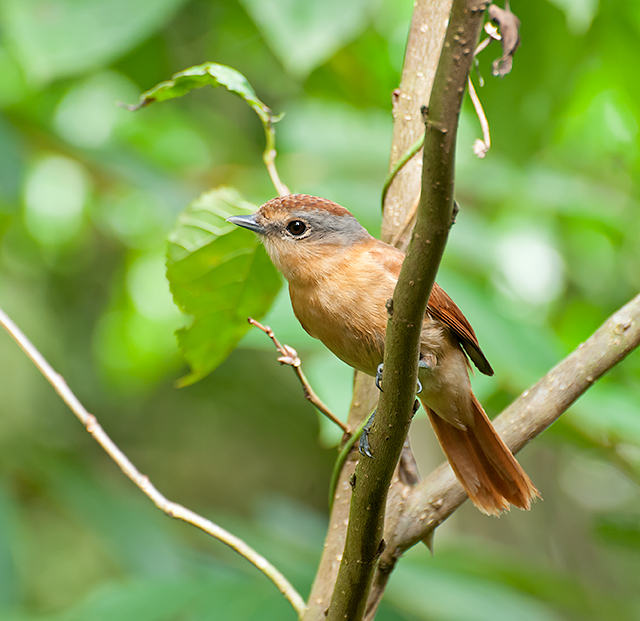
Both sexes have dark irises, blackish bills, and grayish legs and feet. Females are predominantly rich rufous, with paler lores and a whitish belly.[1][2]
The species measures between 12.9 and 14 cm in length and weighs approximately 18.5 g.[3][4]
Habitat
The Cinereous Becard inhabits tropical and lower subtropical forest environments. Its habitats include gallery forests, secondary forests, evergreen forest edges, deciduous woodlands, scrublands, agricultural areas and pastures with scattered trees, and coastal mangroves.[5][6][7]
In Panama, it occurs at elevations between 750 and 1,500 m. In Colombia, it occurs from sea level to 1,500 m, and in Venezuela from sea level to 1,300 m.[8][9][10]
Diet
The species feeds primarily on arthropods and supplements its diet with small fruits and berries.[11]
Behaviour
The Cinereous Becard typically forages alone or in pairs and rarely joins mixed-species feeding flocks. It obtains food by gleaning vegetation and branches while perched and by making upward sallies to capture prey.[12][13]
The species remains in its range throughout the year.[14]
Both sexes appear to have relatively large repertoires of melancholy songs. Its typical song consists of rapidly delivered musical notes that rise in pitch and accelerate toward a trill.[15][16]
Its calls include a high-pitched metallic-sounding note and a buzzy sound.[17]
Reproduction and life cycle
The breeding season includes June in Venezuela and April through October in Colombia.[18]
The species builds a globular nest from leaves and grass, with an entrance on the side. The nest is typically placed in a fork of a high tree branch.[19][20]
Clutches contain between two and five eggs. The female alone incubates the eggs, and the incubation period lasts approximately 18 to 21 days.[21][22][23]
Young birds fledge approximately 20 to 30 days after hatching.[24]
Conservation
The Cinereous Becard was assessed as Least Concern by the IUCN, with its most recent assessment for the IUCN Red List conducted in 2019. The species has an extremely large geographic range.[25][26][27]
Its estimated population comprises at least 500,000 mature individuals and is believed to be decreasing. No immediate threats to the species have been identified.[28][29]
The species is described as uncommon and patchily distributed in the BirdLife factsheet. It occurs in one national park in Panama and at least three protected areas in Brazil.[30][31]
Similar species
The Cinereous Becard and the slaty becard are sister species that form a superspecies.[32]
Classification of the Cinereous Becard
| Kingdom | Animalia |
|---|---|
| Phylum | Chordata |
| Subphylum | Vertebrata |
| Infraphylum | Gnathostomata |
| Parvphylum | Osteichthyes |
| Megaclass | Tetrapoda |
| Class | Aves (Bird) |
| Order | Passeriformes (Passerine) |
| Family | Tityridae (Becards) |
| Genus | Pachyramphus (Becard) |
| Species | Pachyramphus rufus (Boddaert, 1783) |
Where the Cinereous Becard is found
Checklists and occurrence records place Pachyramphus rufus in 10 countries across North America and South America. GBIF holds 15,318 georeferenced records of it.
Countries
- Argentina 14
- Brazil 1,765
- Colombia 9,856
- French Guiana 309
- Guyana 331
- Panama 316
- Paraguay 8
- Peru 493
- Suriname 529
- Venezuela 1,697
Regions and cities with the most records
- Antioquia, Colombia 1,826
- Valle del Cauca Department, Colombia 1,628
- Caldas Department, Colombia 959
- Trujillo, Venezuela 890
- Escuque, Venezuela 884
- Cundinamarca, Colombia 830
- Santander Department, Colombia 756
- Guadalajara de Buga, Colombia 750
- Pará, Brazil 679
- Guacarí, Colombia 667
- Chinchiná, Colombia 652
- Villamaría, Colombia 640
- Manizales, Colombia 636
- Neira, Colombia 635
- Magdalena Department, Colombia 613
- La Tebaida, Colombia 603
- Quindío Department, Colombia 591
- Darien, Colombia 552
- Montenegro, Colombia 498
- Tolima Department, Colombia 498
- Caicedonia, Colombia 487
- Loreto, Peru 470
- Santa Marta, Colombia 449
- Amazonas, Brazil 438
- Valera, Venezuela 410
- Villeta, Colombia 368
- Motatán, Venezuela 360
- Risaralda Department, Colombia 332
- Cartago, Colombia 325
- Armenia, Colombia 324
- Pereira, Colombia 303
- Paramaribo, Suriname 296
- Santa Rosa de Cabal, Colombia 289
- Sabana de Mendoza, Venezuela 283
- La Virginia, Colombia 276
- Marsella, Colombia 275
Range as the checklists state it
Middle America
South America
A number beside a place is its count of GBIF occurrence records. A place without a number comes from a checklist alone. Records show where a species has been observed or collected, which can include escapes and vagrants.
Common names
English
- Cinereous Becard
Names in 23 other languages
- Catalan
- anambé cendrós
- Chinese
- 灰厚嘴霸鹟, 灰比卡雀
- Croatian
- sivi satir
- Czech
- tityra popelavá
- Danish
- Askebekard
- Dutch
- Grijze Bekarde
- Esperanto
- griza titiro
- Finnish
- harmaabekardi, harmaalepinkäistyranni
- French
- Bécarde cendrée
- German
- Graubekarde
- Italian
- Beccaio cenerino
- Japanese
- メスアカカザリドリモドキ
- Lithuanian
- pilkasis bekardas
- Polish
- bekardzik białoczelny
- Portuguese
- caneleiro-cinzento
- Russian
- Серый бекард
- Serbian
- Pepeljasti bekard
- Slovak
- tityra popolavá
- Spanish
- Anambé cinéreo, Anambé-cinéreo, Cabezón cinéreo
- Swedish
- gråbekard
- Turkish
- Kül Rengi Bekard
- Ukrainian
- бекард сірий
- Welsh
- becard llwyd
Synonyms
One other scientific name has been used for this species and is now treated as a synonym of Pachyramphus rufus.
- Muscicapa rufa Boddaert, 1783
Subspecies and varieties
- Pachyramphus rufus juruanus subspecies
- Pachyramphus rufus rufus subspecies
Related species
-
 Rose-throated BecardPachyramphus aglaiae
-
 White-winged BecardPachyramphus polychopterus
-
 Cinnamon BecardPachyramphus cinnamomeus
-
 Chestnut-crowned BecardPachyramphus castaneus
-
 Barred BecardPachyramphus versicolor
-
 Black-and-white BecardPachyramphus albogriseus
-
 Green-backed BecardPachyramphus viridis
-
 Black-capped BecardPachyramphus marginatus
Compare
Questions and answers
What is the scientific name of the Cinereous Becard?
The scientific name of the Cinereous Becard is Pachyramphus rufus. Written with its author, the full name is Pachyramphus rufus (Boddaert, 1783).
Which family does the Cinereous Becard belong to?
Pachyramphus rufus belongs to the family Tityridae, in the order Passeriformes and the class Aves.
Where is the Cinereous Becard found?
Checklists and occurrence records place Pachyramphus rufus in 10 countries, including Colombia, Brazil, Venezuela, Suriname, Peru and Guyana.
What is the conservation status of the Cinereous Becard?
The IUCN Red List category recorded for Pachyramphus rufus is Least Concern (LC).
Where does the Cinereous Becard occur?
It occurs in Brazil, Colombia, French Guiana, Guyana, Panama, Peru, Suriname, and Venezuela. Its presence in Ecuador is considered possible, based on historical specimens, but confirmed records are lacking.[33][34]
What are the recognized subspecies?
The species has two recognized subspecies, P. r. rufous and P. r. juruanus.[35]
Where does the nominate subspecies occur?
The nominate subspecies ranges from the Panama Canal region across northern Colombia, reaching Valle del Cauca Department in the west and Meta Department east of the Andes. It extends eastward across northern Venezuela and the Guianas to Amapá in Brazil, then south to Mato Grosso.[36][37][38]
Where does P. r. juruanus occur?
It occurs from Loreto in eastern Peru eastward into Amazonas in western Brazil.[39]
Sources
Passages the profile rests on
- Both sexes have dark irises, blackish bills, and grayish legs and feet. Source passage: “Both sexes of both subspecies have a dark iris, a blackish bill, and grayish legs and feet.” — English Wikipedia
- Females are predominantly rich rufous, with paler lores and a whitish belly. Source passage: “Females mostly rich rufous with paler lores and a whitish belly.” — ebird.org
- The species measures between 12.9 and 14 cm in length. Source passage: “The cinereous becard is 12.9 to 14 cm (5.1 to 5.5 in) long” — English Wikipedia
- The species weighs approximately 18.5 g. Source passage: “weighs about 18.5 g (0.65 oz).” — English Wikipedia
- The species occupies gallery forests, secondary forests, evergreen forest edges, deciduous woodlands, scrublands, and agricultural areas and pastures with scattered trees. Source passage: “These include gallery forest, secondary forest, the edges of evergreen forest, deciduous woodlands, some scrublands, and agricultural areas and pastures with scattered trees.” — English Wikipedia
- The species also occurs in coastal mangrove habitats. Source passage: “Coastally it also occurs in mangroves.” — English Wikipedia
- The species inhabits tropical and lower subtropical forest environments. Source passage: “The cinereous becard inhabits a wide variety of forest types in the tropical and lower subtropical zones.” — English Wikipedia
- In Panama, the species occurs at elevations between 750 and 1,500 m. Source passage: “In Panama it ranges between 750 and 1,500 m (2,500 and 4,900 ft)” — English Wikipedia
- In Colombia, the species occurs from sea level to 1,500 m elevation. Source passage: “in Colombia from sea level to 1,500 m (4,900 ft)” — English Wikipedia
- In Venezuela, the species occurs from sea level to 1,300 m elevation. Source passage: “in Venezuela from sea level to 1,300 m (4,300 ft).” — English Wikipedia
- The species feeds primarily on arthropods and supplements its diet with small fruits and berries. Source passage: “The cinereous becard feeds mostly on arthropods and includes small fruits and berries in its diet.” — English Wikipedia
- The species typically forages alone or in pairs and rarely joins mixed-species feeding flocks. Source passage: “It typically forages singly or in pairs and seldom joins mixed-species feeding flocks.” — English Wikipedia
- The species obtains food by gleaning vegetation and branches while perched and by making upward sallies to capture prey. Source passage: “It perches at any level in the forest and takes food by gleaning from vegetation and branches while perched and by grabbing it with an upward sally.” — English Wikipedia
- The species remains in its range throughout the year. Source passage: “The cinereous becard is a year-round resident.” — English Wikipedia
- Both sexes appear to have relatively large repertoires of melancholy songs. Source passage: “Both sexes [of the cinereous becard] appear to have rather large repertoire of melancholy songs” — English Wikipedia
- Its typical song consists of rapidly delivered musical notes that rise in pitch and accelerate toward a trill. Source passage: “a fast series of musical notes, e.g. twee, twee, twee-twee-twee-tweetweeteeteetititi, rising in pitch and accelerating to almost a trill” — English Wikipedia
- Its calls include a high-pitched metallic-sounding note and a buzzy sound. Source passage: “high-pitched and metallic-sounding eeeeé that rises slightly at end" and a "buzzy breez-det” — English Wikipedia
- The breeding season includes June in Venezuela and April through October in Colombia. Source passage: “includes June in Venezuela and April to October in Colombia.” — English Wikipedia
- The species builds a globular nest from leaves and grass, with an entrance on the side. Source passage: “Its nest is a globe made from leaves and grass with a side entrance.” — English Wikipedia
- The nest is typically placed in a fork of a high tree branch. Source passage: “It is typically built in a branch fork high in a tree.” — English Wikipedia
- Clutches contain between two and five eggs. Source passage: “The clutch is two to five eggs” — English Wikipedia
- The female alone incubates the eggs. Source passage: “the female alone incubates.” — English Wikipedia
- The incubation period lasts approximately 18 to 21 days. Source passage: “The incubation period is about 18 to 21 days” — English Wikipedia
- Young birds fledge approximately 20 to 30 days after hatching. Source passage: “fledging occurs about 20 to 30 days after hatch.” — English Wikipedia
- The species was assessed as Least Concern by the IUCN. Source passage: “The IUCN has assessed the cinereous becard as being of Least Concern.” — English Wikipedia
- The species was most recently assessed for the IUCN Red List in 2019. Source passage: “has most recently been assessed for The IUCN Red List of Threatened Species in 2019.” — iucnredlist.org
- The species has an extremely large geographic range. Source passage: “This species has an extremely large range” — datazone.birdlife.org
- Its estimated population comprises at least 500,000 mature individuals and is believed to be decreasing. Source passage: “its estimated population of at least 500,000 mature individuals is believed to be decreasing.” — English Wikipedia
- No immediate threats to the species have been identified. Source passage: “No immediate threats have been identified.” — English Wikipedia
- The species is described as uncommon and patchily distributed in the BirdLife factsheet. Source passage: “The species is described as 'uncommon and patchily distributed'” — datazone.birdlife.org
- The species occurs in one national park in Panama and at least three protected areas in Brazil. Source passage: “It occurs in one national park in Panama and at least three protected areas in Brazil.” — English Wikipedia
- The cinereous becard and slaty becard are sister species that form a superspecies. Source passage: “They are sister species and form a superspecies.” — English Wikipedia
- The species occurs in Brazil, Colombia, French Guiana, Guyana, Panama, Peru, Suriname, and Venezuela, with its presence in Ecuador considered possible. Source passage: “It is found in Brazil, Colombia, French Guiana, Guyana, Panama, Peru, Suriname, Venezuela, and possibly Ecuador.” — English Wikipedia
- The species has been tentatively recorded in Ecuador from historical specimens, but confirmed records are lacking. Source passage: “The species is tentatively known in Ecuador from old specimens, and the South American Classification Committee has no confirmed records in that country.” — English Wikipedia
- The species has two recognized subspecies, P. r. rufous and P. r. juruanus. Source passage: “The cinereous becard has two subspecies, the nominate P. r. rufous (Boddaert, 1783) and P. r. juruanus (Gyldenstolpe, 1951).” — English Wikipedia
- The nominate subspecies ranges from the Panama Canal region across northern Colombia. Source passage: “It is found from the area of the Panama Canal across northern Colombia.” — English Wikipedia
- In Colombia, the nominate subspecies reaches Valle del Cauca Department in the west and Meta Department east of the Andes. Source passage: “Its range in Colombia extends in the west south to Valle del Cauca Department and on the eastern side of the Andes to Meta Department.” — English Wikipedia
- The nominate subspecies extends eastward across northern Venezuela and the Guianas to Amapá in Brazil, then south to Mato Grosso. Source passage: “From Colombia its range continues east across northern Venezuela and the Guianas to the Atlantic in Brazil's Amapá state and from there south in Brazil to Mato Grosso.” — English Wikipedia
- The subspecies P. r. juruanus occurs from Loreto in eastern Peru eastward into Amazonas in western Brazil. Source passage: “Subspecies P. r. juruanus is found from Loreto Department in eastern Peru east into western Brazil's Amazonas state.” — English Wikipedia
- The genus name Pachyramphus derives from Ancient Greek words meaning stout or thick and bill. Source passage: “The generic name is from the Ancient Greek pakhus meaning "stout" or "thick" and rhamphos meaning "bill".” — English Wikipedia
- The specific epithet rufus is Latin for red. Source passage: “The specific epithet rufus is Latin for "red".” — English Wikipedia
- The English descriptor cinereous means ash-colored. Source passage: “The English name "cinereous" means ash-colored.” — English Wikipedia
Data
- Catalogue of Life, 2026-10-16 XR cc by
- Global Biodiversity Information Facility CC BY 4.0
- Wikidata CC0
- GeoNames CC BY 4.0
- Wikimedia Commons per image; credit shown with each image
- Within the Catalogue of Life, this name comes from The Integrated Taxonomic Information System cc0
References
- Gill, Frank, & and Minturn Wright. (2006). Birds of the World: Recommended English Names.
This species in other databases
Page built on 27 November 2026. See how the catalog is made and all sources and licences.
Cite this page
ScientificNames.org. (2026). Pachyramphus rufus (Cinereous Becard). Retrieved November 27, 2026, from https://scientificnames.org/species/pachyramphus-rufus
“Pachyramphus rufus (Cinereous Becard).” ScientificNames.org, 2026, scientificnames.org/species/pachyramphus-rufus. Accessed 27 Nov. 2026.
ScientificNames.org. “Pachyramphus rufus (Cinereous Becard).” Accessed November 27, 2026. https://scientificnames.org/species/pachyramphus-rufus.
@misc{scientificnames_pachyramphus_rufus_cinereous_becard,
  author = {{ScientificNames.org}},
  title = {Pachyramphus rufus (Cinereous Becard)},
  year = {2026},
  url = {https://scientificnames.org/species/pachyramphus-rufus},
  note = {Accessed 2026-11-27}
}