Species · Birds
Snow Petrel Pagodroma nivea
The scientific name of the Snow Petrel is Pagodroma nivea. It is a species of bird in the family Procellariidae (fulmars), order Procellariiformes. The name dates from 1777.
- Scientific name
- Pagodroma nivea (G. Forster, 1777)
- Common name
- Snow Petrel
- Genus
- Pagodroma
- Family
- Procellariidae (Fulmars)
- Order
- Procellariiformes
- Class
- Aves
- Red List category
- LC Least Concern
- Environment
- marine, terrestrial
- Recorded in
- 3 countries
- Name status
- accepted in the Catalogue of Life
Overview
Snow Petrels are almost entirely restricted to cold Antarctic waters and breed across Antarctica and subantarctic islands. The species has entirely white plumage and is the only species in the genus Pagodroma.
Written 26 November 2026 from the sources listed below. Each statement was checked against the passage it cites; statements that could not be supported were removed.
Appearance
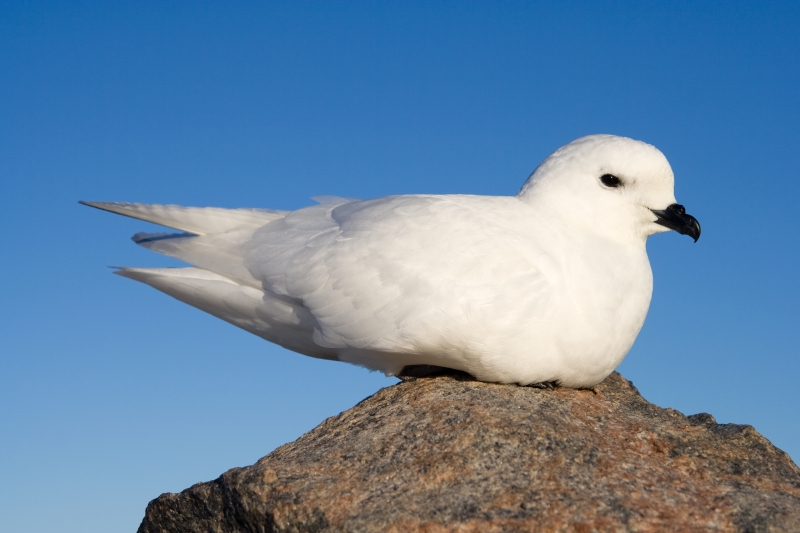
The Snow Petrel has entirely white plumage, coal-black eyes, a small black bill and bluish-gray feet.[1]
Its body length is 30–40 cm and its wingspan is 75–95 cm. The species occurs in two significantly different size forms, one larger and one smaller.[2][3][4]
Habitat
Snow Petrels are almost entirely restricted to cold Antarctic waters and commonly gather on icebergs. They use exposed rocky nesting sites, including inland mountain ranges more than 400 km from the open sea.[5][6][7]
Most documented breeding sites are close to the coast, with a median distance of 1.15 km. Most documented breeding nests occur in cavities in high-grade metamorphic rocks.[8][9]
Snow Petrels nest in cavities in cliff faces, scree slopes and beneath boulders on flat or sloping ground. They require ice-free areas for breeding.[10][11]
Snow Petrels forage predominantly in the Marginal Ice Zone, particularly in marine areas with sea-ice concentrations between 12.5% and 50%.[12][13]
Diet
Snow Petrels feed mainly on fish, krill and squid. They also consume some cephalopods and mollusks.[14][15]
Their diet includes carrion such as seal placentas, dead or stillborn seals, whale carcasses and dead penguin chicks.[16]
Behaviour
Snow Petrel flight is erratic and includes frequent changes of direction. During winter, the birds disperse to pack ice, ice floes and the open sea.[17][18]
Snow Petrels are rarely observed north of the pack ice. They bathe in snow at cleaning areas within their breeding colonies.[19][20]
Reproduction and life cycle
Snow Petrels breed colonially on the Antarctic continent and various Antarctic islands. They construct simple pebble-lined nests, usually in deep rock crevices with overhanging protection.[21][22]
They generally lay one white egg between late November and mid-December. The eggs are incubated for 41–49 days.[23][24]
Chicks are brooded for eight days after hatching and fledge approximately seven weeks after hatching. Chick mortality ranges from 10% to 15%.[25][26][27]
Heavy snowfall can cause Snow Petrels to abandon their nests. Breeding cavities with single, narrow entrances are used more frequently than other cavity types.[28][29]
Hatching success and chick survival are greatest in nests with flat nest bowls. Partners remain faithful to one another for approximately 20 years.[30][31]
Conservation
The estimated Snow Petrel population is approximately four million adult birds. Available population estimates from 222 known breeding sites total at least approximately 77,400 breeding pairs.[32][33]
The IUCN classifies the Snow Petrel as Least Concern.[34]
Classification of the Snow Petrel
| Kingdom | Animalia |
|---|---|
| Phylum | Chordata |
| Subphylum | Vertebrata |
| Infraphylum | Gnathostomata |
| Parvphylum | Osteichthyes |
| Megaclass | Tetrapoda |
| Class | Aves (Bird) |
| Order | Procellariiformes (Petrels) |
| Family | Procellariidae (Fulmars) |
| Genus | Pagodroma |
| Species | Pagodroma nivea (G. Forster, 1777) |
Where the Snow Petrel is found
Checklists and occurrence records place Pagodroma nivea in 3 countries. GBIF holds 37,219 georeferenced records of it.
Countries
Regions and cities with the most records
4 more countries have a few records outside this range
These countries hold a few records of Pagodroma nivea but lie outside the range the checklists give for it. Such records are often zoo or garden specimens, museum material or vagrants, so the species is not counted as occurring there.
Range as the checklists state it
Antarctica/Southern Ocean
A number beside a place is its count of GBIF occurrence records. A place without a number comes from a checklist alone. Records show where a species has been observed or collected, which can include escapes and vagrants.
Common names
English
- Snow Petrel
- Lesser Snow Petrel
Names in 29 other languages
- Afrikaans
- Witstormvoël
- Arabic
- نوء الثلج
- Catalan
- petrell de les neus
- Chinese
- 雪鸌, 雪鹱
- Croatian
- bijeli zovoj
- Czech
- buřňák sněžní
- Danish
- Snepetrel
- Dutch
- sneeuwstormvogel
- Esperanto
- neĝa petrelo
- Estonian
- lumi-tormilind
- Finnish
- lumimyrskyliitäjä
- French
- Fulmar des neiges, Pétrel des neiges
- German
- Kleiner Seesturmvogel, Schneesturmvogel
- Hungarian
- hóhojsza
- Indonesian
- Petrel salju
- Italian
- Petrello delle nevi
- Japanese
- ユキドリ
- Lithuanian
- snieginis audrašauklis
- Norwegian
- snøpetrell
- Polish
- petrel śnieżny
- Portuguese
- Petrel-das-neves, grazina-nival, pardela-das-neves, petrel-nival
- Russian
- Снежный буревестник
- Serbian
- Snežna burnica
- Slovak
- fulmarčík snežný
- Spanish
- Petrel blanco, Petrel de las nieves, Petrel níveo
- Swedish
- ispetrell
- Turkish
- Ak Fırtınakuşu
- Ukrainian
- буревісник білий
- Welsh
- pedryn yr eira
Synonyms
6 other scientific names have been used for this species and are now treated as synonyms of Pagodroma nivea.
- Pagodroma nivea alba Mathews, GM, 1928
- Pagodroma nivea falklandica Mathews, GM, 1912
- Pagodroma nivea falklandica Mathews, GM, 1926
- Pagodroma nivea novegeorgica von der Steinen, K, 1890
- Pagodroma nivea pealei Mathews, GM, 1928
- Procellaria nivea G. Forster, 1777
Subspecies and varieties
- Pagodroma nivea major (Greater Snow Petrel) subspecies
- Pagodroma nivea nivea (Lesser Snow Petrel) subspecies
Related species
-
 Manx ShearwaterPuffinus puffinus
-
 Southern Giant PetrelMacronectes giganteus
-
 Short-tailed ShearwaterArdenna tenuirostris
-
 Northern FulmarFulmarus glacialis
-
 Sooty ShearwaterArdenna grisea
-
 Cory's ShearwaterCalonectris borealis
-
 Bermuda PetrelPterodroma cahow
-
 Great ShearwaterArdenna gravis
Compare
Questions and answers
What is the scientific name of the Snow Petrel?
The scientific name of the Snow Petrel is Pagodroma nivea. Written with its author, the full name is Pagodroma nivea (G. Forster, 1777).
Which family does the Snow Petrel belong to?
Pagodroma nivea belongs to the family Procellariidae, in the order Procellariiformes and the class Aves.
Where is the Snow Petrel found?
Checklists and occurrence records place Pagodroma nivea in 3 countries: Antarctica, South Georgia and the South Sandwich Islands and French Southern Territories.
What is the conservation status of the Snow Petrel?
The IUCN Red List category recorded for Pagodroma nivea is Least Concern (LC).
What other names does the Snow Petrel have?
Pagodroma nivea is also known in English as Lesser Snow Petrel.
What does snow petrel mean?
The specific epithet nivea derives from the Latin word niveus, meaning snow-white. The genus name Pagodroma combines Greek words meaning frost or sea ice and racer or runner.[35][36]
Where are snow petrels found?
Snow Petrels have breeding sites across Antarctica and subantarctic islands. South Georgia represents their northern breeding limit, and they have also been observed at the Geographic South Pole.[37][38][39]
Why are they called petrels?
The genus name Pagodroma combines Greek words meaning frost or sea ice and racer or runner. The specific epithet nivea derives from the Latin word niveus, meaning snow-white.[35][36]
Sources
Passages the profile rests on
- The snow petrel has entirely white plumage, coal-black eyes, a small black bill and bluish-gray feet. Source passage: “The snow petrel is a small, pure white fulmarine petrel with coal-black eyes, a small black bill and bluish gray feet.” — English Wikipedia
- The snow petrel has a body length of 30–40 cm. Source passage: “Body length is 30–40 cm (12–16 in)” — English Wikipedia
- The snow petrel has a wingspan of 75–95 cm. Source passage: “the wingspan is 75–95 cm (30–37 in).” — English Wikipedia
- The species occurs in two significantly different size forms, one larger and one smaller. Source passage: “Snow petrels vary significantly in size with two different forms, a larger and a smaller.” — English Wikipedia
- Snow petrels are almost entirely restricted to cold Antarctic waters. Source passage: “Snow petrels are almost entirely restricted to cold Antarctic waters.” — English Wikipedia
- Snow petrels commonly gather on icebergs. Source passage: “Flocks are characteristically seen sitting on icebergs.” — English Wikipedia
- Snow petrels use exposed rocky nesting sites, including inland mountain ranges more than 400 km from the open sea. Source passage: “Nesting is colonial in small to large colonies on exposed rocks, usually near the sea, but also on inland mountain ranges more than 400 km (250 mi) from the open sea.” — English Wikipedia
- Most documented snow petrel breeding sites are close to the coast, with a median distance of 1.15 km. Source passage: “Most sites are close to the coast (median = 1.15 km)” — pmc.ncbi.nlm.nih.gov
- Most documented breeding nests occur in cavities in high-grade metamorphic rocks. Source passage: “Locally, most nests occur in cavities in high-grade metamorphic rocks.” — pmc.ncbi.nlm.nih.gov
- Snow petrels nest in cavities in cliff faces, scree slopes and beneath boulders on flat or sloping ground. Source passage: “Nesting cavities occur in cliff faces, on scree slopes, and under boulders on flat and sloping ground.” — pmc.ncbi.nlm.nih.gov
- Snow petrels require ice-free areas for breeding. Source passage: “Snow petrels are cavity nesters, requiring ice-free areas for breeding” — pmc.ncbi.nlm.nih.gov
- Snow petrels forage predominantly in the Marginal Ice Zone. Source passage: “When foraging at sea, snow petrels are largely confined to the Marginal Ice Zone [MIZ]” — pmc.ncbi.nlm.nih.gov
- Snow petrels particularly use marine areas with sea-ice concentrations between 12.5% and 50%. Source passage: “intermediate sea-ice concentrations of 12.5–50%” — pmc.ncbi.nlm.nih.gov
- Snow petrels feed mainly on fish, krill and squid. Source passage: “feeding predominantly on fish, krill, and squid” — pmc.ncbi.nlm.nih.gov
- Snow petrels also consume some cephalopods and mollusks. Source passage: “some cephalopods, mollusks, and krill” — English Wikipedia
- Snow petrels consume carrion including seal placentas, dead or stillborn seals, whale carcasses and dead penguin chicks. Source passage: “as well as carrion in the form of seal placentas, dead/stillborn seals, whale carcasses, and dead penguin chicks.” — English Wikipedia
- Snow petrel flight is erratic and includes frequent changes of direction. Source passage: “Flight is erratic with frequent changes of direction.” — English Wikipedia
- During winter, snow petrels disperse to pack ice, ice floes and the open sea. Source passage: “During the winter, they disperse to the pack ice, ice floes, and the open sea.” — English Wikipedia
- Snow petrels are rarely observed north of the pack ice. Source passage: “Only very rarely are they observed north of the pack ice.” — English Wikipedia
- Snow petrels bathe in snow at cleaning areas within their breeding colonies. Source passage: “Colonies are also the sites of cleaning areas where snow petrels, far from the sea, bathe in snow.” — English Wikipedia
- Snow petrels breed colonially on the Antarctic continent and various Antarctic islands. Source passage: “Breeding occurs in colonies on the Antarctic continent and on various Antarctic islands.” — English Wikipedia
- Snow petrels construct simple pebble-lined nests, usually in deep rock crevices with overhanging protection. Source passage: “Nests are simple pebble-lined scrapes usually in a deep rock crevices with overhanging protection.” — English Wikipedia
- Snow petrels generally lay one white egg between late November and mid-December. Source passage: “One white egg is laid between late November and mid-December.” — English Wikipedia
- Snow petrel eggs are incubated for 41–49 days. Source passage: “The egg is incubated 41 to 49 days” — English Wikipedia
- Snow petrel chicks are brooded for eight days after hatching. Source passage: “the chick is brooded for 8 days.” — English Wikipedia
- Snow petrel chicks fledge approximately seven weeks after hatching. Source passage: “They fledge 7 weeks later” — English Wikipedia
- Snow petrel chick mortality ranges from 10% to 15%. Source passage: “chick mortality is 10–15%.” — English Wikipedia
- Heavy snowfall can cause snow petrels to abandon their nests. Source passage: “Nests are abandoned if concealed by heavy snowfall” — English Wikipedia
- Snow petrel breeding cavities with single, narrow entrances are used more frequently than other cavity types. Source passage: “nests with single, narrow entrances are used more frequently” — pmc.ncbi.nlm.nih.gov
- Snow petrel hatching success and chick survival are greatest in nests with flat nest bowls. Source passage: “hatching success and chick survival are greatest when nest bowls are flat” — pmc.ncbi.nlm.nih.gov
- Snow petrel partners remain faithful to one another for approximately 20 years. Source passage: “Snow petrel partners are faithful for life (around 20 years).” — English Wikipedia
- The estimated snow petrel population is approximately four million adult birds. Source passage: “an estimated population of 4 million adult birds.” — English Wikipedia
- Available population estimates from 222 known breeding sites total at least approximately 77,400 breeding pairs. Source passage: “population estimates available for 222 known sites totalled a minimum of ~ 77400 breeding pairs.” — pmc.ncbi.nlm.nih.gov
- The IUCN classifies the snow petrel as Least Concern. Source passage: “the IUCN has classified this bird as least concern.” — English Wikipedia
- The genus name Pagodroma combines Greek words meaning frost or sea ice and racer or runner. Source passage: “The genus name combines the Ancient Greek pagos meaning "frost" or "sea-ice" with dromos meaning "racer" or "runner".” — English Wikipedia
- The specific epithet nivea derives from the Latin word niveus, meaning snow-white. Source passage: “The specific epithet is from the Latin niveus meaning "snow-white".” — English Wikipedia
- Snow petrels have breeding sites across Antarctica and subantarctic islands. Source passage: “Breeding snow petrels are reported at 456 sites across Antarctica and subantarctic islands.” — pmc.ncbi.nlm.nih.gov
- South Georgia represents the northern breeding limit of the snow petrel. Source passage: “Snow petrels are a high-trophic-level seabird endemic to Antarctica with a northern breeding limit in South Georgia” — pmc.ncbi.nlm.nih.gov
- Snow petrels have been observed at the Geographic South Pole. Source passage: “It is one of only three birds that have been seen at the Geographic South Pole” — English Wikipedia
Data
- Catalogue of Life, 2026-10-16 XR cc by
- Global Biodiversity Information Facility CC BY 4.0
- Wikidata CC0
- GeoNames CC BY 4.0
- Wikimedia Commons per image; credit shown with each image
- Within the Catalogue of Life, this name comes from The Integrated Taxonomic Information System cc0
References
- Gill, Frank, & and Minturn Wright. (2006). Birds of the World: Recommended English Names.
This species in other databases
- Catalogue of Life 4BZJK
- Wikidata Q166442
- iNaturalist 4195
- WoRMS urn:lsid:marinespecies.org:taxname:225772
- Avibase snopet1
Page built on 26 November 2026. See how the catalog is made and all sources and licences.
Cite this page
ScientificNames.org. (2026). Pagodroma nivea (Snow Petrel). Retrieved November 26, 2026, from https://scientificnames.org/species/pagodroma-nivea
“Pagodroma nivea (Snow Petrel).” ScientificNames.org, 2026, scientificnames.org/species/pagodroma-nivea. Accessed 26 Nov. 2026.
ScientificNames.org. “Pagodroma nivea (Snow Petrel).” Accessed November 26, 2026. https://scientificnames.org/species/pagodroma-nivea.
@misc{scientificnames_pagodroma_nivea_snow_petrel,
  author = {{ScientificNames.org}},
  title = {Pagodroma nivea (Snow Petrel)},
  year = {2026},
  url = {https://scientificnames.org/species/pagodroma-nivea},
  note = {Accessed 2026-11-26}
}