Species · Birds
Northern Fulmar Fulmarus glacialis
The scientific name of the Northern Fulmar is Fulmarus glacialis. It is a species of bird in the family Procellariidae (fulmars), order Procellariiformes. The name dates from 1761.
- Scientific name
- Fulmarus glacialis (Linnaeus, 1761)
- Common name
- Northern Fulmar
- Genus
- Fulmarus
- Family
- Procellariidae (Fulmars)
- Order
- Procellariiformes
- Class
- Aves
- Red List category
- LC Least Concern
- Environment
- marine, terrestrial
- Recorded in
- 28 countries
- Name status
- accepted in the Catalogue of Life

Overview
The Northern Fulmar is a bird in the family Procellariidae and order Procellariiformes. It primarily inhabits subarctic regions of the North Atlantic and North Pacific oceans. It occurs in light and dark colour morphs, produces stomach oil and can eject foul-smelling oil as a defence against predators.
Written 26 November 2026 from the sources listed below. Each statement was checked against the passage it cites; statements that could not be supported were removed.
Appearance
The Northern Fulmar occurs in light and dark colour morphs, with intermediate forms also common. The light morph has a white head and body with grey wings and tail, while the dark morph is uniformly grey.[1][2][3]
The Northern Fulmar measures approximately 46 cm in length, with a wingspan of 102 to 112 cm. Its body mass ranges from 450 to 1,000 g.[4][5][6]
Habitat
The Northern Fulmar primarily inhabits subarctic regions of the North Atlantic and North Pacific oceans. It is a predator and scavenger in Arctic and temperate pelagic waters.[7][8]
The species breeds throughout northern ocean regions and spends winter at sea in the Northern Hemisphere.[9]
Diet
The Northern Fulmar feeds on shrimps, fish, squid, plankton, jellyfish and carrion.[10]
Behaviour
Northern Fulmars are strong fliers with stiff wing movements and have limited walking ability. When catching fish, they can dive to depths of up to four metres.[11][12][13]
Northern Fulmars produce stomach oil containing wax esters and triglycerides. They can eject foul-smelling stomach oil from the mouth as a defence against predators and use it as an energy source during long flights.[14][15][16]
Northern Fulmars excrete a highly saline solution through their nostrils.[17]
The species makes grunting and chuckling sounds while feeding and produces guttural calls during the breeding season. During courtship, the male performs head-waving movements while calling.[18][19][20]
Reproduction and life cycle
Northern Fulmars begin breeding between six and twelve years of age. They are monogamous and form long-term pair bonds, with breeding birds returning to the same nest site annually.[21][22][23]
The breeding season begins in May. Northern Fulmars nest in large colonies, constructing scrapes on grassy ledges or vegetation saucers on the ground, with both sexes participating in nest building.[24][25][26][27]
Females lay a single white egg measuring 74 by 51 mm. Both sexes incubate the egg for approximately 50 to 54 days.[28][29]
Chicks are brooded for two weeks and fully fledge between 70 and 75 days after hatching.[30][31]
During the breeding season, adult Northern Fulmars generally remain within 500 km of their breeding colony.[32]
Conservation
The Northern Fulmar has an estimated population of 15 to 30 million mature individuals and an estimated extent of occurrence of 28.4 million square kilometres. The species is classified as Least Concern by the IUCN.[33][34][35]
The North American population of Northern Fulmars is increasing. The species' range expanded substantially during the previous century, partly because commercial fishing fleets made fish offal available.[36][37]
Reduced food availability from commercial fishing waste and climatic change may cause the species' range to contract.[38]
A study conducted between 2008 and 2013 found microplastics in the gastrointestinal tracts of 89.5% of sampled Northern Fulmars. The average plastic content was 19.5 pieces weighing 0.461 g per individual.[39][40]
Classification of the Northern Fulmar
| Kingdom | Animalia |
|---|---|
| Phylum | Chordata |
| Subphylum | Vertebrata |
| Infraphylum | Gnathostomata |
| Parvphylum | Osteichthyes |
| Megaclass | Tetrapoda |
| Class | Aves (Bird) |
| Order | Procellariiformes (Petrels) |
| Family | Procellariidae (Fulmars) |
| Genus | Fulmarus (Fulmars) |
| Species | Fulmarus glacialis (Linnaeus, 1761) |
Where the Northern Fulmar is found
Checklists and occurrence records place Fulmarus glacialis in 28 countries across North America. GBIF holds 1,252,607 georeferenced records of it.
Countries
- Belgium 7,934
- Canada 43,345
- Denmark 42,608
- Faroe Islands 56,956
- Finland 16
- France 14,488
- Germany 14,715
- Greenland 7,936
- Guernsey 259
- Iceland 47,136
- Ireland 68,719
- Isle of Man 14,566
- Japan 688
- Jersey 414
- Mexico 645
- Norway 72,158
- Poland 7
- Portugal 67
- Russia 1,944
- Saint Pierre and Miquelon 185
- Spain 575
- Svalbard and Jan Mayen 13,526
- Sweden 19,627
- Thailand 3
- The Netherlands 25,273
- Ukraine 3
- United Kingdom 700,481
- United States 98,333
Regions and cities with the most records
- England, United Kingdom 48,908
- Scotland, United Kingdom 29,875
- California, United States 10,565
- Bridlington, United Kingdom 9,874
- Alaska, United States 8,919
- Pacific Grove, United States 7,858
- Monterey, United States 7,729
- Wales, United Kingdom 7,597
- Marina, United States 7,100
- Seaside, United States 6,794
- Skåne, Sweden 5,636
- Isle of Lewis, United Kingdom 5,613
- Västra Götaland, Sweden 5,524
- Whitley Bay, United Kingdom 4,986
- Tynemouth, United Kingdom 4,966
- Cramlington, United Kingdom 4,850
- North Shields, United Kingdom 4,837
- Peterhead, United Kingdom 4,811
- Penzance, United Kingdom 4,686
- South, Iceland 4,612
- South Shields, United Kingdom 4,612
- Sunderland, United Kingdom 4,456
- Halland, Sweden 4,407
- Jarrow, United Kingdom 4,400
- Hebburn, United Kingdom 4,248
- Wallsend, United Kingdom 4,167
- Västra Frölunda, Sweden 4,129
- Felling, United Kingdom 4,002
- Björlanda, Sweden 3,941
- Gateshead, United Kingdom 3,939
- Washington, United Kingdom 3,938
- Gosforth, United Kingdom 3,929
- Newcastle upon Tyne, United Kingdom 3,891
- Rogaland, Norway 3,849
- Deal, United Kingdom 3,716
- Scarborough, United Kingdom 3,659
5 more countries have a few records outside this range
These countries hold a few records of Fulmarus glacialis but lie outside the range the checklists give for it. Such records are often zoo or garden specimens, museum material or vagrants, so the species is not counted as occurring there.
Range as the checklists state it
Europe & Northern Asia (excluding China)
North America
A number beside a place is its count of GBIF occurrence records. A place without a number comes from a checklist alone. Records show where a species has been observed or collected, which can include escapes and vagrants.
Common names
English
- Northern Fulmar
- Fulmar Petrel
Names in 43 other languages
- Arabic
- فلمار القطب الشمالي, كاسر العظام الشمالي
- Basque
- Fulmarra
- Breton
- Karamell an norzh
- Bulgarian
- Полярен буревестник, Северен фулмар
- Chinese
- 北方暴風鸌〔暴風鸌〕, 暴雪鸌, 暴雪鹱, 暴风鹱
- Czech
- buřňák lední
- Danish
- mallemuk
- Dutch
- noordse stormvogel
- Esperanto
- norda fulmaro
- Estonian
- jää-tormilind
- Faroese
- Havhestur
- Finnish
- myrskylintu
- French
- Fulmar boréal, Pétrel glacial, pétrel fulmar
- German
- Eissturmvogel, Nordatlantischer Eissturmvogel
- Greek
- Αρκτικό θυελλοπούλι, Θυελλοπούλι του Ατλαντικού
- Hebrew
- יסעור שחפי, סערון שחפי
- Hungarian
- északi sirályhojsza
- Icelandic
- Fyll, Fýll
- Italian
- Fulmaro, Fulmaro boreale
- Japanese
- フルマカモメ
- Latvian
- ķilde
- Lithuanian
- šiaurinis fulmaras
- Northern Sami
- Bupmálas, bummálas
- Norwegian Bokmål
- havhest
- Polish
- fulmar, fulmar (zwyczajny)
- Portuguese
- Pombalete, Pombalete do Norte, fulmar-boreal, pombalete-do-norte
- Russian
- Глупыш, северный глупыш
- Scottish Gaelic
- eun crom, eòin chrom, fulmair, fulmaire, fulmairean
- Serbian
- Burnjak, Бурњак
- Slovak
- fulmar ľadový
- Slovenian
- ledni viharnik
- Spanish
- Fulmar boreal, Fulmar norteño
- Swedish
- stormfågel
- Turkish
- Kutup Fırtınakuşu, kuzey fulmari
- Ukrainian
- Буревісник кочівний, Північний фульмар
- Welsh
- Adar Drycin y Graig, Aderyn-drycin y Graig, aderyn drycin y graig
- cor
- Gwylan an garrek
- frr
- Malmuk
- fry
- Mallemok
- glv
- Eean Croymmagh, Fulmyr
- iku
- Qaqudluk
- ipk
- Aivġich nauyaŋat
- kal
- Qaqulluk, malamuk, timmiakuluk
Synonyms
One other scientific name has been used for this species and is now treated as a synonym of Fulmarus glacialis.
- Procellaria glacialis Linnaeus, 1761
Subspecies and varieties
- Fulmarus glacialis auduboni (Atlantic Northern Fulmar) subspecies
- Fulmarus glacialis glacialis (Arctic Atlantic Fulmar) subspecies
- Fulmarus glacialis rodgersii (Pacific Fulmar) subspecies
Related species
-
 Southern FulmarFulmarus glacialoides
-
 Manx ShearwaterPuffinus puffinus
-
 Southern Giant PetrelMacronectes giganteus
-
 Short-tailed ShearwaterArdenna tenuirostris
-
 Sooty ShearwaterArdenna grisea
-
 Cory's ShearwaterCalonectris borealis
-
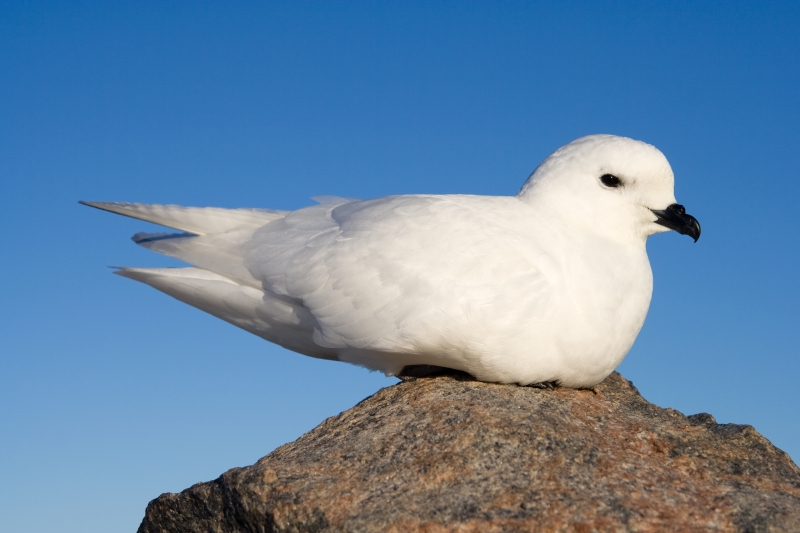 Snow PetrelPagodroma nivea
-
 Bermuda PetrelPterodroma cahow
Compare
Questions and answers
What is the scientific name of the Northern Fulmar?
The scientific name of the Northern Fulmar is Fulmarus glacialis. Written with its author, the full name is Fulmarus glacialis (Linnaeus, 1761).
Which family does the Northern Fulmar belong to?
Fulmarus glacialis belongs to the family Procellariidae, in the order Procellariiformes and the class Aves.
Where is the Northern Fulmar found?
Checklists and occurrence records place Fulmarus glacialis in 28 countries, including United Kingdom, United States, Norway, Ireland, Faroe Islands and Iceland.
What is the conservation status of the Northern Fulmar?
The IUCN Red List category recorded for Fulmarus glacialis is Least Concern (LC).
What other names does the Northern Fulmar have?
Fulmarus glacialis is also known in English as Fulmar Petrel.
Is a fulmar a seagull?
The Northern Fulmar belongs to the family Procellariidae and the order Procellariiformes.[41][42]
What does fulmar mean?
The genus name Fulmarus derives from the Old Norse term Fúlmár, meaning foul-mew or foul-gull. The name refers to the bird's habit of ejecting foul-smelling oil.[43][44]
Can fulmars walk?
Northern Fulmars have limited walking ability.[12]
Where do Northern Fulmar live?
Northern Fulmars primarily inhabit subarctic regions of the North Atlantic and North Pacific oceans. They breed throughout northern ocean regions and spend winter at sea in the Northern Hemisphere.[7][9]
What is the main diet of birds?
The Northern Fulmar feeds on shrimps, fish, squid, plankton, jellyfish and carrion.[10]
Sources
Passages the profile rests on
- The Northern Fulmar occurs in light and dark colour morphs, with intermediate forms also common. Source passage: “Fulmars come in one of two colour morphs; a light one in temperate populations, with white head and body and grey wings and tail, and a dark one in arctic populations, which is uniformly grey; intermediate birds are common.” — English Wikipedia
- The light morph has a white head and body with grey wings and tail. Source passage: “a light one in temperate populations, with white head and body and grey wings and tail” — English Wikipedia
- The dark morph is uniformly grey. Source passage: “a dark one in arctic populations, which is uniformly grey” — English Wikipedia
- The Northern Fulmar measures approximately 46 cm in length. Source passage: “The northern fulmar has a wingspan of 102 to 112 cm (40–44 in) and is 46 cm (18 in) in length.” — English Wikipedia
- Its wingspan ranges from 102 to 112 cm. Source passage: “The northern fulmar has a wingspan of 102 to 112 cm (40–44 in)” — English Wikipedia
- Its body mass ranges from 450 to 1,000 g. Source passage: “Body mass can range from 450 to 1,000 g (16 to 35 oz).” — English Wikipedia
- The species primarily inhabits subarctic regions of the North Atlantic and North Pacific oceans. Source passage: “found primarily in subarctic regions of the North Atlantic and North Pacific oceans.” — English Wikipedia
- Northern Fulmars are predators and scavengers in Arctic and temperate pelagic waters. Source passage: “Northern fulmars are important predators and scavengers in arctic and temperate pelagic waters.” — animaldiversity.org
- The species breeds throughout northern ocean regions and spends winter at sea in the Northern Hemisphere. Source passage: “breeds throughout northern ocean regions and spends the winter at-sea in the northern hemisphere.” — usgs.gov
- The Northern Fulmar feeds on shrimps, fish, squid, plankton, jellyfish and carrion. Source passage: “Northern fulmars will feed on shrimps, fish, squid, plankton, jellyfish, and carrion, as well as refuse.” — English Wikipedia
- Northern Fulmars are strong fliers with stiff wing movements. Source passage: “they are strong fliers, with a stiff wing action quite unlike the gulls.” — English Wikipedia
- The species has limited walking ability. Source passage: “their walking ability is limited” — English Wikipedia
- When catching fish, Northern Fulmars can dive to depths of up to four metres. Source passage: “When eating fish, they will dive up to 4 metres deep to retrieve their prey.” — English Wikipedia
- Northern Fulmars produce stomach oil containing wax esters and triglycerides. Source passage: “They produce a stomach oil made up of wax esters and triglycerides that is stored in the proventriculus.” — English Wikipedia
- The species can eject foul-smelling stomach oil from its mouth as a defence against predators. Source passage: “This can be sprayed out of their mouths as a defense against predators from a very early age” — English Wikipedia
- Northern Fulmars use stomach oil as an energy source during long flights. Source passage: “as an energy rich food source for chicks and for the adults during their long flights.” — English Wikipedia
- Northern Fulmars excrete a highly saline solution through their nostrils. Source passage: “This gland excretes a high saline solution from their nose.” — English Wikipedia
- The species makes grunting and chuckling sounds while feeding. Source passage: “They make grunting and chuckling sounds while eating” — English Wikipedia
- Northern Fulmars produce guttural calls during the breeding season. Source passage: “and guttural calls during the breeding season.” — English Wikipedia
- The male performs head-waving movements while calling during courtship. Source passage: “He commences to wave his head side to side and up and down while calling.” — English Wikipedia
- Northern Fulmars begin breeding between six and twelve years of age. Source passage: “The northern fulmar starts breeding at between six and twelve years old.” — English Wikipedia
- The species is monogamous and forms long-term pair bonds. Source passage: “It is monogamous, and forms long-term pair bonds.” — English Wikipedia
- Breeding birds return to the same nest site annually. Source passage: “It returns to the same nest site year after year.” — English Wikipedia
- The breeding season begins in May. Source passage: “The breeding season starts in May” — English Wikipedia
- Northern Fulmars construct nests as scrapes on grassy ledges or as vegetation saucers on the ground. Source passage: “Their nest is a scrape on a grassy ledge or a saucer of vegetation on the ground” — English Wikipedia
- Both sexes participate in building the nest. Source passage: “Both sexes are involved in the nest-building process.” — English Wikipedia
- The species nests in large colonies. Source passage: “The birds nest in large colonies.” — English Wikipedia
- Females lay a single white egg measuring 74 by 51 mm. Source passage: “A single white egg, 74 mm × 51 mm (2.9 in × 2.0 in)” — English Wikipedia
- Both sexes incubate the egg for approximately 50 to 54 days. Source passage: “is incubated for a period of 50 to 54 days, by both sexes.” — English Wikipedia
- Northern Fulmar chicks are brooded for two weeks. Source passage: “The altricial chick is brooded for 2 weeks” — English Wikipedia
- Chicks fully fledge between 70 and 75 days after hatching. Source passage: “fully fledges after 70 to 75 days.” — English Wikipedia
- Adult Northern Fulmars generally remain within 500 km of their breeding colony during the breeding season. Source passage: “During the breeding season adult Fulmars usually remain within 500 km of their breeding colony” — English Wikipedia
- The Northern Fulmar has an estimated population of 15 to 30 million mature individuals. Source passage: “The northern fulmar is estimated to have between 15,000,000 and 30,000,000 mature individuals” — English Wikipedia
- Its estimated extent of occurrence is 28.4 million square kilometres. Source passage: “occupy an occurrence range of 28,400,000 km2 (11,000,000 sq mi)” — English Wikipedia
- The species is classified as Least Concern by the IUCN. Source passage: “hence it is listed with the IUCN as Least Concern.” — English Wikipedia
- The North American population of Northern Fulmars is increasing. Source passage: “their North American population is on the rise” — English Wikipedia
- The species' range expanded substantially during the previous century partly because commercial fishing fleets made fish offal available. Source passage: “The range of these species increased greatly last century due to the availability of fish offal from commercial fleets” — English Wikipedia
- Reduced food availability from commercial fishing waste and climatic change may cause the species' range to contract. Source passage: “but may contract because of less food from this source and climatic change.” — English Wikipedia
- A study conducted between 2008 and 2013 found microplastics in the gastrointestinal tracts of 89.5% of sampled Northern Fulmars. Source passage: “A study of 143 northern fulmars from 2008 to 2013 found 89.5% of them containing microplastics within their gastrointestinal tracts.” — English Wikipedia
- The average plastic content recorded in the sampled birds was 19.5 pieces weighing 0.461 g per individual. Source passage: “A mean score of 19.5 pieces of plastic and 0.461 g per individual was calculated.” — English Wikipedia
- The species belongs to the family Procellariidae. Source passage: “fulmars are in fact members of the family Procellariidae” — English Wikipedia
- The Northern Fulmar belongs to the order Procellariiformes. Source passage: “The fulmars are in turn a member of the order Procellariiformes” — English Wikipedia
- The genus name Fulmarus derives from the Old Norse term Fúlmár, meaning foul-mew or foul-gull. Source passage: “The genus name comes from the Old Norse Fúlmár meaning "foul-mew" or "foul-gull"” — English Wikipedia
- The genus name refers to the bird's habit of ejecting foul-smelling oil. Source passage: “because of the birds' habit of ejecting a foul-smelling oil.” — English Wikipedia
Data
- Catalogue of Life, 2026-10-16 XR cc by
- Global Biodiversity Information Facility CC BY 4.0
- Wikidata CC0
- GeoNames CC BY 4.0
- Wikimedia Commons per image; credit shown with each image
- Within the Catalogue of Life, this name comes from The Integrated Taxonomic Information System cc0
References
- Fauna Svecica, ed. 2: 51. 1761 where the name was published
- Gill, Frank, & and Minturn Wright. (2006). Birds of the World: Recommended English Names.
This species in other databases
- Catalogue of Life 6K3X3
- Wikidata Q26896
- iNaturalist 4180
- WoRMS urn:lsid:marinespecies.org:taxname:137195
- Avibase norful
Page built on 27 November 2026. See how the catalog is made and all sources and licences.
Cite this page
ScientificNames.org. (2026). Fulmarus glacialis (Northern Fulmar). Retrieved November 27, 2026, from https://scientificnames.org/species/fulmarus-glacialis
“Fulmarus glacialis (Northern Fulmar).” ScientificNames.org, 2026, scientificnames.org/species/fulmarus-glacialis. Accessed 27 Nov. 2026.
ScientificNames.org. “Fulmarus glacialis (Northern Fulmar).” Accessed November 27, 2026. https://scientificnames.org/species/fulmarus-glacialis.
@misc{scientificnames_fulmarus_glacialis_northern_fulmar,
  author = {{ScientificNames.org}},
  title = {Fulmarus glacialis (Northern Fulmar)},
  year = {2026},
  url = {https://scientificnames.org/species/fulmarus-glacialis},
  note = {Accessed 2026-11-27}
}