Species · Crustaceans
Dock Shrimp Pandalus danae
The scientific name of the Dock Shrimp is Pandalus danae. It is a species of crustacean in the family Pandalidae (pandalid shrimps), order Decapoda. The name dates from 1857.
- Scientific name
- Pandalus danae Stimpson, 1857
- Common name
- Dock Shrimp
- Genus
- Pandalus
- Family
- Pandalidae (Pandalid Shrimps)
- Order
- Decapoda
- Class
- Malacostraca
- Environment
- marine
- Recorded in
- 3 countries
- Name status
- accepted in the Catalogue of Life

Overview
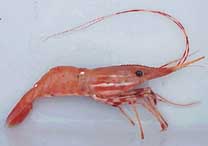
Pandalus danae inhabits rocky, sandy, sandy-shelly, and gravel bottoms, from the lower intertidal zone to depths of 185 m. It is usually translucent orange-red or brownish-red, with red and white carapace spots and narrow red abdominal stripes; some individuals have electric blue stripes.
Written 27 November 2026 from the sources listed below. Each statement was checked against the passage it cites; statements that could not be supported were removed.
Appearance
The dock shrimp is usually light translucent orange-red or brownish-red, with small red and white spots on the sides of its carapace and narrow red longitudinal stripes on its abdomen. Some individuals have electric blue stripes.[1][2]
The shrimp has a prominent upcurved rostrum less than 1.5 times the length of its carapace, terminating in three points. Its dorsal carapace spines extend beyond the midpoint toward the posterior, and the dorsal spines on its rostrum are movable.[3][4][5][6]
The telson has six pairs of small lateral spines. The second abdominal segment has a transverse dorsal groove, while the third lacks a median dorsal ridge and a spine anterior to its posterior edge.[7][8][9]
The first antenna is approximately as long as the carapace. The spine on the antennal scale is longer than the lamella.[10][11]
The species reaches approximately 14 cm in total length. Females may reach 14 cm, although their usual length is 7.5–10 cm.[12][13]
Habitat
Adults occur from just below the intertidal zone to depths of 185 m. Juveniles inhabit shallower water and may occur in the lower intertidal zone.[14][15]
The species inhabits rocky and sandy benthic environments, including rocky, sandy-shelly, sand, and gravel bottoms. It may occur particularly on sand or gravel bottoms where tidal currents are rapid.[16][17][18]
The dock shrimp is often found around docks. Juveniles hide in rock crevices or beneath algae during daylight.[16][19][20]
Diet
Individuals have survived in a holding tank for ten months with little food, including other larvae and silt.[21]
Behaviour
The dock shrimp is a protandrous hermaphrodite, functioning first as a male and subsequently as a female. Individuals generally function as males during their first two years and as females during their second and third years.[22][23]
Some individuals mature initially as females without functioning as males.[24]
The left and right second pereopods differ in structure. The carpus of the left second pereopod has approximately 60 articles, compared with 18–21 on the right.[25][26]
Reproduction and life cycle
Females carrying eggs can be found throughout the year, although the main egg-bearing season is November through April. Females mate after molting in November.[27][28]
Females carry their eggs on the abdomen until they hatch in April. The eggs hatch into swimming larvae.[29][30]
Uses
The dock shrimp is harvested for both recreational and commercial purposes. A productive trap fishery for the species operates in Sooke Harbour.[31][32]
Similar species
Pandalus stenolepis differs from the dock shrimp in having three to five pairs of small lateral telson spines rather than six pairs.[7][33]
Classification of the Dock Shrimp
| Kingdom | Animalia |
|---|---|
| Phylum | Arthropoda |
| Subphylum | Crustacea |
| Class | Malacostraca |
| Order | Decapoda |
| Suborder | Pleocyemata |
| Infraorder | Caridea |
| Superfamily | Pandaloidea |
| Family | Pandalidae (Pandalid Shrimps) |
| Genus | Pandalus (Shrimps) |
| Species | Pandalus danae Stimpson, 1857 |
Where the Dock Shrimp is found
Checklists and occurrence records place Pandalus danae in 3 countries. GBIF holds 27,138 georeferenced records of it.
Countries
Regions and cities with the most records
- Central Saanich, Canada 13,936
- Saanich, Canada 13,755
- Esquimalt, Canada 8,132
- Victoria, Canada 8,112
- Oak Bay, Canada 8,080
- Colwood, Canada 5,854
- Langford, Canada 3,962
- North Vancouver, Canada 2,203
- Burnaby, Canada 1,829
- West Vancouver, Canada 1,732
- Port Moody, Canada 1,615
- New Westminster, Canada 1,613
- Coquitlam, Canada 1,611
- Port Coquitlam, Canada 1,610
- Vancouver, Canada 1,597
- Riley Park, Canada 1,455
- Victoria-Fraserview, Canada 1,443
- Richmond, Canada 1,374
- Fleetwood, Canada 1,030
- Strawberry Hill, Canada 990
- British Columbia, Canada 675
- Harewood, Canada 541
- Nanaimo, Canada 538
- North Cowichan, Canada 465
- Washington, United States 281
- Duncan, Canada 201
- Tacoma, United States 111
- University Place, United States 107
- Lakewood, United States 102
- Alaska, United States 85
- Bainbridge Island, United States 84
- Seattle, United States 83
- Shoreline, United States 82
- Inglewood-Finn Hill, United States 81
- Kirkland, United States 81
- Mountlake Terrace, United States 81
1 more country has a few records outside this range
These countries hold a few records of Pandalus danae but lie outside the range the checklists give for it. Such records are often zoo or garden specimens, museum material or vagrants, so the species is not counted as occurring there.
Range as the checklists state it
East Pacific
A number beside a place is its count of GBIF occurrence records. A place without a number comes from a checklist alone. Records show where a species has been observed or collected, which can include escapes and vagrants.
Common names
English
- Dock Shrimp
- California Prawn
- Coon Stripe Shrimp
Names in 2 other languages
- French
- Crevette des quais, crevette de Danaé
- Spanish
- Camarón de muelle
Synonyms
One other scientific name has been used for this species and is now treated as a synonym of Pandalus danae.
- Pandalus franciscorum Kingsley, 1878
Related species
-
 Northern ShrimpPandalus borealis
-
 Spot PrawnPandalus platyceros
-
 Aesop ShrimpPandalus montagui
-
 Humpback ShrimpPandalus hypsinotus
-
 Alaskan Pink ShrimpPandalus eous
- Ocean Pink ShrimpPandalus jordani
- Sidestripe ShrimpPandalus dispar
- Humpy ShrimpPandalus goniurus
Compare
Questions and answers
What is the scientific name of the Dock Shrimp?
The scientific name of the Dock Shrimp is Pandalus danae. Written with its author, the full name is Pandalus danae Stimpson, 1857.
Which family does the Dock Shrimp belong to?
Pandalus danae belongs to the family Pandalidae, in the order Decapoda and the class Malacostraca.
Where is the Dock Shrimp found?
Checklists and occurrence records place Pandalus danae in 3 countries: Canada, United States and Mexico.
What other names does the Dock Shrimp have?
Pandalus danae is also known in English as California Prawn and Coon Stripe Shrimp.
What habitats do shrimp live in?
The dock shrimp inhabits rocky, sandy, sandy-shelly, and gravel benthic environments, particularly where tidal currents are rapid. Adults occur from just below the intertidal zone to depths of 185 m, while juveniles inhabit shallower water and may occur in the lower intertidal zone.[14][15][16][17][18]
Sources
Passages the profile rests on
- The shrimp is usually light translucent orange-red or brownish-red, with small red and white spots on the sides of its carapace and narrow red longitudinal stripes on its abdomen. Source passage: “The animal is usually light translucent orange-red or brownish-red with small red and white spots on the sides of the carapace and narrow red longitudinal stripes on the abdomen” — inverts.wallawalla.edu
- Some individuals have electric blue stripes. Source passage: “Sometimes has electric blue stripes as well” — inverts.wallawalla.edu
- The shrimp has a prominent upcurved rostrum that is less than 1.5 times the length of its carapace. Source passage: “The prominent upcurved rostrum is not as long as in some other pandalid species--less than 1.5x the length of the carapace.” — inverts.wallawalla.edu
- The rostrum terminates in three points. Source passage: “The rostrum ends in 3 points (trifid).” — inverts.wallawalla.edu
- The dorsal spines on the carapace extend beyond its midpoint toward the posterior. Source passage: “The median dorsal spines on the carapace extend to posterior to the middle of the carapace” — inverts.wallawalla.edu
- The dorsal spines on the rostrum are movable. Source passage: “The dorsal rostrum spines are movable.” — inverts.wallawalla.edu
- The telson has six pairs of small lateral spines. Source passage: “The telson has 6 pairs of small lateral spines (photo).” — inverts.wallawalla.edu
- The second abdominal segment has a transverse dorsal groove. Source passage: “The second abdominal segment has a transverse dorsal groove (photo).” — inverts.wallawalla.edu
- The third abdominal segment lacks a median dorsal ridge and a spine anterior to its posterior edge. Source passage: “Abdominal segment 3 does not have a median dorsal ridge nor a spine ahead of the posterior edge” — inverts.wallawalla.edu
- The first antenna is approximately as long as the carapace. Source passage: “Its first antenna is only about as long as its carapace.” — inverts.wallawalla.edu
- The spine on the antennal scale is longer than the lamella. Source passage: “The spine on the antennal scale is longer than the lamella (photo).” — inverts.wallawalla.edu
- The species reaches approximately 14 cm in total length. Source passage: “Total length to about 14 cm.” — inverts.wallawalla.edu
- Female individuals may reach 14 cm in total length, while their usual length is 7.5–10 cm. Source passage: “A female coonstripe shrimp may reach a total length of 14 cm but the usual length is 7.5 to 10 cm.” — pac.dfo-mpo.gc.ca
- Adults occur from just below the intertidal zone to depths of 185 m. Source passage: “Adults are just subtidal to 185 m.” — inverts.wallawalla.edu
- Juveniles inhabit shallower water and may occur in the lower intertidal zone. Source passage: “Juveniles live shallower and may even be low intertidal.” — inverts.wallawalla.edu
- The species inhabits rocky and sandy benthic environments and is often found around docks. Source passage: “Habitat: Rocky and sandy benthic or often found on docks.” — inverts.wallawalla.edu
- The shrimp lives on rocky or sandy-shelly bottoms. Source passage: “Live on rocky or sandy/shelly bottoms.” — inverts.wallawalla.edu
- The shrimp may inhabit sand or gravel bottoms, particularly where tidal currents are rapid. Source passage: “Otherwise, it inhabits sand or gravel bottoms, usually where a rapid tidal current flows.” — pac.dfo-mpo.gc.ca
- The species sometimes lives around docks. Source passage: “the other followed from this shrimp's habit of living at times around docks.” — pac.dfo-mpo.gc.ca
- Juveniles hide in rock crevices or beneath algae during daylight. Source passage: “Juveniles hide in rock crevices or under algae during the day.” — inverts.wallawalla.edu
- Individuals have survived in a holding tank for ten months with little food, including other larvae and silt. Source passage: “had lived in continuous darkness with little food except other larvae and silt, for 10 months” — inverts.wallawalla.edu
- The species is a protandrous hermaphrodite, functioning first as a male and subsequently as a female. Source passage: “The species are protandrous hermaphrodites (male first, then female).” — inverts.wallawalla.edu
- Individuals generally function as males during their first two years and as females during their second and third years. Source passage: “Shrimps of this species function as males during the first and second years, and as females in their second and third years.” — pac.dfo-mpo.gc.ca
- Some individuals mature initially as females without functioning as males. Source passage: “Some individuals mature first as females never functioning as males.” — pac.dfo-mpo.gc.ca
- The left and right second pereopods differ in structure. Source passage: “The left and right second pereopods are different from one another.” — inverts.wallawalla.edu
- The carpus of the left second pereopod has approximately 60 articles, compared with 18–21 on the right. Source passage: “The carpus of the left pereopod is divided (multiarticulated) into about 60 articles, while the right has 18-21.” — inverts.wallawalla.edu
- Females carrying eggs can be found throughout the year, although the main egg-bearing season is November through April. Source passage: “Females with eggs may be found year round, but the main season is from November to April.” — pac.dfo-mpo.gc.ca
- Females mate after molting in November. Source passage: “After the female molts in November they mate.” — inverts.wallawalla.edu
- Females carry their eggs on the abdomen until they hatch in April. Source passage: “The female carries her eggs on the abdomen until April, when they hatch into pelagic (swimming) larvae.” — inverts.wallawalla.edu
- The eggs hatch into swimming larvae. Source passage: “when they hatch into pelagic (swimming) larvae.” — inverts.wallawalla.edu
- The species is harvested for both recreational and commercial purposes. Source passage: “This species is fished for sport and commercially.” — inverts.wallawalla.edu
- A productive trap fishery for the species operates in Sooke Harbour. Source passage: “a continuing productive trap fishery is carried out in Sooke Harbour.” — pac.dfo-mpo.gc.ca
- Pandalus stenolepis differs from this species in having three to five pairs of small lateral telson spines rather than six pairs. Source passage: “Pandalus stenolepis has 3-5 pairs of small lateral spines on the telson” — inverts.wallawalla.edu
Data
- Catalogue of Life, 2026-10-16 XR cc by
- Global Biodiversity Information Facility CC BY 4.0
- Wikidata CC0
- GeoNames CC BY 4.0
- Wikimedia Commons per image; credit shown with each image
- Within the Catalogue of Life, this name comes from The Integrated Taxonomic Information System cc0
References
- Stimpson, W. (1857). Notices of new species of Crustacea of western North America; being an abstract from a paper to be published in the journal of the Society. Proceedings of the Boston Society of Natural History. 6: 84-89. where the name was published
- Williams, Austin B., Lawrence G. Abele, D. L. Felder, H. H. Hobbs, Jr., R. B. Manning, et al. (1989). Common and Scientific Names of Aquatic Invertebrates from the United States and Canada: Decapod Crustaceans. American Fisheries Society Special Publication 17.
- McLaughlin, P. A., D. K. Camp, M. V. Angel, E. L. Bousfield, P. Brunel, R. C. Brusca, et al. (2005). Common and scientific names of aquatic invertebrates from the United States and Canada: Crustaceans. American Fisheries Society Special Publication 31.
- De Grave, Sammy, and C. H. J. M. Fransen. (2011). Carideorum catalogus: the recent species of the Dendrobranchiate, Stenopodidean, Procarididean and Caridean Shrimps (Crustacea: Decapoda). Zoologische Mededelingen, Vol. 85, No. 9.
- Hendrickx, M. E. (2019). Redescription of the rare shrimp Heterocarpus nesisi (Burukovsky, 1986) (Crustacea: Caridea: Pandalidae) rediscovered off western Mexico, with the proposal of a new genus. Zootaxa, Vol. 4565, No. 1. Link
This species in other databases
- Catalogue of Life 9CZ3Q
- Wikidata Q10615862
- iNaturalist 154708
- WoRMS urn:lsid:marinespecies.org:taxname:515462
Page built on 28 November 2026. See how the catalog is made and all sources and licences.
Cite this page
ScientificNames.org. (2026). Pandalus danae (Dock Shrimp). Retrieved November 28, 2026, from https://scientificnames.org/species/pandalus-danae
“Pandalus danae (Dock Shrimp).” ScientificNames.org, 2026, scientificnames.org/species/pandalus-danae. Accessed 28 Nov. 2026.
ScientificNames.org. “Pandalus danae (Dock Shrimp).” Accessed November 28, 2026. https://scientificnames.org/species/pandalus-danae.
@misc{scientificnames_pandalus_danae_dock_shrimp,
  author = {{ScientificNames.org}},
  title = {Pandalus danae (Dock Shrimp)},
  year = {2026},
  url = {https://scientificnames.org/species/pandalus-danae},
  note = {Accessed 2026-11-28}
}