Species · Insects
Pandesma anysa
Pandesma anysa has no English name on record in the checklists used here. It is a species of insect in the family Erebidae (erebid moths), order Lepidoptera. The name dates from 1852.
- Scientific name
- Pandesma anysa Guenée, 1852
- Genus
- Pandesma
- Family
- Erebidae (Erebid Moths)
- Order
- Lepidoptera
- Class
- Insecta
- Recorded in
- 3 countries
- Name status
- accepted in the Catalogue of Life

Overview
Pandesma anysa is native to south-eastern Asia, including India, and subtropical Africa, and has been introduced to Hawaii. Its larvae feed on the leaves of Pithecellobium dulce and plants belonging to the genera Acacia and Prosopis.
Written 27 November 2026 from the sources listed below. Each statement was checked against the passage it cites; statements that could not be supported were removed.
Habitat
Pandesma anysa is native to south-eastern Asia, including India, and subtropical Africa. It has been introduced to Hawaii.[1][2]
Diet
The larvae feed on the leaves of Pithecellobium dulce. They also consume leaves of plants belonging to the genera Acacia and Prosopis.[3][4][5]
Reproduction and life cycle
The pupae are enclosed in structures made from frass and soil.[6]
Classification of Pandesma anysa
| Kingdom | Animalia |
|---|---|
| Phylum | Arthropoda |
| Subphylum | Hexapoda |
| Class | Insecta (Insect) |
| Order | Lepidoptera |
| Superfamily | Noctuoidea |
| Family | Erebidae (Erebid Moths) |
| Subfamily | Calpinae |
| Genus | Pandesma |
| Species | Pandesma anysa Guenée, 1852 |
Where Pandesma anysa is found
Checklists and occurrence records place Pandesma anysa in 3 countries. GBIF holds 90 georeferenced records of it.
Countries
Regions and cities with the most records
- Lampang, Thailand 31
- Lampang, Thailand 30
- Hawaii, United States 29
- Chiang Mai, Thailand 15
- Chiang Mai, Thailand 15
- Hang Dong, Thailand 15
- Lamphun, Thailand 15
- San Pa Tong, Thailand 15
- San Kamphaeng, Thailand 14
- Aliamanu / Salt Lakes / Foster Village, United States 12
- Kalihi Valley, United States 11
- Pearl City, United States 11
- Joint Base Pearl Harbor Hickam, United States 10
- ʻEwa Beach-Iroquois Point, United States 10
- Diamond Head / Kapahulu / Saint Louis Heights, United States 9
- Honolulu, United States 9
- Kaneohe, United States 9
- Makiki / Lower Punchbowl / Tantalus, United States 9
- Manoa, United States 9
- Mililani Town, United States 9
- Wahiawā, United States 9
- Waikīkī, United States 9
- Mililani Mauka, United States 8
- Mililani Mauka / Launani Valley, United States 8
- Schofield-Wheeler, United States 8
- Wahiawā-Whitmore, United States 8
- Makakilo, United States 7
- Makakilo / Kapolei / Honokai Hale, United States 7
- Makakilo City, United States 7
- Makakilo-Makaīwa Hills-Kunia, United States 7
- Schofield Barracks, United States 7
- ‘Ewa Beach, United States 7
- East Honolulu, United States 6
- Kailua, United States 6
- Kapolei, United States 6
- Kapolei Villages, United States 6
A number beside a place is its count of GBIF occurrence records. A place without a number comes from a checklist alone. Records show where a species has been observed or collected, which can include escapes and vagrants.
Related species
-
 Robust TabbyPandesma robusta
-
 Pandesma muricolor
- Pandesma quenavadi
-
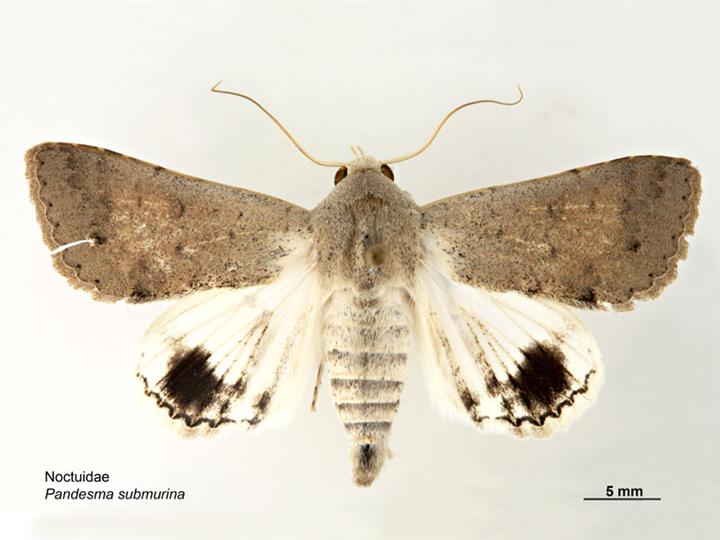 Pandesma submurina
- Pandesma decaryi
- Pandesma partita
- Pandesma satanas
- Pandesma fasciata
Compare
Questions and answers
What types of moths are found in India?
Pandesma anysa is native to south-eastern Asia, including India.[1]
Sources
Passages the profile rests on
- Pandesma anysa is native to south-eastern Asia, including India, and subtropical Africa. Source passage: “It is native to south-eastern Asia, including India and subtropical Africa.” — English Wikipedia
- Pandesma anysa has been introduced to Hawaii. Source passage: “It is an introduced species in Hawaii.” — English Wikipedia
- The larvae feed on the leaves of Pithecellobium dulce. Source passage: “The larvae feed on the leaves of Pithecellobium dulce, Acacia and Prosopis.” — English Wikipedia
- The larvae consume leaves of plants belonging to the genus Acacia. Source passage: “The larvae feed on the leaves of Pithecellobium dulce, Acacia and Prosopis.” — English Wikipedia
- The larvae feed on leaves of plants belonging to the genus Prosopis. Source passage: “The larvae feed on the leaves of Pithecellobium dulce, Acacia and Prosopis.” — English Wikipedia
- The pupae are enclosed in structures made from frass and soil. Source passage: “The pupae are encased in frass and earthen cells.” — English Wikipedia
Data
- Catalogue of Life, 2026-10-16 XR cc by
- Global Biodiversity Information Facility CC BY 4.0
- Wikidata CC0
- GeoNames CC BY 4.0
- Wikimedia Commons per image; credit shown with each image
- Within the Catalogue of Life, this name comes from Global Lepidoptera Index cc by
References
- Guenée, & sensu Berio. (1966). Bolletino della Societa Entomologica Italiana. 96. where the name was published
This species in other databases
Page built on 28 November 2026. See how the catalog is made and all sources and licences.
Cite this page
ScientificNames.org. (2026). Pandesma anysa. Retrieved November 28, 2026, from https://scientificnames.org/species/pandesma-anysa
“Pandesma anysa.” ScientificNames.org, 2026, scientificnames.org/species/pandesma-anysa. Accessed 28 Nov. 2026.
ScientificNames.org. “Pandesma anysa.” Accessed November 28, 2026. https://scientificnames.org/species/pandesma-anysa.
@misc{scientificnames_pandesma_anysa,
  author = {{ScientificNames.org}},
  title = {Pandesma anysa},
  year = {2026},
  url = {https://scientificnames.org/species/pandesma-anysa},
  note = {Accessed 2026-11-28}
}